
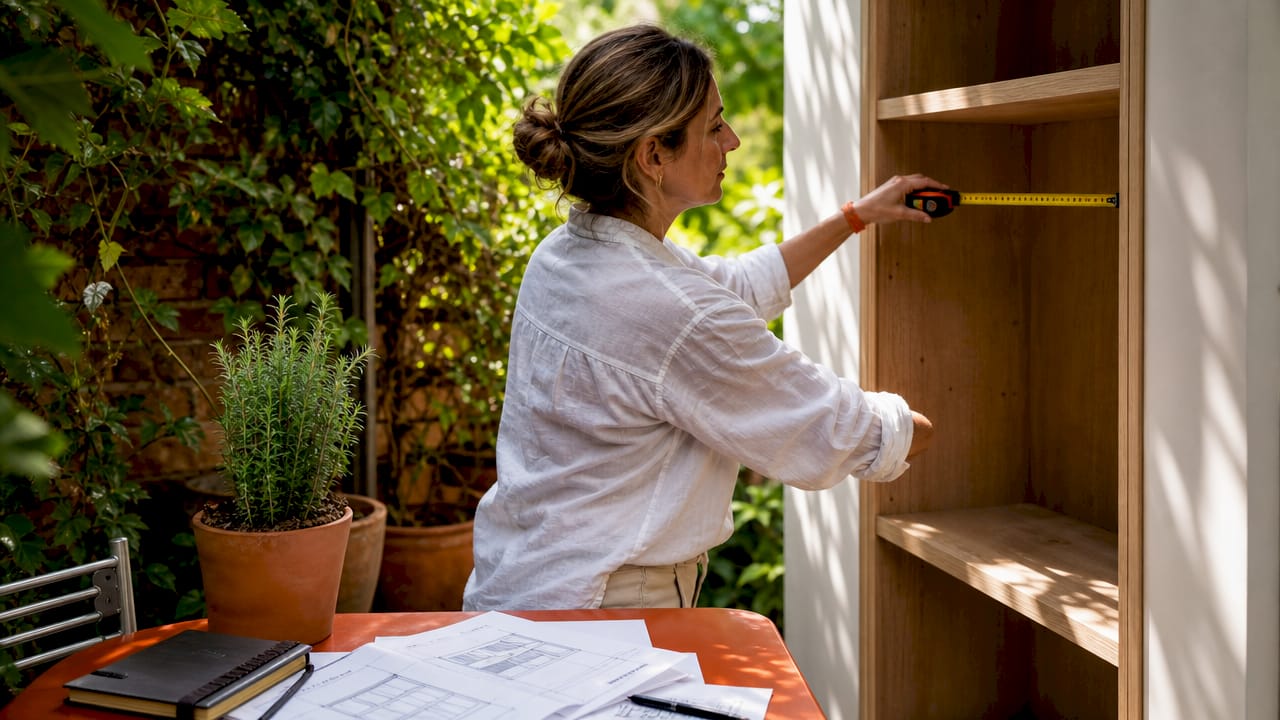
Tailored furniture is furniture designed and built specifically for your home, your space, and your lifestyle, rather than selected from a standard catalogue. Unlike mass-produced pieces, it accounts for exact room dimensions, architectural details, material preferences, and how you actually use the space. Studios like Carrocel, Finest Furniture Studio, and Louis Rhoades Studio have built their reputations on this principle: that furniture should serve the person and the room, not the other way around. When you invest in tailored furniture, you are commissioning a piece that cannot exist anywhere else, because no other home is identical to yours.
What is tailored furniture and how does it differ from standard pieces?
Tailored furniture is custom-designed and crafted to fit a specific home context, considering space, lifestyle, measurements, materials, finishes, and functional needs rather than standard dimensions. The word “tailored” borrows directly from clothing: just as a bespoke suit is cut to your body, tailored furniture is built to your room. The industry term most closely aligned with this concept is bespoke furniture, though the two phrases are often used interchangeably.

The distinction matters because not all furniture sold as “custom” is genuinely tailored. There is a clear spectrum, and understanding it helps you make an informed decision before spending your budget.
The four categories of furniture
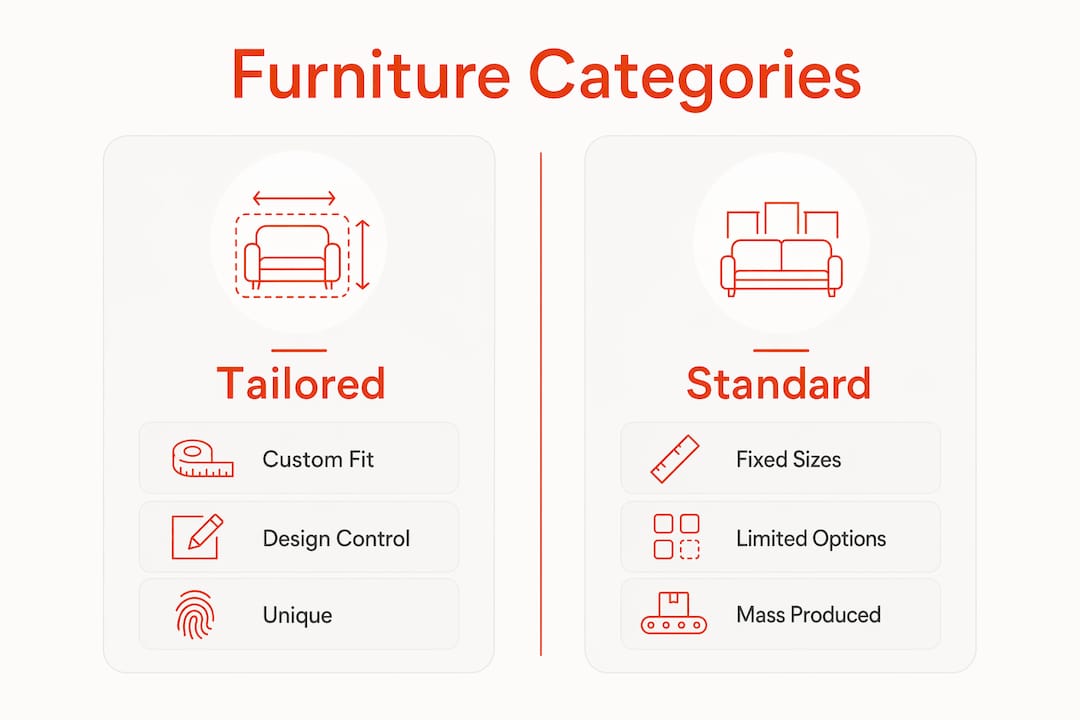
Ready-made furniture comes in fixed sizes and finishes, selected from a showroom or online catalogue. IKEA and similar retailers operate at this end of the spectrum. You adapt your room to the furniture, not the other way around.
Configured furniture allows you to choose from preset modules, colours, or finishes within a fixed framework. Many fitted wardrobe companies operate here. You have options, but the underlying structure is predetermined.
Fully custom furniture is designed around your specifications from the outset. Dimensions, internal layouts, and finishes are all chosen collaboratively. This is closer to true tailoring.
Bespoke furniture starts from a blank sheet of paper. As Louis Rhoades Studio explains, true bespoke means a complete design from scratch rather than adapting or modifying existing templates. Every proportion, joint, and finish is conceived specifically for you.
Comparison: furniture categories at a glance
| Category | Design Control | Starting Point | Outcome |
|---|---|---|---|
| Ready-made | None | Manufacturer’s catalogue | Standard piece, fixed dimensions |
| Configured | Limited | Preset modules | Modified standard piece |
| Fully custom | High | Client brief | Unique dimensions and finishes |
| Bespoke | Complete | Blank slate | One-of-a-kind, architecturally integrated |
Pro Tip: When speaking to a furniture maker, ask directly: “Are you designing this from scratch, or adapting an existing template?” The answer tells you immediately which category you are actually buying.
KODA Studios notes that many sellers misuse ‘bespoke’ to label products with limited options. Knowing the difference protects you from paying bespoke prices for a configured outcome.
Why does tailored furniture matter for your home?
Tailored furniture solves problems that standard pieces simply cannot address. The most common of these is the awkward space: the alcove beside a chimney breast, the sloped ceiling in a loft conversion, the narrow corridor bedroom in a Victorian terrace. Off-the-shelf furniture either ignores these spaces or creates an uncomfortable visual mismatch.
KODA Studios demonstrates this clearly. Their media units hide technology while remaining visually calm, and their sideboards work around architectural details that standard pieces would simply butt up against. The result is a room that feels considered rather than assembled.
Tracy Morris Design reinforces this point. Their approach to custom furniture planning considers architectural constraints, circulation, sight lines, and traffic flow, not just the visible footprint of the piece. A wardrobe that is 50mm too wide can block a door swing. A media wall that ignores cable routing creates a tangle behind the screen. Tailored furniture accounts for all of this before a single panel is cut.
Top advantages of tailored furniture for everyday living
- Perfect fit: Every millimetre is accounted for, from floor to ceiling and wall to wall, eliminating gaps and visual clutter.
- Integrated functionality: Features like hidden storage and cable management are built in from the design stage, not retrofitted.
- Architectural harmony: The piece aligns with cornicing, skirting boards, and room proportions, making it feel as though it has always been there.
- Space maximisation: Awkward alcoves, loft slopes, and under-stair voids become usable storage rather than wasted square footage.
- Long-term value: A piece built to your exact specification and crafted from quality materials outlasts flat-pack alternatives by years.
- Aesthetic consistency: Finishes, colours, and textures are chosen to complement your existing décor, not compete with it.
Pro Tip: Before your first consultation, photograph every architectural quirk in the room: sloped ceilings, exposed pipes, uneven walls, and awkward corners. These details are exactly what a tailored furniture maker needs to begin a genuinely bespoke design.
For homeowners in areas like Richmond, Wimbledon, Chelsea, and Fulham, where Victorian and Edwardian properties are common, these spatial challenges are the rule rather than the exception. Tailored furniture is not a luxury in these homes. It is the practical solution.
What should you expect from the design and collaboration process?
The tailored furniture process is a structured collaboration between you, a designer, and a maker. Understanding each stage helps you prepare properly and get the best outcome from your investment.
Here is what a well-run bespoke furniture project looks like from start to finish:
-
Initial consultation. The designer visits your home to assess the space in person. They measure the room, note architectural details, and discuss how you use the space day to day. This is not a sales visit. It is a diagnostic session.
-
Brief development. You discuss your aesthetic goals, storage requirements, preferred materials, and budget. The maker translates these into a working brief. As Minimal and Modern explains, clients control exact dimensions, shelf depth, cushion softness, panel finish, and wardrobe internal layout at this stage.
-
Design proposals. The maker produces sketches or technical drawings for your review. This is the iterative phase: you respond, they refine, and the design evolves until it matches your vision precisely.
-
Material and finish selection. Samples are presented for woods, veneers, fabrics, and hardware. You confirm every detail before production begins.
-
Production. The piece is crafted to the approved specification. For fitted furniture in London, Finest Furniture Studio completes design to installation within 7–12 days, including removal of any existing furniture.
-
Installation and sign-off. The piece is fitted in your home and checked against the original brief. Any final adjustments are made before the project is closed.
The custom furniture design process works best when you arrive prepared. Know your priorities: is storage capacity more important than aesthetics? Do you need the piece to work around a specific architectural feature? Clear answers at stage one save time and cost throughout.
What materials and craftsmanship define quality tailored furniture?
Material choice is where tailored furniture separates itself most visibly from mass-produced alternatives. The role of materials in bespoke furniture is not purely aesthetic. It determines durability, tactile quality, and how well the piece ages in your home.
Common premium materials and their strengths
- Solid hardwoods (oak, walnut, ash): Dense, durable, and visually rich. They age well and can be refinished if needed.
- Veneers over MDF or plywood: Offer the appearance of solid wood with greater dimensional stability. Ideal for large flat panels like wardrobe doors.
- Lacquered finishes: Provide a smooth, uniform surface in any colour. Popular for modern fitted wardrobes and media walls in Chelsea and Chiswick.
- Metal accents (brushed brass, satin nickel): Used for handles, frames, and inlays to add tactile contrast and visual interest.
- Upholstery fabrics: Relevant for seating, headboards, and storage ottomans. Quality fabrics are chosen for both appearance and wear resistance.
Craftsmanship standards that signal quality
| Indicator | What It Tells You |
|---|---|
| Dovetail or mortise-and-tenon joinery | Traditional woodworking joints that signal structural integrity |
| Soft-close mechanisms | Precision hardware that extends the life of doors and drawers |
| Consistent grain matching | Attention to visual detail across panels and doors |
| Flush fitting to walls and ceilings | Accurate measurement and skilled installation |
| Finished interior surfaces | Quality extends beyond what is immediately visible |
Material choices must also complement the architectural style of your home. A shaker-style fitted wardrobe in a period property in Barnes calls for different finishes than a floor-to-ceiling gloss media wall in a new-build flat in Hammersmith. The maker’s job is to guide you toward materials that work with your architecture, not against it. Explore how bespoke joinery transforms interiors to understand how material and construction choices combine to change the feel of an entire room.
Key takeaways
Tailored furniture delivers lasting value precisely because it is designed around your specific space, lifestyle, and architectural context, not adapted from a generic template.
| Point | Details |
|---|---|
| Definition is specific | Tailored furniture is designed from your brief, not selected from a catalogue or modified from a template. |
| Bespoke starts from scratch | True bespoke means a blank-slate design; configured furniture with options is not the same thing. |
| Spatial problems are solved | Awkward alcoves, loft slopes, and Victorian layouts are where tailored furniture performs best. |
| Process requires preparation | Arriving at consultation with clear priorities and photographs of the space produces better outcomes. |
| Materials determine longevity | Solid hardwoods, quality veneers, and precision joinery define furniture that lasts decades, not years. |
Why i think most homeowners underestimate what “tailored” actually means
Having worked with homeowners across Richmond, Wimbledon, Putney, and Kingston, I have noticed a consistent pattern. People arrive thinking they want “something custom” and leave having discovered they actually want something genuinely bespoke. The gap between those two things is significant, and it is not just semantic.
The most common misunderstanding I encounter is treating tailored furniture as a premium version of what you would find in a showroom. It is not. A showroom piece, however beautiful, was designed for a hypothetical room. A tailored piece is designed for your room, with your ceiling height, your skirting board profile, your sight lines from the doorway, and your daily habits in mind.
What surprises most clients is how much the process changes their relationship with the finished piece. When you have been involved in every decision, from the depth of a shelf to the grain direction on a door panel, the result feels genuinely yours. That sense of ownership is not a marketing concept. It is a real and lasting benefit that no off-the-shelf purchase can replicate.
My honest advice: do not approach a tailored furniture project with a fixed image in mind. Approach it with a clear understanding of how you live and what frustrates you about your current space. The best outcomes I have seen come from clients who described their problems, not their Pinterest boards.
— Aureliu
Bespoke wardrobes and fitted furniture across london
If you are ready to move from standard storage to furniture that genuinely fits your home, Finest Furniture Studio works with homeowners across Richmond, Wimbledon, Chelsea, Fulham, Chiswick, Putney, Kingston, Twickenham, Barnes, Ealing, and Hammersmith, as well as surrounding areas including Walton-on-Thames, Woking, and Guildford.
We specialise in bespoke fitted wardrobes, TV media walls, loft wardrobes, and built-in storage solutions designed from scratch for your specific space. Every project includes a free design visit, full installation within 7–12 days, removal and disposal of your old furniture, and a 10-year quality guarantee. For loft conversions and sloped ceilings, explore our loft wardrobe solutions built to make every awkward inch work. Call us on 07468 150807, message us on WhatsApp, or visit us at 124 City Road, Kemp House, London, EC1V 2NX to arrange your free consultation.
FAQ
What is the difference between tailored and bespoke furniture?
Tailored furniture is a broad term for furniture designed around your specific needs and space. Bespoke furniture is the most precise form of this, starting from a blank-slate design rather than modifying an existing template.
How long does tailored furniture take to make and install?
Timelines vary by project complexity, but fitted bespoke furniture in London, such as wardrobes and media walls, is typically designed, crafted, and installed within 7–12 days from the confirmed brief.
Is tailored furniture worth the investment compared to ready-made?
Tailored furniture solves spatial problems that standard pieces cannot address, integrates with your architecture, and is built from materials chosen for longevity. For homes with awkward layouts or specific storage needs, the long-term value is considerably higher.
How do i know if a furniture maker is genuinely bespoke?
Ask whether the design starts from scratch or from an existing template. A genuinely bespoke maker will begin with your space and brief, not a preset module range. This distinction, highlighted by both KODA Studios and Louis Rhoades Studio, is the clearest indicator of true bespoke practice.
Can tailored furniture work in small or awkward spaces?
Tailored furniture is particularly effective in small and awkward spaces. Loft conversions, alcoves, under-stair voids, and rooms with sloped ceilings are exactly the environments where a made-to-measure approach delivers results that standard furniture cannot match.