
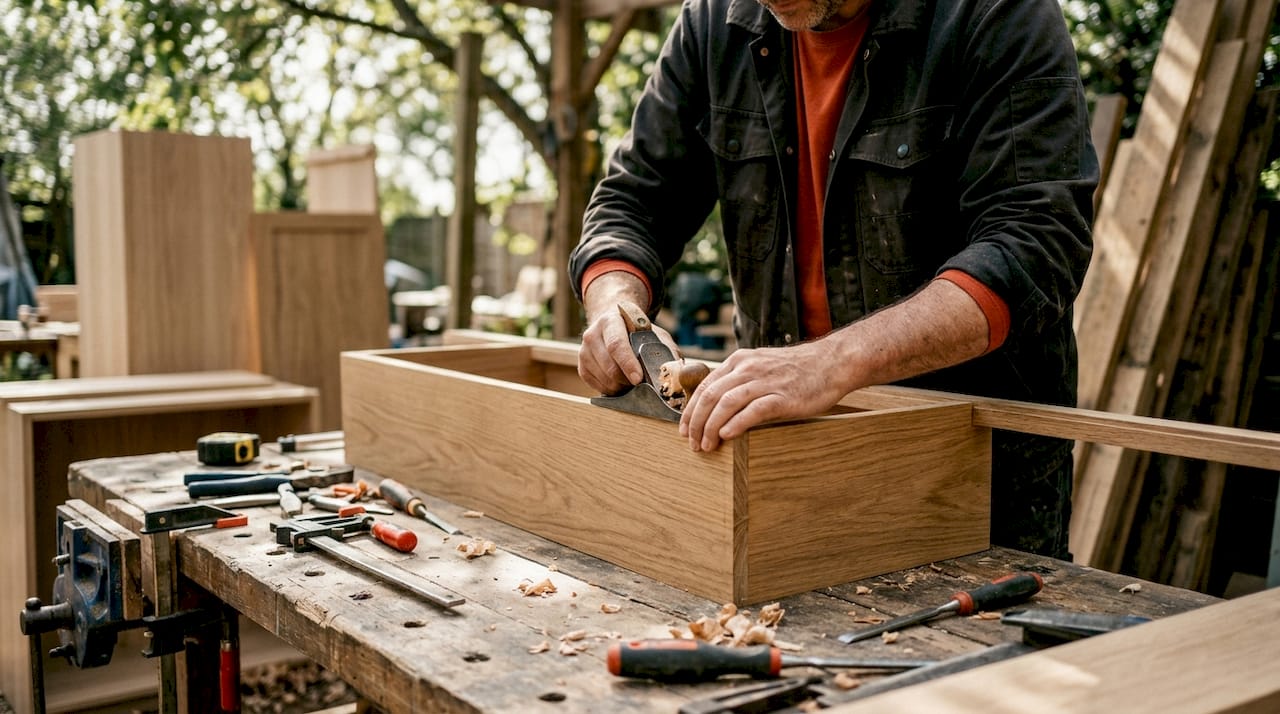
Craftsmanship in furniture is defined as the skilled, deliberate handwork applied at every stage of making, from material selection through to final finish. It is the discipline that separates a piece built to last decades from one designed to be replaced within a few years. The role of craftsmanship in furniture goes far beyond surface appearance. It determines structural integrity, repairability, and the kind of quiet confidence a well-made piece brings to any room. At Finest Furniture Studio, this principle sits at the heart of every bespoke fitted wardrobe, media wall, and storage solution we design and build for homeowners across London, from Richmond and Chelsea to Wimbledon and Putney.
What are the fundamental elements of furniture craftsmanship?
Heirloom-quality furniture depends on four controllable variables: wood species selection, joinery method, finish type, and material honesty. These four pillars determine whether a piece will still perform well in thirty years or begin to fail within five.
Wood species selection affects how a piece responds to humidity, weight, and daily contact. Hardwoods such as oak, walnut, and ash resist denting and warping far better than softwoods or engineered substitutes. The choice of species is not decorative. It is structural.
Joinery method is where craftsmanship becomes most visible to those who know what to look for. Mortise-and-tenon joints, dovetail drawers, and tongue-and-groove panels create mechanical connections that do not rely on adhesive alone. Mass-produced furniture typically uses dowels, cam locks, or staples, which loosen over time under repeated stress.
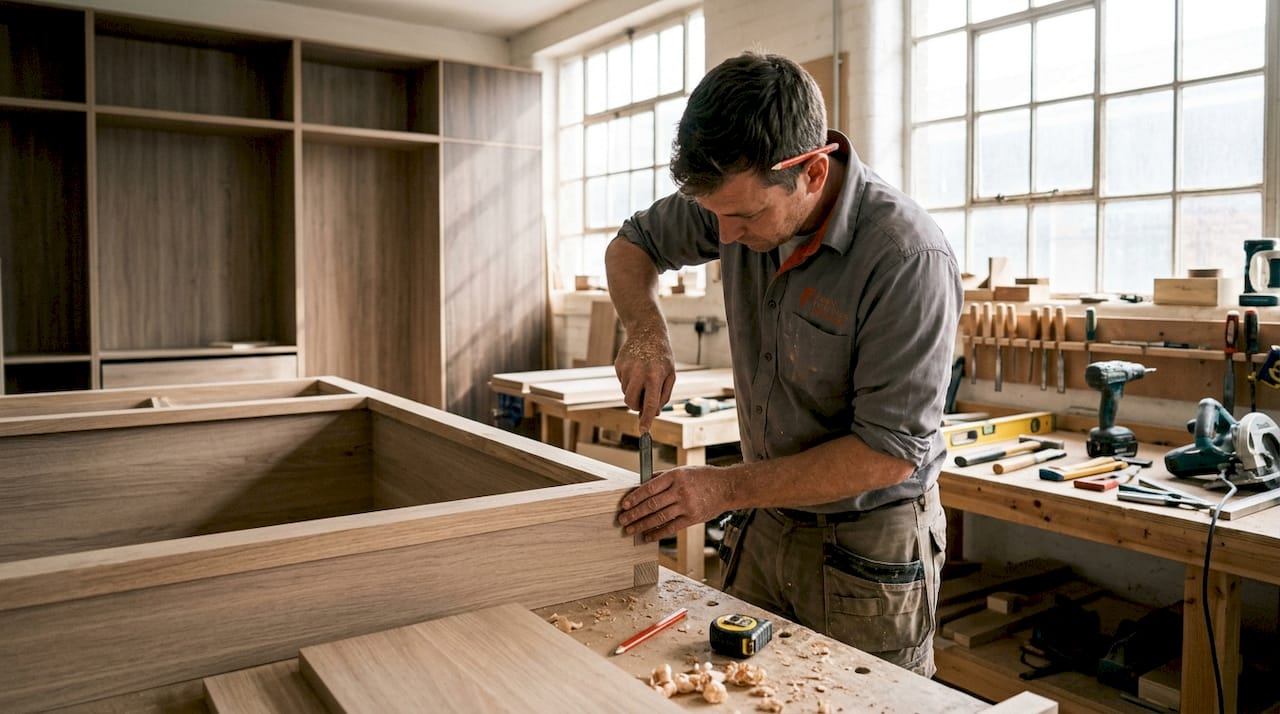
Finish type is widely misunderstood. Most buyers judge a finish by how it looks on the day of purchase. True craftsmanship ensures finishes allow longevity and repair, not just initial appearance. A hand-applied oil or wax finish can be spot-repaired without stripping the entire piece. A factory lacquer cannot.
Material honesty means using the same quality of material in hidden areas as in visible ones. True heirloom-quality furniture requires this throughout, including internal components invisible to the eye. A drawer base made from thin MDF inside an otherwise solid oak cabinet is a form of structural dishonesty that shortens the life of the whole piece.
| Quality criterion | What to look for | Mass-produced equivalent |
|---|---|---|
| Wood species | Named hardwood species, consistent grain | Generic “wood effect” or unlabelled composite |
| Joinery | Dovetail, mortise-and-tenon, tongue-and-groove | Cam locks, dowels, staples |
| Finish | Hand-applied oil, wax, or lacquer with repair potential | Factory spray finish, non-repairable |
| Material honesty | Consistent quality in hidden areas | Downgraded materials in non-visible components |
How does craftsmanship shape the design and aesthetic appeal of bespoke furniture?
Visible marks of the hand and texture elevate craftsmanship to luxury status because they cannot be replicated by industrial processes. A CNC machine can cut a perfect curve. It cannot replicate the slight variation in a hand-planed surface that catches light differently at every angle.
This is the quality that makes bespoke fitted wardrobes in Chelsea or Fulham feel genuinely different from catalogue alternatives. The grain runs continuously across door panels. The shadow lines between sections are consistent because they were planned, not assumed. The colour of a hand-applied stain shifts subtly across the piece, giving it depth that photography rarely captures.

Handmade furniture’s imperfections are integrated as aesthetic richness rather than hidden. A small fissure in a walnut panel, a slight variation in grain direction, or a hand-cut chamfer that is fractionally deeper on one side. These are not flaws. They are evidence of a human decision made at that exact point in the making process.
The contrast with mass production is direct. Factory furniture is designed to photograph well and to look identical across thousands of units. Bespoke furniture is designed to live well in one specific room, for one specific household.
- Grain continuity across panels and doors signals deliberate material selection
- Consistent shadow lines and reveals show planned, not assumed, tolerances
- Hand-applied colour and texture create depth that changes with natural light
- Subtle surface variation confirms hand-finishing rather than factory spraying
- Proportions adjusted to the room rather than a standard catalogue size
Pro Tip: When viewing a bespoke piece, run your hand along the surface against the grain. A hand-finished piece will feel slightly varied. A factory finish will feel perfectly uniform. Neither is wrong, but only one is crafted.
In what ways does craftsmanship ensure greater durability and functionality?
Luxury furniture is truly defined by structural performance and durability under daily use, not by branding or photographic appeal alone. A piece that looks exceptional in a showroom but develops loose hinges, swollen drawers, or delaminating panels within three years has failed the most basic test of quality.
Craftsmanship addresses durability through three specific practices that mass production routinely skips.
The first is custom fitting. Drawers fitted to the case operate smoothly over decades without binding or rattling because they were shaped to their exact housing. A factory drawer is made to a standard tolerance and relies on runners to compensate. When those runners wear, the drawer fails. A hand-fitted drawer has no such dependency.
The second is finish repairability. Spot-repairable finishes are a mark of true craftsmanship, supporting sustainability by extending furniture’s lifespan without full refinishing. A scratch on a hand-oiled surface can be addressed in twenty minutes with a cloth and a small amount of oil. The same scratch on a factory lacquer requires professional stripping and recoating.
The third is structural honesty in construction. When internal components match the quality of external ones, the piece ages uniformly. There is no weak point waiting to fail first.
- Open a drawer fully and check whether the base flexes under light pressure
- Look at the back panel of a cabinet. Thin hardboard signals a cost-cutting decision
- Check hinge mounting points for solid wood backing rather than MDF
- Examine corner joints for mechanical connection, not just adhesive
- Ask whether the finish can be spot-repaired or requires full stripping
Pro Tip: Press firmly on the centre of a shelf with both hands. A well-made shelf will feel solid and show no flex. Significant movement under moderate pressure indicates inadequate material thickness or poor support design.
Why is craftsmanship increasingly valued in modern interiors and luxury markets?
Artisanal craftsmanship is increasingly valued as a direct counter to industrial standardisation, with homeowners actively seeking hand-crafted details such as carved woodwork and custom shapes. The shift is not nostalgic. It is a practical response to the visual fatigue that comes from living with furniture that looks identical to everyone else’s.
London’s affluent neighbourhoods reflect this clearly. Homeowners in Wimbledon, Twickenham, and Barnes are commissioning bespoke fitted wardrobes and media walls that respond to their specific rooms rather than conforming to a catalogue. The demand is for pieces that carry personality and permanence.
Incorporating craft into interiors introduces depth and personality, countering sterile uniformity and celebrating meaningful objects. This is not a minor aesthetic preference. It represents a fundamental shift in what homeowners consider worth investing in.
“Craftsmanship is a quality of attention and judgment over time, making it a signal of human decisions in an increasingly automated production landscape. Luxury is less about perfect appearances and more about the visible trace of the hand, which signals authenticity and human touch.”
Source: Finn Partners, ‘Why the luxury world is falling back in love with craft’
The future of luxury furniture balances technology with traditional craft, using digital tools to enhance rather than replace handwork. This means CNC precision for consistent tolerances combined with hand-finishing for surface quality and detail. The result is furniture that benefits from both approaches without sacrificing either.
For bespoke media walls in Fulham or Hammersmith, this balance is particularly relevant. Digital planning tools allow exact spatial modelling. Hand-finishing ensures the installed piece feels considered and permanent rather than assembled.
How to recognise furniture that embodies true craftsmanship
Genuine artisanal furniture carries specific, identifiable markers. Knowing what to look for protects you from paying a premium for a piece that only appears handcrafted.
Contemporary woodworking craftsmanship involves responsibility through the entire making process, ensuring material honesty and design integrity from concept to execution. This means the maker should be able to explain every decision, from why a particular species was chosen to how the finish will behave in ten years.
When commissioning or purchasing, ask these questions directly:
- What species of timber is used, and where does it come from?
- What joinery method connects the main structural elements?
- Can the finish be spot-repaired, and what product does that require?
- What are the internal components made from?
- Who designed and who built the piece, and were they the same person or team?
The answers reveal whether you are dealing with genuine craft or a well-presented product. A maker who cannot answer the joinery question has not made the piece by hand.
| Indicator | Genuine craftsmanship | Superficial craftsmanship |
|---|---|---|
| Joinery explanation | Maker names specific method and can show it | Vague reference to “solid construction” |
| Internal materials | Same quality as external components | Downgraded board or thin hardboard |
| Finish repairability | Specific product and method given | “Contact us for repairs” |
| Grain continuity | Panels matched and continuous | Random grain direction across panels |
| Provenance | Named maker, specific workshop | Unspecified factory or “handcrafted in Europe” |
For bespoke fitted wardrobes specifically, the quality of the carcass construction matters as much as the door finish. A beautifully fronted wardrobe with a poorly built interior will develop loose shelves, sagging rails, and stiff drawers within a few years of daily use.
Finest Furniture Studio designs and builds every piece in direct consultation with the homeowner or their designer. That process ensures the structural decisions are made for the specific room and use, not adapted from a standard template. You can review completed projects on our website to see how this approach translates into finished installations across London.
Key takeaways
Skilled craftsmanship in furniture determines structural longevity, finish repairability, and aesthetic depth in ways that mass production cannot replicate.
| Point | Details |
|---|---|
| Four pillars of quality | Wood species, joinery method, finish type, and material honesty define genuine craftsmanship. |
| Hidden quality matters | Internal components must match external quality to ensure long-term structural integrity. |
| Finish repairability | Spot-repairable finishes extend furniture lifespan without full refinishing, a key craftsmanship marker. |
| Aesthetic depth | Hand-finished surfaces carry grain variation and texture that factory processes cannot reproduce. |
| Ask the right questions | A maker who cannot explain joinery method or finish repairability has not built the piece by hand. |
Craftsmanship is an investment, not a premium
Working on bespoke fitted wardrobe and media wall projects across London has taught me one thing consistently. Homeowners who focus on craftsmanship at the point of commission never regret it. Homeowners who focus primarily on price and then discover the limitations of what they bought almost always do.
The most common regret I hear is about drawers. A drawer that binds after eighteen months, or a shelf that sags under the weight of folded clothing, is not a minor inconvenience. It is a daily reminder that a decision was made for short-term saving rather than long-term quality. The cost of replacing or repairing a poorly built fitted wardrobe in a Richmond or Kingston home typically exceeds what the original quality upgrade would have cost.
What surprises most homeowners is how little the visible surface tells them about the quality of what they are buying. A beautifully photographed wardrobe with mirrored sliding doors can hide a carcass built from thin board with dowel joints and a factory finish that cannot be repaired. The surface looks identical to a genuinely crafted piece. The difference only becomes apparent over time.
My honest recommendation is to treat craftsmanship as the primary criterion, not a secondary consideration after colour and style. Style can be adjusted. Structure cannot. A well-built piece can be refinished, recoloured, and adapted. A poorly built piece can only be replaced.
The luxury furniture checklist we publish covers exactly this evaluation process in practical terms. Use it before any significant furniture purchase or commission.
— Aureliu
Finest Furniture Studio: bespoke craftsmanship for London homes
Finest Furniture Studio designs and builds bespoke fitted wardrobes, loft wardrobes, and media walls for homeowners across West London, including Richmond, Wimbledon, Chelsea, Putney, and Fulham. Every piece is built with structural honesty, hand-finished surfaces, and joinery that performs under daily use for years.

We offer a free design visit to every new client, with fitting completed within 7–12 days and a 10-year quality guarantee on every installation. We also remove and dispose of your existing wardrobe as part of the service. Our bespoke wardrobes West London page shows completed projects with full specification detail. For loft conversions and awkward spaces, our fitted wardrobes solutions make use of every available inch.
Call us on 07468 150807, message via WhatsApp, or visit us at 124 City Road, Kemp House, London, EC1V 2NX.
FAQ
What is the role of craftsmanship in furniture quality?
Craftsmanship determines structural integrity, finish repairability, and long-term durability through skilled joinery, honest material use, and hand-applied finishes. It is the primary factor separating furniture that lasts decades from furniture that fails within a few years.
How does craftsmanship affect the durability of bespoke fitted wardrobes?
Custom-fitted drawers, solid carcass construction, and spot-repairable finishes all extend the working life of a fitted wardrobe significantly. A hand-fitted drawer shaped to its exact housing will operate smoothly for decades without the binding or rattling common in factory-built alternatives.
What is the difference between traditional and modern furniture craftsmanship?
Traditional craftsmanship relies entirely on hand tools and hand-fitting. Modern craftsmanship combines digital planning and CNC precision for consistent tolerances with hand-finishing for surface quality and detail. The best contemporary bespoke furniture uses both approaches.
How can I tell if furniture is genuinely handcrafted?
Ask the maker to name the joinery method and explain how the finish can be repaired. A genuinely crafted piece will have a specific, nameable answer to both questions. Vague responses such as “solid construction” or “contact us for repairs” indicate factory production.
Why is craftsmanship particularly important in luxury interiors?
Luxury interiors depend on pieces that carry visual depth, tactile quality, and structural permanence. Craftsmanship delivers all three through hand-finished surfaces, honest materials, and joinery that performs under daily use. These qualities cannot be replicated by industrial production at any price point.