


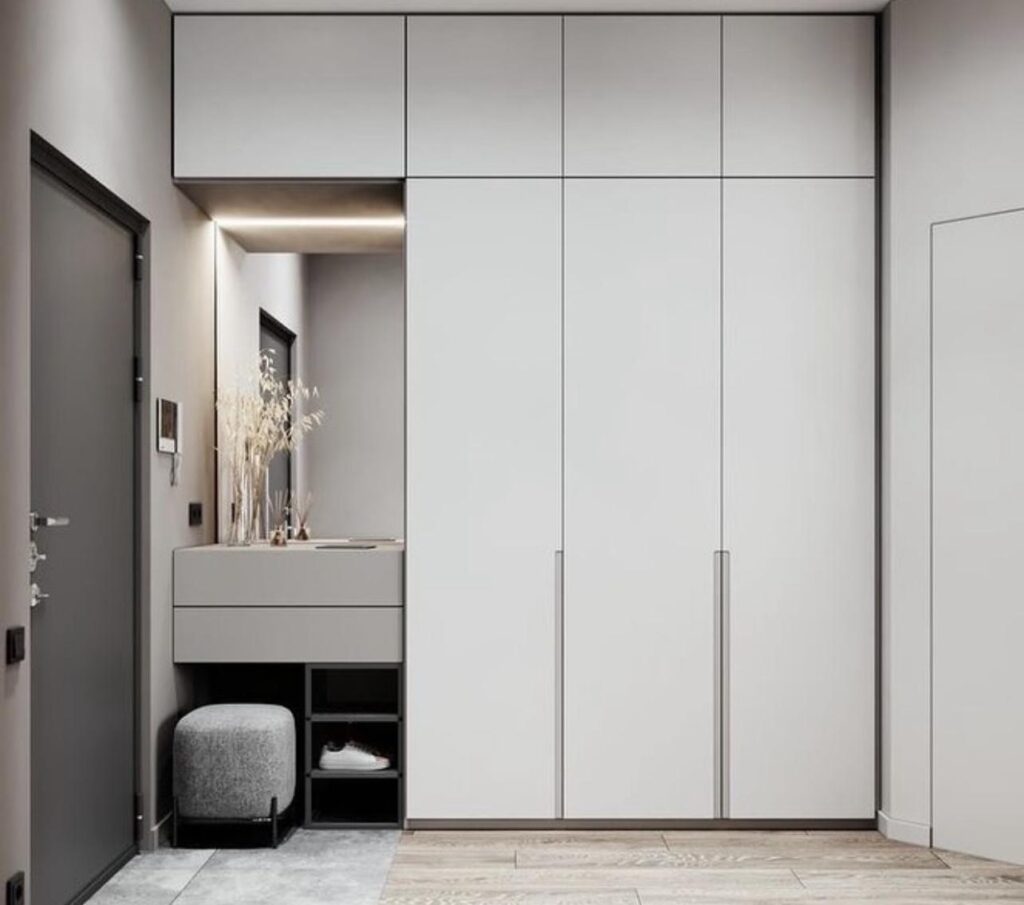
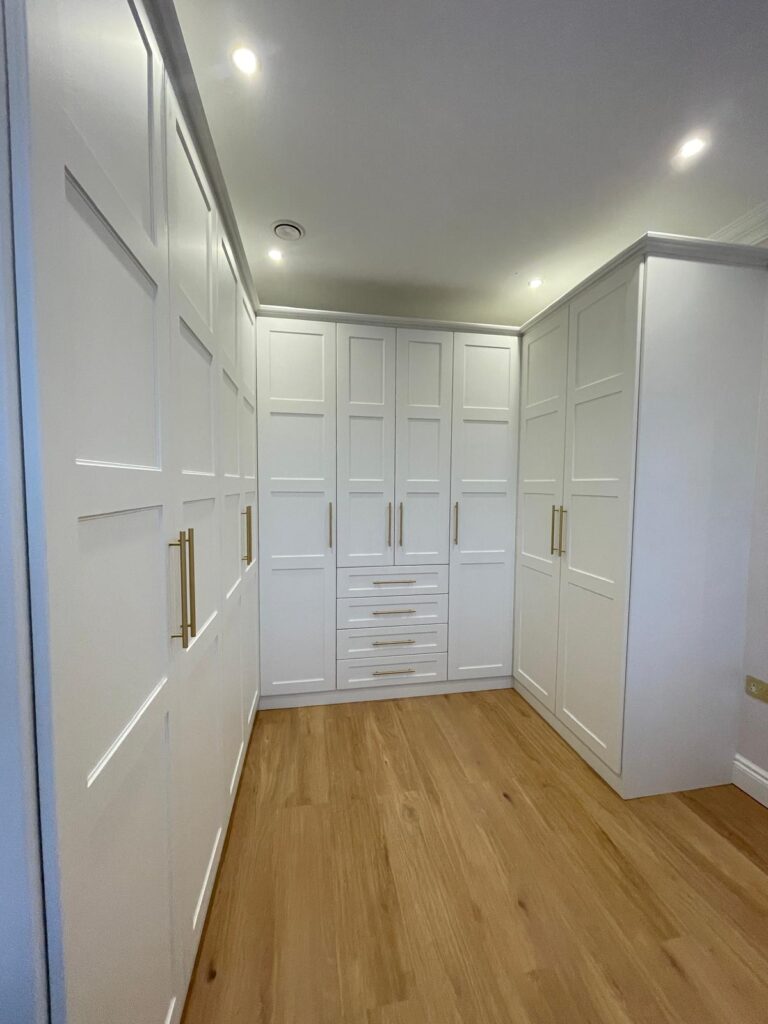
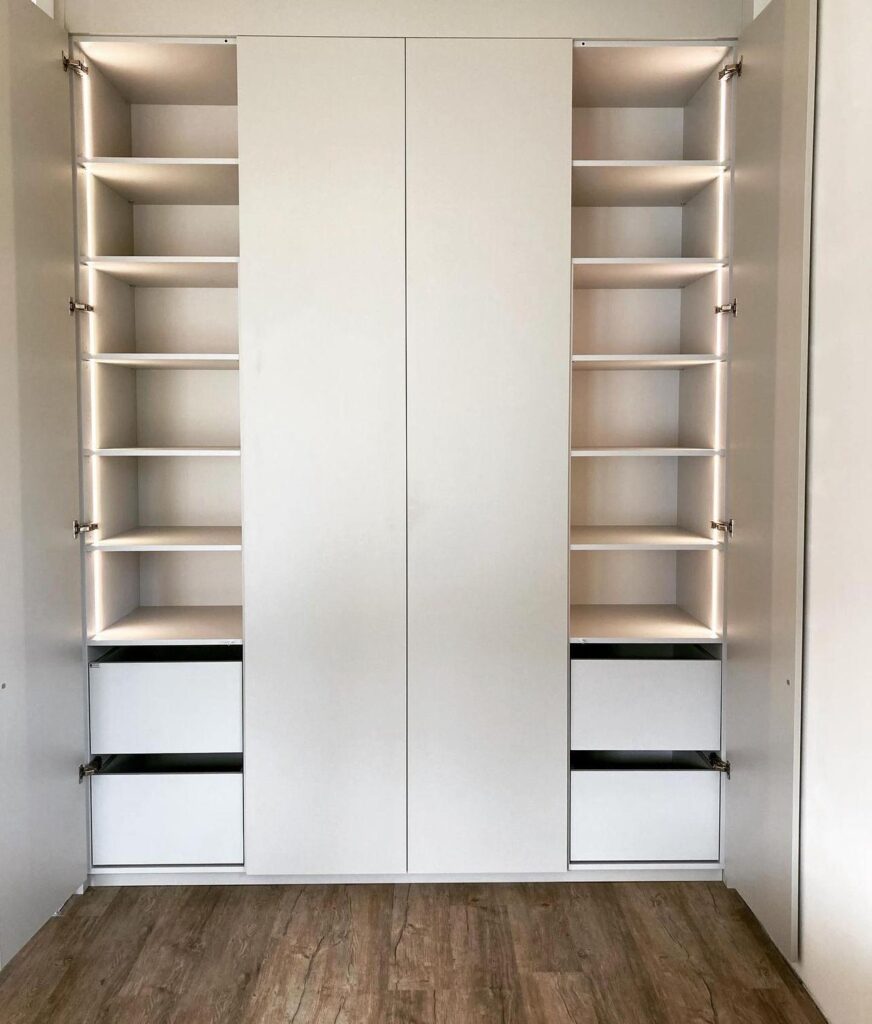

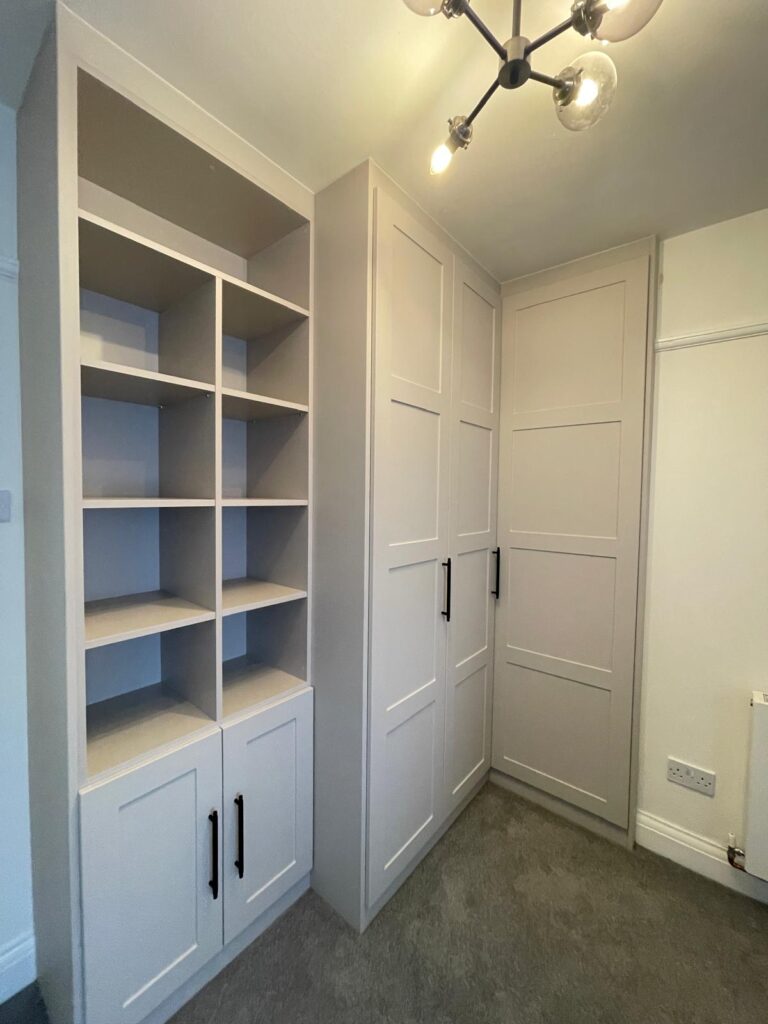
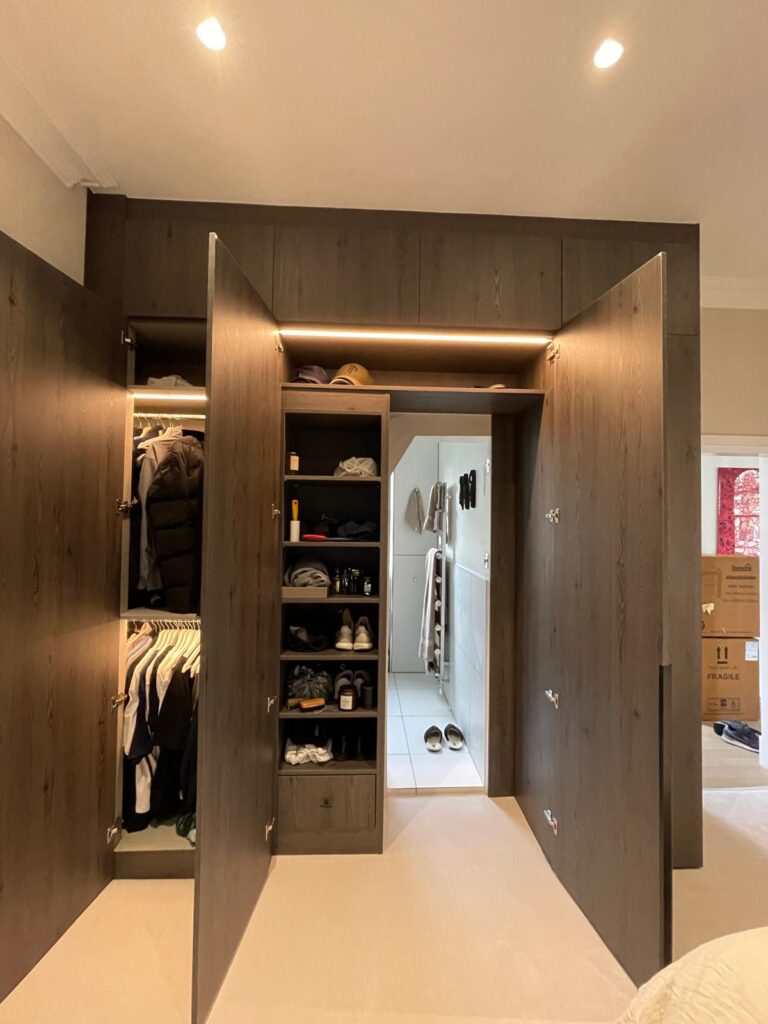

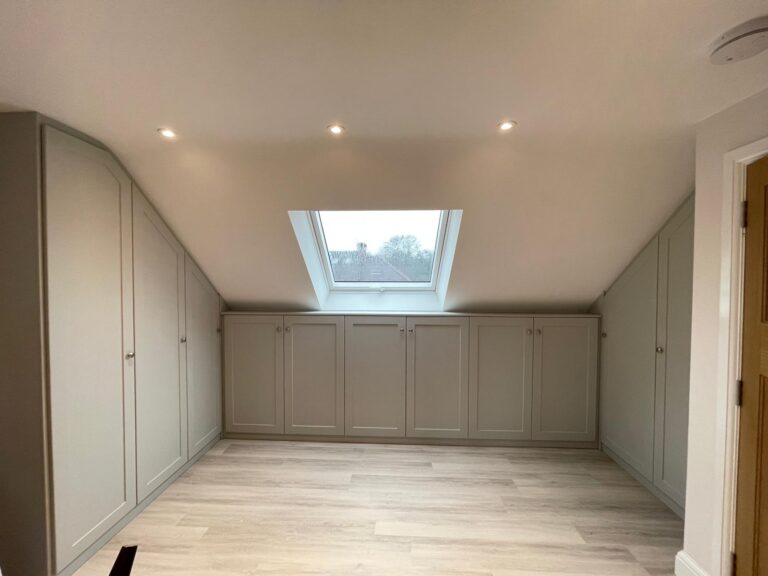

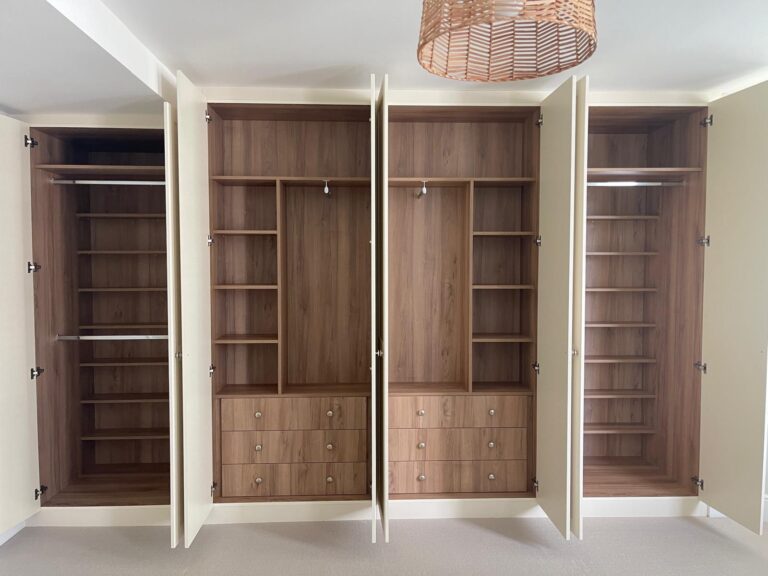
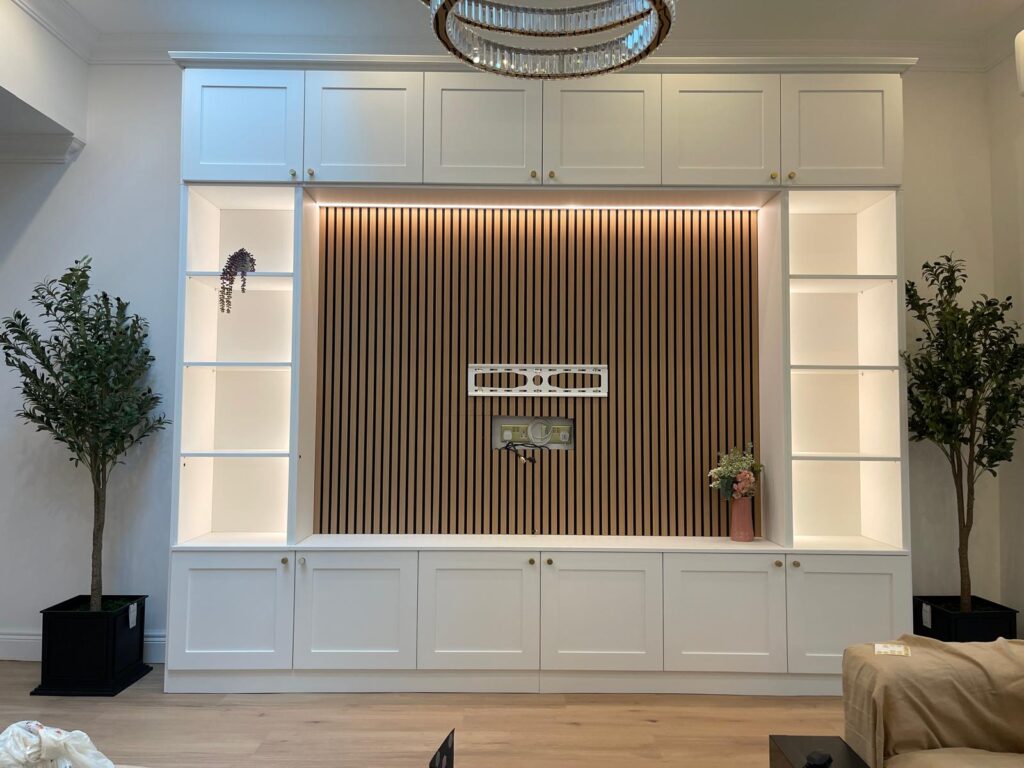

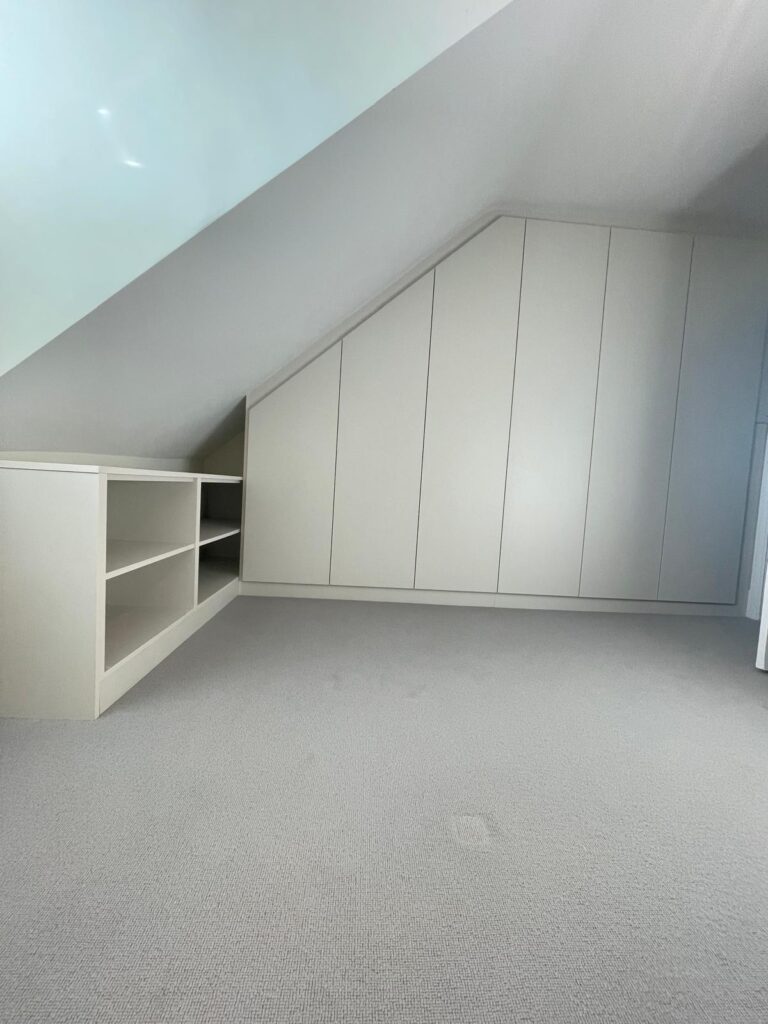

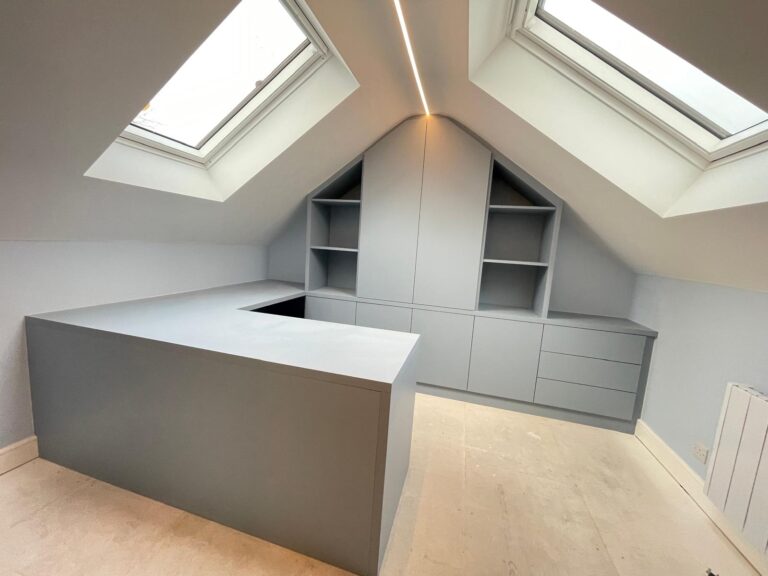
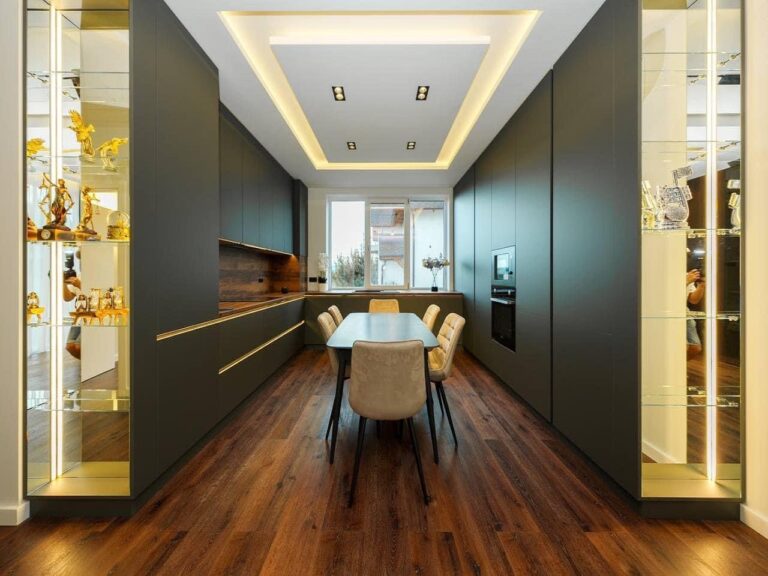
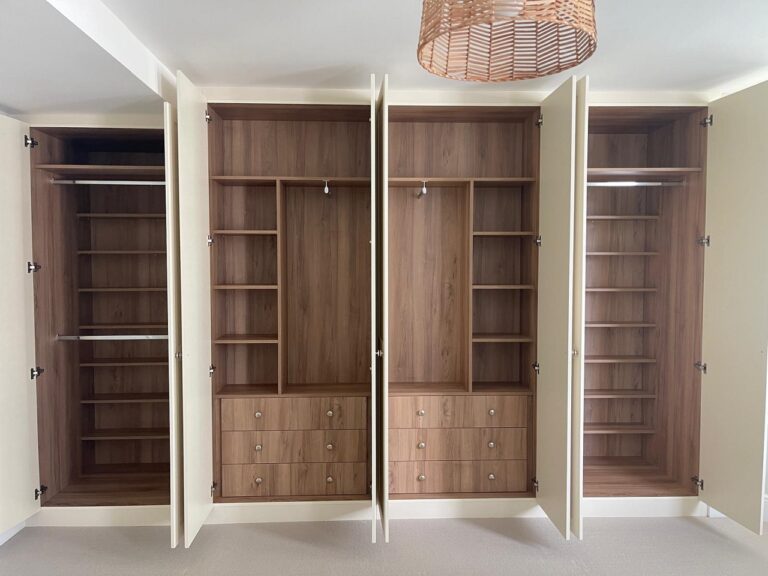

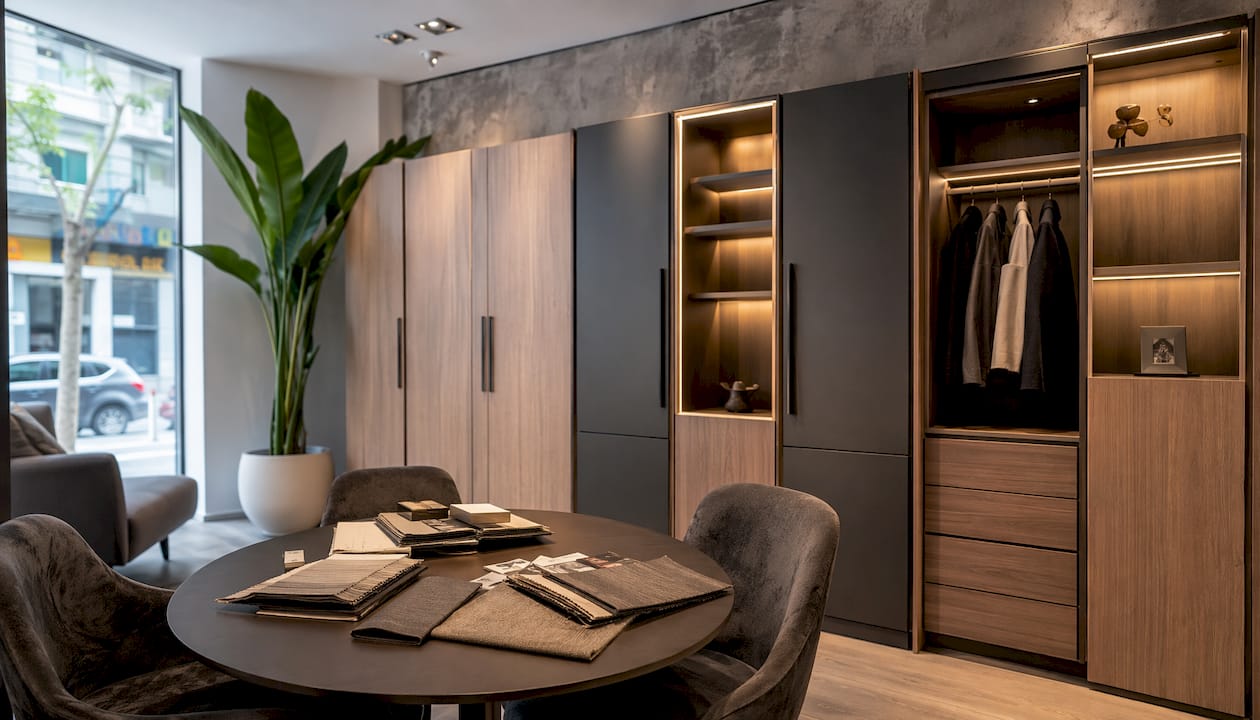
Most fitted furniture is standard-rated for VAT because HMRC explicitly excludes prefabricated and site-built furniture (other than kitchen furniture) from the definition of “building materials.” Building Regulations, meanwhile, are triggered not by the furniture itself but by what the installation involves: structural alterations, new electrical circuits, or changes that affect fire safety or ventilation.
Three checks to make before any installation begins:
- Installation method: Is the unit a prefabricated modular carcass or a site-shaped enclosure? The answer determines VAT treatment under HMRC VCONST13640.
- Structural alterations: Does the job require removing a partition, cutting into a wall, or forming a new alcove? If so, Building Control notification is likely required.
- Electrical work: Does the installation include new LED circuits, integrated lighting, or any wiring connected to the consumer unit? That triggers Part P of the Building Regulations.
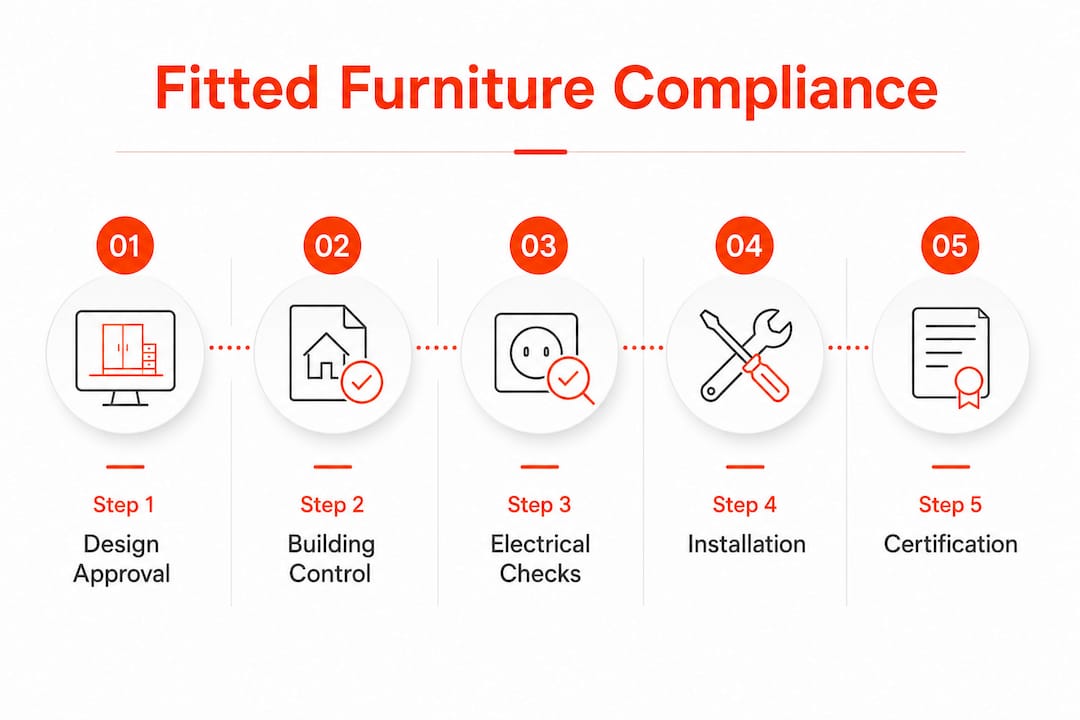
At handover, request a VAT invoice with the rate clearly stated, a Competent Person certificate for any electrical work, and a Building Control completion notice where structural work was carried out.
Table of Contents
- What counts as fitted or built-in furniture?
- VAT treatment: when is fitted furniture zero-rated or standard-rated?
- Which building-regulation triggers apply to fitted furniture?
- Electrical work, Part P, and Competent Person schemes
- What paperwork to keep and why it matters at sale
- Pre-install checklist: questions to ask before you sign
- Common pitfalls and red flags when commissioning fitted furniture
- How Finest Furniture Studio manages compliance
- Fire safety regulations and fitted furniture materials
- Accessibility standards and fitted furniture
- Timeline for complying with building regulations
- Consequences of non-compliance with building regulations or VAT rules
- Key takeaways
- Why compliance is the foundation of good craftsmanship
- Finest Furniture Studio: bespoke fitted furniture with full compliance documentation
- Useful sources
- FAQ
What counts as fitted or built-in furniture?
HMRC VCONST13610 draws a clear line. The exclusion from “building materials” covers finished or prefabricated furniture, furniture supplied as assembly kits, and the raw materials used to make fitted furniture — with one important exception: kitchen furniture is treated separately and can qualify as building materials.
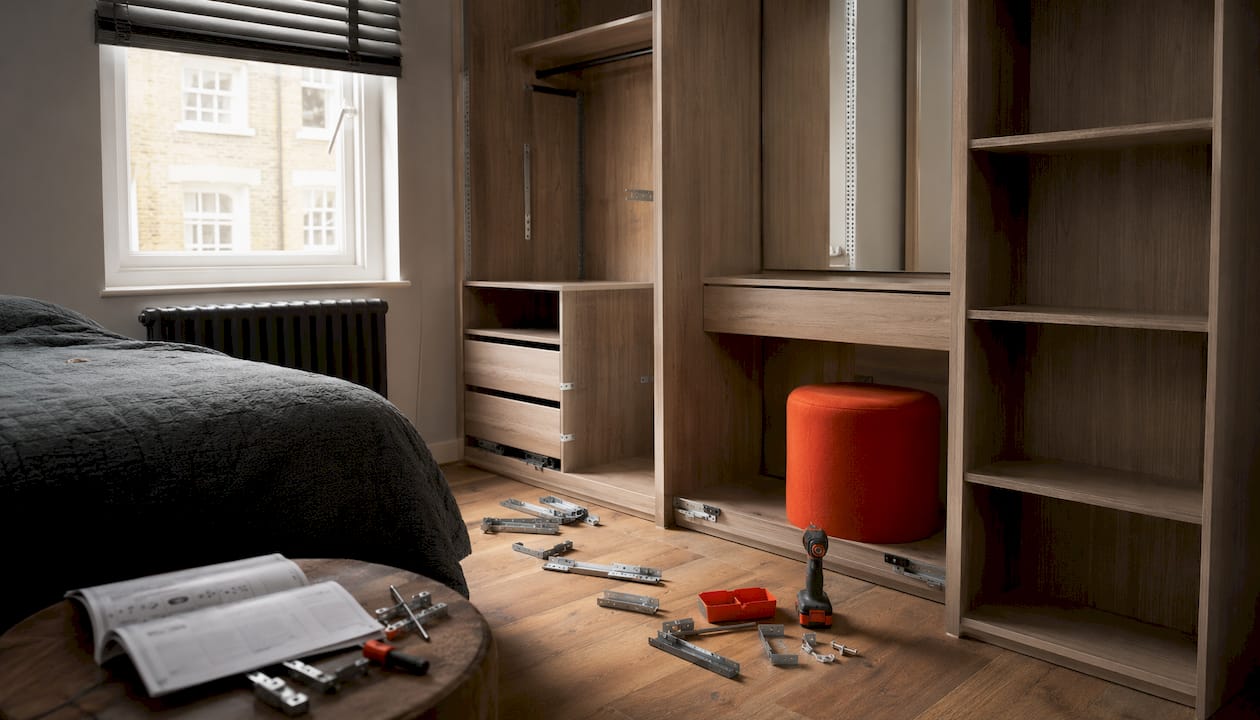
In practice, three types of installation arise:
| Installation type | Typical examples | Likely VAT treatment |
|---|---|---|
| Prefabricated modular carcass | Bespoke wardrobes, alcove units with internal shelving and hanging rails | Standard-rated (excluded from building materials) |
| Site-shaped fitted components | Wardrobes cut to fit a sloped ceiling or chimney breast recess | Standard-rated (still furniture) |
| Simple enclosed space, no fit-out | Airing cupboard shell, under-stair void with a door only | May qualify as building materials |

The distinction matters because calling a unit “bespoke” does not change its VAT classification. Tribunals look at construction, appearance, and whether the unit reads as furniture or as part of the building fabric. A beautifully crafted fitted wardrobe with internal carcasses, hanging rails, and drawer boxes is furniture — regardless of how precisely it fits the room.
How to spot it on site:
- The installer arrives with pre-made carcass panels rather than building a shell from scratch using plasterboard or studwork.
- The unit has a back panel, internal shelving, and door furniture — all characteristics of furniture rather than a built enclosure.
- The space would be usable storage without any additional fit-out once the unit is removed.
Pro Tip: If an installer tells you the whole job is zero-rated because it is “part of the building,” ask them to point to the specific HMRC guidance. For non-kitchen fitted furniture, that claim is almost always wrong.
VAT treatment: when is fitted furniture zero-rated or standard-rated?
The short answer: fitted furniture that is not kitchen furniture is standard-rated at 20% in virtually every residential scenario. VAT Notice 708 explains that builders charge VAT on materials at the same rate as their work, so where construction work is zero-rated (a new build, for example), incorporated building materials can also be zero-rated. The catch is that fitted furniture is explicitly excluded from the definition of building materials under Note 22 of the VAT Act.
Kitchen furniture: the important exception
VCONST13680 confirms that finished or prefabricated kitchen furniture, and materials for constructing fitted kitchen furniture, are building materials when ordinarily incorporated in a building. Furniture in utility rooms attached to the kitchen also qualifies. This means a developer fitting out a new-build kitchen can zero-rate those units; the same developer fitting bespoke wardrobes in the bedrooms cannot.
| Furniture type | New build (zero-rated work) | Existing home (standard-rated work) |
|---|---|---|
| Kitchen units | Zero-rated (building materials) | Standard-rated |
| Utility room units (adjacent to kitchen) | Zero-rated | Standard-rated |
| Bedroom wardrobes | Standard-rated | Standard-rated |
| Under-stair storage with fit-out | Standard-rated | Standard-rated |
| Simple airing cupboard shell | Potentially zero-rated | Standard-rated |
Tribunal decisions that shaped the boundary
Cases including McLean Homes Midlands Ltd and Moores Furniture Group Ltd have repeatedly confirmed that fitted furniture becomes “incorporated” into a building when it is fixed to or enclosed within the fabric. The High Court in McLean Homes stated that “fitted furniture would seem to refer to furniture that was incorporated into the building by the process of fitting.” That analysis still governs how HMRC and tribunals approach borderline cases today.
Key point: Labelling a unit “bespoke” or “built-in” carries no VAT benefit for non-kitchen furniture. The construction method and appearance are what matter.
What to request on your invoice:
- A clear description of the goods and services (e.g. “supply and installation of prefabricated modular wardrobe carcasses with internal fit-out”).
- The VAT rate applied to each element (labour and materials may be split).
- The supplier’s VAT registration number.
- Confirmation of whether the work relates to a new build or an existing dwelling.
Pro Tip: For new build fitted wardrobes, ask your developer or main contractor whether the overall construction contract is zero-rated. If it is, your fitted furniture installer may still charge standard-rate VAT on wardrobes — but the developer may be able to reclaim it. Get this confirmed in writing before contracts are signed.
Which building-regulation triggers apply to fitted furniture?
Building Regulations do not generally apply to freestanding furniture or straightforward fitted furniture where no structural changes are made. The triggers arise from what happens to the building during installation, not from the furniture itself.
| Trigger | Regulation | When it applies |
|---|---|---|
| Structural alteration (removing a partition, cutting into a loadbearing wall) | Part A (Structure) | Forming an alcove, creating a walk-in wardrobe by removing a wall |
| New electrical circuit connected to consumer unit | Part P (Electrical safety) | Integrated LED lighting, powered drawer systems |
| Changes affecting fire compartmentation | Part B (Fire safety) | Wardrobes built into a fire-rated wall or escape route |
| Ventilation changes | Part F (Ventilation) | Enclosing a space that previously had natural ventilation |
| Fixed heating or plumbing attachments | Parts G/J | Heated rails, in-wardrobe plumbing |
Building Regulations guidance is published as a series of Approved Documents, each covering a specific area. For most fitted wardrobe projects, Part P is the most commonly triggered.
When to notify Building Control:
- You are removing or altering a structural element.
- Electrical work is being carried out by someone who is not registered with a Competent Person scheme.
- The installation affects a fire-rated wall or ceiling.
- The work involves a new consumer unit or a new circuit in a bathroom or kitchen.
You can notify your Local Authority Building Control (LABC) directly, or use an Approved Inspector. In Scotland and Northern Ireland, the devolved equivalents apply: Local Authority Building Standards in Scotland, and Building Control under the Building Regulations (Northern Ireland) Order 1979.
Electrical work, Part P, and Competent Person schemes
Part P of the Building Regulations covers electrical safety in dwellings. Any work that creates a new circuit, replaces a consumer unit, or involves wiring near a bath or shower is notifiable. For fitted furniture, the most common trigger is integrated LED lighting that requires a new circuit back to the consumer unit.
Notifiable electrical work includes:
- New circuits from the consumer unit (including dedicated lighting circuits for wardrobes).
- Any electrical work in a room containing a bath or shower.
- Replacement of a consumer unit.
- New circuits in a kitchen or outdoors.
The practical route for most installations is to use an electrician registered with a Competent Person scheme such as NICEIC or NAPIT. A registered installer can self-certify the work, meaning they notify the relevant authority on your behalf and issue you a compliance certificate without requiring a separate Building Control inspection.
Steps to follow when electrical work is involved:
- Confirm the electrician’s registration before work begins — search the NICEIC or NAPIT register online.
- Agree in writing that they will self-certify and provide a certificate on completion.
- If no certificate arrives within 30 days of completion, contact the scheme operator directly.
- Keep the certificate with your property documents.
If the electrician is not scheme-registered, you must notify Building Control before the work starts, pay the relevant fee, and arrange an inspection. This adds time and cost to the project.
Pro Tip: For bespoke wardrobes with concealed LED lighting, always confirm at the quotation stage whether the lighting circuit is new or an extension of an existing circuit. A new circuit requires a registered electrician; a simple spur from an existing ring may not — but get that confirmed in writing.
What paperwork to keep and why it matters at sale
Conveyancers routinely ask for Building Control records and Competent Person certificates when a property changes hands. Missing paperwork does not just slow a sale — it can require retrospective inspections, remedial works, or indemnity insurance, all of which add cost and delay.
Documents to retain after any fitted furniture installation:
- VAT invoice with a clear description of works and VAT rate applied.
- Competent Person certificate for any electrical work (NICEIC or NAPIT issued).
- Building Control completion notice where structural work was carried out.
- Manufacturer warranties and installation guarantee (Finest Furniture Studio provides a 10-year workmanship guarantee).
- Photographs taken before, during, and after installation showing the condition of walls, floors, and any structural elements.
- Written contract or order confirmation stating materials, finishes, and scope of work.
GOV.UK confirms that local authorities hold records of Building Control approvals, and that the absence of records often leads to retrospective inspections during conveyancing. Storing these documents digitally alongside your property deeds is the simplest safeguard.
Pro Tip: Create a single folder — physical or digital — labelled with the property address and installation date. Include every document listed above. If you sell within five years of a major installation, your solicitor will thank you.
Pre-install checklist: questions to ask before you sign
A well-run installation starts with the right questions at the quotation stage. Use this checklist before committing to any supplier.
At quotation:
- What VAT rate will you charge, and can you confirm this in writing with reference to HMRC guidance?
- Does the installation involve any structural alterations? If so, who is responsible for notifying Building Control?
- Is the electrician registered with NICEIC or NAPIT? Can you provide their registration number?
- What is the lead time from order to installation, and what is the typical installation duration?
- Will you remove and dispose of the existing furniture?
Contract and written confirmation:
- A clear description of all materials, finishes, and dimensions (see our measurement guide for reference).
- The VAT rate applied to labour and materials separately.
- Confirmation of who will obtain and provide compliance certificates.
- Warranty terms in writing, including duration and what is covered.
- Agreed disposal of old units.
At handover:
- Final invoice matching the agreed description and VAT treatment.
- Competent Person certificate (if electrical work was carried out).
- Building Control completion notice (if structural work was carried out).
- Photographs of the completed installation.
- Manufacturer product warranties for hardware and materials.
Common pitfalls and red flags when commissioning fitted furniture
Most problems with fitted furniture compliance come down to poor communication at the start of a project, not deliberate wrongdoing. Knowing the warning signs protects you.
Red flags in quotations and contracts:
- No VAT rate shown on the quote, or a blanket claim that the whole job is “zero-rated” without explanation.
- No mention of who is responsible for Building Control notification.
- The electrician is described as “qualified” but no scheme registration is offered.
- Unusually low pricing for electrical or structural work — often a sign that compliance steps are being skipped.
- Vague descriptions such as “supply and fit wardrobes” with no breakdown of materials or scope.
Common mistakes homeowners make:
- Accepting verbal assurances about VAT treatment or certification.
- Assuming the installer will “sort the paperwork” without confirming this in the contract.
- Not requesting certificates at handover because the work “looked fine.”
- Failing to check whether an alcove wardrobe required structural work that should have been notified.
If you discover non-compliant work after the fact, contact your local Building Control office to discuss retrospective regularisation. For electrical work, contact NICEIC or NAPIT to understand your options. Document everything: photographs, invoices, and any correspondence with the installer.
Pro Tip: A well-planned wardrobe project includes a written scope of works before a single panel is cut. If a supplier resists putting the VAT treatment and certification responsibilities in writing, treat that as a serious warning sign.
How Finest Furniture Studio manages compliance
At Finest Furniture Studio, compliance is built into every project from the first design visit. We provide a written contract that clearly states the VAT treatment applied to your installation, the scope of works, and who is responsible for any certification. Where electrical work is required — such as integrated LED lighting in a bespoke walk-in wardrobe — we work with registered electricians who self-certify under NICEIC or NAPIT, so you receive the compliance certificate as part of your handover pack.
What we deliver on every project:
- A clear VAT invoice describing all materials and labour with the applicable rate.
- A 10-year workmanship guarantee in writing.
- Removal and disposal of your old wardrobe or storage unit.
- Typical installation completed within about a week to two weeks of order.
- Handover documentation including certificates, photographs, and warranty paperwork.
We cover Richmond, Wimbledon, Putney, Kingston, Chiswick, Fulham, Chelsea, Ealing, Twickenham, Barnes, Hammersmith, Central London, and selected commuter towns including Walton-on-Thames, Woking, Guildford, and Reading.
Pro Tip: At your free design visit, ask us directly about the VAT treatment for your specific project. We will confirm in writing whether your installation is standard-rated and explain exactly what documentation you will receive at handover.
Fire safety regulations and fitted furniture materials
Fire safety is a genuine consideration for fitted furniture, particularly in flats, houses in multiple occupation (HMOs), and properties with timber-framed construction. The relevant framework is Part B of the Building Regulations, supported by Approved Document B.
For most domestic wardrobe installations, the key requirements are:
- Compartmentation: A wardrobe built into a fire-rated wall (for example, a party wall between flats) must not compromise the fire rating of that wall. Any penetrations for wiring or fixings must be fire-stopped.
- Materials: MDF and solid timber are the standard carcass materials and are acceptable under normal domestic use. In HMOs or properties subject to a fire risk assessment, the landlord or responsible person may need to specify materials with a higher fire-resistance rating.
- Escape routes: Fitted furniture must not obstruct or reduce the width of a protected escape route. This is rarely an issue in standard bedrooms but becomes relevant in corridor or landing installations.
For decorative storage solutions that combine aesthetics with compliance, the finish and material choice matters as much as the structural design.
Accessibility standards and fitted furniture
Part M of the Building Regulations covers access to and use of buildings. For new builds and certain conversions, fitted furniture must not obstruct the minimum circulation space required for wheelchair access. The Nationally Described Space Standard sets out minimum room dimensions, and fitted wardrobes that reduce floor area below those thresholds can create compliance issues in new-build schemes.
In practice, the most common accessibility consideration for fitted furniture is door clearance. Sliding doors are often preferred in compact bedrooms precisely because they do not reduce the usable floor area when open. For clients with specific accessibility requirements, adjustable internal fittings — variable-height hanging rails, pull-down systems, and full-extension drawers — are worth specifying at the design stage rather than retrofitting later.
Timeline for complying with building regulations
A typical fitted wardrobe project that includes structural work and electrical installation follows this sequence:
- Design and quotation (1–2 weeks): Scope of works agreed, VAT treatment confirmed, structural and electrical requirements identified.
- Building Control notification (before work starts): Submit a Building Notice or Full Plans application to your LABC if structural work is involved. Fees and timescales vary by authority.
- Structural works (if required): Partition removal, alcove formation, or wall alterations carried out and inspected by Building Control.
- Furniture installation (7–12 days typically): Carcasses fitted, internal components installed, doors hung.
- Electrical work and self-certification (concurrent or immediately after): Registered electrician completes circuits and issues Competent Person certificate within 30 days.
- Building Control sign-off (if applicable): Inspector visits, completion notice issued.
- Handover pack assembled: All certificates, invoices, warranties, and photographs collated.
For straightforward fitted wardrobe installations with no structural changes and no new electrical circuits, steps 2, 3, and 6 do not apply, and the whole process from order to handover typically takes 7–12 days.
Consequences of non-compliance with building regulations or VAT rules
Non-compliance carries real financial and legal risk, and it tends to surface at the worst possible moment: when you are trying to sell.
Building Regulations non-compliance:
- Local authorities can require remedial works or even removal of non-compliant installations.
- Without a completion notice, conveyancers may require indemnity insurance, which adds cost and does not fix the underlying problem.
- For electrical work carried out without notification or self-certification, retrospective regularisation requires a Building Control inspection and fee, and the inspector may require remedial works if the installation does not meet current standards.
VAT misclassification:
- If a supplier incorrectly zero-rates an installation that should be standard-rated, HMRC can assess the supplier for the unpaid VAT, interest, and penalties. In some cases, HMRC may also pursue the customer if they knew or should have known the VAT treatment was wrong.
- Vague or ambiguous invoices are a common trigger for HMRC enquiries. An invoice that simply reads “supply and fit wardrobes — zero-rated” without any supporting rationale is a red flag for both HMRC and conveyancers.
The safest position is straightforward: use a registered installer, get the paperwork at handover, and keep it with your property documents.
This article is general information, not professional legal, tax, or financial advice. Confirm the current rules with HMRC, your local Building Control body, or a qualified professional for your specific situation.
Key takeaways
Fitted furniture is almost always standard-rated for VAT, and Building Regulations are triggered by the installation works — structural alterations, new electrical circuits, or fire safety impacts — not by the furniture itself.
| Point | Details |
|---|---|
| VAT classification | Non-kitchen fitted furniture is standard-rated; kitchen furniture in new builds can be zero-rated as building materials under VCONST13680. |
| Electrical work triggers Part P | New circuits for integrated lighting must be self-certified by a registered NICEIC or NAPIT electrician, or notified to Building Control. |
| Structural alterations need Building Control | Removing a partition or forming an alcove requires a Building Notice or Full Plans application before work starts. |
| Keep all documentation | VAT invoices, Competent Person certificates, and completion notices are requested by conveyancers and must be retained with property records. |
| Finest Furniture Studio | Provides a written VAT invoice, 10-year workmanship guarantee, and full handover documentation on every installation across London and commuter towns. |
Why compliance is the foundation of good craftsmanship
There is a tendency in the fitted furniture industry to treat compliance as an afterthought — something to sort out if a problem arises. We think that gets it exactly backwards. The documentation you receive at handover is not bureaucracy; it is evidence that the work was done properly, by people who knew what they were doing, to standards that will hold up when a conveyancer or building inspector looks at them years later.
At Finest Furniture Studio, a free design visit is where we establish not just the aesthetics but the compliance picture: what VAT rate applies, whether any structural or electrical work is involved, and what certificates you will receive. Our installations typically complete within 7–12 days, we remove and dispose of your old furniture, and every project comes with a 10-year guarantee. That guarantee only means something if the underlying installation is compliant — which is why we treat the paperwork as part of the product.
Finest Furniture Studio: bespoke fitted furniture with full compliance documentation
Choosing a fitted wardrobe or storage solution in London means navigating both design decisions and compliance requirements. Finest Furniture Studio makes that straightforward. Every project includes a clear VAT invoice, a 10-year workmanship guarantee, removal and disposal of your existing furniture, and a full handover pack with all relevant certificates.
We serve homeowners and developers across Richmond, Wimbledon, Putney, Kingston, Chiswick, Fulham, Chelsea, Ealing, Twickenham, Barnes, Hammersmith, and Central London, as well as commuter towns including Walton-on-Thames, Woking, Guildford, and Reading. Whether you need a bespoke wardrobe in West London or a fitted storage solution for a Richmond property, our team handles the design, installation, and documentation from start to finish.
Call or WhatsApp us on 07468 150807, or visit us at 124 City Road, Kemp House, London, EC1V 2NX to book your free design visit. For Richmond homeowners, explore our fitted wardrobes in Richmond service page for local project examples and pricing guidance.
Useful sources
| Source | What it covers | Relevant sections |
|---|---|---|
| HMRC VCONST13640 | VAT treatment of cupboards, wardrobes, and fitted furniture; the three formation types | VAT treatment, definitions |
| HMRC VCONST13610 | Note 22 exclusions: what counts as furniture vs building materials | VAT treatment, definitions |
| HMRC VCONST13680 | Kitchen furniture as building materials; utility room rules | VAT treatment |
| VAT Notice 708 | Zero-rating and reduced-rating of construction work and materials | VAT treatment |
| HMRC VCONST13300 | Meaning of “incorporated”; McLean Homes analysis | VAT treatment, definitions |
| GOV.UK Building work guidance | Part P, Competent Person schemes, NICEIC, NAPIT, conveyancing records | Electrical work, documentation |
| Approved Documents (GOV.UK) | Full set of Building Regulations Approved Documents (Parts A–S) | Building regulations triggers, fire safety |
| Nationally Described Space Standard | Minimum room dimensions for new builds; accessibility thresholds | Accessibility standards |
FAQ
What counts as fitted furniture for VAT purposes?
HMRC VCONST13610 defines fitted furniture as finished or prefabricated furniture, furniture in kit form, and the raw materials used to construct it — all of which are excluded from “building materials” and therefore standard-rated, except kitchen furniture.
Does a built-in wardrobe trigger Building Regulations?
A built-in wardrobe does not trigger Building Regulations on its own. Regulations apply when the installation involves structural alterations, new electrical circuits, or changes that affect fire safety or ventilation.
What is a Competent Person certificate and do I need one?
A Competent Person certificate is issued by a scheme-registered electrician (such as one registered with NICEIC or NAPIT) to confirm that electrical work meets Building Regulations. You need one whenever new circuits are installed as part of a fitted furniture project, such as integrated wardrobe lighting.
Are fitted wardrobes in a new build zero-rated for VAT?
Bedroom wardrobes remain standard-rated even in a new build, because fitted furniture (other than kitchen furniture) is excluded from the definition of building materials under Note 22 of the VAT Act. Kitchen units in a new build can be zero-rated.
What happens if I sell my home without the right certificates?
Conveyancers will flag missing Building Control or Competent Person certificates during the sale process. This typically leads to retrospective inspections, potential remedial works, or the need for indemnity insurance — all of which can delay or complicate the transaction.