
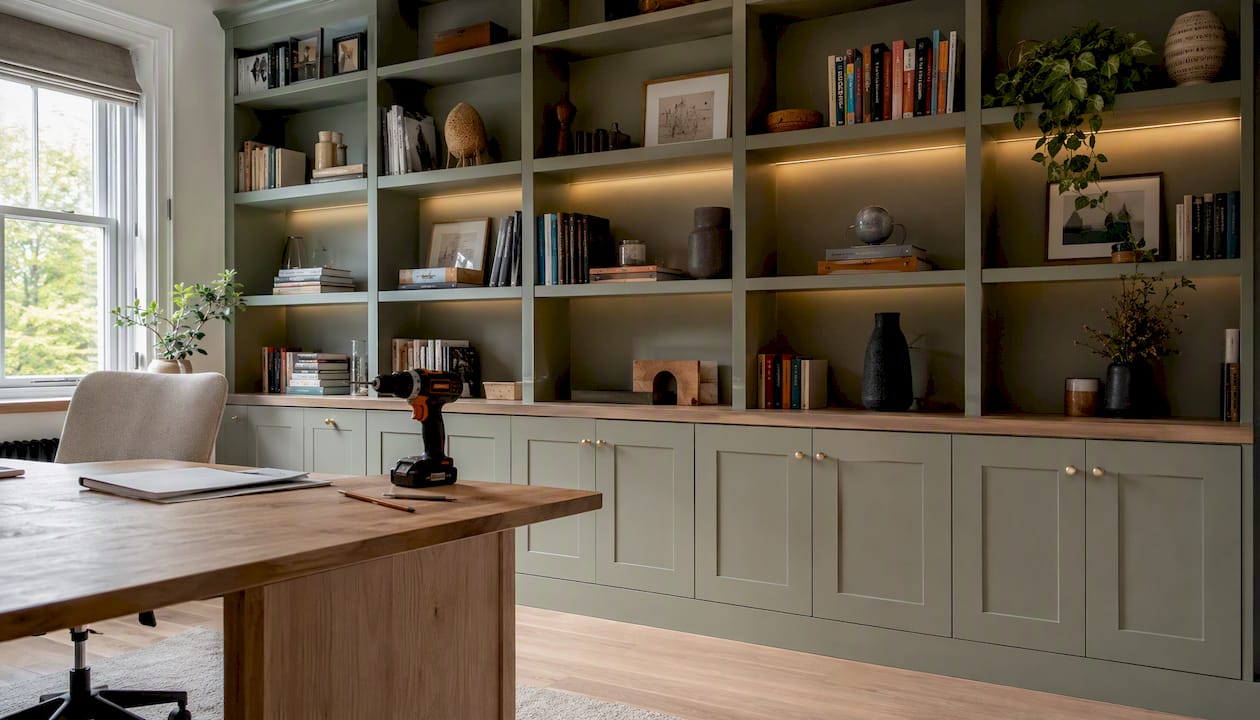
For most UK homeowners, a bespoke fitted bookcase wall delivers the best long-term result, particularly in older London properties with alcoves, uneven walls, or irregular floor plans. If your budget is tight or your tenancy is temporary, ready-made modular shelving from mass-market retailers gets you functional storage quickly. The decision usually comes down to three factors: how long you plan to stay, whether your walls are square, and how the backdrop will read on a video call.
Three fast picks:
- Best for budget: Modular flat-pack units (IKEA BILLY or KALLAX) offer adjustable shelving at accessible price points and suit regular, square walls.
- Best for tight or temporary spaces: Wall-mounted floating shelves above a desk keep the floor clear and can be removed without major damage.
- Best for long-term or awkward alcoves: A bespoke fitted bookcase wall, scribed to your exact walls, floor, and ceiling, gives a built-in finish that no off-the-shelf unit can replicate.
Quick action steps before you do anything else:
- Measure wall width at three heights (top, middle, bottom) and note the smallest figure.
- Identify your wall type: solid masonry, timber stud, or dot-and-dab plasterboard.
- Set a realistic budget, including fixings, finishing, and installation.
- Decide whether you want a DIY project or a professionally fitted result.
Pro Tip: If you are on a video call more than three times a week, treat your bookcase wall as a backdrop first and a storage unit second. What the camera sees matters as much as what the shelves hold.
Key takeaways
A bespoke fitted bookcase wall, scribed to your exact room dimensions, is the most effective long-term home office storage solution for UK properties with alcoves or irregular walls.
| Point | Details |
|---|---|
| Choose your route early | Ready-made suits square walls and short tenancies; bespoke fitted joinery suits alcoves, long-term stays, and professional backdrops. |
| Measure at three heights | Wall width varies in older UK homes; always use the smallest measurement when specifying a fitted unit. |
| Match fixings to wall type | Solid masonry takes standard fixings; stud and dot-and-dab walls need specialist anchors fixed into structure. |
| Plan cable management first | Integrate cable routing into the unit design before installation; retrofitting is always harder and more expensive. |
| Finest Furniture Studio | Offers bespoke fitted bookcase walls with a 10-year guarantee and typical 7–12 day installation across London. |
Table of Contents
- What types of home office bookcase wall suit different needs?
- Where can you buy wall-mounted bookcases and shelving in the UK?
- How to measure and plan your wall bookcase correctly
- What you need to know about fixings, wall types, and load capacity
- How to style and organise your bookcase wall for work and video calls
- What are the alternatives to a full bookcase wall?
- How do you choose between ready-made shelving and bespoke fitted units?
- Why bespoke fitted bookcases often win in London homes
- Maintenance and care tips for wall-mounted bookcases
- A design-first perspective on your home office bookcase wall
- Finest Furniture Studio: bespoke bookcase walls designed around your home
- Sources
- FAQ
What types of home office bookcase wall suit different needs?
The term “bookcase wall” covers several distinct product types, and choosing the wrong one for your room geometry or use case is the most common planning mistake.
Floating shelves are wall-fixed boards with concealed internal brackets. They suit the space above a desk where you want a clean, minimal look. Depth typically runs 200–250mm, which is enough for paperbacks and small objects but not deep hardbacks or lever arch files.
Modular wall systems such as IKEA’s BILLY and KALLAX combine freestanding or wall-anchored units into a library wall with desk integration. They are adjustable, widely available, and straightforward to reconfigure. The trade-off is that standard units rarely fit a British alcove without visible gaps at the sides or ceiling.
Built-in bookcase walls are the fitted joinery category: units manufactured to the exact dimensions of your room, scribed to walls and ceiling, and finished to match your interior. This is the approach that produces the seamless, floor-to-ceiling library look seen in Georgian and Victorian townhouses across Richmond, Wimbledon, and Chelsea.
Wall-mounted cabinets combine open shelving with closed lower storage, which is practical for a home office where you need to hide printers, cables, and stationery. Many bespoke joinery suppliers offer integrated desk bridges as part of the same unit.
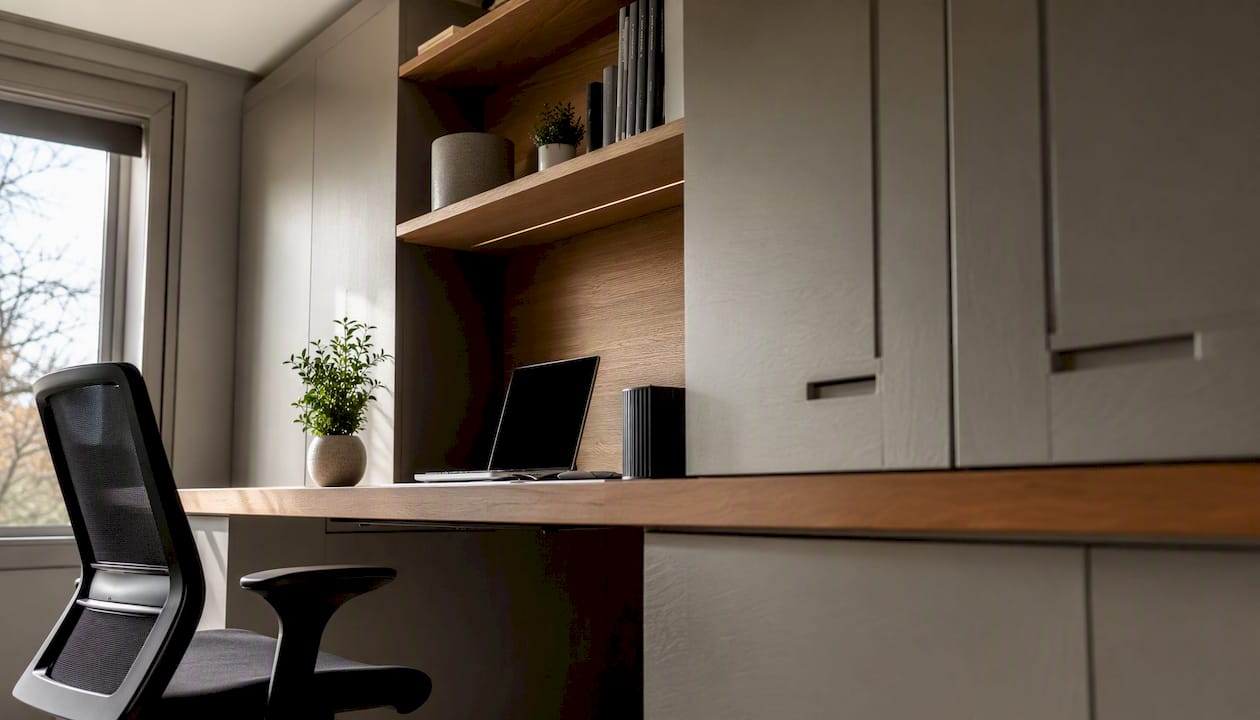
Integrated desk-library combinations mount the desk surface directly to the wall unit, creating a single piece of furniture that uses every centimetre of wall space. These suit smaller rooms in Putney, Hammersmith, or Ealing where a freestanding desk would dominate the floor plan.
Pro Tip: Mix open upper shelving with closed lower cupboards. Open shelves above eye level display books and objects; closed doors below the desk line hide the everyday clutter that reads poorly on camera and makes a room feel busy.
Where can you buy wall-mounted bookcases and shelving in the UK?
There are four realistic buying routes, each with a different profile on price, lead time, and fit quality.
Mass-market retailers (IKEA, John Lewis, Wayfair UK, Made.com) stock modular and freestanding units that are available immediately or within a few weeks. IKEA’s BILLY range and KALLAX grid units are the most widely used starting points for a library wall with desk. John Lewis and Made.com offer more considered designs at mid-range prices. Wayfair UK carries a broad catalogue across price bands. These routes suit square rooms and standard ceiling heights.
Online marketplaces such as Amazon list thousands of wall shelf options, with basic floating shelf sets available at low entry-level prices. The catalogue is wide but quality varies considerably, so check load ratings and fixing specifications carefully before purchasing.
Specialist bespoke joiners and fitted furniture services design, manufacture, and install units to your exact dimensions. Lead times vary by supplier and project scope. This route suits alcoves, chimney breast recesses, and rooms where standard units would leave unsightly gaps. Cost is higher than ready-made, but the result fits the room rather than the room fitting the unit.
Local carpenters and design-and-build studios offer a middle ground: bespoke manufacture with a more personal service and often faster turnaround than large fitted furniture companies. For homeowners in Barnes, Twickenham, Kingston, or Chiswick, a local studio that offers a free design visit is worth prioritising.
When contacting any bespoke supplier, ask upfront about: scribing capability (fitting units flush to uneven walls), finish options, cable integration, and whether they remove and dispose of existing furniture.
Well-planned built-in shelving can increase perceived property value and make the most of underused alcoves in typical UK homes.
How to measure and plan your wall bookcase correctly
Getting the measurements right before you order anything saves significant cost and frustration. Follow this sequence:
- Measure wall width at three heights: top (near ceiling), middle, and bottom (near skirting). Use the smallest measurement for any fitted unit to avoid a unit that cannot physically enter the space.
- Measure floor-to-ceiling height at both ends of the wall and in the centre. Older UK homes frequently have floors and ceilings that are not level.
- Note depth available: standard desk depth is 600mm; shelving above a desk typically runs 200–300mm deep to avoid encroaching on headroom.
- Check shelf spacing needs: paperbacks need 200–230mm clear height; hardbacks need 240–300mm; large-format books and lever arch files need 320–400mm.
- Identify obstructions: skirting boards, coving, picture rails, sockets, light switches, radiators, and pipework all affect unit dimensions and fixing positions.
- Check for external walls: shelving on an external wall in an older property may need a ventilation gap behind to prevent condensation.
| Book or item type | Recommended shelf height (clear) | Typical depth needed |
|---|---|---|
| Paperbacks | 200–230mm | 200–230mm |
| Hardbacks | 240–300mm | 200–250mm |
| Large-format / coffee table | 320–400mm | 240–300mm |
| Lever arch files | 320–400mm | 240–300mm |
Shelf spacing data sourced from BookaBuilderUK’s alcove shelving guide.
Pro Tip: In a Victorian or Edwardian alcove, measure the depth of the chimney breast recess at three points: the back wall is rarely parallel to the front opening. A bespoke joiner will scribe the unit to account for this; a flat-pack unit will leave a visible gap.
For further planning guidance, the home office storage options article covers layout decisions in detail.
What you need to know about fixings, wall types, and load capacity
The wall type determines almost everything about how your shelving can be fixed and how much weight it can safely carry.
Solid masonry walls (brick, stone, or dense block) are the most forgiving. They accept standard masonry fixings and can carry substantial loads when fixed correctly. Most pre-1930s London properties have solid masonry party and external walls.
Timber stud walls (a timber frame with plasterboard faces) require fixings into the studs themselves. Plasterboard alone will not hold a loaded bookcase. Locate studs with a detector before specifying any shelf position, and design shelf heights around stud positions rather than purely aesthetic preference.
Dot-and-dab plasterboard on masonry is common in post-war and refurbished properties. The plasterboard is bonded to the masonry with adhesive dabs, leaving a void behind. Standard wall plugs can pull through; specialist long-reach fixings or resin anchors are needed to reach the masonry behind.
Floating shelves rely on hidden internal steel supports. According to trade guides on bespoke shelving, weight capacity depends heavily on wall construction, and solid masonry is strongly preferred for heavier loads.
Safety checklist before installation:
- Confirm wall type and use the correct fixing for it.
- Locate and avoid buried cables and pipework (use a detector).
- Fix into studs or masonry, never into plasterboard alone for loaded shelves.
- Check that cable routing behind units does not create a fire risk.
- On external walls, leave a ventilation gap or use a breathable membrane.
- For floor-to-ceiling units, fix the top to a ceiling joist or wall plate, not just the plaster.
Finest Furniture Studio offers a 10-year guarantee on bespoke fitted units, with typical on-site installation completed within 7–12 days.
How to style and organise your bookcase wall for work and video calls
A well-organised home office storage wall does two jobs: it stores what you need and it looks composed on camera. Most people underestimate the second requirement until they see themselves on a Zoom call with a chaotic shelf behind them.
Practical organisation principles:
- Group books by height or colour on open shelves at eye level and above; this reads as deliberate rather than accidental on camera.
- Use lidded boxes or labelled fabric baskets on lower shelves for stationery, cables, and everyday items you reach for regularly.
- Reserve closed lower cupboards for printers, routers, and anything with a cable attached.
- Leave deliberate negative space on at least one shelf. A shelf packed to every edge reads as cluttered; one or two objects with breathing room around them reads as considered.
Cable management is the detail most people leave until last and regret. Plan cable channels into the unit design before installation. Surface-mounted cable trunking in a matching finish is the simplest retrofit; a bespoke joiner can route cables internally during manufacture.
Lighting lifts a bookcase wall from functional to genuinely impressive. LED strip lighting inside upper shelves or above the unit adds warmth and depth. For video calls, a shelf-mounted LED panel at eye level provides flattering fill light without a separate ring light cluttering your desk.
Pro Tip: Browse the House & Garden bookshelf ideas gallery before finalising your layout. Seeing 61 real-room examples in one place quickly shows you which arrangements read as calm and professional versus busy and distracting.
What are the alternatives to a full bookcase wall?
A full fitted bookcase wall is not the right answer for every situation. These alternatives are worth considering before committing.
- Freestanding bookcases: Lower upfront cost, no fixings required, and easy to move. The downside is that they rarely reach the ceiling, leave gaps at the sides, and can look temporary in a professional home office.
- Storage cabinets: Tall, closed-door cabinets hide everything and keep the room looking clean. They suit offices where confidentiality matters or where the aesthetic is minimal. Less useful as a backdrop.
- Pegboard panels: Highly flexible for tools, accessories, and small items. Works well in a creative or craft-adjacent home office. Reads as informal on camera.
- Tall cupboards: A pair of floor-to-ceiling cupboards flanking a desk creates a built-in look without full joinery costs. IKEA’s PAX system is a common approach.
- Wall panels with integrated desk: A single wall-spanning panel with a fold-down or fixed desk surface suits very small rooms where a separate bookcase would dominate.
Pro Tip: If you rent your property, freestanding units or pegboard are the practical choice. For owners planning to stay five or more years, the investment in fitted joinery typically pays back in both daily utility and property appeal.
For readers exploring space-saving storage more broadly, there are further options worth considering beyond the bookcase wall category.
How do you choose between ready-made shelving and bespoke fitted units?
Work through this checklist before contacting any supplier or placing an order.
- Budget: Ready-made modular units are the lower-cost entry point. Bespoke fitted joinery carries a higher upfront cost but typically requires no modification and lasts the life of the property.
- Permanence: Planning to stay five or more years? Bespoke fitted units are worth the investment. Renting or likely to move within two years? Modular or freestanding is the pragmatic choice.
- Wall regularity: Square walls with standard ceiling heights suit ready-made units. Alcoves, chimney breast recesses, sloped ceilings, or bowed walls require scribing and bespoke manufacture.
- Load requirements: Heavy book collections, large monitors, or integrated AV equipment need fixings into structure and shelves engineered for the load.
- Styling priorities: If the bookcase wall is a significant visual feature or a video call backdrop, finish quality and a flush fit to the room matter more than they would in a utility space.
- Lead time: Ready-made units are available within days to weeks. Bespoke fitted joinery typically involves a design visit, manufacture, and installation phase.
Questions to ask any bespoke supplier:
- Do you scribe units to walls, floors, and ceilings?
- Can you integrate cable management and electrical sockets?
- What is your guarantee period and what does it cover?
- Do you remove and dispose of existing furniture?
- Can we see sample finishes before committing?
Red flags that suggest you need a professional joiner rather than flat-pack:
- The alcove is not square at any measurement point.
- You need integrated lighting, sockets, or cable routing.
- The ceiling height varies across the wall.
- You want a painted finish that matches existing joinery exactly.
The fitted wardrobe buying guide from Finest Furniture Studio covers many of the same decision points and is worth reading alongside this checklist.
Why bespoke fitted bookcases often win in London homes
The majority of London properties built before 1960 were not designed with standard furniture dimensions in mind. Alcoves beside chimney breasts, walls that bow by 20–30mm across their width, and ceiling heights that vary from one end of a room to the other are the norm in Richmond, Wimbledon, Fulham, and Chelsea. Ready-made units leave visible gaps; bespoke fitted units do not.
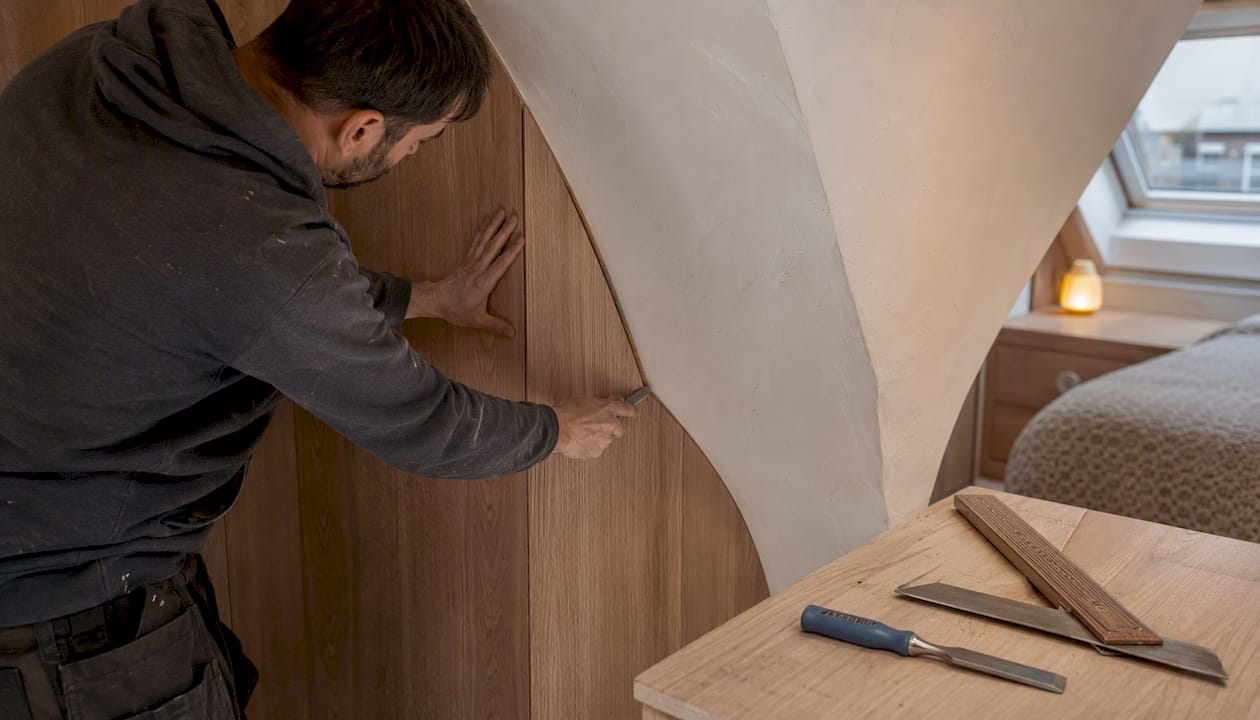
Professional joiners scribe fitted units directly to walls, floors, and ceilings, shaving the unit’s edges to follow the exact profile of the surface. The result is a flush fit with no gaps for dust, no visible packing pieces, and a finish that reads as part of the architecture rather than furniture placed against it.
Bespoke suppliers can also incorporate features that no ready-made unit offers: integrated desk bridges, hidden cable management, and rolling ladders for tall libraries. For a home office that doubles as a professional backdrop, these details matter.
What Finest Furniture Studio offers for home office bookcase walls:
- Free design visit to measure and discuss your requirements in your home.
- Made-to-measure manufacture using premium materials and finishes.
- Professional installation, typically completed within 7–12 days on site.
- A 10-year guarantee on all fitted work.
- Removal and disposal of any existing furniture.
- Service across Richmond, Wimbledon, Putney, Kingston, Chiswick, Fulham, Chelsea, Ealing, Twickenham, Barnes, Hammersmith, and broader London.
For readers in West London specifically, the bespoke bookcase design service page covers local options and examples in detail.
Pro Tip: Ask your joiner to show you a sample of the scribed finish before installation begins. A well-scribed unit should sit flush to the wall with no visible filler or shadow gap. If a supplier cannot demonstrate this, look elsewhere.
Finest Furniture Studio’s bespoke fitted solutions carry a 10-year guarantee and are typically installed within 7–12 days.
Maintenance and care tips for wall-mounted bookcases
A fitted bookcase wall is a long-term investment, and a modest maintenance routine keeps it looking sharp for years.
Dusting and cleaning: Dust open shelves every one to two weeks with a microfibre cloth. For painted MDF or timber units, a slightly damp cloth removes marks without damaging the finish. Avoid abrasive cleaners, which dull painted surfaces over time.
Checking fixings: Once a year, check that wall fixings are still tight, particularly on stud walls where seasonal movement can loosen screws. Tighten any that feel loose before adding weight to the shelf.
Wood movement: Solid timber shelves expand and contract with humidity. In centrally heated UK homes, this is most noticeable in winter when heating runs continuously.
Touch-up painting: Keep a small quantity of the original paint for touch-ups. Painted MDF is particularly susceptible to chipping at corners and door edges. A small brush and the matching colour sorts most marks in minutes.
Avoiding overloading: Shelves have a rated load capacity. Spreading weight evenly across a shelf is better than concentrating heavy items at one end. For shelves spanning more than 900mm, a central support or thicker shelf board prevents long-term sag.
A design-first perspective on your home office bookcase wall
The most common mistake people make when planning a home office storage wall is treating it purely as a storage problem. It is also a backdrop, a sightline, and in many London homes, the most prominent architectural feature in the room.
Start with what the camera sees. Position your desk so the bookcase wall sits behind you, not to the side where it appears as a partial, awkward slice of shelf. A centred, symmetrical arrangement reads as intentional; an asymmetric one reads as accidental, even when it is not.
Finish choice matters more than most people expect. A painted finish in a muted tone reads far better on camera than raw timber or a high-gloss lacquer, which can create reflections. Designers frequently recommend muted greens and warm neutrals for joinery in a home office context. Farrow & Ball’s Lichen, for example, is a muted sage green that reads as calm and considered on screen without appearing cold or clinical.
Think about the relationship between the bookcase wall and the light source. A unit on a wall opposite a window will be well-lit naturally; one on the same wall as the window will sit in shadow. If natural light is limited, plan shelf-mounted or overhead lighting into the unit from the start rather than retrofitting it later.
Finest Furniture Studio: bespoke bookcase walls designed around your home
Ready-made shelving solves a storage problem. A bespoke fitted bookcase wall from Finest Furniture Studio solves a room. The difference is a unit that fits your exact alcove, matches your existing joinery, hides your cables, and carries a 10-year guarantee on every joint and finish.
We offer a free design visit at your home across Richmond, Wimbledon, Putney, Kingston, Chiswick, Fulham, Chelsea, Ealing, Twickenham, Barnes, Hammersmith, and the wider London area. During the visit, we measure your space precisely, discuss finish options, and advise on cable integration and lighting. Manufacture and installation typically follow within 7–12 days. We also remove and dispose of any existing furniture, so the process is straightforward from start to finish.
To request your free design visit, call or WhatsApp us on 07468 150807, or visit us at 124 City Road, Kemp House, London, EC1V 2NX. You can also explore our fitted home office service page or browse bespoke bookcase options for West London to see the range of finishes and configurations we offer.
Sources
These sources are worth bookmarking as you plan your home office shelving wall.
Use these sources to build a clear brief before your first supplier conversation. The more specific your reference images and measurements, the faster and more accurate the quoting process will be.
FAQ
What is the best bookcase for a home office?
A bespoke fitted bookcase wall is the best long-term option for most UK home offices, particularly in properties with alcoves or irregular walls. For tighter budgets or temporary spaces, modular units such as IKEA BILLY or KALLAX offer a practical starting point.
What is the bookshelf rule for styling?
Leave deliberate negative space on at least one shelf and group items by height or colour. A shelf packed to every edge reads as cluttered; spacing objects with breathing room around them creates a composed, professional look.
What are the alternatives to a bookshelf wall?
Freestanding bookcases, tall storage cabinets, pegboard panels, and wall panels with an integrated desk are all practical alternatives. Freestanding units suit renters; fitted cupboards flanking a desk create a built-in look at lower cost than full joinery.
Where can I buy wall-mounted bookshelves in the UK?
IKEA, John Lewis, Wayfair UK, Made.com, and Amazon.co.uk all stock wall-mounted shelving at varying price points. For a bespoke fitted result in London, Finest Furniture Studio offers a free design visit and a 10-year guarantee on all fitted work.
How much weight can a wall-mounted bookcase hold?
Load capacity depends on wall type and fixing method. Solid masonry walls with correctly specified fixings carry the highest loads. Stud walls require fixings directly into the timber studs; plasterboard alone will not safely support a loaded bookcase.