
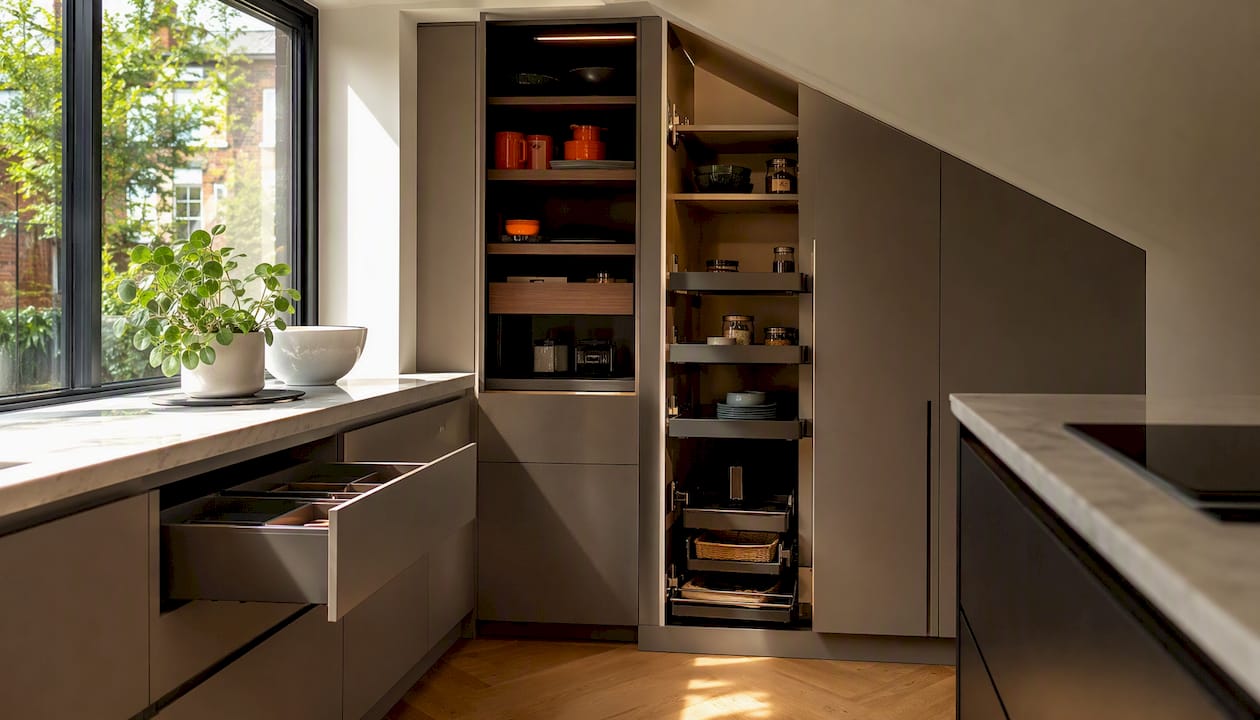
Six changes deliver most of the benefit before you spend a penny on bespoke work: declutter and zone your cupboards, add shelf risers to double vertical space, fit door-mounted racks for spices and cling film, install a lazy Susan in dead corner cupboards, decant into stackable clear containers, and run a five-minute nightly reset with a strict one-in one-out rule for gadgets. Each targets a different failure point (wasted height, dead corners, invisible stock, and slow creep back to chaos) so together they cover most of what makes a small kitchen feel impossible to live in.
None of these require drilling, which matters if you rent. Here’s the breakdown of what to do first and roughly what it costs.
- Declutter and zone first (free): Pull everything out, sort into prep/cook/clean/storage groups, and only put back what you actually use. This step alone reveals which cupboards are underused before you buy anything.
- Shelf risers (£8 to £20 for a set): Turn one shelf into two levels, ideal for tins, mugs, and small jars.
- Door-mounted organisers (£10 to £18): Hooks or wire racks on the inside of a cupboard door hold spice jars, foil, or cleaning sprays without touching a single screw.
- Lazy Susan for corners (£10 to £25): Spins deep or blind corner cupboards into reach instead of leaving jars stranded at the back.
- Stackable clear containers (£15 to £40 for a starter set): Decanting dried goods into uniform, see-through tubs frees shelf space and stops duplicate buying.
- Nightly reset and one-in one-out (free): A five-minute clear-down each evening and a rule that nothing new comes in without something old leaving.
Renters can do all six without risking a deposit. Homeowners planning to stay put longer might add fixed rails or pull-out baskets to the same list, which the sections below cover in detail.
Key Takeaways
The most effective kitchen storage system combines decluttering, zoning by task, and low-cost vertical organisers, with bespoke fitted units reserved for structural gaps those fixes can’t reach.
| Point | Details |
|---|---|
| Start with a 30-minute declutter | Empty one cupboard, sort into keep/donate/bin, and measure shelf depth and width before buying anything. |
| Buy shelf risers and a lazy Susan first | These two items together cost less than £50. |
| Watch for three bespoke signals | A chimney breast, sloping ceiling, or awkward void that no standard organiser fits properly signals it’s time for a custom solution. |
| Maintain with two daily habits | A five-minute nightly reset and a one-in one-out rule for gadgets keep any system working long-term. |
| Consider Finest Furniture Studio for structural gaps | Finest Furniture Studio offers free design visits, installations typically within seven days, and a 10 year guarantee for persistent storage problems. |
Table of Contents
- Kitchen storage tips start with decluttering and planning zones
- Vertical space and shelf risers multiply your storage
- Door and undershelf organisers reclaim wasted surfaces
- Fix deep cupboards and dead corners
- Drawer dividers and the file method for pans
- Fridge, freezer and pantry organisation that cuts waste
- Walls, rails and hanging storage free up cupboards
- Deciding what stays on the worktop
- Habits that keep your kitchen storage system working
- A budget starter kit and where to buy it in the UK
- When bespoke fitted storage is the right next step
- Lighting inside cupboards and drawers
- Why small changes usually beat big renovations for most kitchens
- Ready for a permanent fix? Book a free design visit
- Sources
- FAQ
Kitchen storage tips start with decluttering and planning zones
Buying organisers before you declutter is the single most common mistake, according to advice from professional organisers. You end up with a beautifully labelled container for spices you never use, sitting inside a cupboard that’s still overflowing everywhere else. The fix is to strip a cupboard back to bare shelves, sort every item into “keep,” “donate,” and “bin,” and only then think about what kind of storage would actually help.
Zoning follows straight after decluttering. Group items by task rather than by type: a prep zone near your chopping board (bowls, boards, oils), a cooking zone near the hob (pans, utensils, spices), a cleaning zone under the sink (sprays, cloths, bin bags), a general storage zone for tins and dry goods, and an appliance zone for anything electrical. If you have young children, a low, easily reached cupboard can become a self-serve zone for snacks, cups, and plastic plates, an idea that works particularly well in family kitchens according to zoning guidance from Life in Velvet.
Before you buy a single organiser, take three measurements: the internal shelf depth, the internal width, and the door clearance (how far a cupboard door swings before it hits a worktop or handle). These numbers stop you ordering a pull-out basket that jams the door shut or a riser that’s a centimetre too tall for the shelf above it.
Pro Tip: If you rent, measure everything before you buy but avoid marking or adjusting the cupboard itself. Stick to friction-fit and freestanding organisers that lift straight out at the end of your tenancy, since renter-focused advice consistently favours these over anything screwed or glued in place.
Quick planning checklist for the session: empty one cupboard at a time, sort into three piles, wipe the shelf, measure depth and width, decide the zone, then repeat.
Vertical space and shelf risers multiply your storage
Most kitchen cupboards waste a third of their height because a single shelf leaves a gap above the tins or mugs sitting on it. That gap is dead space until you add a riser, tiered stand, or stackable insert, which effectively creates a second shelf inside the same footprint. Professional organisers name unused vertical space as the most common storage mistake they see, and shelf risers are usually the cheapest fix available.
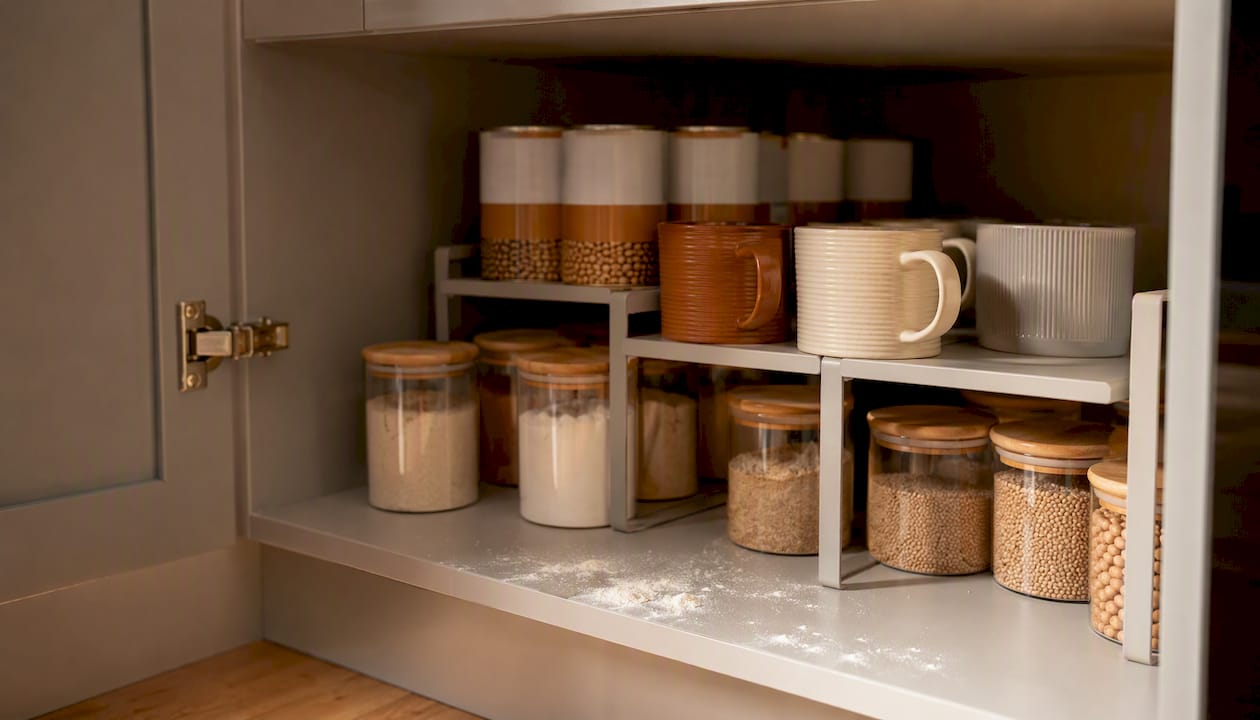
The rule of thumb: measure the height of the item you want to store, then check how much clearance remains above it before the next shelf. If there’s more than 8 to 10 centimetres spare, a riser or stacking rack almost always fits. Risers work best for lightweight, uniform items: tins, small jars, mugs, and tea or coffee tins. Heavier or oddly shaped items (large pots, mixing bowls) are usually better left on the base shelf.
For open storage rather than inside a cupboard, a pegboard like the IKEA SKÅDIS turns a blank wall into fully adjustable vertical storage, and pairs well with a KUNGSFORS-style rail for hanging utensils. Both are covered in more depth in the walls and hanging section below.
| Organiser type | What it stores best | Typical UK price range |
|---|---|---|
| Wire or acrylic shelf risers | Tins, mugs, small jars | £8 to £20 |
| Tiered stacking rack | Plates, tins, tinned tomatoes | £10 to £25 |
| Stackable clear containers | Pasta, rice, cereal, snacks | £15 to £40 for a set |
| Under-shelf wire basket | Bags, foil rolls, tea towels | £10 to £18 |
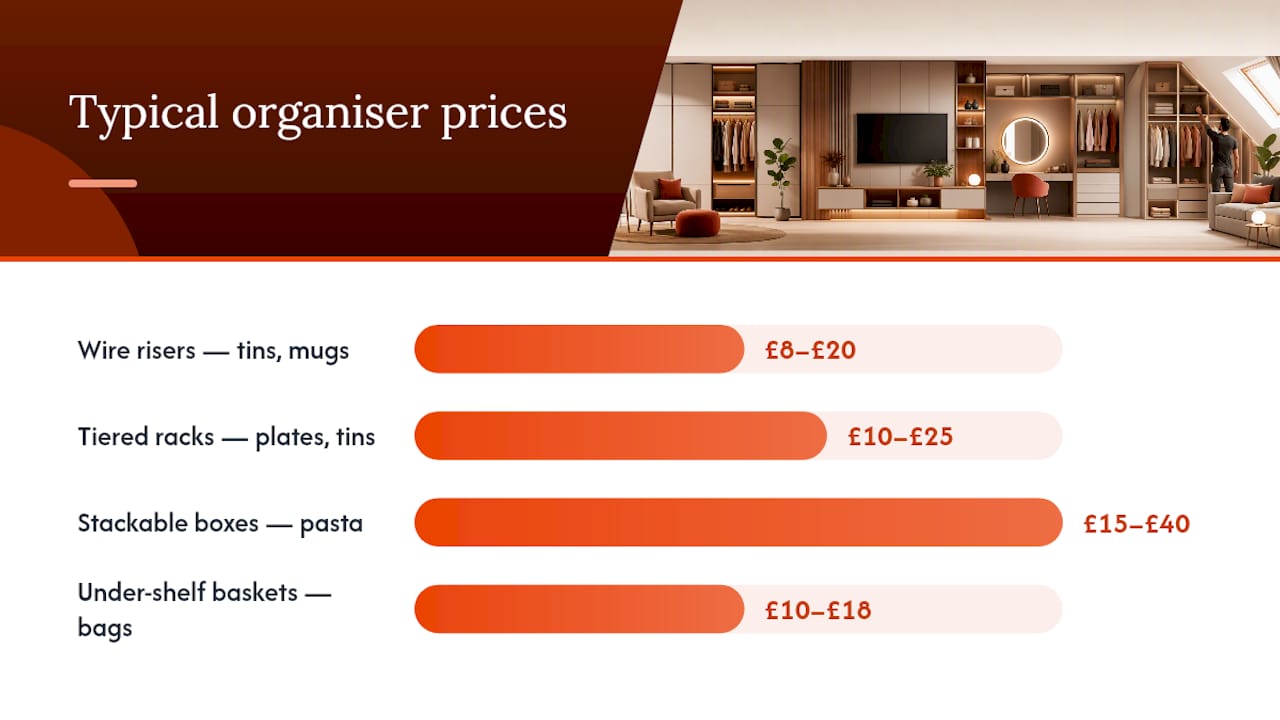
Retailers such as IKEA, Argos, Amazon UK and Lakeland all stock these organiser types at broadly comparable price points, so it’s worth measuring twice and buying once rather than guessing at sizes online.
Door and undershelf organisers reclaim wasted surfaces
Every cupboard door and the underside of every shelf is unused storage until you add something to it. Inside-door racks hold spice jars, cling film boxes, or cleaning sprays; under-shelf wire baskets hang below an existing shelf to catch sponges, tea towels, or bags without taking up any shelf space themselves; and tension rods wedge across a cupboard to create a divider for trays, chopping boards, or baking sheets stood on their side.
- Inside-door spice racks: Best for anything you reach for daily; keeps spice jars visible instead of buried at the back of a cupboard.
- Under-shelf wire baskets: Slide onto an existing shelf lip and free up a section of shelf below for taller items.
- Tension rods: Create instant vertical dividers for trays and chopping boards, and adjust to fit almost any cupboard width.
- Over-door hooks: Hold tea towels, oven gloves, or a small bin bag roll, and lift off cleanly when you move.
Most of these are friction-fit or hook-over designs that need no adhesive and no drilling, which makes them the safest first purchase for renters. Homeowners planning to stay long-term might prefer a screwed-in door rack for extra rigidity, but it’s rarely necessary for anything lighter than a full spice collection.
Pro Tip: Under the sink, measure around your pipework before buying an organiser. A slim two-tier riser or a set of small stacking crates usually copes better with pipe bends than a single wide tray, which often won’t sit flat.
Check the stated weight limit on any door-mounted rack before loading it with heavy jars. Overloaded inside-door organisers are one of the most common reasons cupboard doors sag or come away from their hinges over time.
Fix deep cupboards and dead corners
Blind corner cupboards and deep base units are where jars and gadgets go to disappear. A lazy Susan solves this by rotating everything within reach, a friction-fit pull-out shelf slides forward on runners without any drilling, and a pull-out wire basket does the same job for looser items like carrier bags or root vegetables.
- Lazy Susan: Best for round or square corner cupboards where items get pushed to the back; works especially well for jars, tins, and bottles.
- Friction-fit pull-out shelf: Sits on top of an existing shelf and slides forward, giving you a mini drawer effect without altering the cupboard itself.
- Pull-out wire basket: Ideal for bulkier or irregularly shaped items that don’t stack neatly, such as bagged onions or cleaning bottles.
To pick the right retrofit, measure the internal diameter of a corner cupboard (for a lazy Susan) or the internal width and depth of a base cupboard (for a pull-out shelf or basket). The most common pitfall is buying a lazy Susan that’s too large to clear the cupboard’s internal hinges, so check the swing radius, not just the shelf width.
Pro Tip: If your tenancy agreement rules out anything that alters the cupboard interior, a friction-fit pull-out or a simple stacking basket that lifts straight out gives you most of the benefit of a full retrofit with none of the risk to your deposit.
Drawer dividers and the file method for pans
A drawer full of loose utensils is chaos in miniature: everything shifts every time you open it, and the item you want is always underneath something else. Expandable bamboo dividers, or a rigid interlocking insert, solve this by giving every utensil its own lane. They beat flimsy plastic trays because they adjust to the exact width of your drawer instead of leaving awkward gaps at the edges where things migrate.
For pots and pans, ditch the stack. Stacked pans mean you always lift out three to get to the one at the bottom, and the friction wears non-stick coatings faster than almost anything else. The “file” method, standing pans upright in a rack or divider like files in a cabinet, means every pan is visible and reachable in one motion. A slim lid rack fitted into a nearby cupboard solves the separate problem of lids that never match whatever pan you’ve just pulled out.
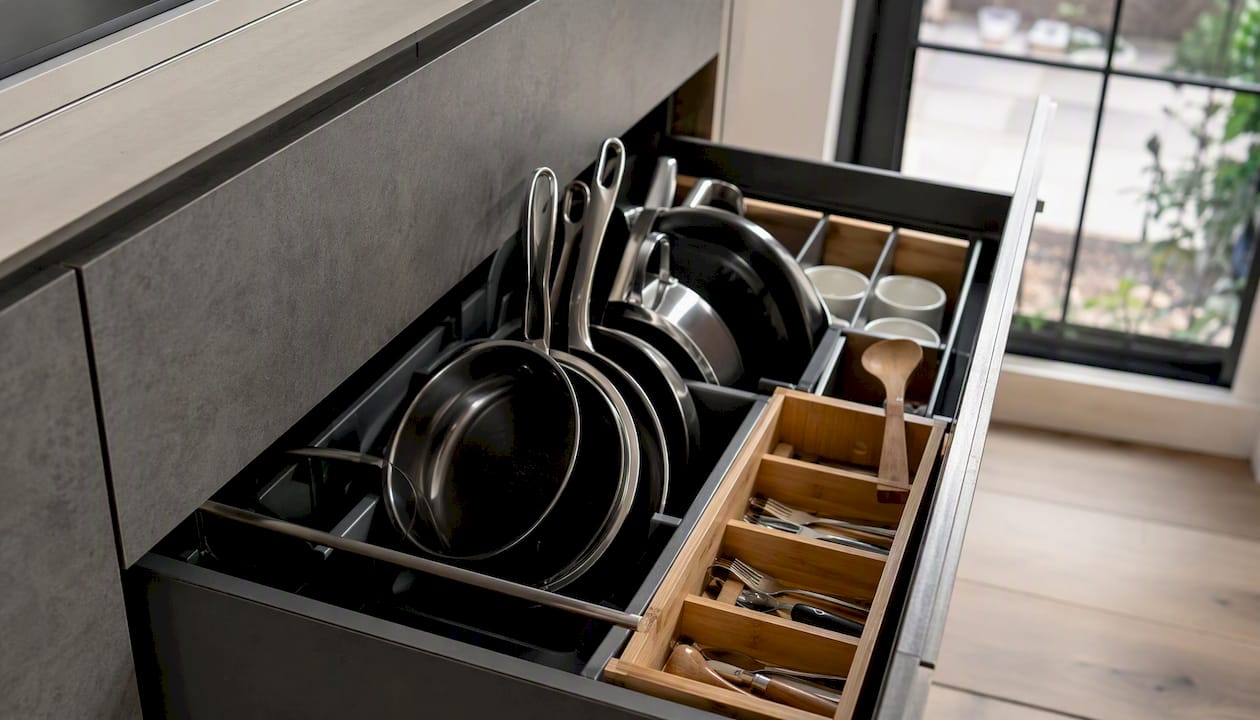
Before: one drawer with tangled spatulas and three stacked pans wedged into a cupboard that won’t fully close. After: a divided drawer where each utensil has a slot, and a vertical pan rack where every pan slides out without disturbing the others.
Shopping checklist for drawer organisation:
- Measure the drawer’s internal width and depth.
- Choose an expandable divider set sized to that measurement, not a fixed-width one.
- Buy a vertical pan rack sized to your deepest cupboard.
- Add a slim lid rack or divider for the cupboard door or a nearby gap.
- Fit dividers, then only return pans and utensils you actually use weekly.
Fridge, freezer and pantry organisation that cuts waste
Food gets wasted mostly because it’s forgotten, not because there isn’t room for it. A first-in, first-out system, where older items move to the front and new stock goes to the back, keeps everything visible and used before it spoils. Clear stackable containers help here too: transparent tubs let you see at a glance what’s running low, whereas opaque boxes hide the problem until you’re restocking blind.
- Fridge door: Condiments and anything that doesn’t need to stay cold, since the door is the warmest zone.
- Top shelf: Ready-to-eat items and leftovers, kept at eye level so they don’t get forgotten.
- Middle shelf: Dairy and eggs, where temperature stays most consistent.
- Bottom shelf: Raw meat and fish, stored below other food to prevent drips contaminating anything underneath.
- Drawers: Fruit and vegetables, which need the higher humidity these compartments are designed to hold.
- Freezer: Lay food flat in bags before freezing, then stand the frozen blocks upright once solid, so they stack like files rather than piling up loose.
A simple label with the date something went into the freezer or pantry solves most “is this still good?” hesitation. Decanting dry goods into matching containers helps visibility, but only decant what you actually restock often; bulk items you rarely buy twice are better left in their original packaging to save the extra step.
Walls, rails and hanging storage free up cupboards
Wall space above a worktop or beside a cupboard is often the most underused storage zone in the whole kitchen. A pegboard such as the IKEA SKÅDIS gives you a fully adjustable grid for hooks, small shelves, and containers, and it can be mounted on a freestanding frame if you’d rather not put screws in a rented wall. A KUNGSFORS-style rail fitted with S-hooks turns a strip of wall into hanging storage for utensils, mugs, or even small pans, and a magnetic strip mounted near the hob keeps knives and metal spice tins off the worktop entirely.
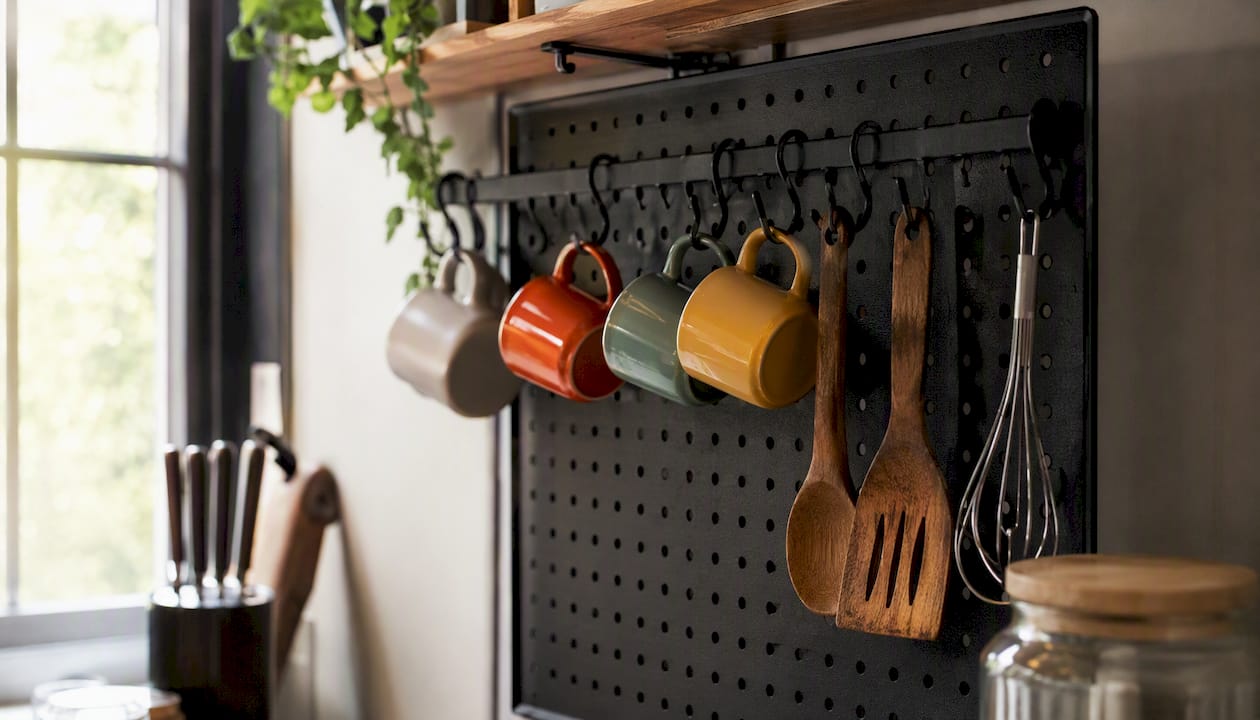
For renters, adhesive-strength wall hooks and a freestanding pegboard on a base unit give most of the same benefit without a single screw hole. Homeowners with a longer-term view usually get more out of a properly screwed rail, since it holds heavier loads and looks tidier when everything hangs at a consistent height. Either way, keep hanging storage close to where you’ll use it, utensils near the hob, mugs near the kettle, so the system saves steps rather than just looking neat.
Always check the stated weight limit before hanging cast iron pans or a full set of knives from a single rail, and keep hanging storage away from directly above the hob unless it’s specifically rated for heat, since rising steam and grease shorten the life of anything mounted too close.
Deciding what stays on the worktop
A cluttered worktop is usually the result of appliances staying out “just in case” rather than because they’re used daily. A simple three-point rule cuts through this: how often do you use it, is it safe and easy to reach where it lives, and does it get in the way of actual food prep. If an item fails on two of the three, it belongs in a cupboard.
- Frequency: The kettle and toaster earn worktop space in most households; a slow cooker used twice a month doesn’t.
- Safety and accessibility: Anything heavy or awkward to lift, such as a stand mixer, is safer left out if the alternative is hauling it down from a high shelf weekly.
- Impact on prep space: If an appliance eats into your only chopping area, it needs to move even if you use it often.
An appliance garage, a cupboard fitted with a roll-up or lift-up door near a plug socket, hides a coffee machine or air fryer while keeping it plugged in and ready. A small rolling trolley works as flexible extra worktop that tucks away when not needed. Weekly-use appliances like a slow cooker or waffle maker are usually better stored in a low cupboard than left permanently visible, freeing the worktop for the two or three items you genuinely reach for every day.
Habits that keep your kitchen storage system working
Organising a kitchen once is easy. Keeping it organised six months later is the part most people struggle with, which is why a five-minute nightly reset matters more than any single organiser you buy. Here’s the routine:
- Clear the worktop of anything used that day and return it to its zone.
- Load or empty the dishwasher so surfaces stay clear overnight.
- Wipe down the hob and worktop while they’re still warm.
- Check the bin and food waste caddy, and take them out if nearly full.
- Do a thirty-second scan for anything obviously out of place.
The one-in one-out rule handles the slower creep: gadgets, mugs, and storage containers accumulate because nothing forces a decision when something new arrives. Pair every new purchase with a matching removal, ideally decided at the point of buying rather than left for “later,” which rarely happens. A kitchen-closing alarm on your phone, or a designated donate box by the door, gives the habit a physical trigger rather than relying on willpower alone.
Pro Tip: Keep the donate box visible, not tucked in a cupboard. A box you see every day gets filled and emptied; a box you forget about becomes just another thing cluttering the house.
A budget starter kit and where to buy it in the UK
If you’re starting from nothing, five items cover most of what a small kitchen needs, and none require professional installation.
- Shelf risers (a set of two or three)
- A lazy Susan for one deep or corner cupboard
- A set of stackable clear containers for dry goods
- An expandable drawer divider
- Two tension rods for cupboard dividers
Buy in that order, measuring the relevant cupboard or drawer before each purchase, and favour adjustable items over fixed sizes wherever the price difference is small. Check the return policy before ordering online, since a riser or basket that’s a centimetre out is common and most major UK retailers accept returns within 30 days.
A renter-first buying order guide recommends fixing drawers before tackling cupboards, since drawer chaos tends to be the most visible daily frustration and the cheapest to solve. Starting there also builds momentum before you take on a full cupboard declutter.
When bespoke fitted storage is the right next step
Off-the-shelf organisers solve most everyday clutter, but some kitchens have constraints no riser or basket can fix: a chimney breast eating into cupboard depth, a sloping ceiling above a run of units, or a pantry gap too awkward for standard flat-pack sizing. If you’ve decluttered, zoned, and added the low-cost fixes above and you’re still fighting the same dead space every week, that’s the signal to consider a made-to-measure solution rather than another trip to buy more inserts.
Ask yourself a few questions before committing: Is the wasted space a recurring, structural problem rather than a one-off clutter issue? Are you staying in the property long enough to justify the investment? Would an integrated appliance garage or a built-in pantry solve something a standalone unit can’t? Custom-fitted storage exists precisely for awkward footprints that off-the-shelf products were never designed to fit.
A bespoke project typically starts with a free design visit, where measurements are taken and layout options discussed, followed by manufacture and a fitted installation. Finest Furniture Studio completes most installations within seven days once a design is confirmed, backed by a 10 year guarantee on the finished work, which is unusually long for the fitted furniture trade.
Pro Tip: At a free design visit, have your cupboard measurements, a rough budget, and a list of your biggest daily frustrations ready. It gives the designer a genuine starting point rather than a blank page.
Lighting inside cupboards and drawers
A cupboard packed with organisers is only useful if you can actually see what’s in it, and most kitchen cupboards are among the darkest spots in the room. Battery-powered LED strip lights or small puck lights, stuck to the underside of a shelf, light the shelf below without any wiring, which makes them a genuinely renter-friendly upgrade. Motion-sensor versions switch on automatically when you open the door and off again once it closes, so you’re not left fumbling for a switch with your hands full.
For drawers, a slim LED strip fixed along the inside edge illuminates dividers and pan racks that would otherwise sit in shadow, particularly useful in base cabinets that don’t catch natural light. Warm white bulbs (around 3000K) tend to suit kitchens better than cool white, since they’re less harsh against wood or painted cabinetry and make food easier to identify at a glance. A £15 to £25 set of stick-on LED lights usually covers two or three cupboards, making this one of the cheapest upgrades on this entire list relative to how much it improves daily usability.
Why small changes usually beat big renovations for most kitchens
The instinct when a kitchen feels chaotic is to think about ripping it out. In most cases that instinct is wrong, or at least premature. A kitchen that’s genuinely too small rarely needs a full renovation to function properly; it needs the contents edited down and reorganised around how the space is actually used. Decluttering and zoning first, then layering in cheap organisers, resolves the majority of complaints people have about their kitchens long before a tradesperson gets involved.
Sequencing matters more than budget here. Declutter and zone, add the low-cost fixes covered above, live with the new system for a few weeks, and only then judge whether the problem was clutter or genuinely inadequate storage. Design professionals tend to recommend exactly this order, because skipping straight to bespoke cabinetry without decluttering first often means paying to fit beautiful units around exactly the same amount of unnecessary stuff.
Where the sequence genuinely runs out of road, an awkward chimney breast, a sloping loft ceiling, an under-stairs void with no standard-sized product that fits, that’s where a custom fitted approach earns its cost. The judgement call isn’t emotional; it’s structural. Bespoke work is a targeted remedy for a specific footprint problem, not a first-line response to general clutter.
Ready for a permanent fix? Book a free design visit
If you’ve worked through the fixes above and you’re still fighting the same dead corner, sloping ceiling, or under-stairs gap every week, that’s a structural problem no riser or basket will solve. Finest Furniture Studio designs and fits bespoke pantries, under-stairs storage, and fitted units built to the exact dimensions of your kitchen, not the nearest flat-pack size.

A free design visit covers measurements, layout options, and a walkthrough of what’s realistically achievable in your space, with no obligation attached. Most installations complete within seven days of a confirmed design, every project carries a 10 year guarantee, and the team removes and disposes of any old units as part of the job. Homeowners across Richmond, Wimbledon, Putney, Kingston, Chiswick, Fulham, Chelsea, Ealing, Twickenham, Barnes, and Hammersmith regularly commission exactly this kind of fitted work when off-the-shelf storage has reached its limit. To take the next step, browse the bespoke kitchen storage guide or call or WhatsApp 07468 150807 to arrange your free design visit.
Sources
- These 7 simple tricks from professional organisers stop you wasting so much of your kitchen space
- No-Drill Kitchen Cabinet Organization for Renters
- The Renter’s Guide to Apartment Storage Without Drilling (2026) – Nest N Thrive
- How to organise kitchen cupboards | Life in Velvet
FAQ
How can I maximise storage in a small kitchen?
Declutter every cupboard first, sort items into task-based zones, then add shelf risers, a lazy Susan for corners, and door-mounted racks to use vertical and awkward space you’re currently wasting.
What are some clever kitchen storage solutions?
Friction-fit pull-out baskets for deep cupboards, a pegboard such as the IKEA SKÅDIS for wall storage, and the vertical “file” method for pans all solve specific problems that flat shelving can’t.
What shouldn’t be stored in kitchen cabinets?
Avoid storing heavy items above shoulder height, cleaning chemicals near food, or anything flammable near the hob or oven; keep everyday items at eye or waist level and hazardous products in a dedicated cleaning zone.
What are good storage ideas for renters specifically?
Friction-fit pull-out shelves, tension rods, over-door hooks, and freestanding pegboards give most of the benefit of a full retrofit and remove cleanly at the end of a tenancy.
When should I consider bespoke fitted kitchen storage?
Consider a custom fit when the problem is structural, such as a chimney breast, sloping ceiling, or awkward under-stairs gap, rather than simple clutter that decluttering and low-cost organisers haven’t resolved.