
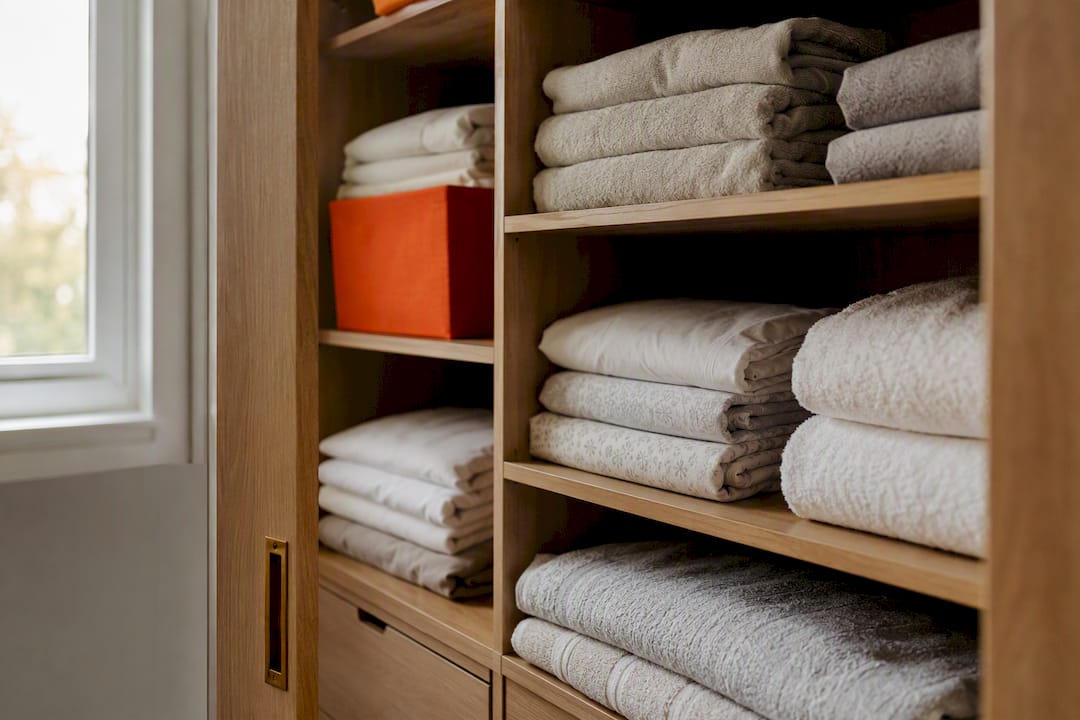
A built-in linen closet is the most space-efficient, longest-lasting way to keep sheets, towels and bulky bedding organised, and it beats freestanding units on every measure that matters over time. Before you call anyone, do three things: measure the width, depth and height of your intended spot, count what you actually own (sheet sets, towel sets, spare duvets, awkward items like heated blankets), and decide whether a hallway, bedroom wall or under-stair void suits your layout best.
- Measure width, depth and height of the available wall or void.
- List every linen category you own, including bulky or seasonal items.
- Note your preferred location and check nearby door swing or corridor width.
Shelf-depth standards (around 300 to 400 mm for towels and sheets) and zoned spacing will shape the final design, and a bespoke specialist like Finest Furniture Studio can turn those measurements into a working plan within days rather than weeks.
Key Takeaways
A built-in linen closet works best when shelf depth, zoning and material grade are decided before any joinery is cut.
| Point | Details |
|---|---|
| Measure before you design | Record width, depth and height, then list every linen item you own before choosing a footprint. |
| Keep shelves shallow | Use 300 to 400 mm shelf depth for towels and sheets so items stay visible and reachable. |
| Zone vertically | Place seasonal items on top, towels mid-level, sheets below, and hampers at the base. |
| Match material to timeline | Builder-grade lasts 6 to 10 years; bespoke hardwood can exceed 25 years for long-term homes. |
| Choose a low-risk installer | Finest Furniture Studio offers a seven-day install, a 10-year guarantee, and free old-unit disposal. |
Table of Contents
- Why choose a built-in linen closet over freestanding storage
- How do you size a linen closet correctly?
- What internal fittings actually improve daily use?
- Which door style suits your hallway?
- Material choices and what they mean for lifespan
- Is bespoke joinery worth it for a linen closet?
- What actually matters when you’re planning one
- How Finest Furniture Studio designs and fits your linen closet
- Sources
- FAQ
Why choose a built-in linen closet over freestanding storage
Freestanding units get sold as flexible, but flexibility is exactly the problem when you have an alcove, a stair void, or an awkward eave doing nothing. A built-in linen cupboard is designed once, for that exact space, and it stops working as furniture and starts working as architecture. Designers increasingly treat the linen cupboard as a household’s “backstage manager,” a fixture that removes the daily friction of hunting for a matching pillowcase or a spare towel, and that behavioural payoff is easy to underestimate until you’ve lived with proper zoned storage.
- Reclaims genuinely awkward space: under stairs, alcoves, eaves.
- Reduces musty smells and fabric creasing through proper zoning and airflow.
- Adds resale appeal, since built-in joinery reads as a permanent home feature, not furniture the seller takes with them.
Pro Tip: If you’re renting or plan to move within two years, a well-made modular system will serve you better than paying for bespoke joinery you can’t take with you.
How do you size a linen closet correctly?
Get the footprint wrong and you’ll spend years fighting either cramped shelves or wasted air. A small single-person household usually needs a footprint of roughly 900 to 1,200 mm wide; a family managing multiple bedrooms tends to need closer to 1,200 to 1,800 mm, sometimes split across two zones. A well-specified example runs around 1200 × 600 × 2400 mm, generous enough for several sets of sheets and towels when the shelving is planned rather than guessed, following a structured storage-planning approach.
- Set shelf depth first. Towels and folded sheets both sit comfortably at 300 to 400 mm; anything deeper hides items at the back and creates retrieval friction, a point confirmed by closet dimension guidance.
- Zone from top to bottom. Seasonal or rarely used items go on the top shelf, towels sit at eye level, sheets go just below, and hampers or cleaning supplies take the base.
- Vary vertical spacing by zone. Uniform 300 mm spacing throughout wastes 30 to 40% of usable vertical capacity compared with spacing tailored to what actually sits on each shelf.
- Audit before you commit. Count sheet sets, towel sets and bulky extras, then match that number against shelf capacity rather than eyeballing it.
What internal fittings actually improve daily use?
The carcass and the doors get most of the attention, but the fittings inside decide whether the closet earns its keep every morning. Adjustable shelving, pull-out baskets and door-mounted racks are the practical trio that keep linen visible instead of buried, a system worth building in from the start rather than retrofitting later.
- Specify pull-out baskets or full-extension drawers for any shelf deeper than 400 mm, since deep fixed shelves are where sheets go to disappear.
- Build in a dedicated hamper drawer at the base rather than relying on a freestanding basket that blocks the door swing.
- Fit a ventilation grille or leave gaps between baskets to stop trapped moisture turning fresh linen musty.
- Choose door-activated LED strips over battery units if the budget allows; hardwired lighting and any charging sockets are far cheaper to plan now than to retrofit once the joinery is in, a point joinery specialists consistently flag.
Pro Tip: Ask your designer to fit adjustable shelf pins rather than fixed battens. Linen needs change as children grow and bedding sizes shift, and adjustable shelving is the only future-proof option.
Which door style suits your hallway?
Door choice comes down to corridor width and budget more than taste. Hinged doors are cheapest and simplest but need clear floor space to swing. Bifold doors suit narrow hallways and give near-full access without a deep swing arc. Pocket doors disappear into the wall for a clean look but usually require structural work to build the wall cavity, so they cost more and take longer. Sliding doors work well on wide, flat walls but always leave one side of the cupboard partially covered.
- Hinged: cheapest, best where floor space isn’t tight.
- Bifold: ideal for narrow landings, gives wide access.
- Pocket: cleanest look, needs a stud wall built to house it.
- Sliding: good for wide walls, but half the interior stays covered at any time.
Material choices and what they mean for lifespan
Material choice is where most of the long-term value gets decided, and it’s the one decision worth spending time on rather than defaulting to whatever’s cheapest at quote stage. Builder-grade MDF or particleboard units cost the least upfront but typically last only 6 to 10 years before edges chip or shelves sag. Mid-tier fitted built-ins using moisture-resistant plywood and laminate finishes generally hold up for 12 to 18 years, a sensible middle ground for most homes. Bespoke joinery built from hardwood carcasses can exceed 25 years, which changes the maths considerably once you spread the cost over decades rather than comparing sticker prices, according to comparative material planning data.
- Builder-grade/modular: lowest cost, 6 to 10 years, limited reconfigurability.
- Mid-tier plywood/laminate: balanced cost and durability, 12 to 18 years.
- Bespoke hardwood: highest upfront cost, 25+ years, fully reconfigurable.
A hybrid approach, a modular carcass finished with bespoke doors, often lands in the sweet spot: Finest Furniture Studio frequently recommends this route for homeowners who want a genuinely built-in look without paying full bespoke rates on every internal component.
Is bespoke joinery worth it for a linen closet?
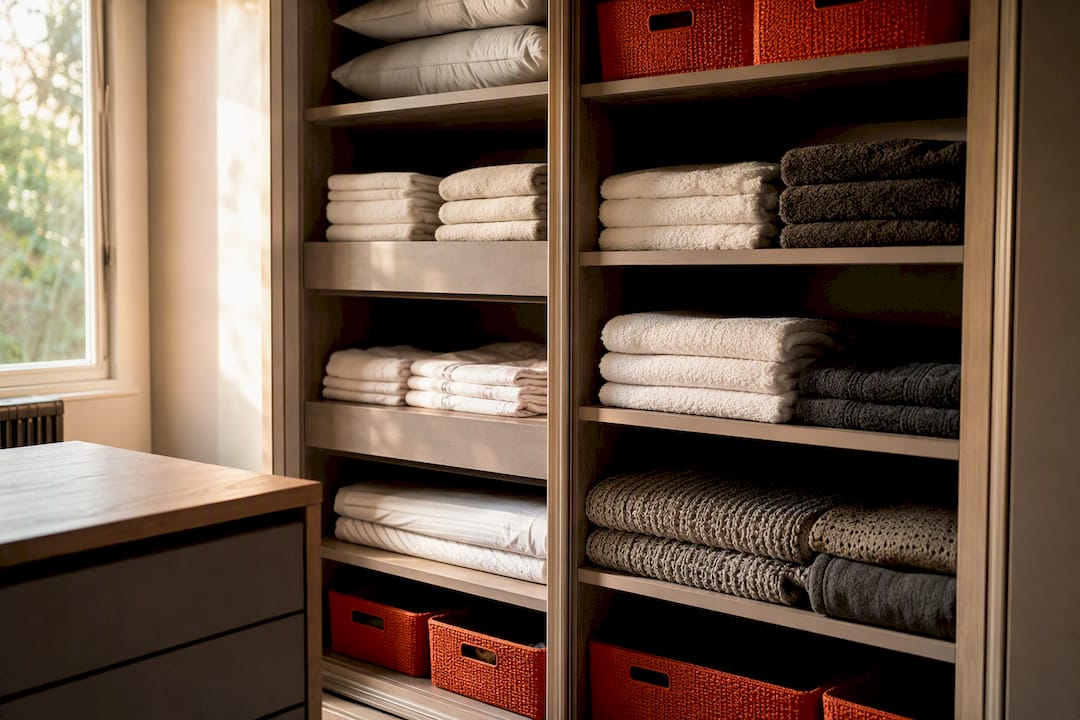
Bespoke makes sense once your space stops being a simple rectangle. Sloped ceilings, chimney breasts, stair voids and irregular alcoves all defeat flat-pack modular units, and that’s precisely where custom joinery earns its cost. If you’re planning to stay in the property for years and want a finish that matches the rest of the home rather than a visible retrofit, bespoke is the stronger long-term choice, a conclusion supported by broader analysis of fitted storage in tight London footprints.
The commissioning process itself is fairly linear:
- Survey. A designer visits, measures the space and discusses your linen inventory and preferences.
- Design. You receive a 3D visual so you can approve shelf zoning, door style and finish before anything is cut.
- Manufacture. The carcass, doors and fittings are built off site to your exact specification.
- Install. Fitters bring everything on site and complete the build.
Finest Furniture Studio typically completes the full installation within seven days of manufacture finishing, and every project carries a 10-year guarantee on quality, which is unusually long for bespoke joinery in London.
What to check before you sign off a linen closet quote
- Measure width, depth, height and note any door swing or radiator that limits the footprint.
- Photograph the space, including the ceiling line if it slopes.
- Ask about carcass material, hardware grade, ventilation strategy and how old furniture is removed.
- Treat vague warranty terms, no offer of a site visit, or unusually short lead times paired with unnamed materials as red flags.
What actually matters when you’re planning one
Most guidance on linen storage focuses on aesthetics: door finishes, handle styles, colour matching. That’s the wrong starting point. The measurements matter more than the mood board. Get shelf depth and zoning right and almost any reasonable door style will look fine; get them wrong and no amount of styling rescues a cupboard where towels won’t stack straight or sheets vanish behind deeper items.
The conventional advice to “just add more shelves” also falls short. More shelves without variable spacing simply multiplies the wasted vertical space, since a shelf sized for a spare duvet doesn’t need the same gap as one holding folded pillowcases. Homeowners who treat this as a layout exercise, not a furniture purchase, end up with cupboards that still work five years on.
If there’s one thing worth prioritising above door style, colour or hardware, it’s committing to a measured plan before contacting anyone. Know your inventory, know your zones, and treat the installer’s warranty length as a genuine signal of how confident they are in their own joinery. A rapid seven-day install backed by a decade of cover tells you far more about build quality than a glossy brochure ever will. Get those fundamentals settled first, and the rest of the decision becomes straightforward.
— Aureliu
How Finest Furniture Studio designs and fits your linen closet
Finest Furniture Studio’s advantage over generic flat-pack retailers is straightforward: you get a bespoke design visit, a working 3D plan, and an installation typically completed within seven days, all backed by a 10-year guarantee that most modular suppliers simply don’t offer.
A free design visit covers a full survey of your space, measurements, and a discussion of your linen inventory so the shelf zoning matches what you actually own, whether that’s a hallway alcove in Richmond or an under-stair void in Wimbledon. We will also take away and dispose of the old wardrobe or cupboard as standard, so there’s no separate skip hire or removal to arrange. Homeowners across Chiswick, Putney, Kingston and Central London have used this same process for fitted bedrooms, alcove wardrobes and under-stair storage, and the linen closet follows the identical route: survey, 3D design, manufacture, install.
Explore the full approach in our definitive guide to bespoke fitted furniture in West London, or contact us for a free design visit by message or call for more information on 📞07468 150807 or WhatsApp, at 124 City Road, Kemp House, London, EC1V 2NX.
Sources
- Why everyone should have a linen cupboard — House & Garden
- Storage planning as a design discipline — Studio Matrx
- Linen closet dimensions: standard sizes and custom sizing tips – D and G Flooring
- Linen closet organization: a system that actually holds | Bella Systems Custom Closets
FAQ
What size should a built-in linen closet be?
A workable footprint is roughly 900 to 1,200 mm wide for a single household or 1,200 to 1,800 mm for a family, with a common specification of 1200 × 600 × 2400 mm as a design baseline.
How deep should linen closet shelves be?
Shelf depth of 300 to 400 mm keeps towels and folded sheets visible and easy to reach, rather than the deeper shelves that hide items at the back.
Is a built-in linen closet worth the cost compared with freestanding units?
For homeowners staying put for several years, yes: built-in joinery lasts longer, uses awkward space better, and adds more resale appeal than modular furniture that leaves with the seller.
How long does it take to install a bespoke linen closet?
With Finest Furniture Studio, installation typically completes within seven days of manufacture, following an initial survey and 3D design approval.
Should I choose bespoke or modular for a linen cupboard?
Choose bespoke when the space has awkward geometry, such as a sloped ceiling or stair void; modular suits simple rectangular spaces or shorter-term living arrangements.