
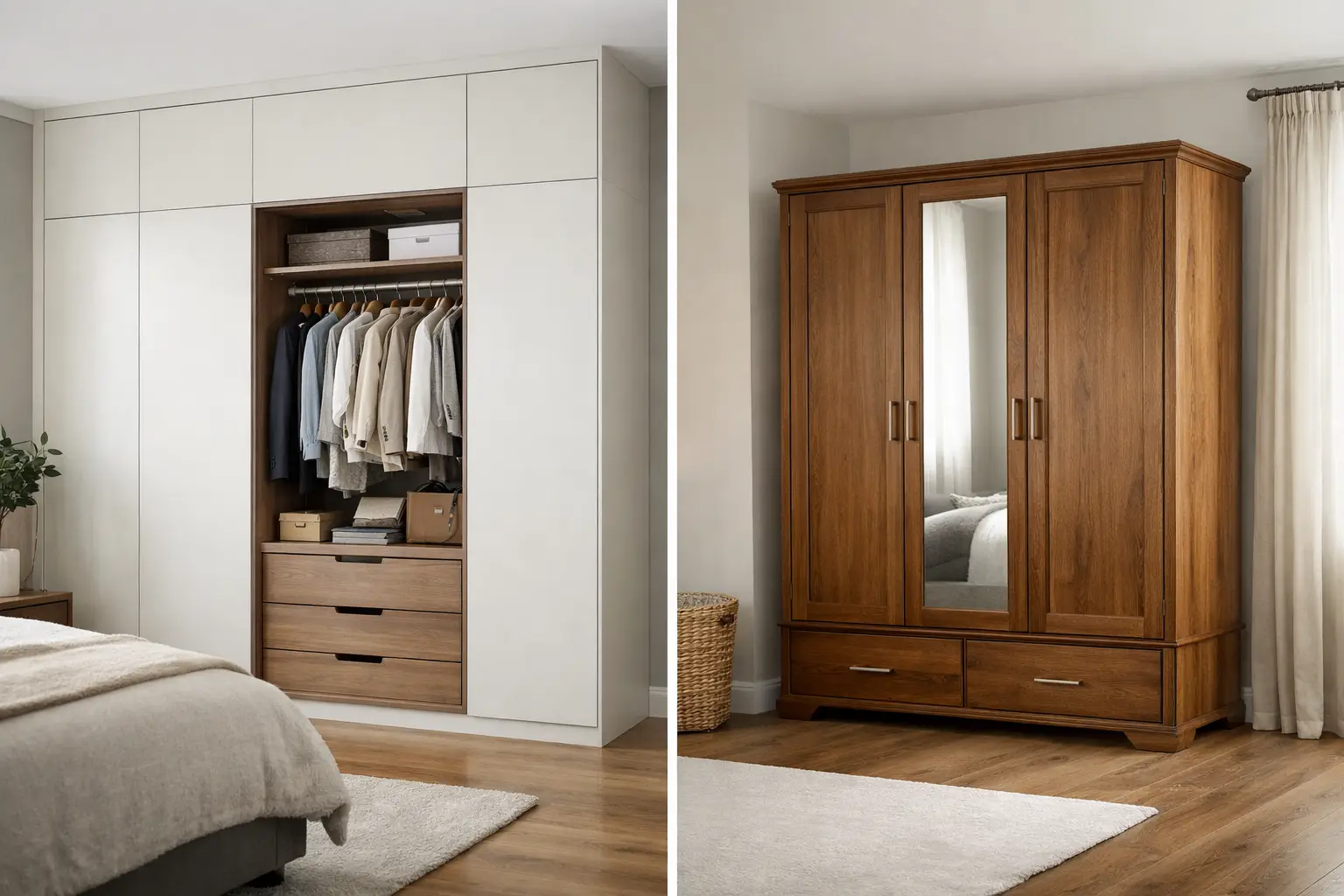
If you are planning a bedroom redesign, the fitted wardrobes vs freestanding wardrobes question usually comes up earlier than expected. It often starts with a simple thought – do you want a wardrobe that works around the room, or one that asks the room to work around it? That difference shapes not only how your bedroom looks, but how well it functions every day.
For some homes, a freestanding wardrobe is perfectly sensible. For others, especially where alcoves, chimney breasts, sloping ceilings or awkward corners are involved, fitted storage makes far better use of the space. The best choice depends on your layout, your priorities and how long you expect to stay in the property.
Fitted wardrobes vs freestanding wardrobes: the real difference
At first glance, the comparison seems simple. Freestanding wardrobes are movable pieces of furniture that arrive ready-made or partly assembled. Fitted wardrobes are built into the room and made to measure.
In practice, the gap is wider than that. Freestanding wardrobes give you a fixed amount of storage in a fixed shape. Fitted wardrobes are designed around the architecture of the room and around the way you live. That means the decision is not just about furniture style. It is about whether you want flexibility of movement or precision of fit.
A well-made freestanding wardrobe can look attractive and suit a range of interiors. It can also be bought quickly, which appeals if you need an immediate solution. But it will nearly always leave dead space above, beside or behind it, and in a London home where every centimetre matters, that can feel like an expensive compromise.
When freestanding wardrobes make sense
Freestanding wardrobes are often the right option for renters, first-time buyers or anyone who expects to move soon. If portability matters, fitted furniture will not suit in the same way. You can take a freestanding piece with you, reposition it, sell it or replace it without altering the room.
They also work well in larger bedrooms where space efficiency is less of a concern. If the room is generous and the storage demand is modest, a carefully chosen wardrobe may be all you need. In a guest bedroom, for example, built-in storage can sometimes be more than the space requires.
Budget can be another reason. At the entry level, freestanding wardrobes usually cost less upfront than bespoke fitted wardrobes. Flat-pack and high street options offer a lower starting point, although the quality, finish and longevity can vary considerably.
There is a trade-off, though. Lower purchase price does not always mean better value over time. If you need extra chests, rails, boxes or additional furniture to compensate for wasted space, the savings can narrow rather quickly.
Why fitted wardrobes are often the better long-term choice
Fitted wardrobes tend to come into their own when the room has awkward proportions or when a cleaner, more tailored finish matters. They use the full height and width of the available wall, which means no wasted gaps gathering dust and no visual clutter from furniture that feels slightly too small, too deep or too tall for the room.
This is especially valuable in Victorian and Edwardian homes, loft conversions and modern extensions, where layouts rarely behave in a standard way. Alcoves, uneven walls and sloping ceilings are difficult for freestanding furniture to handle gracefully. Bespoke fitted wardrobes can turn those awkward areas into useful storage instead of leaving them underused.
There is also the aesthetic advantage. Because fitted wardrobes are designed as part of the room, they tend to look calmer and more architectural. Doors can align neatly, finishes can complement the rest of the interior, and the overall effect is more intentional. In a principal bedroom, that often makes a significant difference.
Storage capacity: not all wardrobes hold the same amount
One of the biggest surprises for homeowners is how much more a fitted wardrobe can hold compared with a freestanding one of a similar visual footprint. That is because fitted designs use the full envelope of the space, including height that would otherwise be wasted.
A freestanding wardrobe may stop 20 to 40 centimetres below the ceiling. It may also sit a little forward from the wall to allow for skirting boards. Those details sound minor, but together they reduce usable capacity.
Fitted wardrobes allow every internal section to be planned properly. Long hanging, double hanging, shelving, drawers, shoe storage and overhead compartments can be arranged around your clothing and routine, rather than forcing your belongings to adapt to a generic interior. If you own more tailoring, dresses, handbags or seasonal items than average, that level of planning is genuinely useful.
Style and finish in modern bedrooms
Freestanding wardrobes come in many styles, from traditional painted pieces to minimalist contemporary designs. If you enjoy mixing furniture or changing your interiors regularly, that variety can be appealing.
Fitted wardrobes, however, offer more control. You can choose door styles, colours, internal layouts, handles and finishes that suit the architecture of your room rather than trying to match a ready-made product to it. In design-led homes, this tends to feel more refined.
That does not mean fitted always has to look formal or expensive. A simple shaker design in a soft neutral can look just as relaxed as a freestanding piece, while using the room far better. Equally, a sleek sliding wardrobe can suit a more contemporary scheme where space around the bed is tight.
Cost: the honest view
Cost is where the fitted wardrobes vs freestanding wardrobes debate becomes more nuanced. If you compare the cheapest freestanding wardrobe with a bespoke fitted installation, freestanding will almost always win on upfront spend. But that is not a like-for-like comparison.
A better question is this: what are you paying for? With fitted wardrobes, you are paying for made-to-measure design, better space usage, integrated aesthetics, tailored internals, manufacturing and professional installation. With freestanding wardrobes, you are paying for a movable piece of furniture produced to standard dimensions.
For homeowners investing in a long-term bedroom scheme, fitted storage often justifies its cost because it solves several problems at once. It stores more, looks better integrated and reduces the need for extra furniture. In smaller London bedrooms, that can transform how spacious the room feels.
If your timescale is short or your plans are temporary, freestanding still has a place. The right choice depends less on the headline price and more on whether the solution matches the life of the room.
Installation, disruption and practicality
Freestanding wardrobes are quicker to buy, although not always quicker to live with. Delivery delays, self-assembly and awkward manoeuvring upstairs can all be part of the process. And once the wardrobe is in place, you still have to accept whatever compromises come with it.
Fitted wardrobes involve a design and installation process, so they require more planning. The benefit is that the result is tailored from the outset. A professional team can measure precisely, work around details such as sockets and coving, and install the wardrobe in a way that feels built for the room rather than squeezed into it.
For busy households, that planning stage is often worth it. A good process should feel organised and reassuring, not drawn out. At Finest Furniture Studio, for example, many projects are fitted within 7 to 10 days once ready for installation, which gives homeowners the benefit of bespoke design without an unnecessarily long wait.
Which option adds more value to your home?
Fitted wardrobes are not estate-agent magic, but they do tend to strengthen the impression of quality in a home. Buyers notice storage, especially in bedrooms where square footage is under pressure. Well-designed built-in wardrobes can make a room feel more complete and easier to imagine living in.
Freestanding wardrobes do not add value in the same way because they are considered furniture rather than part of the property. A beautiful piece can still enhance the room visually, but it will not usually carry the same sense of permanence or finish.
This matters most in homes where buyers expect thoughtful interiors – period houses, renovated family homes and high-spec flats, for example. In those settings, bespoke storage often supports the overall standard of the property.
How to decide between fitted and freestanding
The simplest way to choose is to look at the room honestly. If the bedroom is square, spacious and temporary in purpose, freestanding may be entirely sufficient. If the room is awkward, compact or part of a larger renovation, fitted wardrobes are usually the smarter investment.
It also helps to think beyond the wardrobe itself. Do you want the room to feel calm and uncluttered? Do you need to maximise every inch? Are you furnishing a forever home, or solving a short-term storage issue? The more the bedroom needs to work hard, the more fitted furniture tends to earn its place.
There is no single winner in the fitted wardrobes vs freestanding wardrobes debate because the right answer depends on context. But where design, storage efficiency and long-term value matter, fitted wardrobes usually offer more than a place to hang clothes. They help the whole room work better.
The best wardrobe is not the one that looks good in a showroom. It is the one that suits your home so well that, after a week of using it, you wonder how you managed without it.