
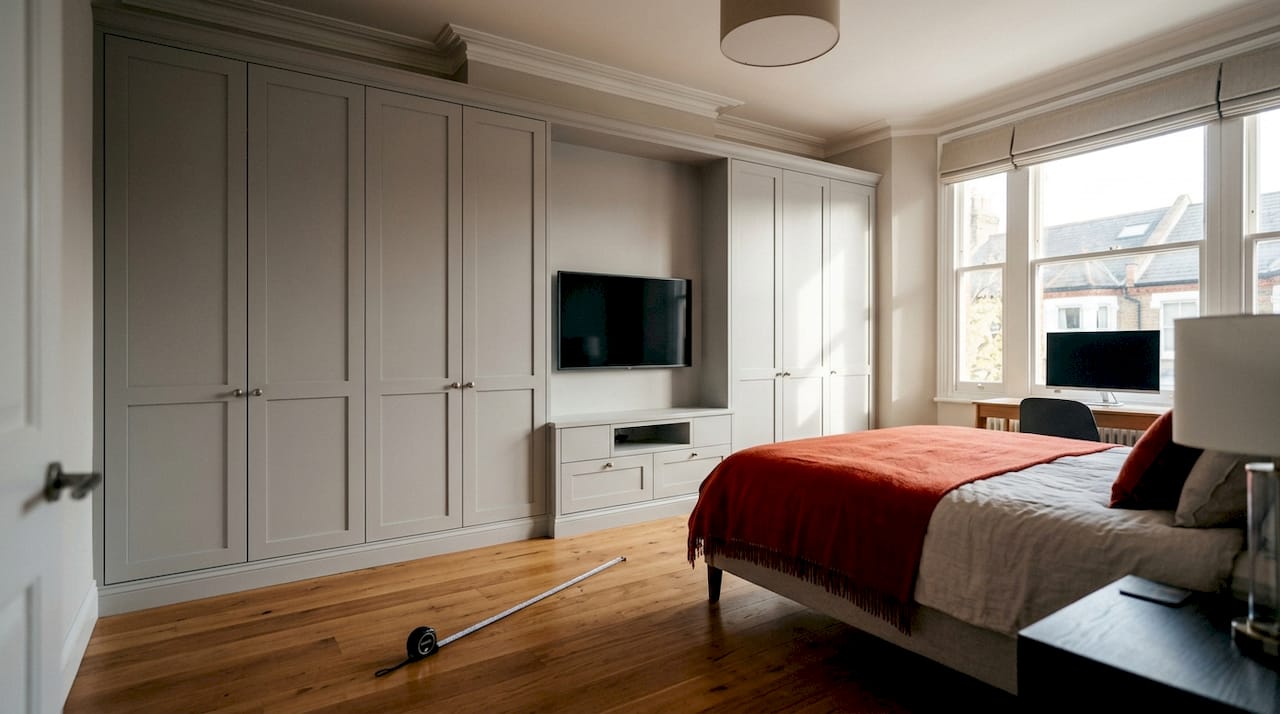
Bespoke furniture is defined as a piece designed and built specifically for your home, your dimensions, and your daily life. Ready-made furniture is manufactured to standard sizes for an average room that rarely matches yours. The question of why bespoke over ready-made comes down to three things: fit, quality, and longevity. Finest Furniture Studio works with homeowners across London, from Richmond to Chelsea and Wimbledon to Putney, and the same pattern appears every time. Rooms with awkward alcoves, sloping ceilings, or tight loft conversions simply cannot be served by catalogue furniture. Bespoke joinery treats your space as an architectural problem worth solving properly.
Why bespoke over ready-made starts with spatial intelligence
The most compelling argument for custom furniture is not aesthetics. It is geometry. Studio Bisson defines bespoke as an architectural response to space constraints, not a luxury add-on. That distinction matters enormously for London homeowners dealing with Victorian terraces, Edwardian alcoves, and loft conversions in Twickenham or Barnes.
Ready-made furniture is built around a fictional average room. Standard wardrobe units come in fixed widths of 50cm, 75cm, or 100cm. Your alcove is 87cm wide. The gap that remains is not a minor inconvenience. It collects dust, wastes usable storage, and makes the room feel unfinished. Bespoke joinery fills that space completely, wall to wall and floor to ceiling, with no filler panels or awkward voids.
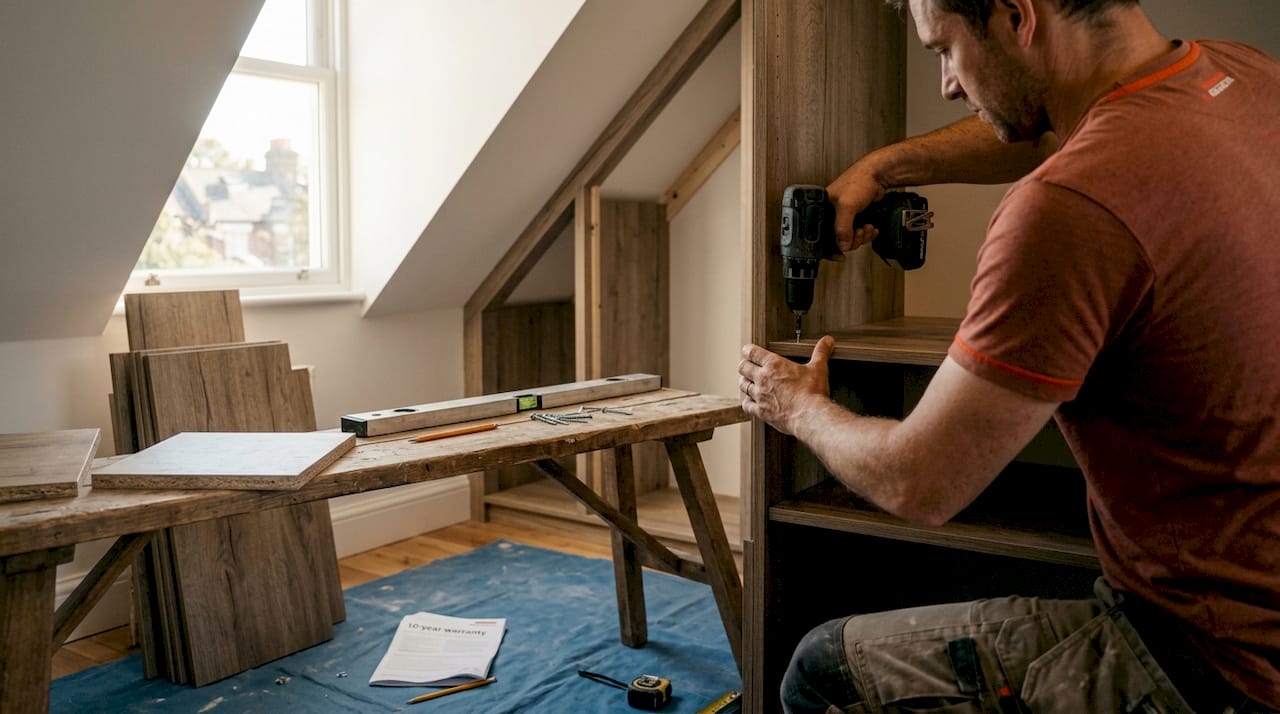
Period properties present the sharpest challenge. Rooms in Kensington, Fulham, and Chiswick often feature chimney breast projections, angled walls, and ceilings that drop at one end. Fitted furniture for period properties requires a maker who measures the actual room, not a catalogue. Bespoke design turns those constraints into features. A sloping ceiling becomes a fitted wardrobe that follows the roofline precisely. An awkward corner becomes a walk-in dressing area.
The same principle applies to loft conversions across Ealing, Hammersmith, and Kingston. Sloped ceiling wardrobes built to the exact pitch of the roof recover storage space that would otherwise be completely lost. Ready-made units cannot do this. They stand upright against a wall that is not upright, leaving triangular dead zones at the top.
Key spatial advantages of bespoke furniture:
- Full-height coverage from floor to ceiling, eliminating dust-collecting gaps above units
- Exact-width fitting to alcoves, chimney breasts, and recesses without filler panels
- Roofline-following profiles for loft conversions and sloped ceilings
- Under-stair integration for storage in spaces ready-made units cannot reach
- Architectural continuity with cornicing, skirting boards, and period features
Pro Tip: Measure your room at three heights: floor level, mid-height, and ceiling level. Older London homes frequently have walls that are not parallel, and a bespoke maker will account for every millimetre.
How do materials and craftsmanship differ in bespoke furniture?
Material quality is the structural argument for custom furniture, and it is decisive. Oraanj Interiors highlight that bespoke joinery uses solid timber frames and superior carcass materials, while standard fitted furniture typically relies on MDF or particleboard. That difference determines how long your furniture lasts and how it performs under daily use.
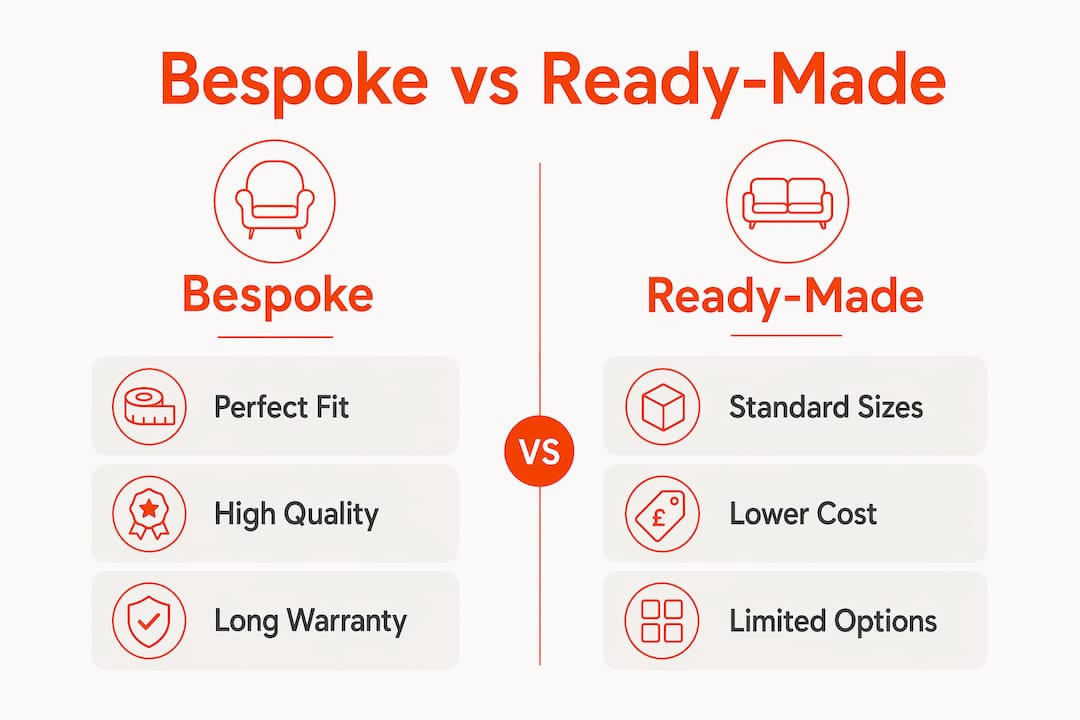
Particleboard is an engineered wood product made from compressed wood chips and resin. It is inexpensive, consistent, and widely used in ready-made furniture. It is also susceptible to moisture, heavy loads, and repeated fixing. Wardrobe rails loaded with winter coats, drawer runners used daily for years, and hinges screwed into particleboard edges all degrade faster than the equivalent in solid timber or high-grade plywood. Quality materials in bespoke joinery lead to better ageing and durability over time, far exceeding most ready-made alternatives.
Joinery craftsmanship compounds the material advantage. Bespoke makers use techniques including mortise-and-tenon joints, dovetail drawer construction, and full-extension soft-close runners on hardwood-lined drawers. These are not decorative choices. They are structural decisions that affect how the piece performs after five, ten, or twenty years of use. Ready-made furniture is assembled with cam locks and dowels, which are adequate for light use but not for a primary bedroom wardrobe in a family home in Wimbledon or Putney.
| Feature | Bespoke joinery | Standard ready-made |
|---|---|---|
| Frame material | Solid timber or high-grade plywood | MDF or particleboard |
| Drawer construction | Dovetail or box joint, soft-close | Cam-lock assembly, basic runners |
| Finish options | Full specification: colour, grain, hardware | Catalogue selection only |
| Structural lifespan | 15–25 years with normal use | 5–10 years before degradation |
| Moisture resistance | Higher, especially with solid timber | Lower, particleboard swells with damp |
| Repair and modification | Joinable, repairable, adaptable | Difficult to repair; usually replaced |
Pro Tip: Ask your maker what carcass material they use. High-grade birch-faced plywood is a strong indicator of quality. Avoid any maker who cannot specify the board grade.
Finish control is another material advantage that ready-made furniture cannot match. Owners can specify every detail of a bespoke piece, from the exact paint colour to the internal fittings tailored to specific possessions. That means your wardrobe interior can be configured around your actual wardrobe: long-hang sections for dresses, short-hang for jackets, pull-out shoe racks at the base, and velvet-lined jewellery drawers. A catalogue unit offers a fixed interior that you adapt your possessions to fit. Bespoke reverses that relationship entirely. You can explore the role of materials in bespoke furniture in more detail to understand how timber species and board grades affect the finished result.
Does bespoke furniture add value to your home?
Bespoke joinery adds measurable value in prime London postcodes. Estate agents recognise bespoke craftsmanship as positively influencing buyer perceptions and offers. That is not a vague claim about “kerb appeal.” It reflects a specific buyer behaviour: purchasers in competitive markets like Richmond, Chelsea, and Wimbledon treat fitted joinery as a quality signal for the entire property.
Fitted wardrobes can add value to property by making rooms feel larger, more organised, and better maintained. Buyers interpret built-in storage as evidence of a well-considered home. A bedroom with a floor-to-ceiling fitted wardrobe reads as a principal bedroom. The same room with a freestanding flat-pack unit reads as a spare room. That perception gap affects offers.
The long-term financial case for bespoke rests on replacement cycles. Bespoke furniture represents a long-term investment in quality of life and home character. A well-made bespoke wardrobe built in 2026 will still be structurally sound in 2046. A ready-made equivalent will likely need replacing within a decade. The upfront cost difference narrows considerably when you account for two or three replacement cycles of cheaper furniture.
The strongest return on investment comes from specific rooms and scenarios:
- Principal bedrooms in family homes, where storage quality directly affects daily life and buyer perception
- Open-plan living areas in flats across Fulham and Hammersmith, where a bespoke media wall or shelving unit defines the entire room
- Loft conversions in Ealing and Twickenham, where bespoke storage recovers otherwise unusable space
- Period properties in Kensington and Barnes, where bespoke joinery matches the architectural quality of the building
- Homes being prepared for sale, where fitted storage signals quality to buyers in competitive markets
Smithers of Stamford states that bespoke is best suited to irregular spaces, long-term owners, and homeowners with clear design intent. That framing is useful. If you plan to stay in your home for five or more years, the investment calculus shifts firmly in favour of bespoke.
What are the practical trade-offs of choosing bespoke?
Bespoke furniture demands more planning than ready-made. Bespoke requires a longer lead time, often several weeks or months from design sign-off to installation. That timeline is not a flaw. It reflects the design consultation, material sourcing, and workshop production that produce a piece built specifically for your home. Ready-made furniture ships from a warehouse. Bespoke furniture is made for you.
The practical steps for a successful bespoke project follow a clear sequence:
- Book a design consultation. A maker visits your home, measures every dimension, and photographs the space. This is where spatial constraints are identified and solutions proposed.
- Agree the specification. Confirm materials, finishes, internal fittings, and hardware. Every decision made here is reflected in the final piece.
- Review and approve drawings. Technical drawings show exactly how the piece will look and fit. Approve these before production begins.
- Allow for production time. Workshop production typically takes several weeks. Plan around this if you have a moving date or renovation schedule.
- Prepare the room. Painting, flooring, and electrical work should be complete before installation begins. Bespoke furniture is fitted to a finished room, not the other way around.
- Installation and snagging. A professional installer fits the piece and addresses any minor adjustments on the day.
Cost is the most common concern, and it deserves a direct answer. Bespoke furniture costs more than ready-made at the point of purchase. The gap varies by specification, but it is real. The question is not whether bespoke costs more. The question is whether the additional cost is justified by the space, the use, and the timeline.
Over-specifying bespoke furniture in low-priority rooms reduces return on investment. A bespoke wardrobe in a principal bedroom in Richmond is a sound investment. A bespoke unit in a rarely used guest room in a rental property is harder to justify. Prioritise bespoke for spaces that affect your daily life and your home’s market appeal. Use fitted or ready-made solutions where the impact is lower.
The modular middle ground is worth understanding. Modular fitted furniture sits between fully bespoke and ready-made. It uses standard-sized carcasses that are combined and finished to look built-in. It costs less than fully bespoke and fits better than ready-made. For straightforward rectangular rooms without architectural complications, modular fitted furniture is a practical choice. For rooms with the spatial complexity common in London homes, fully bespoke remains the right answer.
Pro Tip: If your budget is limited, prioritise bespoke for the internal fittings and use a high-quality modular carcass. The interior configuration affects daily use more than the carcass material in most bedrooms.
Key takeaways
Bespoke furniture outperforms ready-made in fit, material quality, and long-term value, making it the right choice for London homes with complex spaces or high design standards.
| Point | Details |
|---|---|
| Spatial fit is decisive | Bespoke fills awkward alcoves, sloped ceilings, and loft spaces that ready-made units cannot reach. |
| Material quality lasts longer | Solid timber frames and dovetail joinery outlast particleboard and cam-lock assembly by a decade or more. |
| Property value increases | Estate agents confirm bespoke joinery improves buyer perception and supports stronger offers in prime postcodes. |
| Plan for longer lead times | Bespoke production takes weeks or months; align your project timeline with renovation or moving schedules. |
| Prioritise high-impact rooms | Reserve bespoke investment for principal bedrooms, living areas, and spaces that affect daily life and market value. |
Bespoke furniture in London: what I have actually seen
Working with homeowners across Wimbledon, Putney, and Richmond over many years, I have noticed a consistent pattern. The homeowners who hesitate over bespoke costs are often the same ones who have already replaced two or three flat-pack wardrobes in the same room. The maths rarely favours the cheaper option when you account for the full replacement cycle.
The misconception I encounter most often is that bespoke is a vanity choice. It is not. Bespoke furniture should be seen as an architectural component, not a luxury. When a Victorian terrace in Barnes has a chimney breast that projects 30cm into the bedroom, a ready-made wardrobe either blocks it awkwardly or leaves a gap beside it. A bespoke piece wraps around it. That is not indulgence. That is good design solving a real problem.
The emotional impact is also underestimated. Homeowners consistently report that a well-fitted wardrobe or media wall changes how they feel about the entire room. A bedroom with a floor-to-ceiling fitted wardrobe feels considered and calm. The same room with mismatched freestanding units feels provisional. That feeling affects how you live in your home every day, not just when you are selling it.
My honest view is that the bespoke versus ready-made debate is often framed around the wrong question. Homeowners ask “can I afford bespoke?” when the more useful question is “what will this room cost me if I get it wrong twice?” For high-use, high-visibility spaces in London homes, bespoke is not the expensive option. It is the efficient one.
— Aureliu
Finest Furniture Studio: bespoke wardrobes built for your home
Finest Furniture Studio designs and installs bespoke wardrobes, fitted wardrobes, TV media walls, and loft storage solutions across London, including Richmond, Wimbledon, Putney, Chelsea, Fulham, Chiswick, Kingston, Ealing, Twickenham, and Barnes.
Every project begins with a free design visit to your home. We measure every dimension, photograph the space, and propose a solution built around your specific layout. Our bespoke wardrobes in West London are fitted within 7–12 days and backed by a 10-year quality guarantee. We also remove and dispose of your old wardrobe at no extra charge. For a free design consultation, call or WhatsApp us on 07468 150807, or visit us at 124 City Road, Kemp House, London, EC1V 2NX. You can also explore our fitted wardrobes in Richmond to see completed projects near you.
FAQ
What is the main reason to choose bespoke over ready-made furniture?
Bespoke furniture is designed to fit your exact space, including awkward alcoves, sloped ceilings, and irregular walls that standard units cannot accommodate. It also uses higher-grade materials and joinery techniques that significantly extend its lifespan.
Does bespoke furniture add value to a property?
Estate agents confirm that bespoke joinery improves buyer perceptions and supports stronger offers, particularly in prime London postcodes such as Richmond, Wimbledon, and Chelsea. Fitted wardrobes make rooms feel larger and better maintained, which directly influences buyer decisions.
How long does bespoke furniture take to produce and install?
Bespoke furniture typically requires several weeks from design approval to installation, depending on specification and workshop capacity. Finest Furniture Studio completes installation within 7–12 days once production is finished.
Is bespoke furniture worth the extra cost?
For principal bedrooms, loft conversions, and high-visibility living spaces, bespoke furniture delivers better long-term value than ready-made alternatives when you account for durability and replacement cycles. Over-specifying in low-priority rooms, such as rarely used guest rooms, reduces the return on investment.
What is the difference between bespoke and modular fitted furniture?
Bespoke furniture is designed and built from scratch to your exact dimensions and specification. Modular fitted furniture uses standard-sized carcasses combined and finished to appear built-in, which costs less but cannot address complex spatial constraints in the way fully bespoke joinery can.