


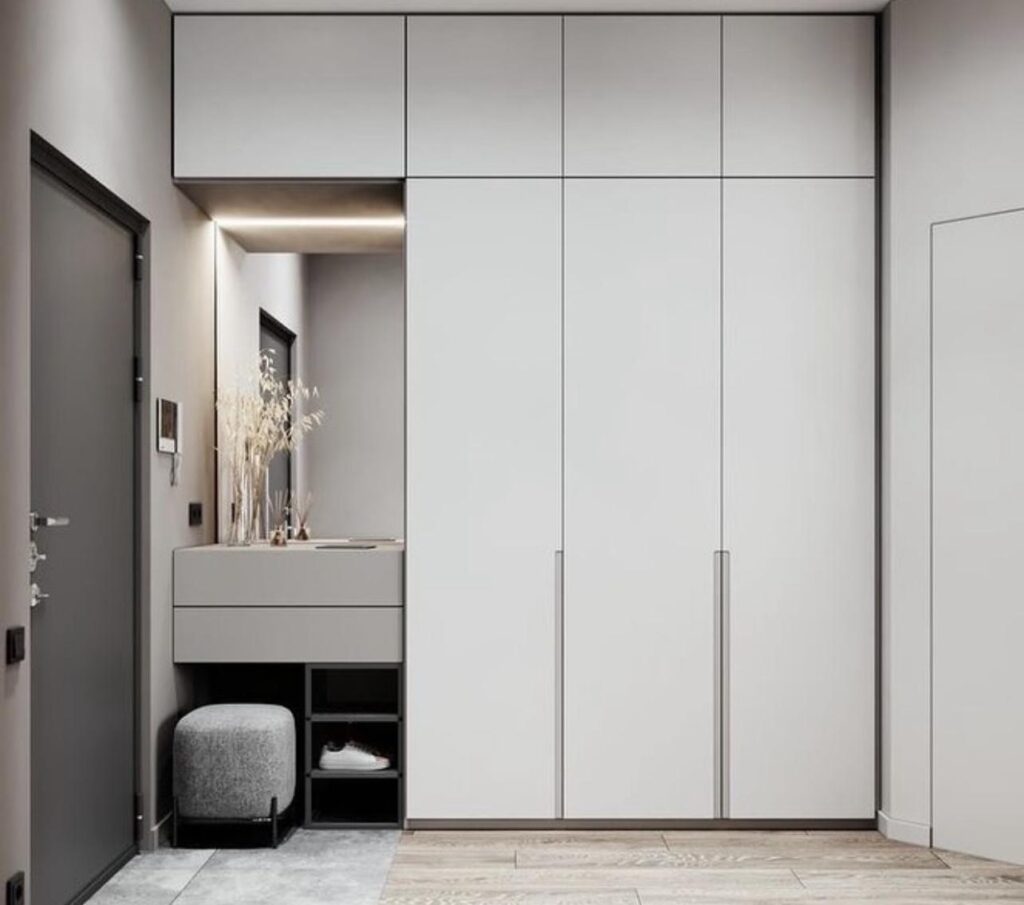
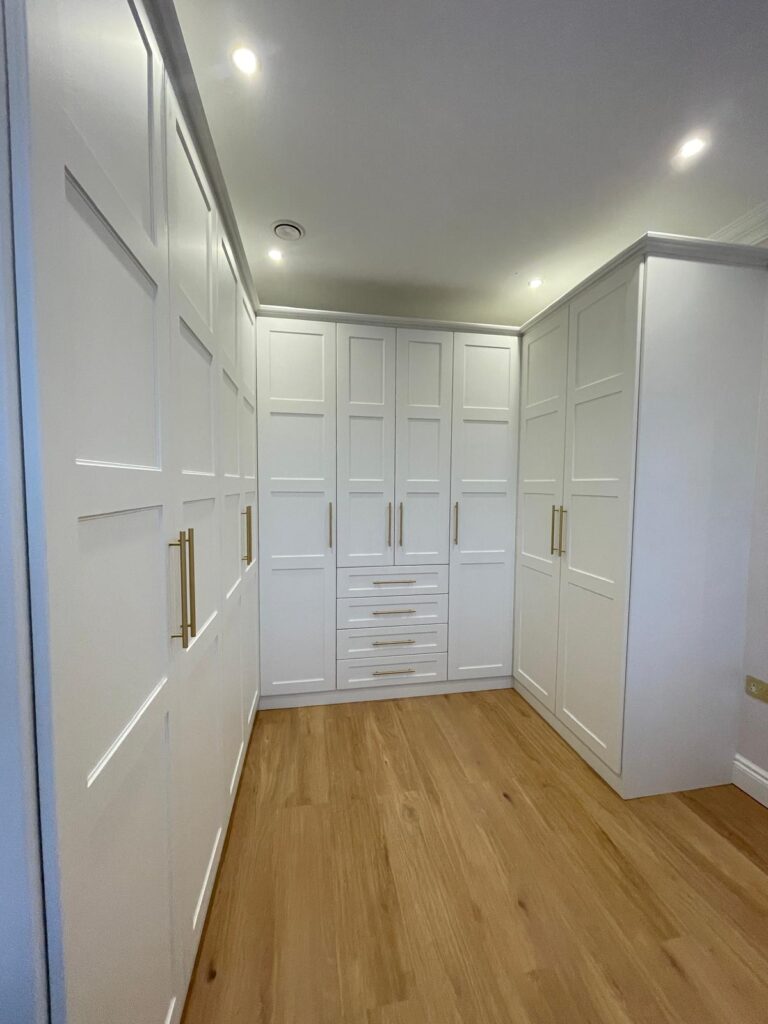
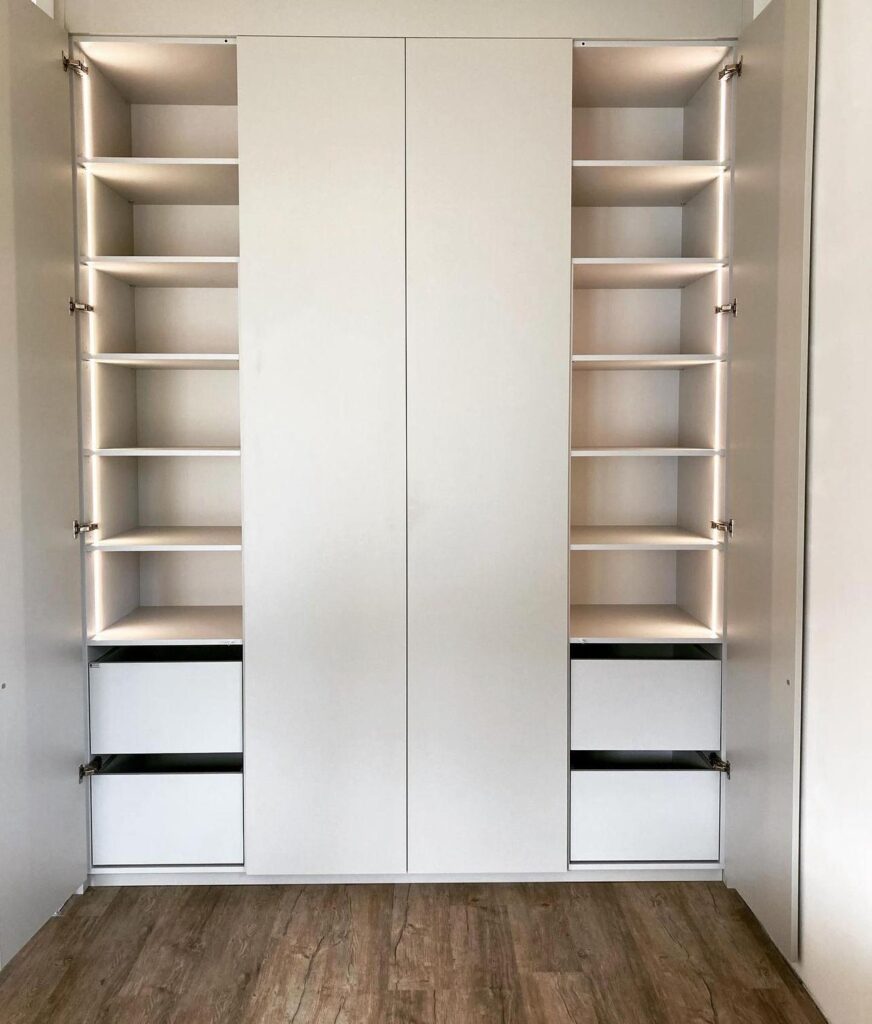

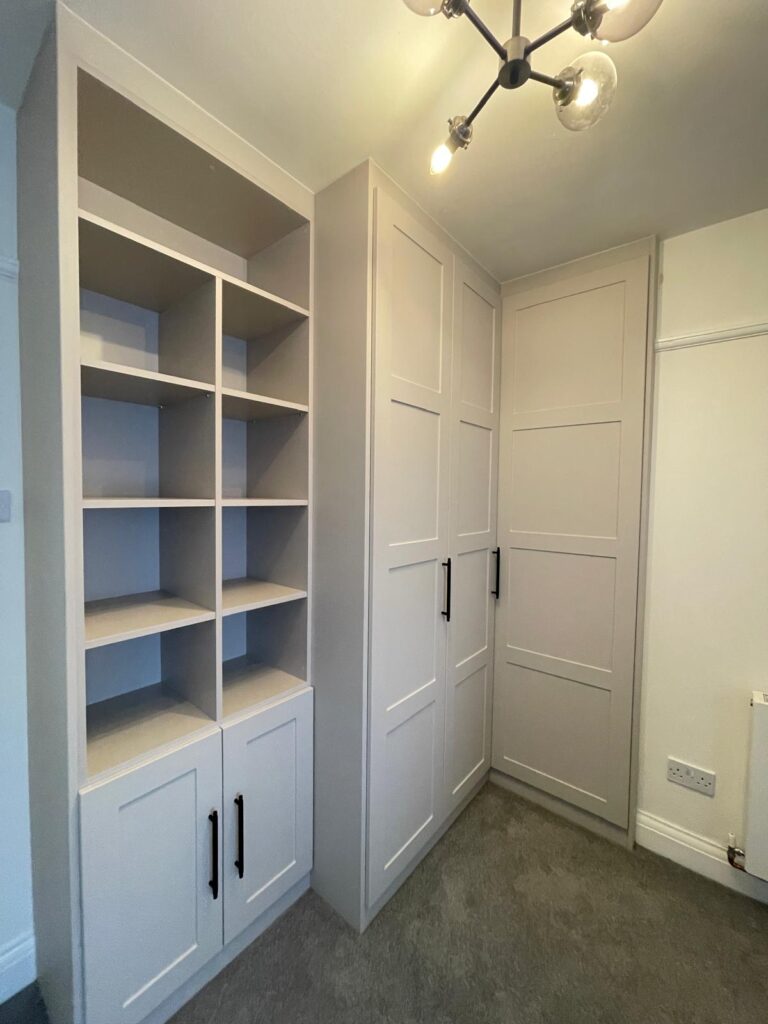
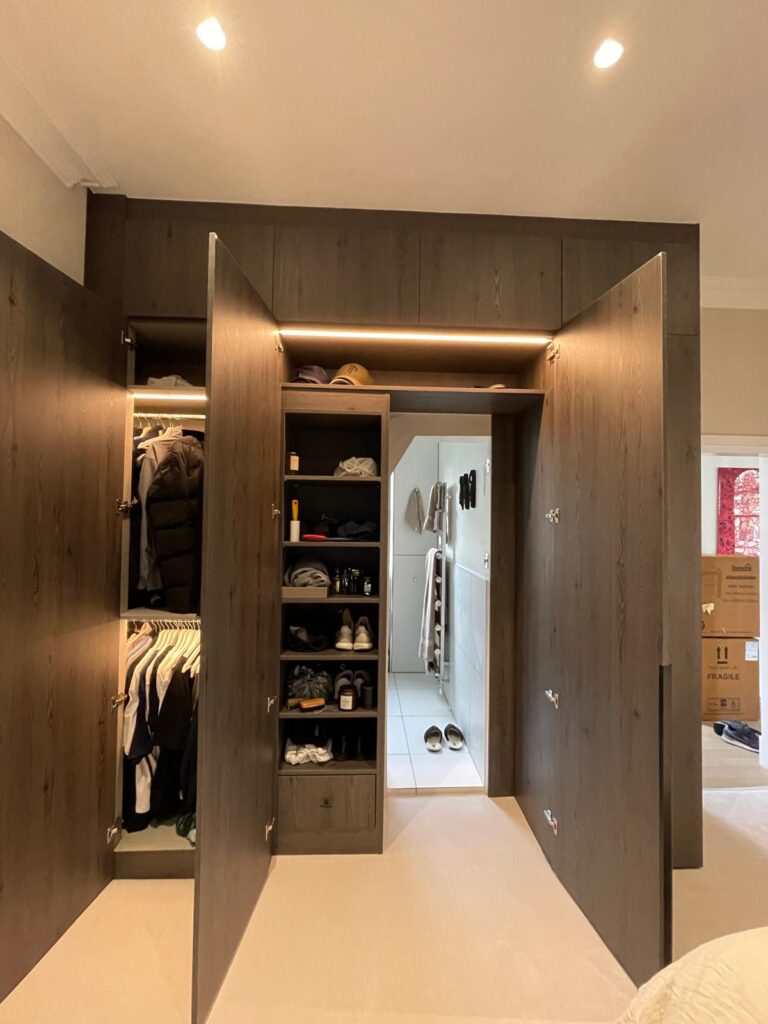

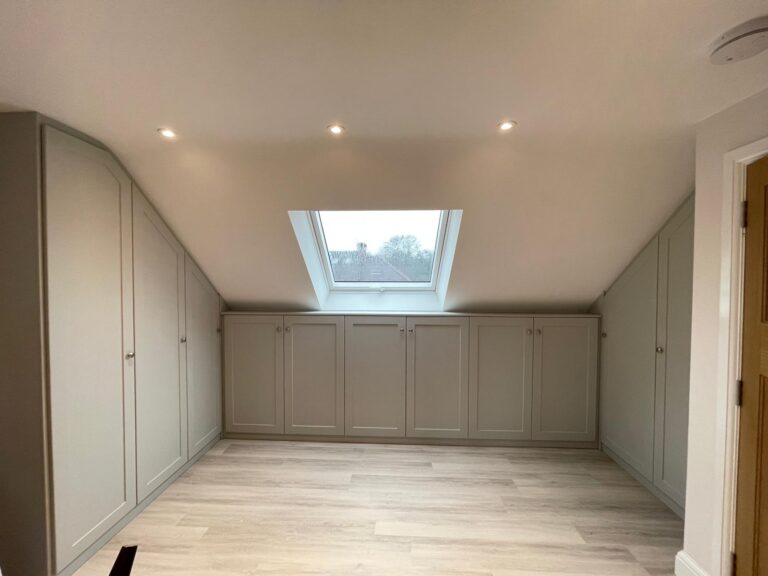

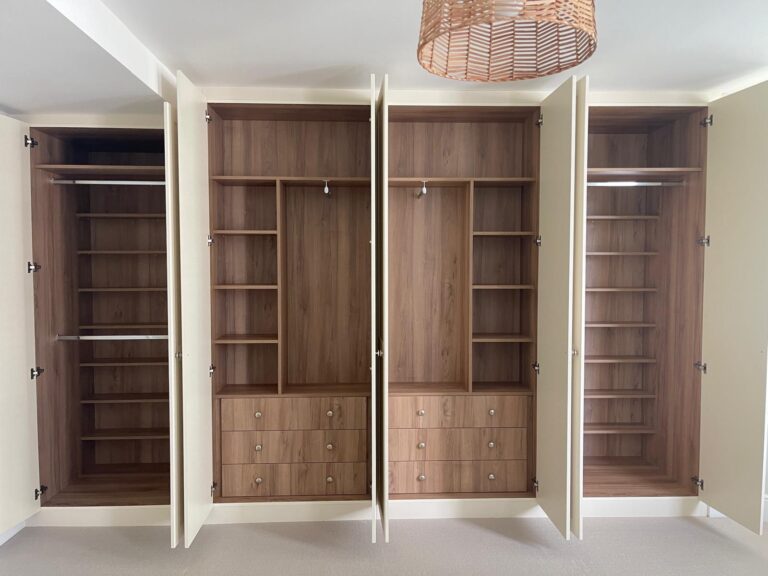
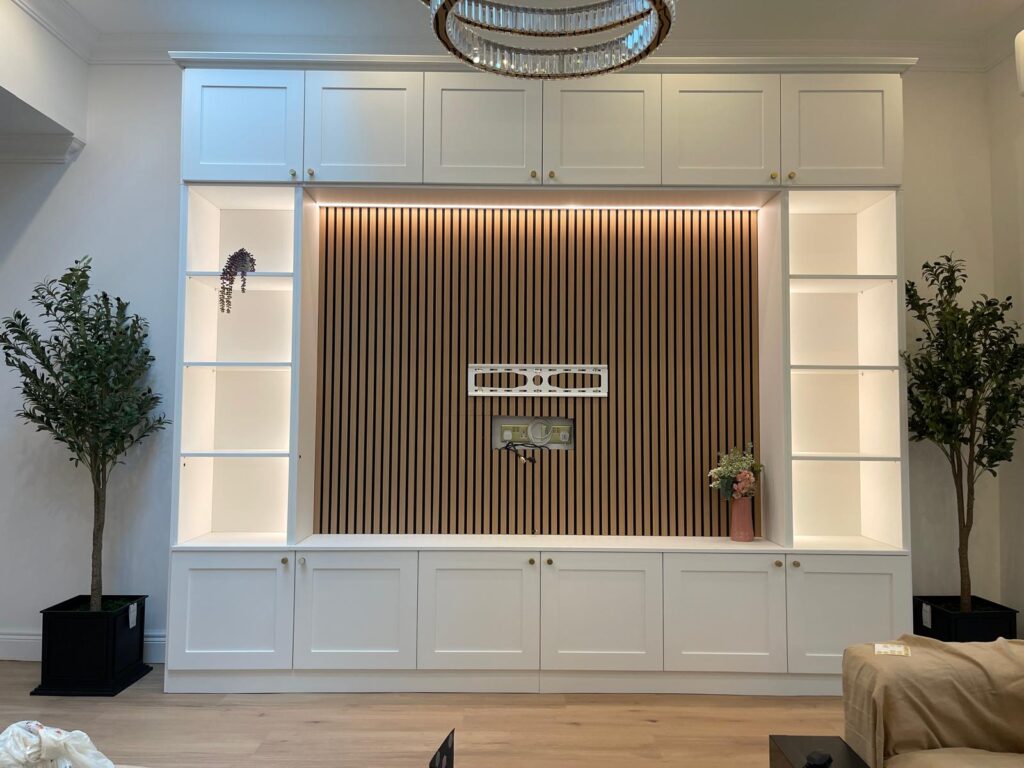



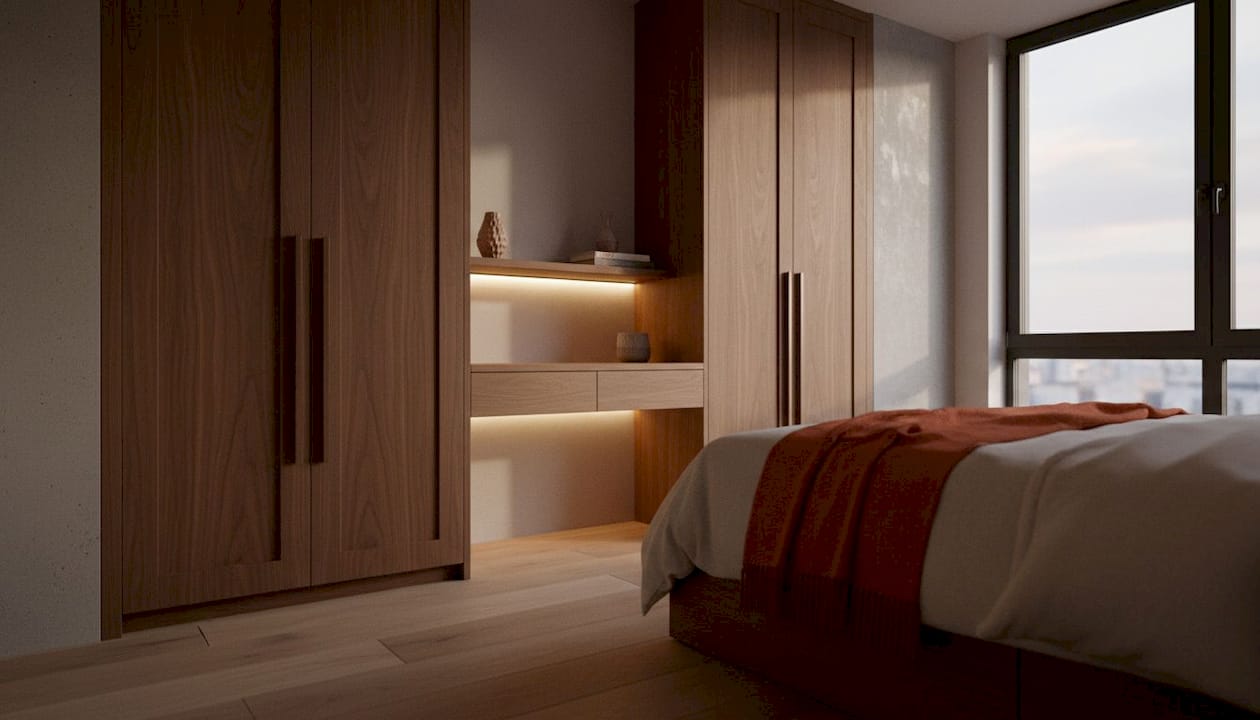
The dominant fitted furniture styles shaping London homes in 2026 combine Organic Modern warmth with Edwardian elegance, built around bespoke craftsmanship, natural materials, and integrated lighting. Homeowners across Richmond, Wimbledon, Chelsea, and Chiswick are moving decisively away from generic modular storage toward pieces that feel permanent, tactile, and architecturally considered. The shift is not just aesthetic. It reflects a deeper change in how Londoners think about their homes: less “more storage,” more “sort this room out properly, once.”
The key themes defining fitted furniture in 2026 are:
- Materials: Oak, walnut, and ash replacing painted MDF as primary choices
- Colour palette: Latte beige, mushroom grey, olive green, and deep navy
- Texture: Fluted timber panels, reeded glass, and fabric-wrapped drawer fronts
- Lighting: Hard-wired LED strips designed in from the start, not added as an afterthought
- Sustainability: Responsibly sourced timbers and low-VOC finishes
- Integration: Furniture built to the room’s exact geometry, not configured from standard modules
Table of Contents
- What interior design trends are shaping London fitted furniture in 2026?
- How does fitted furniture work with London’s architecture and awkward spaces?
- What makes bespoke fitted furniture genuinely different in 2026?
- How Finest Furniture Studio approaches bespoke fitted furniture for London homes
- What personalisation options do London homeowners choose in 2026?
- Which fitted furniture styles suit different London property types?
- How does London’s heritage influence fitted furniture design in 2026?
- Finest Furniture Studio: bespoke fitted furniture for west London homes
- Key takeaways
- FAQ
What interior design trends are shaping London fitted furniture in 2026?
The Quiet Luxury aesthetic is the clearest force in London interiors this year. It favours tactile matte finishes, natural timber grains, and earth-toned palettes that feel grounded rather than showy. Latte beige, oatmeal taupe, and mushroom grey are the colours appearing most consistently across fitted wardrobes and media walls in west London homes.
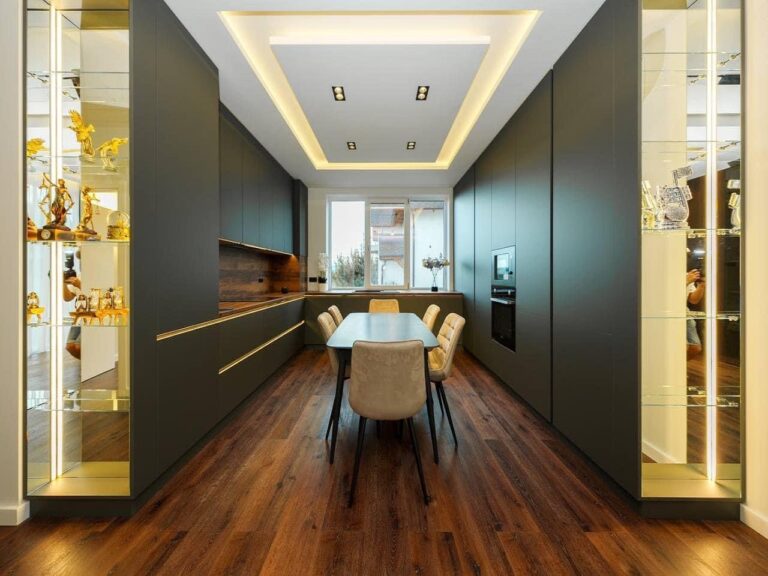
The cold, sterile grey that dominated the previous decade is giving way to something warmer. Deeper accent colours, navy, charcoal, and rich olive, are being used confidently on fitted furniture where good light and quality joinery make the room feel considered rather than cautious. Factory lacquer means any colour from a standard paint deck is achievable with a surface that holds properly.
Textured surfaces are the other defining shift. Fluted timber panels, reeded glass in wardrobe doors, and fabric-wrapped drawer fronts catch light differently at different times of day, making a room feel alive rather than static. This is particularly effective in bedrooms, where the quality of light changes more than in most other rooms.
Key trends at a glance:
- Quiet Luxury palette — warm neutrals, earth tones, and deep accent hues replacing cool greys
- Natural wood grain — oak, walnut, and ash as primary materials, not accents
- Fluted and reeded detailing — texture adding depth without visual noise
- Layered lighting — integrated LEDs combined with plinth and accent lighting
- Warm metal hardware — brushed brass and muted bronze replacing chrome
- Sustainable finishes — low-VOC paints and responsibly sourced timber
How does fitted furniture work with London’s architecture and awkward spaces?
London properties rarely follow a standard template. Chimney breasts interrupt wall lines, ceilings slope in loft conversions, and many rooms need to perform more than one role. Victorian and Edwardian homes present particular challenges: uneven walls and floors that make standard modular furniture look visibly wrong.
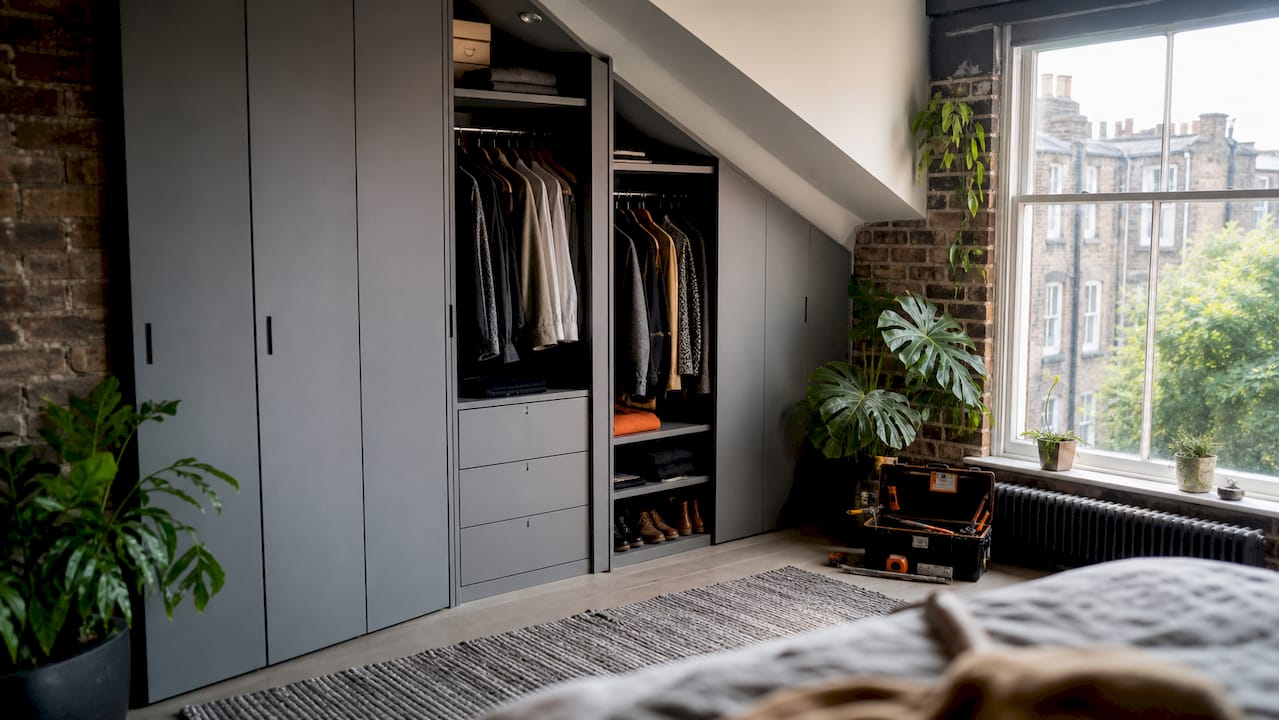
Expert bespoke installers address this with laser surveying, capturing every irregularity so that carcasses can be scribed directly to uneven surfaces. The result looks like an original part of the building rather than something fitted around it. In properties across Putney, Hammersmith, and Twickenham, this precision is what separates genuinely bespoke work from off-the-shelf solutions dressed up with a painted finish.
Fitted furniture also resolves the spatial challenges specific to London living:
- Alcove wardrobes built around chimney breasts, turning an architectural feature into the anchor of the room
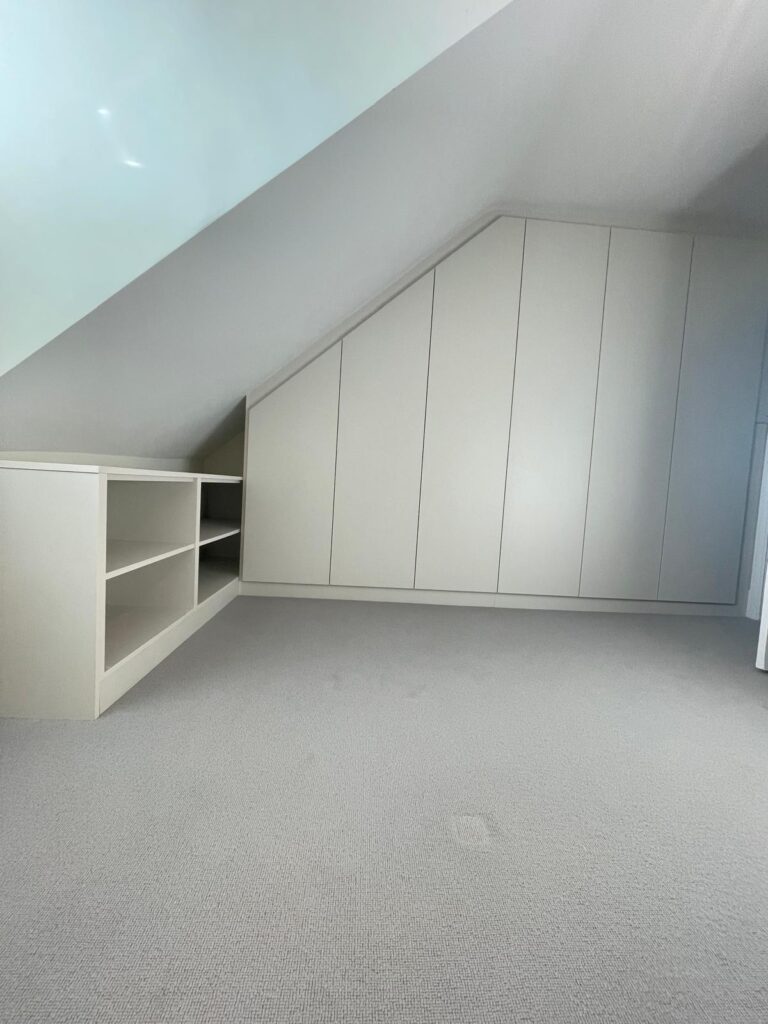
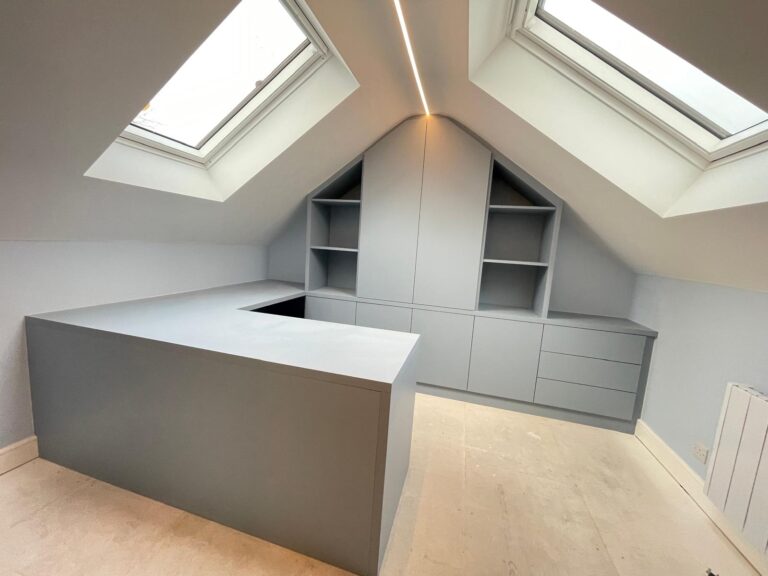
- Loft wardrobes shaped to sloping ceilings, making eaves storage feel intentional rather than compromised
- Under-stairs storage converting dead hallway space into practical cupboards and shelving
- Integrated media walls creating a focal point in living rooms while concealing cables and equipment
- Full-height wardrobes reclaiming the space above standard-height furniture that typically gathers dust
Pro Tip: Ask your installer to use a laser level during the site survey, not just a tape measure. In period properties, walls can be out of plumb by several centimetres, and only laser surveying catches the full picture before fabrication begins.
What makes bespoke fitted furniture genuinely different in 2026?
The craftsmanship gap between bespoke and modular fitted furniture is widening. Clients now specify clothing rail heights calibrated to the exact length of the garments that will hang on them, and hard-wired lighting systems rather than battery strips. These details are not luxury extras. They are the difference between furniture that works properly every day and furniture that requires workarounds.
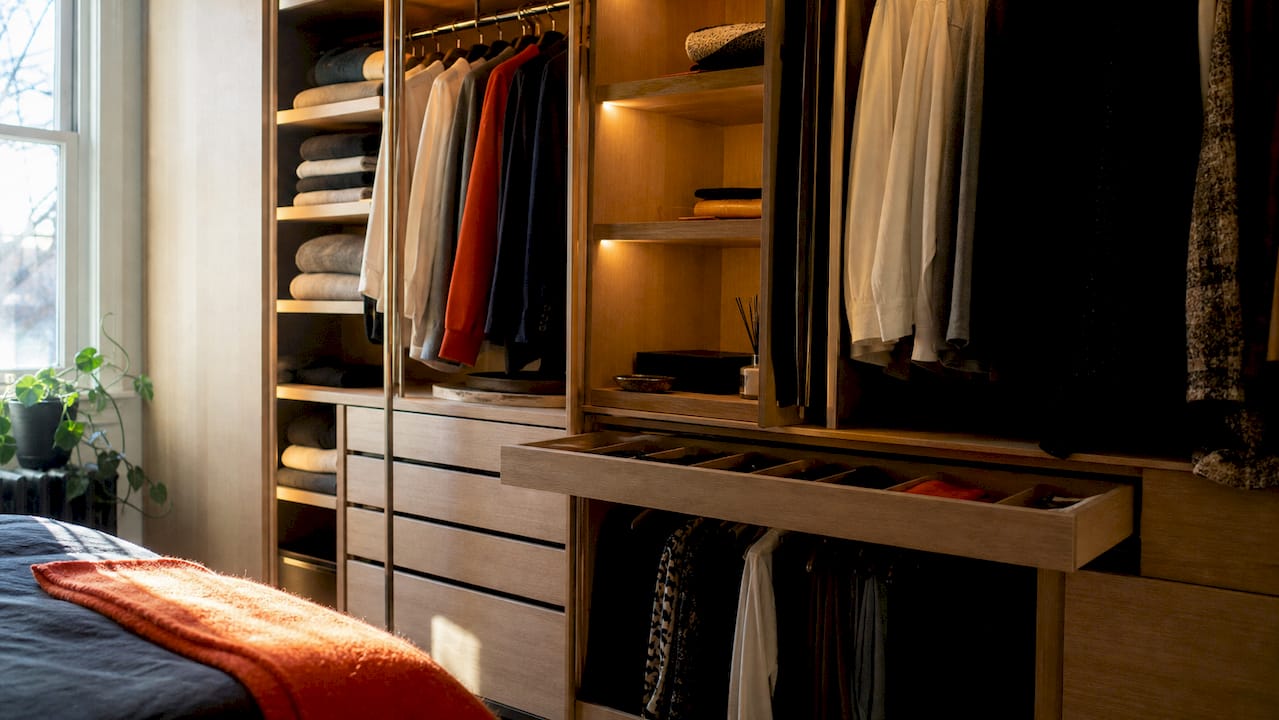
Integrated LED lighting is now a standard expectation: 70% of bespoke fitted wardrobes installed in 2026 include it. The best installations design lighting in from inception, with door-triggered strips positioned to illuminate hanging rails and shelving rather than just the door opening. Layered lighting schemes combining these internal LEDs with plinth lighting and accent pieces are a defining feature of high-quality fitted furniture this year.
Sustainability is equally central. Responsibly sourced timbers and low-VOC paints are now the baseline expectation among London homeowners who want furniture built to last decades, not years. Modular internal systems that can be reconfigured as lifestyles change reduce the need for future renovations, which is both a practical and an environmental advantage.
How Finest Furniture Studio approaches bespoke fitted furniture for London homes
Finest Furniture Studio designs and installs bespoke wardrobes across London, covering the full range of fitted furniture types that London properties actually require. Every project begins with a free design visit, where we assess the room’s architecture, measure precisely, and discuss how you use the space day to day.
Our fitted furniture services include:
- Alcove wardrobes — built around chimney breasts and irregular recesses for a flush, architectural finish
- Loft and sloped wardrobes — shaped to angled ceilings where standard furniture simply cannot go
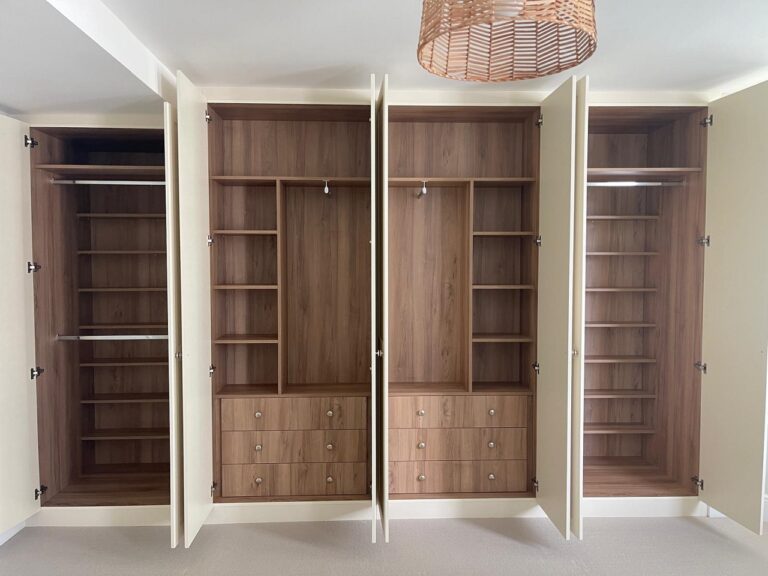
- Walk-in wardrobes — with custom shelving, hanging rails, drawers, shoe storage, and optional LED lighting
- Under-stairs storage — turning hallway dead space into practical, well-organised cupboards
- TV media walls — integrated units that frame screens, conceal equipment, and add real character to living rooms
- Built-in and fully fitted wardrobes — available in shaker, modern flat-panel, wood-effect, and mirrored finishes
Installation typically completes within 7–12 days, and every piece carries a 10-year guarantee. We also remove and dispose of your old wardrobe as part of the service, so there is nothing left for you to manage.
Bespoke commissioning at the highest level typically spans 3–6 months from consultation to installation. Finest Furniture Studio’s 7–12 day installation window reflects a pre-fabrication process that compresses that timeline without compromising on precision or finish quality.
What personalisation options do London homeowners choose in 2026?
Personalisation has moved well beyond choosing a door colour. London homeowners are now specifying the interior of their fitted furniture with the same care they give to the exterior finish. Functional luxury means storage that simplifies daily routines: dedicated compartments for watch collections, leather-lined drawers for jewellery, integrated laundry hampers, and discreet charging drawers for devices.
Door style choices reflect the same specificity. Shaker profiles suit period homes in Barnes, Ealing, and Kingston particularly well, while skinny shaker and flat-panel designs work in more contemporary settings. Mirror fret doors add light and a sense of depth in smaller bedrooms. Wood-effect finishes, particularly ash oak with grey undertones and walnut with bronze tints, are replacing high-gloss laminates across the board.
Hardware choices have become more considered too. Small knobs, understated pulls, and brushed brass or muted bronze finishes age better than trend-led choices and complement both classic and contemporary schemes. The goal is always details that support the architecture rather than compete with it. You can explore wardrobe interior ideas to see how internal configurations are planned around real wardrobes and real lifestyles.
Which fitted furniture styles suit different London property types?
London’s housing stock is genuinely varied, and the right fitted furniture style depends heavily on the property type.
Victorian and Edwardian terraces (common across Wimbledon, Putney, and Chiswick) suit shaker-style fitted wardrobes with painted finishes in heritage tones. Alcove cabinetry flanking chimney breasts is the natural choice, respecting the architecture while adding storage. Full-height wardrobes work particularly well here, reclaiming the vertical space that period ceilings offer.
Loft conversions call for furniture built specifically to the roofline. Low-level eaves cupboards, integrated wardrobes with sloped tops, and concealed storage under the pitch turn a potentially awkward room into one of the most characterful in the house.
Modern flats in central London and areas like Brixton or New Malden often benefit from flat-panel, handleless fitted furniture that reads as part of the wall. Space-saving bathroom fittings follow a similar logic: every fitting chosen to maximise a compact footprint without visual clutter.
Larger townhouses in Richmond, Chelsea, and Fulham are where walk-in wardrobes and full media wall commissions are most common. These properties have the floor area to dedicate a room or a generous wall to fitted storage, and homeowners here are investing in the full specification: integrated lighting, custom interiors, and premium timber finishes.
How does London’s heritage influence fitted furniture design in 2026?
London’s architectural heritage is not a constraint. It is a design asset. The 2026 approach is not to contrast old and new but to let them coexist with subtlety. Original cornices, fireplaces, and ceiling proportions are preserved, while contemporary joinery and lighting bring functionality and clarity to the same room.
This shows up most clearly in how fitted furniture handles period details. A wardrobe built into an alcove beside a Victorian fireplace does not fight the chimney breast. It frames it. Panelling that echoes original wall mouldings, cornice details that align with existing plasterwork, and timber tones that complement original floorboards all contribute to interiors that feel resolved rather than renovated.
The Organic Modern and Edwardian elegance styles coexisting in 2026 fitted furniture reflect exactly this balance: handcrafted traditional detail combined with warm, earthy modern palettes. It is a distinctly London sensibility, and it is what makes bespoke fitted furniture here feel different from anywhere else.
Finest Furniture Studio: bespoke fitted furniture for west London homes
West London homeowners in Richmond, Wimbledon, Putney, and Chiswick get a fitted furniture service built around their specific properties, not a catalogue of standard sizes.
Finest Furniture Studio offers custom-made wardrobes in west London with a free design visit, a 7–12 day installation, a 10-year guarantee, and full removal of your existing wardrobe. Whether you need a shaker alcove wardrobe in a Victorian terrace, a loft wardrobe shaped to a sloped ceiling, a walk-in wardrobe for a master suite, or a TV media wall for a living room, we design and build it to your exact space and style. Every finish, interior configuration, and hardware choice is yours to specify. Call us on 07468 150807, WhatsApp us, or book a free design visit at 124 City Road, Kemp House, London, EC1V 2NX.
Key takeaways
London fitted furniture in 2026 is defined by bespoke craftsmanship, natural materials, and architectural integration that turns storage into a permanent design feature of the home.
| Point | Details |
|---|---|
| Dominant aesthetic | Quiet Luxury: warm neutrals, natural timber, and matte finishes replacing cold greys |
| Integrated lighting | 70% of bespoke wardrobes installed in 2026 include hard-wired LED lighting designed in from the start |
| Architectural fit | Laser surveying ensures fitted furniture integrates with uneven period walls and floors |
| Commissioning time | Standard bespoke commissions span 3–6 months; Finest Furniture Studio installs within 7–12 days |
| Finest Furniture Studio | Offers free design visits, a 10-year guarantee, and full wardrobe removal across west London |
FAQ
What are the main fitted furniture trends in London for 2026?
The leading trends are Quiet Luxury palettes (warm neutrals and earth tones), natural wood finishes in oak and walnut, fluted and reeded surface textures, and hard-wired integrated LED lighting. Bespoke craftsmanship and architectural integration are priorities over off-the-shelf solutions.
How does the 2026 interior design direction affect fitted wardrobes?
The shift away from sterile minimalism toward warm, layered interiors means fitted wardrobes are being specified in deeper colours, natural timber grains, and tactile finishes rather than high-gloss white. Interior configurations are also more personalised, with compartments designed around specific storage needs.
What fitted furniture styles work best in Victorian and Edwardian London homes?
Shaker-style fitted wardrobes with painted heritage tones suit period properties particularly well. Alcove cabinetry flanking chimney breasts is the most architecturally sympathetic choice, and full-height wardrobes make the most of the generous ceiling heights typical of Victorian and Edwardian terraces.
How long does bespoke fitted furniture take to commission and install?
Standard bespoke commissions typically span 3–6 months from initial consultation to installation. Finest Furniture Studio completes installation within 7–12 days, with a free design visit and a 10-year workmanship guarantee included.
What is the 2026 colour direction for fitted furniture in London homes?
The colour direction moves firmly toward warm, mineral-based neutrals: latte beige, oatmeal taupe, mushroom grey, and earthy accents including olive green and clay brown. Deeper tones such as navy and charcoal are used confidently on fitted furniture where light and joinery quality support them.