








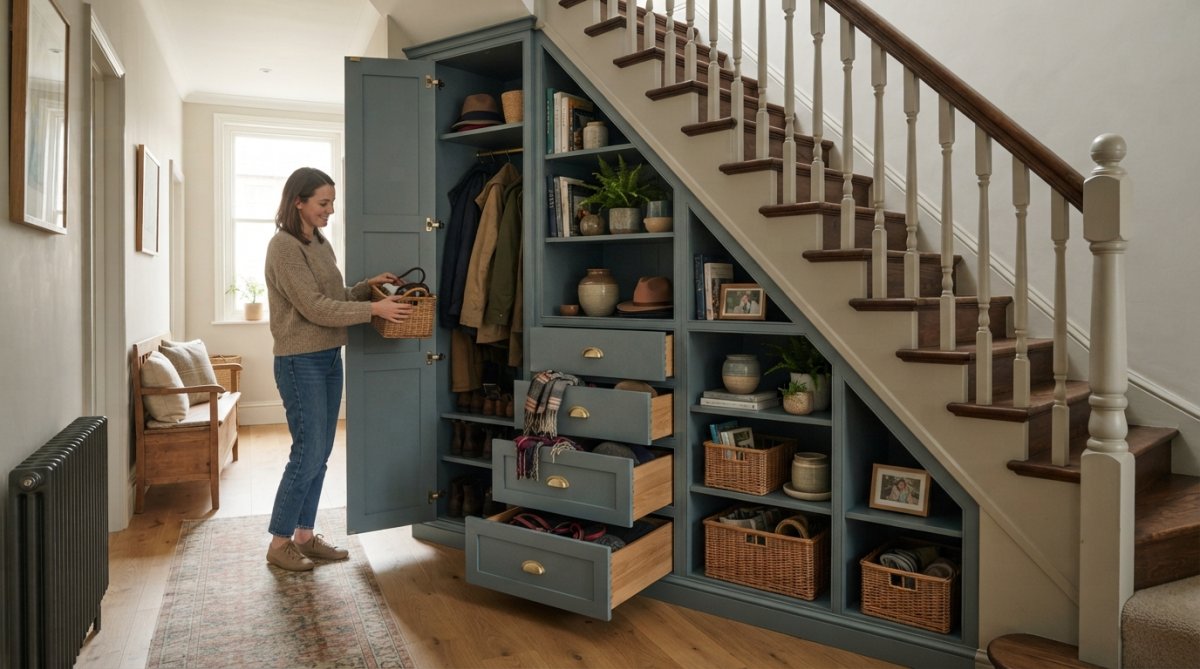
Table of Contents
- Why Bespoke Understairs Storage Ideas Transform Small Spaces
- Types of Bespoke Understairs Storage: From Cupboards to Wine Cellars
- Under Stair Storage Design Ideas UK: Matching Your Home Style
- Specialist Uses: Wine Storage, Home Office & Reading Nooks
- Small Understairs Toilet Ideas UK: Practical Bathroom Solutions
- Custom Under Stair Storage Cost UK: What to Expect
- DIY Planning Guide: Measuring and Designing Your Space
- Smart Home Integration and Sustainable Materials for Modern Storage
Last Updated: July 26, 2026
Why Bespoke Understairs Storage Ideas Transform Small Spaces
The average UK home has lost 10% of usable storage capacity over the past decade, yet living spaces remain static. Bespoke understairs storage ideas 2026 solve this directly, transforming wasted space under staircases into functional, beautiful storage that maximises organisation and style.
Most homeowners overlook the area beneath their stairs entirely. Yet when properly designed, this space can hold as much as a small bedroom’s worth of storage. What separates truly effective bespoke solutions from off-the-shelf cupboards is customisation. Bespoke designs account for specific angles, ceiling heights, and architectural quirks that standard units cannot accommodate.
Common challenges with underused under-stair areas
The space under stairs presents three specific problems. First, ceiling height decreases toward the back, making standard shelving useless. Second, access is restricted; you cannot reach items at the back without removing everything in front. Third, the footprint is irregular, with angles that don’t match standard furniture dimensions.
Many homeowners attempt DIY solutions or flat-pack units that never fit properly. Shelves sit at awkward angles. Doors don’t close. Storage becomes an eyesore rather than a design feature. Bespoke solutions differ fundamentally by engineering specifically for your space.
How custom-built solutions differ from off-the-shelf storage
Off-the-shelf cupboards are designed for standard rectangular spaces. Under a staircase, they fail immediately. Custom-built solutions are engineered specifically for your space. A joiner measures every angle, slope, and obstruction. The final design accounts for these realities rather than fighting against them.
Finest Furniture Studio specialises in this work. Rather than forcing a standard unit into an awkward space, the team designs around the architecture. Pull-out drawers replace fixed shelves in tight spaces. Soft-close runners ensure doors don’t slam. Materials, whether solid oak or sustainable MDF, are chosen to match your home’s aesthetic and durability requirements.
Types of Bespoke Understairs Storage: From Cupboards to Wine Cellars
Bespoke understairs storage ideas 2026 span many applications, each solving a different problem.
Pull-out drawers and shelving for maximum accessibility
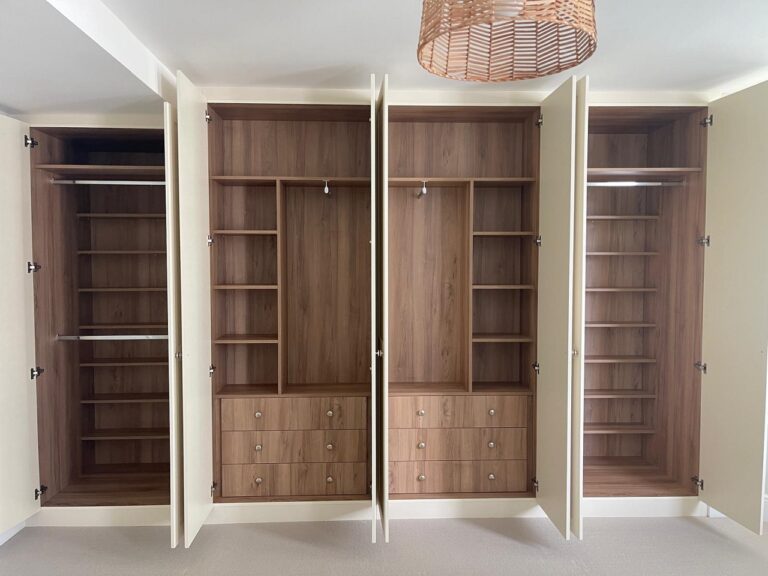
Pull-out drawers are the workhorse of under-stair storage. Unlike fixed shelves where you must crouch and reach to the back, drawers slide smoothly on runners, bringing everything within arm’s reach. Soft-close mechanisms prevent slamming, essential in homes with young children.
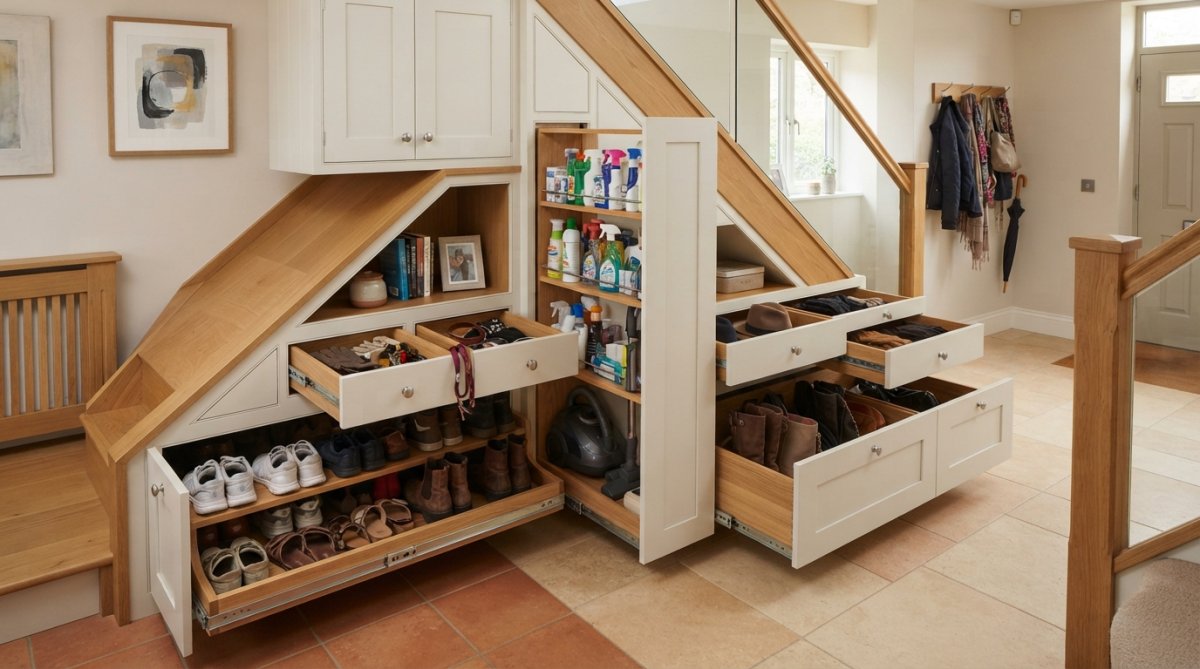
Shelving works best in shallower sections where ceiling height is adequate. A combination approach, drawers for deep storage, shelves for display, maximises both accessibility and visual appeal. Material choice matters: solid oak drawers feel premium and last decades, while MDF is budget-conscious and takes paint beautifully.
Hidden storage and display areas
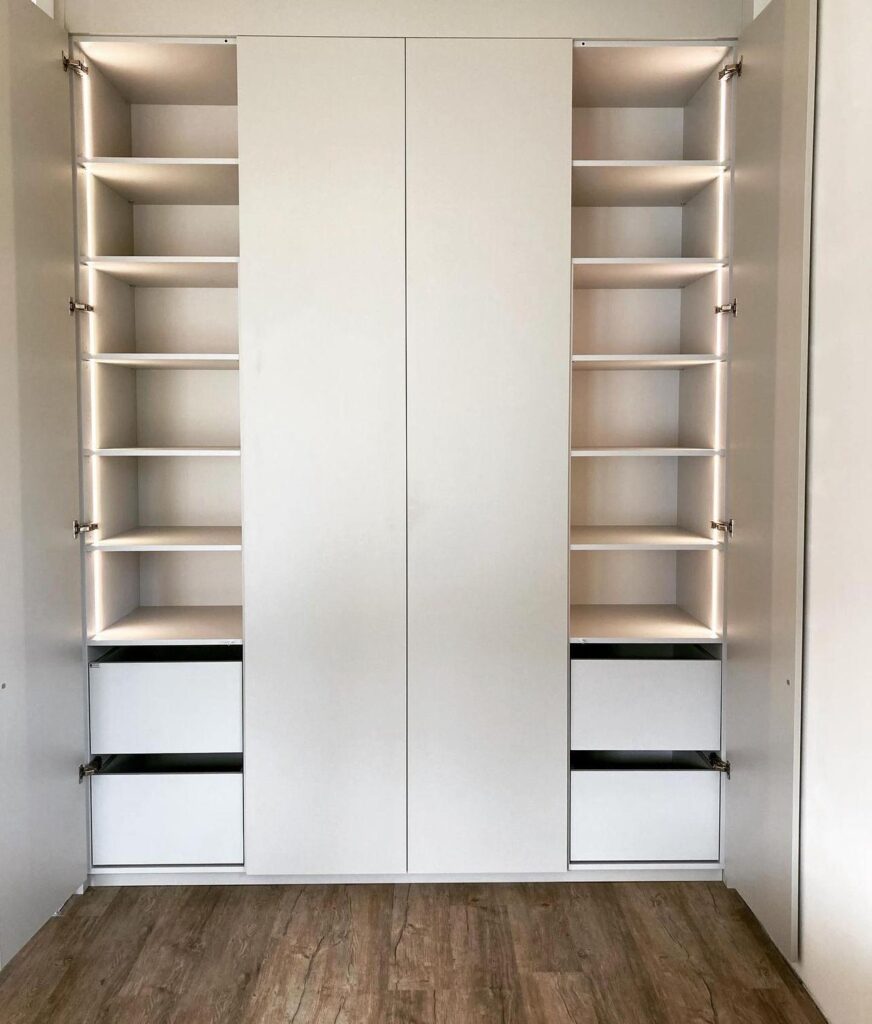
Some designs incorporate hidden compartments for valuables or important documents, maintaining a clean visual appearance from the hallway. Display areas work differently: open shelving with integrated lighting transforms the space into a gallery for books or collectibles. Integrated LED strips or recessed spotlights elevate the design significantly.
Under Stair Storage Design Ideas UK: Matching Your Home Style
The aesthetic dimension of bespoke understairs storage cannot be separated from function.
Modern minimalist designs with soft-close runners
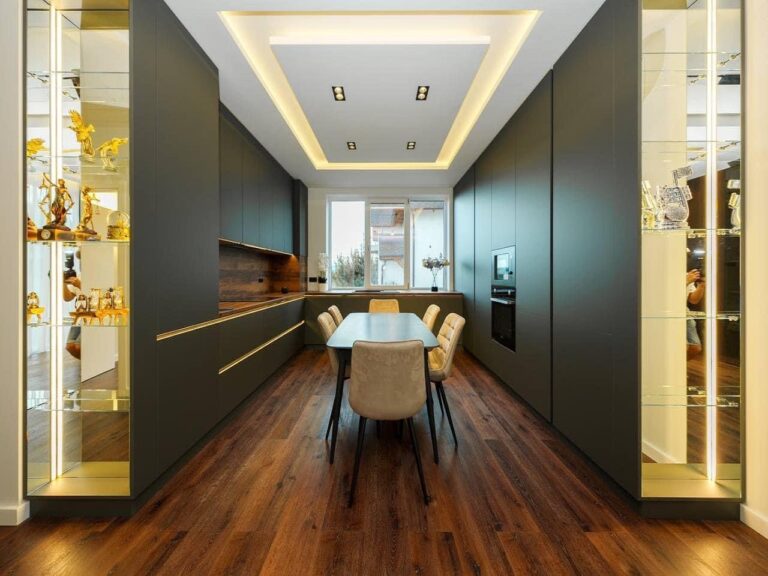
Contemporary homes demand clean lines and minimal visual clutter. Modern under-stair designs typically feature flush-fit doors with integrated handles, neutral colours, and soft-close mechanisms. Soft-close runners eliminate jarring sounds, creating an impression of quality and refinement.
Modern designs often incorporate subtle lighting. LED strips running along drawer edges or shelf undersides create ambient illumination that serves both functional and decorative purposes, particularly effective in open-plan homes.
Traditional joinery and solid oak finishes
Period homes call for different approaches. Solid oak is the material of choice, warm, durable, and authentic to period aesthetics. Joinery should reflect traditional craftsmanship: visible wood grain, hand-finished surfaces, and hardware that complements period fixtures. This approach costs more but delivers longevity and aesthetic authenticity that justifies the investment.
Handling sloping ceilings and awkward spaces
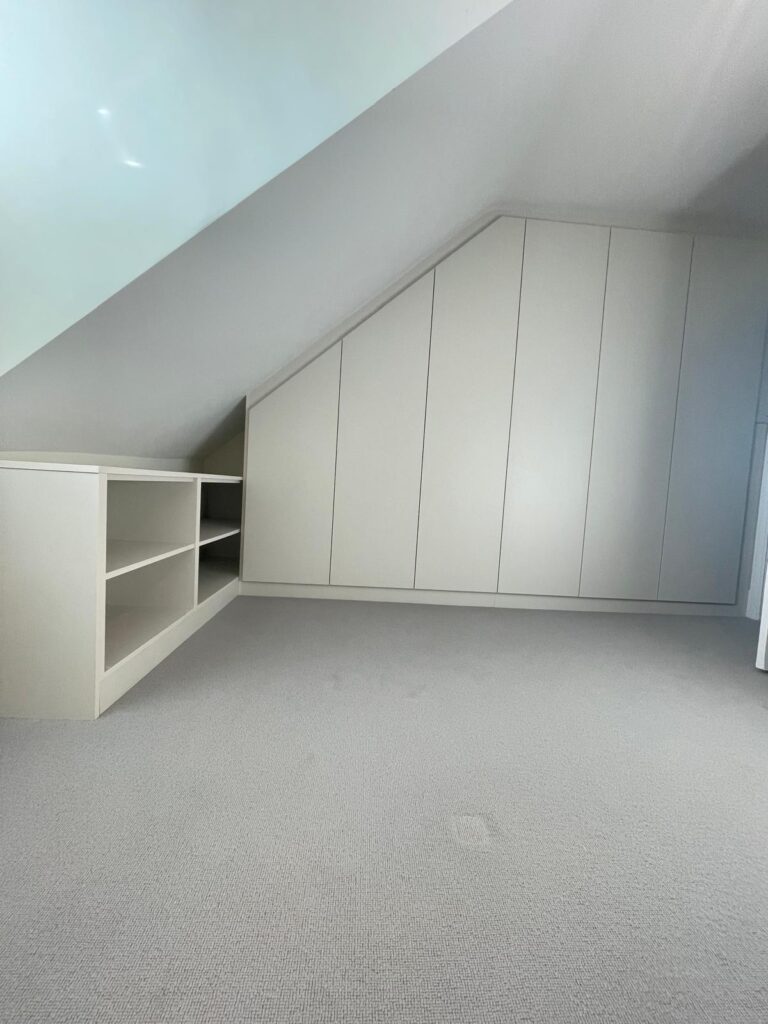
Sloping ceilings are the defining challenge of understairs storage. Effective design accepts this reality rather than fighting it. Graduated shelving, shelves that step down as you move back, accommodates the slope naturally. Pull-out drawers work exceptionally well in sloped spaces because they don’t require standing room to access contents.
Awkward spaces with pillars, pipes, or irregular angles require bespoke solutions by definition. A skilled joiner designs around obstacles, sometimes creating feature elements rather than hiding them.
Specialist Uses: Wine Storage, Home Office & Reading Nooks
Beyond general storage, understairs space can be reimagined for specific purposes.
Understairs Wine Storage UK: Climate Control and Display
Wine requires specific conditions: consistent temperature (around 13°C), stable humidity (50-70%), and darkness. A purpose-built understairs wine storage solution can provide this through climate control, either passive (through insulation and ventilation design) or active (with a dedicated wine cooler unit).
Ventilation is critical. Poor airflow leads to mould and cork deterioration. Effective designs include discrete vents or ducting that maintains air circulation without creating drafts. Lighting should be minimal and warm-toned; bright lighting degrades wine quality over time.
Under Stairs Home Office: Workspace in Compact Footprints
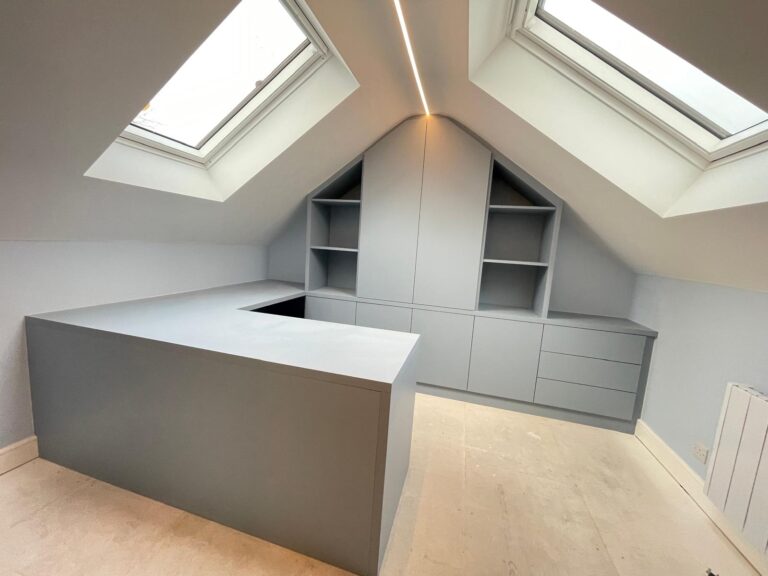
Remote work has made compact home offices essential in space-constrained homes. An understairs space can accommodate a small desk, storage for files and supplies, and shelving for equipment within a footprint of just 1.5m × 1m.
The key is vertical storage. Wall-mounted shelving, floating desks, and cable management systems keep the space functional without clutter. Lighting is critical; a desk under stairs can feel cave-like without proper illumination. Integrated LED strips or a small desk lamp are non-negotiable.
Playrooms, reading nooks and pet spaces
Children’s playrooms benefit from under-stair storage that combines accessibility with safety. Low shelving and open cubbies make it easy for children to find and store items independently. Reading nooks create a cosy retreat with a cushioned bench, ambient lighting, and shelving for books. Pet nooks work similarly, with a cushioned bed, ventilation, and perhaps a small gate.
Small Understairs Toilet Ideas UK: Practical Bathroom Solutions
Understairs spaces often become cloakrooms or downstairs toilets, a practical use requiring careful design.
Building regulations and ventilation requirements
UK building regulations (Part F) govern ventilation in bathrooms and WCs. A downstairs toilet under the stairs must have either natural ventilation or mechanical extraction. Since windows are rarely possible, mechanical ventilation is standard.
Extraction fans must move air at a minimum rate (typically 6 litres per second for a toilet) and operate for 20 minutes after use. Poor ventilation leads to condensation, mould, and odours. Building control approval is required before installation.
Space-saving fixtures and fitted storage integration
A toilet, small sink, and storage can all fit in an understairs space if designed thoughtfully. Wall-hung toilets save floor space compared to pedestal models. Compact sinks (often corner-mounted or wall-hung) minimise footprint while maintaining functionality.
Storage integration is crucial. Shelving above the toilet, cabinets beside the sink, and under-sink storage maximise every centimetre. Mirrored cabinet doors provide storage and reflect light, making the small space feel larger.
Custom Under Stair Storage Cost UK: What to Expect
Cost is the question most homeowners ask first. Understanding what drives pricing clarifies whether the investment makes sense.
Factors affecting bespoke storage pricing
Several variables determine final cost. Space size is primary; a 2m² understairs area costs significantly less than a 5m² space. Complexity is secondary; a simple shelving system costs less than a design incorporating pull-out drawers and integrated lighting. Material choice is tertiary; solid oak costs roughly 40% more than quality MDF.
Accessibility and existing conditions matter too. A space with straightforward access is cheaper than one requiring custom solutions for pipes, pillars, or irregular angles. Installation complexity varies; simple shelving might take 2-3 days while complex designs could take a week or more.
Material choices: MDF vs solid oak and sustainable options
MDF is the budget option, stable and taking paint beautifully, costing roughly 50-60% less than solid oak. The tradeoff is longevity; MDF in high-moisture environments degrades faster than solid wood. Solid oak is the premium choice, durable and developing a beautiful patina over time, lasting decades with minimal maintenance.
Sustainable options are emerging. FSC-certified plywood, reclaimed wood, and bamboo offer environmental benefits without the cost premium of solid oak.
Why transparent pricing and no hidden fees matter
Transparent pricing means you know the total cost upfront. No surprises. No mid-project revelations that additional work costs extra. This builds trust and allows proper budgeting.
DIY Planning Guide: Measuring and Designing Your Space
Before commissioning a bespoke design, understanding your space is essential.
Step-by-step measurement checklist for awkward spaces
Accurate measurements are non-negotiable. A 2cm error compounds across a 2m width, resulting in poorly fitting doors and drawers.
Measure these dimensions:
- Width at the front, middle, and back of the space
- Height at the front, middle, and back (to account for sloping ceilings)
- Depth from the front edge to the back wall
- Distance from the floor to any obstructions
- Angles of any sloping surfaces
Document existing conditions:
- Electrical outlets and switches
- Pipes or ducting
- Structural pillars or load-bearing walls
- Existing finishes
- Lighting fixtures or power points needed
Photograph the space from multiple angles with a tape measure for scale reference.
Visualising your design: lighting, ventilation and functionality
Once measurements are complete, sketch a rough design. Consider how items will be accessed, what will be stored, how frequently items will be accessed, lighting requirements, and ventilation needs.
Lighting transforms understairs storage from dark and cave-like to inviting. LED strips under shelves, recessed spotlights, or integrated panel lights are all effective. Ventilation prevents condensation and odours, essential in enclosed spaces.
| Design Consideration | Purpose | Impact on Cost |
|---|---|---|
| Pull-out drawers | Accessibility in deep spaces | +15-25% |
| Soft-close mechanisms | Silent, quality feel | +10-15% |
| Integrated lighting | Ambiance and functionality | +8-12% |
| Solid oak materials | Durability and aesthetics | +35-45% |
| Climate control (wine) | Temperature/humidity regulation | +20-30% |
| Custom shelving angles | Accommodate sloped ceilings | +5-10% |
Smart Home Integration and Sustainable Materials for Modern Storage
Bespoke understairs storage ideas 2026 increasingly incorporate smart home technology and sustainable materials.
Automated lighting and climate control for wine and specialty storage
Smart lighting systems can activate automatically when a drawer opens. Motion sensors eliminate manual switches. Colour-adjustable LED systems allow you to shift from task lighting to ambient lighting depending on the time of day.
For wine storage, smart climate control monitors temperature and humidity continuously, alerting you if conditions drift outside the ideal range. Some systems integrate with your home automation platform, allowing remote monitoring via smartphone.
Eco-friendly material choices and sustainable joinery practices
FSC-certified timber ensures wood comes from responsibly managed forests. Reclaimed wood adds character while reducing demand for new timber. Bamboo grows rapidly and is harvested sustainably, making it an excellent alternative to traditional hardwoods.
Low-VOC finishes reduce harmful off-gassing, important in enclosed spaces. Water-based paints and natural oils are increasingly available and perform comparably to traditional finishes. Choosing sustainable materials typically costs 10-15% more than conventional options, but the environmental benefit and long-term durability justify the investment.
Frequently Asked Questions
How much does bespoke understairs storage cost in the UK?
Pricing for custom under stair storage cost UK varies significantly based on materials, design complexity, and your space dimensions. Solid oak and premium finishes command higher investment than MDF alternatives. Factors include soft-close hardware, integrated lighting, and whether you're fitting a simple cupboard or specialist space like wine storage. For transparent, upfront pricing tailored to your home, a free design visit reveals exact costs without hidden charges. Contact Finest Furniture Studio to discuss your budget.
Can you actually fit a toilet under the stairs in the UK?
Yes, small understairs toilet ideas UK are viable if your space meets Building Regulations. You'll need adequate headroom (typically 2.1m minimum), proper ventilation (either natural or mechanical), and sufficient floor area. The sloping ceiling presents challenges but fitted storage integration can maximise usability. Water supply and waste routing must comply with UK plumbing standards. Professional design ensures your installation meets all legal requirements whilst maximising the compact footprint effectively.
What materials are best for bespoke understairs storage?
Solid oak delivers durability and timeless aesthetics, ideal for traditional homes and wine storage requiring stable conditions. MDF offers budget-friendly versatility and modern finishes. For eco-conscious homeowners, sustainable timber and recycled materials provide environmentally responsible alternatives without compromising quality. Soft-close runners and quality hardware ensure longevity regardless of material choice. Your home's style, budget, and intended use (wine, shoes, office) should guide material selection for optimal functionality and appearance.
How long does installation take for bespoke understairs storage?
Finest Furniture Studio's 7-day fitting service reflects realistic timelines from design approval to completion. Actual duration depends on space complexity, material choices, and whether specialist features like wine climate control or integrated lighting are included. Straightforward cupboards or shelving typically complete faster than bespoke home offices or bathroom conversions. Your free design visit establishes a clear project timeline, allowing you to plan around the work with confidence and minimal disruption to your home.
This article was written using GrandRanker