
Table of Contents
- Assess Your Current Wardrobe and Space
- Small Wardrobe Decluttering Checklist
- How to Maximise Vertical Storage in Wardrobes
- Smart Storage Solutions for Awkward Spaces
- Choosing the Right Hangers and Organizers
- Bespoke Fitted Wardrobe Storage Solutions for Custom Spaces
- Maintain Your Organized Wardrobe
- Conclusion
Last Updated: August 23, 2026
Assess Your Current Wardrobe and Space
Before organizing, understand what you’re working with. Measure your room’s dimensions, note ceiling height, and identify awkward angles. Then pull everything out of every drawer, shelf, and cupboard, you cannot organize what you cannot see.
Count items by category: tops, trousers, dresses, outerwear, shoes, accessories. Be honest about condition. Stained items, broken zips, and clothes that don’t fit are clutter, not options. Small spaces don’t tolerate ambivalence; every item must earn its place.
Small Wardrobe Decluttering Checklist
Decluttering is the foundation of any wardrobe organization system. You cannot maximize a small space by keeping everything.
The Four-Box Method
Label four boxes clearly: keep, donate, sell, or bin. Go through your wardrobe item by item, making snap decisions in 10 seconds. Your gut reaction is usually correct.
Keep: Items you wear regularly, that fit well, and that you genuinely like. If you haven’t worn it in a year, it goes.
Donate: Good condition but not for you. Charity shops or friends who might wear them.
Sell: Designer pieces or expensive items in excellent condition. Online platforms recover some value.
Bin: Damaged beyond repair, stained, or genuinely unwearable. Be ruthless here.
The Four-Box Method works because it removes the "maybe" pile. Maybe piles grow and become permanent. By forcing a choice, you actually finish the job.
Seasonal Rotation Strategies
Small spaces require strategy. You cannot store a full year of clothing if you only have room for three seasons at a time.
Identify your climate and seasons. Store off-season clothing in under-bed storage boxes, vacuum bags, or a separate cupboard. Label boxes clearly with the season and year. Before rotating, inspect everything and wash items before storing them to prevent moths and mildew.
Rotate twice yearly: spring/summer in May, autumn/winter in September. This timing aligns with weather changes and gives you a natural checkpoint to reassess what you actually wore.
| Step | Timing | Action |
|---|---|---|
| Sort by season | January, July | Pull out off-season items |
| Inspect for damage | Before storage | Repair or discard damaged pieces |
| Clean thoroughly | Before packing | Wash or dry-clean stored items |
| Store in labeled boxes | Year-round | Use vacuum bags or sealed containers |
| Rotate in new season | May, September | Bring out next season’s wardrobe |
How to Maximise Vertical Storage in Wardrobes
Vertical space is wasted space in most small bedrooms. The area above your head, above your door, and along your walls can hold far more than you think. If it’s empty wall space, it’s underutilized real estate.
Double Hanging Rods
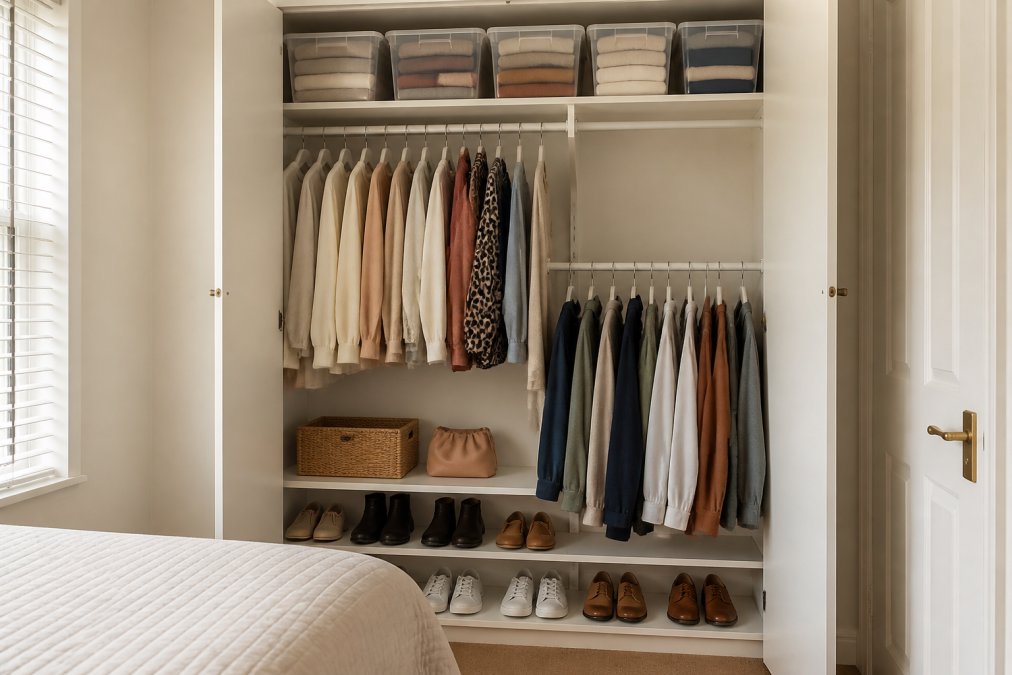
A double hanging rod system doubles your hanging capacity without expanding your footprint. A standard wardrobe has one rod at shoulder height; a double system places a second rod 60-75 centimetres below it. Hang longer items (dresses, coats, trousers) on the upper rod and shorter items (tops, shirts, jackets) on the lower rod.
Installation is straightforward. Tension rods work without drilling for renters; permanent rods take 30 minutes and cost £15-30. A wardrobe that previously held 40 hanging items now holds 70-80.
High-Shelf Installation and Storage Bins
Install a shelf 10-15 centimetres below the ceiling or use the existing space above your wardrobe. Use clear plastic bins with labels on the front and spine. Stacked properly, five or six bins fit in the space above a standard wardrobe.
High-shelf storage works best for items you access infrequently: winter coats in summer, summer shoes in winter, or spare towels. Everyday items should remain at arm height.
Smart Storage Solutions for Awkward Spaces
Every small space has awkward zones: gaps beside radiators, understairs spaces, or alcoves with sloping ceilings. These areas defeat standard storage solutions but reward creative thinking.
Door-Mounted Storage and Hooks
The back of your wardrobe door or bedroom door is free storage. Over-door hooks hold belts, scarves, bags, or lightweight jackets. Adhesive hooks work on rental properties and require no drilling. A door-mounted shoe rack holds 8-12 pairs.
Door-mounted storage works only for lightweight items. Heavy coats will strain hinges over time.
Under-Bed Storage and Tension Rods
Under-bed storage is the most underutilized space in most bedrooms. Flat storage boxes slide under beds and hold off-season clothing, spare bedding, or shoes. Measure the clearance under your bed first; many beds sit only 15-20 centimetres high (the NIH).
Tension rods create hanging storage under beds. Install a rod horizontally under the bed frame and hang lightweight items: scarves, belts, or lightweight jackets. Label boxes clearly and maintain an inventory.
Choosing the Right Hangers and Organizers
The right hangers prevent creasing, maximize space, and make your wardrobe look intentional. Plastic hangers take up more space than wooden or metal hangers. Slim-profile hangers reduce width by 30-40% compared to standard plastic, meaning 15-20 additional items per rail (peer-reviewed research).
Match your hanger style. A wardrobe of mixed hangers looks disorganized. Uniformity creates visual calm, which matters more in small spaces where everything is visible.
Shelf dividers prevent clothing from toppling sideways on open shelves. Acrylic dividers cost £5-10 per pair and keep folded items upright and organized.
Bespoke Fitted Wardrobe Storage Solutions for Custom Spaces
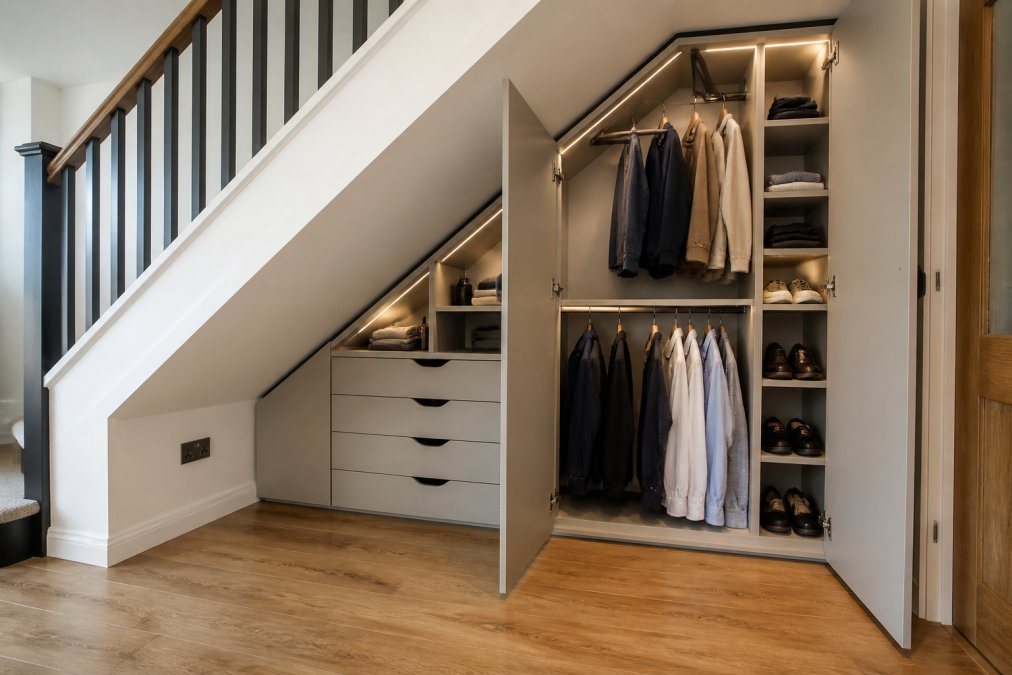
Standard wardrobes are designed for standard spaces. Most UK homes have alcoves, understairs areas, sloping ceilings, or irregular walls. Standard solutions fail in these spaces.
Why Bespoke Solutions Work for Small Spaces
A bespoke fitted wardrobe is designed for your specific space, items, and needs. Nothing is wasted. A bespoke solution uses 100% of available space; a standard wardrobe uses 60-70%. In a small space, that difference is transformative.
Bespoke solutions accommodate awkward features: sloping ceilings, radiators, electrical outlets, windows, or uneven walls. At Finest Furniture Studio, bespoke solutions are built to last with a 10-year warranty covering structural integrity and functionality.
DIY vs. Professional Systems
DIY solutions offer flexibility and lower upfront cost. For renters or those with budget constraints, DIY shelving and tension rods work. However, DIY approaches rarely use space as efficiently and are often reactive rather than designed as a complete system.
Professional bespoke systems are designed as a complete solution. Every millimetre is considered. Installation is faster, a bespoke wardrobe typically installs within 7 days. Finest Furniture Studio offers transparent pricing with no hidden fees. A design visit is complimentary, and you receive a fixed quote before work begins.
Maintain Your Organized Wardrobe
Organization requires maintenance to prevent regression. Set a monthly audit: spend 30 minutes reviewing what you’ve worn. Items you haven’t touched in a month should prompt questions about whether to keep them.
Seasonal reviews happen twice yearly. Before rotating seasons, reassess what you actually wore. Hangers reveal habits: hang all items backward initially, then hang forward when worn. After three months, anything still backward hasn’t been worn.
Return items to the same place after wearing them. Wash everything before seasonal storage and use cedar blocks or lavender sachets to deter moths (the CDC). Ensure storage boxes are sealed and dry; UK homes are damp, and moisture causes mildew.
Organizing a small wardrobe requires ruthlessness, strategy, and the right storage approach. For spaces that defy standard solutions, understairs alcoves, sloping ceilings, or genuinely awkward dimensions, bespoke fitted wardrobe storage solutions deliver efficiency that DIY approaches cannot match. Finest Furniture Studio designs custom solutions for your exact space, installs within 7 days, and backs everything with a 10-year warranty. Book a free design visit to see how much more your space can hold.
Frequently Asked Questions
How can I effectively organize my small wardrobe?
Start by decluttering ruthlessly using the four-box method: keep, donate, sell, or discard. Then maximize vertical storage with double hanging rods, high shelves, and shelf dividers. Use slim hangers, drawer organizers, and door hooks to reclaim floor space. Consider seasonal rotation to reduce what you store year-round. Finally, label everything so you know exactly what you own and can find items quickly without creating chaos.
What are common wardrobe organisation mistakes to avoid?
The biggest mistake is keeping clothes you don't wear, which wastes precious space. Avoid overcrowding hanging rods, as this makes items wrinkle and become inaccessible. Don't ignore vertical space above your head or under the bed. Many people also choose the wrong hanger type (bulky wooden hangers waste space; slim velvet ones work better). Finally, skip labeling systems and you'll lose track of what you own, defeating the purpose of organization entirely.
How do I organize my small closet when I have too many clothes?
Ruthless decluttering comes first. Assess each item: Does it fit? Do you actually wear it? Does it align with your lifestyle? Remove anything that doesn't meet all three criteria. Once you've reduced volume, use bespoke fitted wardrobe storage solutions or modular systems designed for your specific space. Double-hang rods, pull-out drawers, and custom shelving can help maximize your storage capacity. Seasonal rotation also helps: store off-season items in under-bed storage or garment bags to free up active closet space.
Can bespoke fitted furniture really help with small space storage?
Yes. Bespoke fitted wardrobes are designed specifically for your space, including awkward areas like sloping ceilings, understairs alcoves, or narrow corners that standard furniture can't address. Custom solutions maximize every centimetre of available height and depth, often providing significantly more storage than off-the-shelf alternatives. Professional design also improves accessibility and organization, making it easier to maintain your system long-term. The investment pays dividends through durability and the mental clarity that comes from a truly functional space.
This article was written using GrandRanker