

Table of Contents
- Why Material Choice Matters for Bespoke Under Stairs Cupboards
- MDF vs Plywood for Fitted Furniture
- Materials for Fitted Cupboards: Solid Wood and Melamine Options
- Under-Stairs Cupboard Doors: Material Suitability and Design
- Durable Cupboard Finishes: Paint, Veneer and Spray Options
- Moisture, Ventilation and Environmental Considerations
- Making Your Material Choice: Budget, Space and Longevity
- Frequently Asked Questions
Last Updated: October 12, 2026
Why Material Choice Matters for Bespoke Under Stairs Cupboards
The space beneath your stairs is wasted potential in most homes. A poorly chosen material leads to sagging shelves and warped doors within a few years; the right one turns that awkward corner into storage that lasts decades.
Selecting materials for bespoke under stairs cupboards isn’t just about aesthetics, it’s about which board handles moisture, weight, and daily use.
This guide covers MDF, plywood, solid wood, and melamine-faced board, where each belongs, the trade-offs, and how to choose.
MDF vs Plywood for Fitted Furniture
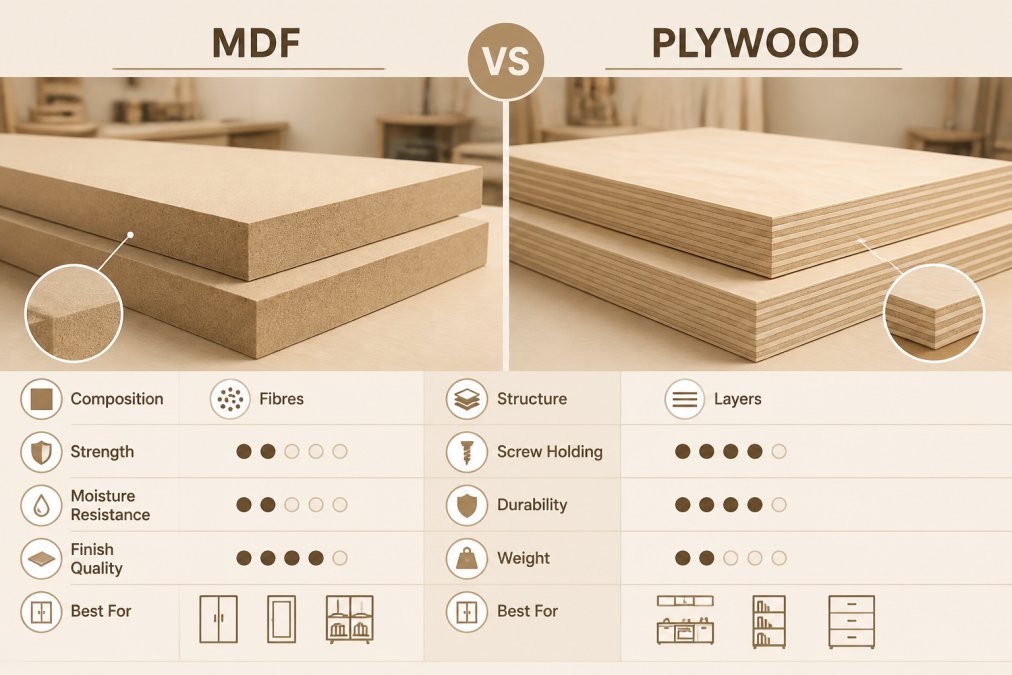
The table below compares MDF and plywood on the criteria that decide whether a cupboard still works in ten years.
| Criterion | MDF | Plywood |
|---|---|---|
| Construction | Wood fibres bonded with resin into a uniform board | Thin veneer layers glued cross-grain |
| Strength and stiffness | Moderate; sags on long unsupported spans | High; spans further before deflection |
| Moisture behaviour | Swells and crumbles once water penetrates the edges | Tolerates intermittent damp; edges still need sealing |
| Finish quality | Excellent for paint; no grain to telegraph through | Grain and layered edges show unless banded or veneered |
| Repairability | Filler and repaint works on small dents; swollen board cannot be saved | Local sanding and refinishing possible; delamination is terminal |
| Weight | Heavy and dense | Lighter for the same thickness |
| Screw holding | Poor at edges; screw holes strip under repeated load | Good; holds hinges and runners far better |
| Typical best use | Painted doors, flat panels, dry alcoves | Carcasses, shelves, drawer boxes, structural supports |
What this means in practice
The biggest difference is how each board fails. MDF fails gradually: a shelf bows, a door swells at the bottom edge, a hinge screw works loose. Plywood fails suddenly and locally: a knock chips an edge, water gets between the veneer layers, and that section delaminates.
A common pattern among joiners is to use both in the same cupboard: plywood for the carcass, shelves and drawer boxes where strength and screw holding matter, and MDF for door faces where a flawless painted finish matters more. That combination usually outperforms an all-MDF build and costs less than an all-plywood one.
Thickness and span
Board thickness changes the calculation more than most homeowners expect: an 18 mm and a 25 mm shelf behave very differently over a 900 mm span. Keep unsupported MDF shelves shorter and add a central divider or hardwood lipping to the front edge. Plywood tolerates longer spans, but any shelf carrying books or tools over roughly a metre still benefits from a mid support.
If you want a painted finish but need plywood’s strength, ask for a plywood carcass with MDF doors. You get the structural performance where it counts and the smooth paint finish where it shows.
Where each board is the wrong answer
MDF is wrong anywhere water can reach an unsealed edge: against an external wall, beneath a bathroom, next to a cold-water tank, or in a hallway that never dries out. Plywood is wrong when the budget is tight and the cupboard is purely decorative, or when you want a perfectly flat sprayed door with no grain.
Materials for Fitted Cupboards: Solid Wood and Melamine Options
Solid Wood: Premium Durability
Solid wood, oak, ash, pine, or walnut, is the premium choice for bespoke under stairs cupboards.
Its main advantage is longevity: a well-made solid wood cupboard can outlast the house it’s in, and natural grain and patina create character engineered boards can’t match.
The cost is substantial, typically two to three times more than MDF, and it requires skilled joinery.
Solid wood suits homes where the under-stairs space is visible and integral to the design. It’s less practical if you’re renting or the cupboard sits in a garage or utility room.
Melamine-Faced Board: Budget-Friendly Alternative
Melamine-faced board is plywood or MDF with a thin plastic laminate bonded to the surface.
Melamine is practical for utilitarian spaces.
The limitation is that melamine can’t be repaired: if the surface chips or peels you can’t sand it smooth and repaint, so you’re stuck with the damage or a new panel.
For budget projects in low-visibility spaces, melamine makes sense. Anywhere you care about appearance or longevity, plywood or solid wood is worth the extra cost.
Under-Stairs Cupboard Doors: Material Suitability and Design
Cupboard doors face different demands than the carcass: they swing repeatedly, so hinge points must be strong, and they’re highly visible, so finish quality matters.
MDF doors work well painted: the smooth surface accepts paint evenly and won’t warp or stick. Plywood doors are stronger and suit natural finishes.
The door frame that holds the hinges should never be MDF if the cupboard sees regular use, repeated opening and closing will eventually strip the screw holes.
If you’re mixing materials, use MDF for flat panels and plywood or solid wood for the frame.
Durable Cupboard Finishes: Paint, Veneer and Spray Options
The finish protects the material and determines how the cupboard looks. Three options exist: paint, wood veneer, and spray finish.
Paint is the most forgiving finish: it hides imperfections, works on any board, and primed MDF accepts it beautifully.
Wood veneer, a thin layer of solid wood glued to the board surface, creates a timber look without the cost of solid wood, and works particularly well on plywood.
Spray finish, a factory-applied lacquer or polyurethane, creates a smooth, professional appearance.
Moisture, Ventilation and Environmental Considerations
Most material guides stop at “avoid MDF in damp spaces”. That’s correct but incomplete: two further questions matter, what the cupboard does to the air in your home, and what happens to the material at the end of its life.
Moisture: where it actually comes from
Under-stairs cupboards sit in one of the most awkward positions in a house: often against an external wall, frequently beside pipework, and usually the last place anyone thinks to ventilate.
That distinction changes the fix: a visible leak needs plumbing attention, vapour migration needs separation between wall and cupboard back, and condensation needs airflow. Choosing a moisture-tolerant board without addressing these simply delays the problem.
Ventilation: the cheapest intervention
A cupboard sealed tight against a cold wall traps damp air behind it. Two simple measures solve most of this:
- Stand the cupboard off the wall. A 25-50 mm gap behind the back panel lets air move and stops the back becoming the coldest surface in the assembly.
- Vent the cupboard itself. A grille low down and another high up creates a chimney effect, so air moves through the space rather than sitting in it. This is standard practice in fitted furniture and costs very little.
If the space contains a water tank, boiler, or exposed pipework, ventilation is not optional: trapped warm air plus a cold surface equals condensation, and no board material survives that indefinitely.
A damp-smelling under-stairs cupboard is a ventilation problem, not a material problem. Upgrading from MDF to plywood in a space with no airflow simply moves the failure point later.
Indoor air quality and emissions
Engineered boards are bonded with resins, and those resins are the source of most indoor air quality concerns in fitted furniture. Formaldehyde is the substance most often discussed, regulated in the UK through the timber and board supply chain rather than furniture-specific legislation, so a cupboard’s emissions profile depends heavily on the board supplier, not just the board type.
What you can reasonably ask for:
- Low-emission boards. Reputable suppliers offer boards manufactured to reduced-emission specifications. Ask your maker which board brand and specification they use, and whether it carries a recognised low-emission designation.
- Water-based and low-VOC finishes. Solvent-borne lacquers and some two-pack sprays release more VOCs during curing than water-based alternatives. A sprayed finish applied in a workshop and fully cured before installation is a very different proposition from one applied on site in an occupied room.
- Curing time before installation. Freshly finished components should cure properly before being fitted into a small, poorly ventilated space.
Responsible sourcing and end of life
Timber sourcing in the UK is generally traced through recognised certification schemes, and a maker should be able to tell you where their sheet material and solid timber come from. The picture is more nuanced than “solid wood good, engineered board bad”:
- Engineered boards make efficient use of timber, including material that would otherwise be waste, and their stability reduces offcuts. Their weakness is the resin binder and, in melamine-faced board, the plastic laminate.
- Solid timber from certified sources is genuinely renewable, but slower to produce and more of it is lost to defects and movement-related waste.
- Melamine-faced board is the hardest to recycle because the laminate cannot easily be separated from the core. It performs well in service but has the poorest end-of-life story of the main options.
A practical decision sequence
Work through these in order, because each changes the answer to the next:
- Is the space damp or poorly ventilated? If yes, fix ventilation and separation first, then choose plywood or a moisture-tolerant board for anything structural.
- Is the cupboard in an occupied room? If yes, prioritise low-emission boards and water-based or fully cured finishes, and allow components to off-gas before installation.
- Will the cupboard be repainted or refinished? If yes, favour a board that accepts paint and can be sanded back, MDF doors on a plywood carcass.
- Does end-of-life matter to you? If yes, avoid melamine-faced board and favour materials that can be separated and recycled.
None of these steps requires spending more. The first two are about design and specification, and they prevent the failures that make homeowners replace a cupboard years early.
Making Your Material Choice: Budget, Space and Longevity
The right material depends on three factors: your budget, the space’s conditions, and how long you want the cupboard to last.
For a space with moisture or temperature swings, plywood is the minimum choice, stronger, more stable, and more resistant to environmental stress than MDF.
For maximum durability and appearance, solid wood with a painted or veneered finish is the gold standard.
The material you choose for the carcass, doors, and shelves should reflect these priorities.
Choosing materials for bespoke under stairs cupboards is fundamentally about matching materials to function. A free design visit lets us assess your under-stairs area, identify moisture or structural challenges, and recommend materials that will deliver durability and style. British Standards for furniture design and safety provides guidance on load capacity and structural requirements, but the practical expertise comes from experience with hundreds of installations.
Frequently Asked Questions
What is the best material for bespoke under-stairs cupboards?
The best material depends on your priorities. MDF offers excellent paint finishes at a lower cost, making it ideal for contemporary designs. Plywood provides greater strength and moisture resistance, suiting high-traffic areas. Solid wood delivers premium durability and timeless appeal but costs more. Melamine-faced board balances affordability with a factory-finished look. For under-stairs spaces prone to temperature and humidity changes, moisture-resistant options like plywood or treated MDF perform better than standard MDF.
Is MDF or plywood better for under-stairs storage?
Plywood generally outperforms standard MDF in under-stairs environments because it resists moisture and temperature fluctuations better, and it supports heavier loads without sagging. However, moisture-resistant MDF (HDF) can work well if your under-stairs space has good ventilation and stays dry. MDF excels when you want a smooth, paintable surface for a bespoke finish. Plywood shows wood grain, so it suits natural or stained finishes. Your choice depends on the space’s conditions, desired aesthetic, and budget.
What material is best for cupboard doors and drawer fronts?
For under-stairs cupboard doors, MDF with a spray-painted finish creates a smooth, contemporary look and hides imperfections well. Plywood with veneer offers a natural wood appearance and greater durability. Solid wood doors provide premium longevity and character but require more maintenance. Melamine-faced boards work for budget-conscious projects but show wear faster. Consider traffic patterns: high-use doors benefit from spray-finished MDF or plywood veneer, while decorative doors in quieter spaces can use melamine or solid wood.
How should under-stairs cupboards be finished to last longer?
Spray-painted finishes on MDF or plywood create the most durable, smooth surface that resists chipping and fingerprints better than brush-applied paint. Wood veneer over plywood protects the board while delivering a natural aesthetic. Solid wood benefits from sanding and refinishing every 5-10 years to maintain appearance and protection. Ensure proper ventilation around cupboards to prevent moisture accumulation, which degrades all finishes. Quality hardware (hinges, runners, handles) also extends functional life by reducing strain on doors and drawers.

