
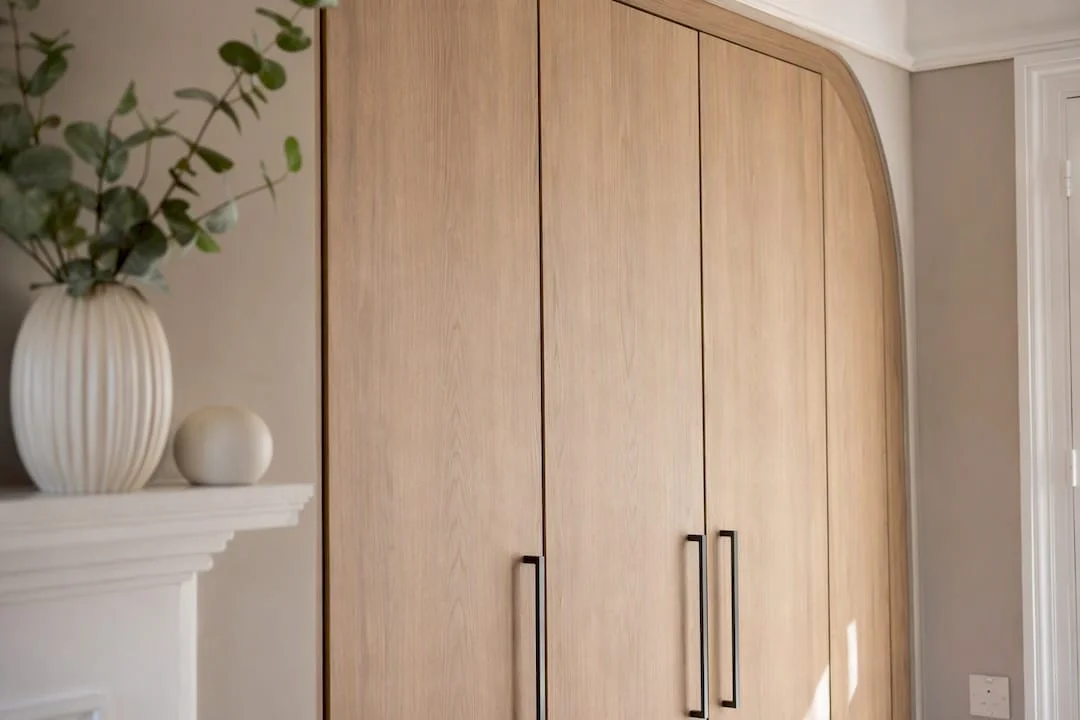
For most period homes, bespoke fitted chimney breast wardrobes beat freestanding furniture, flat-pack alcove units, or leaving the space unused. A full-wall run works best when you want maximum storage and a seamless look; two matching alcove wardrobes suit rooms where you want symmetry either side of a visible chimney breast; a single alcove unit fits when only one recess is usable. Whichever route you choose, the next step is the same.
- Book a measured on-site survey before you commit to a layout
- Ask whether the quote includes scribed panels, not cover strips
- Confirm the warranty and disposal terms in writing
TL;DR:
- Bespoke fitted wardrobes with on-site measurement and scribing outperform flat-pack and freestanding options, especially in irregular period alcoves.
- A full-wall run maximizes storage and provides a seamless look, while matching alcoves preserve period features like fireplaces.
- Accurate multi-point measurement and structural checks, including moisture inspection, are essential to prevent gaps, warping, or damp issues.
- Internal depths of 650 to 680mm offer optimal clearance for hangers and coats, while sliding doors reduce internal space but improve access.
- Choosing a skilled installer who prioritizes precise measurement and bespoke scribing ensures long-lasting fit and finish, backed by clear warranties and old wardrobe disposal.
Table of Contents
- What are the main chimney breast wardrobe layouts?
- How should you handle measurement and structural checks?
- What internal depths and layouts actually work?
- Which materials and finishes suit chimney breast wardrobes?
- What should you budget for cost, timeline and disruption?
- How do you choose the right maker or installer?
- Why Finest Furniture Studio suits this kind of project
- The case for prioritising process over price
- Get a bespoke design visit for your chimney breast
- Key Takeaways
- Sources
- FAQ
What are the main chimney breast wardrobe layouts?
Chimney breasts split a wall into two alcoves, and how you treat that split shapes everything else about the design. Three approaches cover most period properties.
- Full-wall run. The chimney breast disappears behind a continuous bank of wardrobe doors, giving you the most storage and the cleanest sightline. It needs enough depth over the chimney breast itself to keep doors flush, sometimes achieved with stepped or boxed-out carcasses.
- Two matching alcove wardrobes. Built into each recess either side of the chimney breast, these create a symmetrical look while leaving the breast exposed as a feature, useful if you want to keep a fireplace or period surround visible.
- Single alcove or wall-to-end panel. Sometimes only one recess is usable, perhaps because the other holds a window or door. A single fitted unit, finished with a scribed end panel rather than a visible cover strip, still gives a built-in result.
Sliding doors suit full-wall runs particularly well because they avoid door-swing clashes, but they typically eat more internal depth than hinged interior closet doors. A full-width sliding run often delivers more usable storage than two separate sliding alcoves, simply because you are not doubling up on track and frame allowances.
Pro Tip: If you like the idea of sliding doors but the chimney breast projects deep into the room, ask your designer about hinged doors on the shallower sections and sliding on the full-depth run. Mixing systems within one project is common and keeps every section usable.
How should you handle measurement and structural checks?
Skip the tape measure at your peril. Victorian and Edwardian alcoves are rarely square, and a wardrobe built to a single measurement will gap at the skirting, the cornice, or both.
- Insist on multi-point measurement, taken at several heights and depths in each alcove, not just one reading top and bottom
- Ask how the installer plans to scribe panels to the wall’s actual profile, since irregular walls and floors in period houses make precise scribing essential for a genuinely built-in finish
- Check the installer’s approach to floor irregularities, since adjustable plinths and scribed base panels are the standard fix for uneven period floors
- Raise structural concerns early if the chimney has been partially removed upstairs, if you spot large cracks near the breast, or if a lintel looks compromised. That is a job for a structural engineer, not a furniture maker
Moisture is the other check people forget. Chimney breasts often sit against external walls, and fitting timber carcasses directly onto a damp wall traps condensation behind the units. A proper survey should flag damp readings before any wardrobe is designed, not after installation.
What internal depths and layouts actually work?
Depth decisions drive almost everything else in the design, from how coats hang to whether drawers feel usable.
- 600mm is the practical minimum for hanging space, letting shirts and coats clear the door without crushing
- 650 to 680mm is the optimal range, giving proper clearance for padded hangers and coat shoulders
- Sliding door systems reduce usable internal depth compared with hinged doors, because the track and door pack take up space inside the carcass, a trade-off worth weighing against the full-wall depth arithmetic explained by sliding wardrobe specialists
- Where the chimney breast leaves a shallower pocket than the rest of the run, vertical finished boards or shelf stacks turn that narrow space into usable storage rather than dead space
- Internal configurations usually mix full-height hanging, half-height double hanging, shelving, drawers, and shoe storage, arranged around where the chimney breast actually intrudes
- Soft-close hinges, concealed runners, and heavy-duty sliding tracks all cost more upfront but hold their alignment for years rather than months
Get the depth wrong and no amount of clever internal fittings will fix it. A rail set too close to the door simply will not clear hangers.
Which materials and finishes suit chimney breast wardrobes?
- Moisture-resistant MDF is the standard carcass material for most fitted work and holds paint finishes well
- Plywood carcasses cost more but resist warping better in rooms prone to humidity, worth considering for chimney breasts against external walls
- Solid timber suits higher-end joinery and painted doors but needs careful specification near any residual damp
- Painted in-situ doors, laminate finishes, and mirrored panels are the three most common door choices, and a good installer will continue your existing cornice and skirting lines across the new units rather than stopping abruptly at the wardrobe edge
- Sealed backs, breathable finishes, and a small ventilation gap behind the carcass all help manage residual moisture rather than trapping it against the wall
Ask what maintenance the finish needs. Painted doors mark more easily than laminate but touch up more easily too.
What should you budget for cost, timeline and disruption?
Costs for bespoke fitted units vary by size and finish, and fitted wardrobes generally cost more than freestanding or flat-pack furniture, largely because scribing and site-specific joinery take more skilled labour than assembling a standard carcass. Treat any quote you receive as scoped to your alcove dimensions rather than comparing headline figures between suppliers.
- Site survey. A measured visit confirms dimensions, floor levels, and any structural or damp concerns before design begins.
- Production. Bespoke carcasses, doors, and internal fittings are manufactured off-site once the design is signed off.
- Installation. On-site fitting typically runs a matter of days rather than weeks, with scribing and finishing done in place.
Expect some disruption during fitting, dust sheets, and a few days without full use of the room. A reputable installer removes and disposes of your old wardrobe as part of the job, so ask for that in writing alongside the warranty terms before you sign anything.
How do you choose the right maker or installer?
The questions you ask before signing tell you more than the sales brochure ever will.
- How exactly do you measure, and how many points do you take per alcove?
- Will panels be scribed to the wall, or finished with visible cover strips?
- What fixings do you use into masonry, and have you worked on chimney breasts before?
- Can you match existing cornice and skirting profiles across the new units?
Red flags include a quote given without a site visit, no photographs of past chimney-breast projects, and warranty terms that stay vague when you ask for specifics. Trust signals work the other way: documented before-and-after examples, genuine client testimonials, and a clear written policy on both warranty and disposal of your old furniture. Checking independent reviews, such as those published on Trustpilot for fitted-wardrobe providers, is a sensible extra step before you commit.
To compare quotes properly, make sure each one specifies unit depth, the internal fittings included, finish type, whether scribing is quoted or cover strips, and disposal of old furniture. Without that detail, two quotes at different prices may not be describing the same job at all.

Pro Tip: Ask every installer for one photograph of a chimney-breast job that is at least two years old. Fresh installations always look sharp. It’s the two-year-old ones that tell you whether the doors still hang straight and the scribing has held.

Why Finest Furniture Studio suits this kind of project
Finest Furniture Studio builds its chimney breast wardrobes around exactly the process this guide recommends: a measured on-site design visit first, bespoke manufacture to match, and installation typically completed within 7 to 12 days.
- On-site survey and design consultation before any manufacturing begins
- Scribed panels finished to your actual wall profile, not generic cover strips
- A 10-year guarantee on the finished installation
- Old wardrobe removal and disposal included as standard
Explicit warranty terms and disposal of old furniture are the kind of practical detail that reassures homeowners, and both should be requested in writing before any contract is signed.
Past projects range from matching alcove pairs either side of a period fireplace to full mirrored fitted runs across a chimney breast wall, with case studies available for chimney breast alcove wardrobes in London and localised examples for Chiswick alcove cupboards. The studio serves Richmond, Wimbledon, Putney, Kingston, Chiswick, Fulham, Chelsea, Ealing, Twickenham, Barnes, Hammersmith, and Central London, along with New Malden, Maidenhead, and Reading. Book a free design visit to see what your own chimney breast could take.
The case for prioritising process over price
Most guidance on chimney breast wardrobes fixates on layout, depth, and finish, all genuinely useful, but it underplays the one variable that decides whether any of that matters: how the installer measures and scribes. A beautifully specified unit built to a single tape-measure reading will still gap against a bowed Victorian wall.
The conventional advice to “get three quotes and compare price” falls apart here because two quotes rarely describe the same scope of work. One installer’s price includes scribed panels and structural checks near the chimney breast; another’s assumes a straightforward flat-pack fit with cover strips. Comparing those numbers side by side tells you nothing useful.
What I’d prioritise first, before finish, before hardware, before even the layout decision, is the survey process itself. Ask how many measurement points an installer takes and whether scribing is standard or an upcharge. That single question filters out most of the suppliers who will disappoint you, long before you get anywhere near choosing a door finish.
— Aureliu
Get a bespoke design visit for your chimney breast
If you have been weighing up flat-pack alcove kits or a freestanding wardrobe wedged against the chimney breast, neither solves the gap problem the way a scribed, bespoke unit does. Finest Furniture Studio replaces the guesswork of standard-sized furniture with a measured design visit, bespoke manufacture around your exact alcove dimensions, and installation usually finished within 7 to 12 days, including removal and disposal of your old wardrobe.

Whether you need a full-wall run, matching alcove wardrobes, or a single fitted unit, the studio’s custom made wardrobes service covers London and the surrounding areas listed above, backed by a 10-year guarantee. Contact Finest Furniture Studio on 07468 150807, by WhatsApp, or visit 124 City Road, Kemp House, London, EC1V 2NX to arrange your free design visit and get a detailed quote for your chimney breast alcoves.
Key Takeaways
Bespoke fitted wardrobes, measured and scribed on site, consistently outperform freestanding or flat-pack alternatives for chimney breast alcoves.
| Point | Details |
|---|---|
| Choose the right layout | Full-wall runs maximise storage; matching alcove pairs keep the chimney breast visible for symmetry. |
| Insist on multi-point measurement | Period alcoves are rarely square, so scribed panels beat visible cover strips for a built-in finish. |
| Check structure and moisture first | Pause for a structural engineer near removed chimneys, cracks, or damp readings before design proceeds. |
| Plan depth around 650 to 680mm | This range clears hangers comfortably; sliding doors reduce usable internal depth further. |
| Book a design visit with Finest Furniture Studio | Measured survey, scribed panels, 7 to 12 day installation, and a 10-year guarantee, with old wardrobe disposal included. |
FAQ
Is it cheaper to build your own wardrobe or buy one?
A DIY or flat-pack unit costs less upfront, but it rarely fits an irregular chimney breast alcove properly, leaving gaps at the skirting or cornice. Bespoke fitted wardrobes cost more but avoid the wasted space and remedial work that ill-fitting flat-pack units often need.
Can you turn a chimney breast into a cupboard?
Yes, one alcove beside a chimney breast can become a fitted cupboard, or the chimney breast itself can be built around within a full-wall run of wardrobes. A measured survey confirms whether structural or moisture checks are needed first.
What to do with a chimney breast in a bedroom?
The two main options are building fitted wardrobes into the alcoves either side to keep the breast as a visible feature, or running a full-wall wardrobe across the entire wall to conceal it completely. The right choice depends on whether you want to preserve a period fireplace or maximise storage.
Can you put panelling on a chimney breast?
Panelling can be applied directly to a chimney breast as a decorative finish, provided the wall has been checked for damp beforehand. Where a wardrobe run is being fitted alongside, matching the panelling to the wardrobe’s scribed finish and skirting line gives the most cohesive result.

