
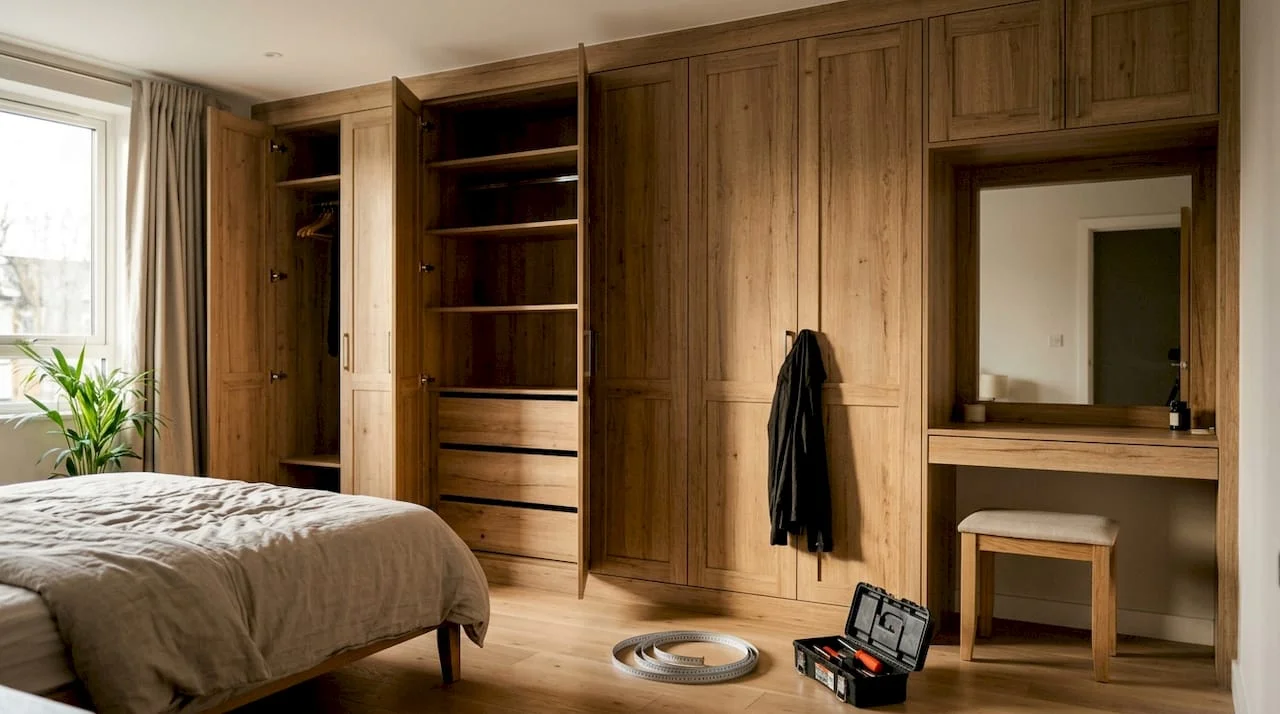
Classic wardrobe design is defined as a furniture tradition built on architectural permanence, traditional joinery, and proportional harmony with the surrounding room. Unlike modular units assembled from standard parts, a classic wardrobe is conceived as a permanent fixture, as integral to the room as its cornicing or skirting boards. Defining classic wardrobe designs means understanding three core principles: structural integrity through frame-and-panel construction, material quality rooted in seasoned hardwoods, and visual coherence with the home’s existing architecture. At Finest Furniture Studio, we work with these principles daily, translating them into bespoke fitted wardrobes for homes across Richmond, Wimbledon, Chelsea, and central London. This guide explains every layer of that tradition, from joinery techniques to seasonal wardrobe curation.
What are the fundamental architectural features of classic wardrobes?
Classic wardrobes prioritise architectural intent, designed as permanent home fixtures with elaborate mouldings and rich wood finishes. That permanence is not decorative ambition. It is structural logic: a wardrobe that reads as part of the room’s architecture will never look dated, because it was never separate from the room to begin with.
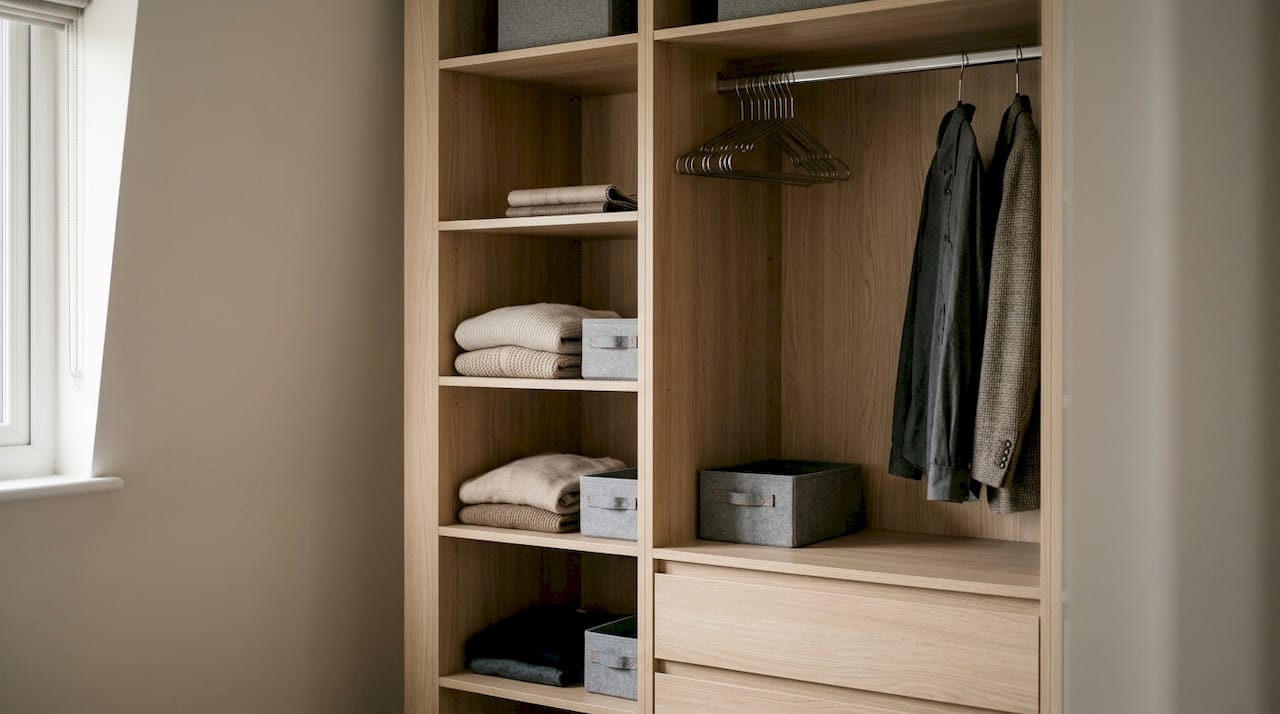
Three elements create that effect: the plinth, the panel, and the cornice. The plinth grounds the piece, visually anchoring it to the floor. The panel provides rhythm across the door face, breaking a flat surface into proportioned sections. The cornice connects the wardrobe to the ceiling line, completing the architectural frame. Classic joinery relies on plinth, panel, and cornice elements, using frame-and-panel construction to allow wood movement, which prevents cracking and adds lasting permanence. Remove any one of these three elements and the piece loses its architectural authority.
Door style is where character becomes most visible. The most recognised options include:
- Shaker doors: recessed flat panel within a square-edged frame; clean, restrained, and suited to both period and transitional interiors
- Raised and fielded panels: the central panel projects slightly from the frame, creating shadow lines that shift with natural light
- Bolection moulding doors: a projecting moulding bridges the frame and panel, adding depth typical of Georgian and Victorian interiors
- Ogee-profile doors: a curved moulding profile that references classical architecture directly
Symmetry governs all of these styles. Classic wardrobes are almost always arranged as mirrored compositions, with a central door or drawer bank flanked by equal sections. That balance is not arbitrary. It reflects the proportional systems used in British domestic architecture from the Georgian period onwards, and it is why a well-made classic wardrobe feels resolved rather than assembled.
Classic wardrobes should complement existing architectural features such as coving and skirting, with cornice scale matched to room mouldings for authentic integration. A cornice that is too shallow in a high-ceilinged Victorian room will look like an afterthought. One that is too deep in a modest Edwardian terrace will overpower the space.
Pro Tip: Match your wardrobe’s cornice profile and depth to the existing ceiling coving before ordering. Bring a photograph and a measurement of the coving depth to your design consultation. This single step separates a wardrobe that looks built-in from one that looks placed.
Which materials and joinery techniques define classic wardrobe quality?
Material selection is the foundation of longevity in classic wardrobe construction. Quartersawn oak is preferred for classic wardrobes due to its stability, and kiln-dried stock is prioritised to avoid warping in heated UK homes. Quartersawing cuts the log radially, so the growth rings run perpendicular to the face. This orientation resists cupping and twisting far better than plain-sawn timber. In a centrally heated London home, where humidity fluctuates significantly between seasons, that stability is not a luxury. It is a practical requirement.
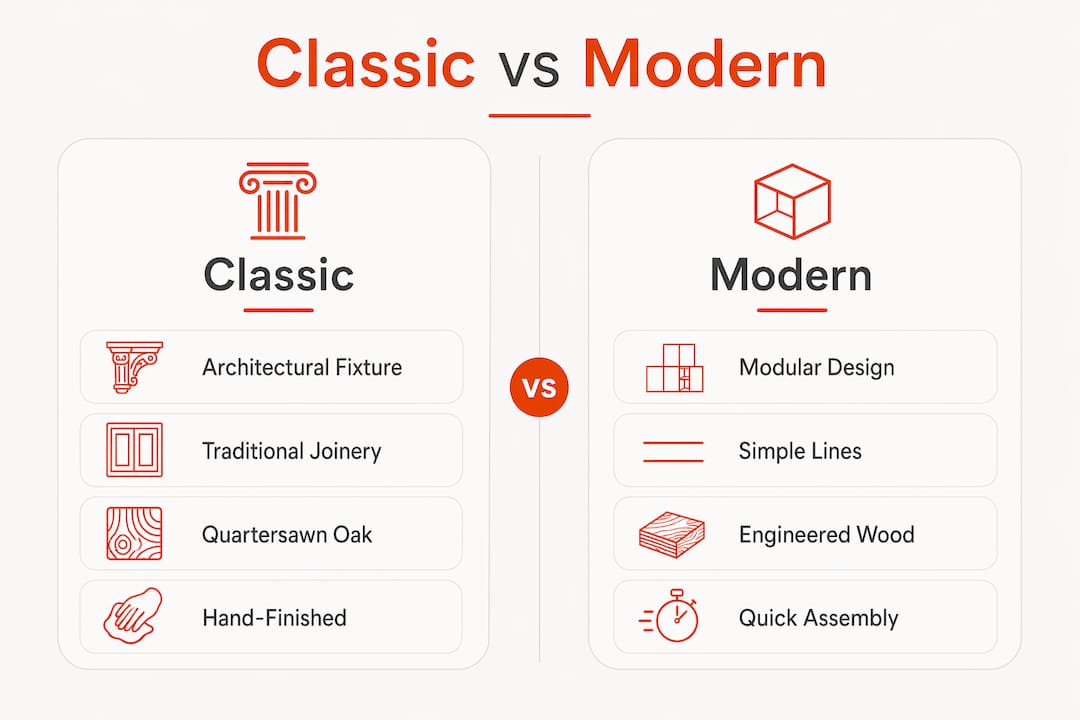
Beyond oak, traditional makers use American black walnut for darker, richer interiors, and painted hardwood frames where a lacquered finish is preferred. The key distinction is always between solid hardwood and engineered substitutes. Solid hardwood can be repaired, re-sanded, and refinished decades later. Most engineered boards cannot.
The joinery technique matters as much as the material. Classic designs rely on frame-and-panel joinery to accommodate natural wood movement, a critical step to avoid cracking that many flat-pack styles cannot replicate. In frame-and-panel construction, the solid wood panel floats freely within a grooved frame. As the wood expands and contracts with seasonal humidity changes, the panel moves without splitting. Mortise-and-tenon joints hold the frame together without relying on adhesive alone, producing a connection that remains tight for generations.
The table below summarises the key material and joinery attributes relevant to classic wardrobe construction.
| Attribute | Traditional classic approach | Practical benefit |
|---|---|---|
| Timber species | Quartersawn oak, walnut, painted hardwood | Dimensional stability across seasons |
| Drying method | Kiln-dried to 8–10% moisture content | Prevents warping in heated interiors |
| Door construction | Frame-and-panel with floating solid panel | Accommodates wood movement without cracking |
| Frame joinery | Mortise-and-tenon, pegged or wedged | Long-term structural integrity without adhesive dependency |
| Surface finish | Hand-applied oil, wax, or lacquer in multiple coats | Depth of finish; repairable and refinishable |
Pro Tip: Ask your maker or fitter for the moisture content reading of the timber batch before installation. Kiln-dried stock should read between 8% and 12% for UK interior conditions. Timber above that range will shrink after fitting, opening gaps at joints and panel edges.
For further guidance on choosing the right materials for your fitted wardrobe, the bespoke material selection guide from Finest Furniture Studio covers the full range of options available in 2026.
How do classic wardrobe designs differ from modern and contemporary styles?
The fundamental difference between classic and modern wardrobes lies in architectural intent versus modularity. Classic wardrobes are designed to integrate with the room. Modern wardrobes are designed to fit within it. That distinction sounds subtle, but it produces entirely different visual results.
Construction time for traditional, custom-built wardrobes is typically over 40 hours due to intricate hand-finishing and joinery, compared to 15–20 hours for modern units. That time difference reflects genuine craft investment. Hand-cut mouldings, fitted cornices, and individually hung doors with traditional hinges all require skilled labour that cannot be replicated by CNC routing alone.
The comparison table below outlines the key contrasts across the most relevant design and construction categories.
| Category | Classic wardrobe | Modern wardrobe |
|---|---|---|
| Design intent | Permanent architectural fixture | Modular, reconfigurable unit |
| Door style | Panelled, moulded, Shaker | Flat slab, handleless, or frameless glass |
| Hardware | Brass or antique iron knobs, cup handles | Integrated push-to-open, brushed steel bar handles |
| Construction time | 40+ hours | 15–20 hours |
| Finish depth | Multi-coat oil, wax, or lacquer | Factory-applied foil or lacquer |
| Repairability | High: surfaces can be refinished | Low: foil and laminate surfaces cannot be re-sanded |
Mixing the two styles requires deliberate restraint. Mixing traditional and contemporary styles must be done cautiously to prevent visual dissonance, with one style dominating to maintain harmony. Victorian mouldings paired with flat-fronted, handleless doors in the same room create a conflict that neither style wins. The solution is not to avoid mixing entirely, but to establish a clear hierarchy.
The most effective approach is to use classic architectural elements as the fixed framework and introduce modern details within that frame. A Shaker-door wardrobe with contemporary brushed brass bar handles, for example, sits comfortably in both a period terrace and a recently renovated flat. The Shaker style itself occupies the middle ground: it is traditional in origin but restrained enough to read as modern in the right context.
The following points summarise where classic and modern wardrobes diverge most sharply in practical terms:
- Longevity: Classic wardrobes, built from solid hardwood with traditional joinery, outlast modular units by decades when properly maintained.
- Repairability: Solid wood surfaces can be sanded, refinished, or repainted. Factory-applied foil and laminate cannot.
- Integration: Classic designs follow the room’s proportional system. Modern units impose their own geometry on the space.
- Cost per year: The higher upfront cost of a classic wardrobe typically produces a lower cost per year of use over a 20-to-30-year lifespan.
The role of bespoke joinery in achieving this level of integration is explored in detail on the Finest Furniture Studio website, with examples drawn from real projects across west London.
How to build a classic wardrobe in your home and personal style
Building a classic wardrobe, whether as a piece of furniture or as a personal clothing collection, follows the same underlying logic: prioritise quality, establish a clear structure, and resist the pull of short-lived trends.
In the context of personal style, the capsule wardrobe is the closest equivalent to classic wardrobe design principles. A 2026 capsule wardrobe system typically includes approximately 30 items, focusing on neutral colour palettes and durable materials to maximise versatility. Thirty items sounds restrictive until you consider that each piece is chosen to work with at least five others. That interoperability is exactly what classic design achieves: every element earns its place through function and proportion, not novelty.
Building a timeless wardrobe involves prioritising quality materials and cost-per-wear over fleeting trends, ensuring durability and lasting style. Cost-per-wear is a straightforward calculation: divide the price of a garment by the number of times you wear it. A well-cut wool overcoat worn 150 times costs far less per wear than a trend-driven piece worn three times before it looks dated.
The following steps apply whether you are building a classic fitted wardrobe for your bedroom or curating a timeless clothing collection within it.
- Audit what you already own. Identify the pieces you reach for repeatedly. These are your anchors. Everything else is a candidate for removal.
- Establish a neutral base. Classic clothing essentials centre on black, white, navy, camel, and grey. These colours work across seasons and require no coordination effort.
- Invest in structure first. For clothing, this means tailored pieces: a well-cut blazer, a straight-leg trouser, a quality shirt. For the wardrobe itself, this means the carcass, the joinery, and the door style before considering internal fittings.
- Add seasonal layers, not seasonal replacements. Wardrobe basics for every season are built by adding lightweight linens in spring and heavier wools in autumn, not by replacing the core collection twice a year.
- Match internal storage to actual behaviour. Classic fitted wardrobes should be designed around how you dress, not around a generic interior layout. If you own more folded knitwear than hanging suits, specify more shelving and fewer hanging rails.
- Review annually. Timeless wardrobe design is an ongoing curation prioritising quality and functional elegance rather than a one-off project. The same principle applies to a fitted wardrobe: revisit the interior configuration as your storage needs change.
For homes in Putney, Kingston, Twickenham, and Barnes, where period architecture is common, the internal layout of a classic fitted wardrobe often needs to accommodate both hanging garments and folded storage in equal measure. Finest Furniture Studio designs each interior around the client’s actual wardrobe contents, not a standard template. The expert wardrobe designers in west London page shows how that process works in practice.
Key takeaways
Classic wardrobe design delivers lasting value through architectural integration, traditional joinery, and material quality that modern modular units cannot replicate.
| Point | Details |
|---|---|
| Architectural integration | Match cornice, plinth, and panel scale to existing room mouldings for a built-in appearance. |
| Material stability | Specify kiln-dried quartersawn oak to prevent warping in centrally heated UK homes. |
| Joinery longevity | Frame-and-panel construction with mortise-and-tenon joints outlasts flat-pack alternatives by decades. |
| Style hierarchy | When mixing classic and modern elements, let one aesthetic dominate to avoid visual dissonance. |
| Capsule principle | Apply the 30-item capsule logic to both clothing and wardrobe design: every element must earn its place. |
Why classic wardrobe design is worth the investment, in my view
I have spent years working with clients across London who arrive at a design consultation having already bought and discarded at least one flat-pack wardrobe. The conversation is always the same. The unit looked fine in the showroom. At home, it looked like furniture that had been placed in a room rather than built for it. The cornice was too shallow. The doors bowed slightly after the first winter. The laminate chipped at the corners within two years.
The mistake is not choosing modern over classic. The mistake is choosing on price per unit rather than cost over time. A well-made classic wardrobe, built from kiln-dried hardwood with proper frame-and-panel doors, will still be in service when the house changes hands. That is not sentiment. It is a practical calculation.
What I find most underestimated is the effect of scale. Clients often focus on door style and finish colour, which are important, but the cornice depth and plinth height are what determine whether the wardrobe reads as furniture or as architecture. Get those proportions right and the finish almost does not matter. Get them wrong and no amount of beautiful timber will save the piece.
My honest advice: spend the design time on proportion before you spend money on materials. Measure your ceiling height, your coving depth, and your skirting board height. Bring those numbers to your designer. At Finest Furniture Studio, that is where every bespoke project begins, and it is the single step that separates a wardrobe that looks right from one that merely looks expensive.
— Aureliu
Finest Furniture Studio: bespoke classic wardrobes for London homes
Finest Furniture Studio designs and manufactures bespoke fitted wardrobes, walk-in closets, and loft wardrobes for homes across Richmond, Wimbledon, Chelsea, Fulham, Chiswick, and central London. Every project begins with a free design visit, where we measure your space and discuss the architectural features that will define the finished piece.
Our fitted wardrobes are built from quality materials, with cornice, plinth, and panel profiles matched to your room’s existing mouldings. Fitting is completed within 7–12 days, and we remove and dispose of your old wardrobe as part of the service. Every installation carries a 10-year quality guarantee. For homes in west London, the bespoke wardrobes west London guide covers the full range of options available. Call us on 07468 150807, message us on WhatsApp, or visit us at 124 City Road, Kemp House, London, EC1V 2NX to arrange your free consultation.
FAQ
What is the definition of a classic wardrobe design?
A classic wardrobe design is a fitted furniture piece built on architectural principles: plinth, panel, and cornice elements that integrate with the room’s existing mouldings. It uses traditional joinery and solid hardwood to create a permanent, proportionally resolved fixture rather than a modular storage unit.
What wood is best for a classic fitted wardrobe?
Quartersawn oak is the preferred choice for classic wardrobes due to its dimensional stability. Kiln-dried stock, brought to 8–10% moisture content, resists warping in centrally heated British homes.
How long does it take to build a classic wardrobe?
Traditional, custom-built wardrobes typically require over 40 hours of construction time due to hand-finishing and intricate joinery. This compares to 15–20 hours for modern modular units.
Can I mix classic and modern wardrobe styles?
Mixing styles is possible but requires one aesthetic to dominate. Pairing a Shaker-door wardrobe with contemporary hardware works well. Combining Victorian mouldings with flat-fronted handleless doors in the same piece creates visual conflict.
How many items should a classic capsule wardrobe contain?
A well-structured capsule wardrobe contains approximately 30 items, built around neutral colours such as black, white, navy, and grey. Each piece is chosen to work across multiple outfits and seasons, reflecting the same principle of versatility that defines classic wardrobe design.

