
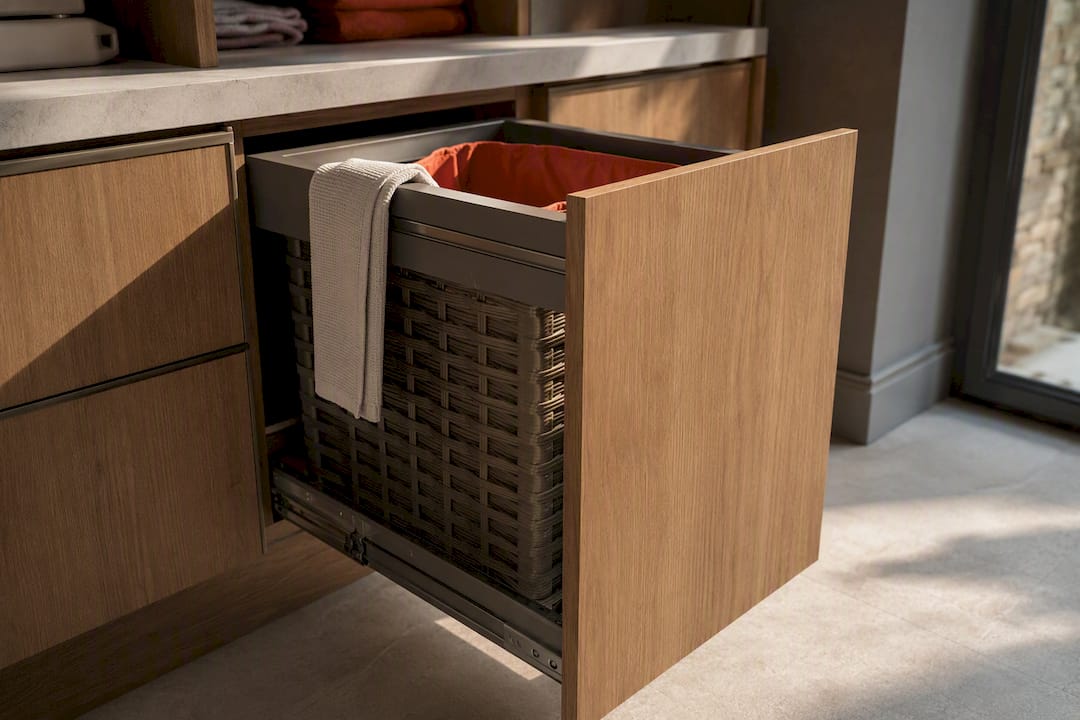
If your cabinet offers at least 475mm of internal depth and a clear 450–457mm width, a pull-out or tilt-out module is usually the fastest, cheapest fix. If it doesn’t, or the box isn’t sound, a bespoke built-in hamper specified by a joiner is the better route. Either way, start with a tape measure: internal width, internal depth, and door type decide everything that follows.
TL;DR:
- Most cabinets need at least 457mm internal width and 475mm depth to accommodate laundry hampers, with deeper cabinets preferred for full extension.
- Retrofit kits suit sound cabinets with standard sizes and minimal depth or structural issues, usually installing within a single day.
- Bespoke joinery is recommended for unusual, shallow, or damaged cabinets, or when matching existing finishes and ventilation are priorities.
- Laundry baskets typically hold 40 to 50 liters, suitable for several days’ laundry for one or two people.
- Proper hardware, such as heavy-duty, soft-close runners and Hinges rated for frequent use, is essential for durability and should be specified with warranty considerations.
Table of Contents
- What size cabinet do you need for integrated laundry hampers?
- Can you retrofit an existing cabinet or do you need a new build?
- What materials and ventilation stop mildew and odour buildup?
- How many compartments do you actually need?
- What hardware makes an integrated hamper last?
- What does an integrated hamper cost, and how long does it take?
- What do installers actually see on-site?
- Why bespoke joinery usually wins for built-in hampers
- How Finest Furniture Studio designs and fits integrated hampers
- Sources
- FAQ
What size cabinet do you need for integrated laundry hampers?
Integrated laundry hampers are built around standard cabinet widths: 300mm, 450mm, 500mm and 600mm. Each width suits a different job.
- 300mm modules fit a single narrow sorter, often tucked beside a sink unit where space is tight.
- 450mm is the most common single-basket width, matching standard base cabinets.
- 500mm gives a little extra room for a deeper liner or a slightly larger basket without demanding a full 600mm run.
- 600mm is the workhorse size for twin or triple sorting compartments, since it matches a standard base unit.
Most trade modules need a minimum clear internal width of roughly 457mm and an internal depth starting around 475 to 485mm. Anything tighter and the basket won’t clear the door swing or the carcass sides. Depth matters more than most homeowners expect: many pull-out wardrobe baskets are built to a nominal 485mm depth, so a shallower cabinet will foul the back panel before the runner reaches full extension.
To check your own cabinet, measure the clear internal width between the side panels, the depth from the front face to the back panel, the toe-kick height if the basket needs to clear it, and whether the door is hinged or a simple face frame, since tilt-out fronts need different hardware to full pull-out baskets.
Can you retrofit an existing cabinet or do you need a new build?
Not every cabinet is a candidate. Run through this before you order anything:
- Check the box is structurally sound. Chipboard carcasses that have swelled from damp, or flimsy flat-pack sides, won’t hold a laden basket reliably.
- Confirm internal depth. You need at least 475–485mm clear, plus a little extra for runner hardware.
- Identify the door type. Hinged doors suit tilt-out baskets; a full cabinet opening suits a pull-out on drawer runners.
- Inspect existing hinges and fixing points. Worn or stripped screw holes usually mean new fixing points, not just a new basket.
- Choose your kit. Match runner load rating and basket depth to the measurements you’ve taken.
- Install and test. Fit the runners square, mount the basket, then run it through several full open and close cycles before loading it.
- Adjust. Most runner systems have depth and height adjustment screws, worth using before you call the job finished.
If the carcass is unsound, the depth falls short, or the door geometry is unusual (an angled reveal, a mirrored front, an odd stud position), that’s the point to call a joiner rather than force a retrofit kit. Bring photos of the cabinet interior, the door swing, and exact width and depth measurements to that conversation. It saves a wasted site visit.
What materials and ventilation stop mildew and odour buildup?
Laundry sits wet, sometimes for hours, before it’s washed. That makes material choice and airflow more important here than in almost any other piece of fitted storage.
- Powder-coated wire baskets are the most common trade choice: they shed moisture fast and resist rust better than bare steel.
- Ventilated polymer tubs work well for softer loads and are easy to wipe down.
- Machine-washable fabric liners add a hygiene layer you can pull out and wash on a hot cycle.
Ventilation matters as much as the basket itself. Perforated back panels, small grille slots, or even a discreet gap under the plinth let humid air escape rather than settle against the cabinet back, and joinery guidance consistently recommends vented rear panels specifically to reduce mildew risk without disturbing the cabinet’s appearance.
Pro Tip: Pull liners out and air the basket for an hour after washing day. It costs nothing and does more for odour control than any deodoriser block.
How many compartments do you actually need?
Single-basket modules suit a couple or a smaller household with one wash routine. Twin compartments let you separate darks and lights, or adults’ and children’s laundry, without a second trip downstairs. Triple sorters, usually built into a 600mm run, suit larger families who separate colours, whites and delicates as a matter of course.
Capacity scales with width: many pull-out baskets in 450 to 600mm modules hold roughly 40 to 50 litres each. A rough guide for estimating your own need: a single adult generates about one full 40 litre basket a week; a family of four fills two or three in the same period. If that sounds like more baskets than your utility room has floor space for, a single multi-compartment 600mm module can replace several freestanding baskets at once.

Liner choice affects hygiene as much as sorting does. Washable fabric liners are easiest to keep fresh; polymer tubs wipe clean but don’t breathe as well; removable drawstring bags are the simplest to empty straight into the machine.
What hardware makes an integrated hamper last?
The hardware you specify matters more here than in almost any other cabinet fitting, because wet laundry is heavy and the basket gets used daily.
- Full-extension, soft-close, heavy-duty runners are the standard specification, because damp laundry adds real load stress that lighter hardware wasn’t built for.
- Avoid basic roller runners on anything carrying a full laundry load; they wear and sag faster than ball-bearing runner systems.
- Tilt-out fronts need hinges rated for repeated daily cycling, not decorative cabinet hinges.
Installer experience backs this up directly: trade guidance recommends full-extension, soft-close, heavy-duty runners precisely because damp laundry increases load stress and causes cheaper runners to fail early. Ask your fitter for the runner’s load rating in writing, and confirm what warranty covers the hardware separately from the joinery.
What does an integrated hamper cost, and how long does it take?
Retrofit kits are the budget option. Costs depend mainly on basket type, runner quality and whether you’re paying for labour or fitting it yourself, with better-rated runners adding noticeably to the price of a basic kit.
- Retrofit kits: lower cost, quick to source, limited by your existing cabinet’s dimensions.
- Bespoke units: higher cost, but built to your exact opening, finish and door style.
- Factors that push bespoke pricing up include matched wood-effect or Shaker-style fronts, an integrated benchtop, or a nearby sink or worktop that needs coordinating.
Timeline is where the two routes really diverge. A retrofit kit can often be fitted in a single visit once measurements are confirmed. A bespoke joinery project, from design visit through manufacture to fitting, typically runs to a defined installation window once measurements are locked in, which is where a fitter working to a 7 to 12 day installation timeframe has a clear advantage over ad hoc joinery quotes.
What do installers actually see on-site?
On real jobs, the same few issues come up repeatedly. Cabinets measured “roughly” 450mm often turn out 15 to 20mm short once the door lining is accounted for, which is why we always remeasure on-site rather than trust a client’s tape measure alone. Adding a vent slot under the plinth is the most common fix we make for older utility cabinets that were never built with laundry storage in mind. Reinforcing the base of an existing carcass before fitting heavy-duty runners is the second most common.
Before a design visit, it helps to have photos of the cabinet interior, appliance model numbers if the hamper sits near a washer or dryer, and your own width and depth measurements. Aureliu and the team at Finest Furniture Studio use exactly this information to confirm on-site whether retrofit or bespoke is the right call.
Why bespoke joinery usually wins for built-in hampers
Off-the-shelf retrofit kits are honest, sensible products, and for a sound cabinet with the right depth, they’re often the right call. But most homes weren’t built with laundry sorting in mind, and that’s where bespoke joinery earns its cost.
A bespoke hamper is built to the opening you actually have, not the nearest standard size. That means the finish matches your existing wardrobe or utility cabinetry exactly, ventilation is designed in rather than retrofitted as an afterthought, and the runners and hinges come with a proper warranty attached to the whole unit, not just the basket.
If your cabinet is a standard width and sound, buy the kit. If it’s an awkward alcove, an odd depth, or you want it to disappear into a wider fitted utility room design, measure up and book a design visit before you commit to either route.
— Aureliu
How Finest Furniture Studio designs and fits integrated hampers
Finest Furniture Studio builds laundry hampers into fitted wardrobes, utility cabinets and under-stair storage, cut to your exact opening rather than a standard module size. That matters most in the awkward spaces retrofit kits can’t reach: a shallow alcove, a sloped ceiling, or a run that needs to match existing Shaker or wood-effect fronts elsewhere in the house.

A design visit starts with a full site measure, covering internal width, depth and door swing, and ends with a fixed quote and visuals of the finished unit. Installation typically runs 7 to 12 days from confirmed design, backed by a 10-year guarantee on the joinery. We’ll also take away and dispose of your old wardrobe or basket unit, so there’s nothing left for you to deal with. Our services cover Richmond, Wimbledon, Putney, Kingston, Chiswick, Fulham, Chelsea, Ealing, Twickenham, Barnes, Hammersmith, Central London and surrounding areas.
If your utility room, bedroom or under-stair space needs a hamper built into a wider bespoke wardrobe project, get in touch for a free design visit. Call or WhatsApp 07468 150807, or visit us at 124 City Road, Kemp House, London, EC1V 2NX.

Sources
Dimension and depth figures in this guide draw on trade technical pages for pull-out laundry and wardrobe baskets, including KWSMPOLA’s product specification and Fiteo’s pull-out wardrobe wire basket details. Capacity figures come from Gamma Fittings’ compact pull-out laundry basket listing. Hardware and runner recommendations reference Blum’s trade runner guidance, while ventilation and liner advice draws on Joyce Kitchens’ laundry storage guide. Readers planning a larger utility remodel may also find this rear extension with utility case study a useful reference point.
- KWSMPOLA product technical details (PWS)
- Pull-out wardrobe wire basket with roller runners (Fiteo)
- Pull-out laundry basket COMPACT (Gamma Fittings)
- Hardware guidance and trade-runner recommendations (Blum kit resource)
FAQ
What is the minimum cabinet width for an integrated laundry hamper?
Most trade modules need a clear internal width of around 457mm, with standard cabinet widths of 300mm, 450mm, 500mm and 600mm covering the vast majority of installations.
How deep does my cabinet need to be for a pull-out laundry basket?
Aim for at least 475 to 485mm of internal depth, with 500 to 520mm preferred where full-extension runners need clearance to open fully.
Can I retrofit a laundry basket into my existing wardrobe or cabinet?
Yes, provided the carcass is structurally sound and meets the minimum width and depth thresholds; if it doesn’t, a bespoke unit built to your exact opening is the better option.
How much laundry does a typical integrated hamper hold?
Most pull-out baskets in 450 to 600mm modules hold roughly 40 to 50 litres, enough for several days of laundry for one or two people.
How long does it take to install a bespoke integrated laundry hamper?
A retrofit kit can often be fitted in a single visit, while a bespoke joinery project through Finest Furniture Studio typically completes within a 7 to 12 day installation window once measurements are confirmed.
Recommended
- Custom Understairs Storage UK: The 2026 Guide to Maximising Hallway Space
- Custom Understairs Storage UK: The Ultimate How-To Guide for West London Homeowners
- Bespoke Understairs Pull-Out Drawers: The 2026 Guide to Maximising Hallway Space
- Clever Understairs Storage in Hammersmith: 5 Bespoke Examples to Transform Your Hallway

