
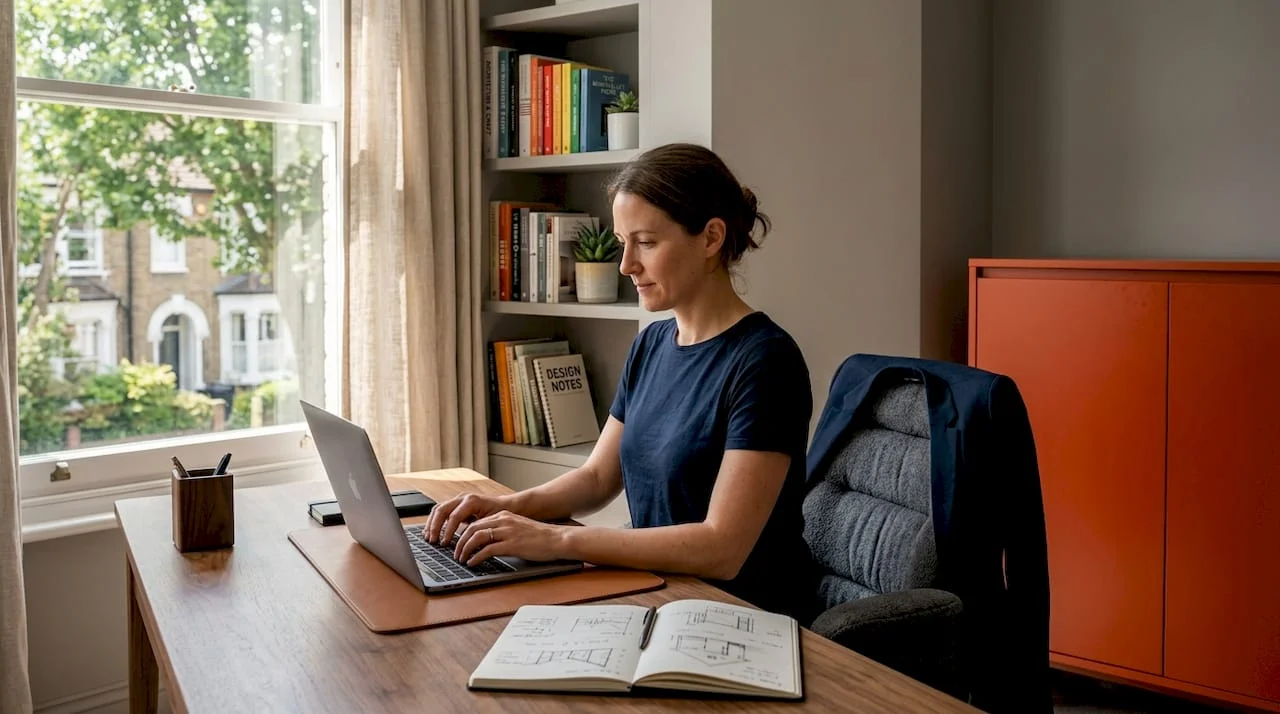
Creating a home office that is genuinely luxurious, highly functional, and entirely your own is one of the most rewarding design challenges a West London homeowner can face. The stakes are high: your workspace must project confidence, support long working hours in comfort, and integrate seamlessly with the refined aesthetic of the rest of your home. This guide walks you through the essential furniture types, the criteria that separate truly bespoke pieces from merely expensive ones, and the practical decisions that will shape a workspace you are proud to spend time in every day.
Table of Contents
- How to evaluate luxury home office furniture
- Statement desks: Centrepiece and command
- Storage solutions: Bespoke cabinetry and shelving
- Seating: Ergonomic luxury for peak productivity
- Summary comparison: Choosing the right blend for your space
- The real secret to a truly bespoke home office
- Bring your home office vision to life with bespoke solutions
- Frequently asked questions
Key Takeaways
| Point | Details |
|---|---|
| Prioritise craftsmanship | The best home office furniture seamlessly combines superior materials, ergonomic comfort, and bespoke design. |
| Choose with intent | Intentional selection of desks, seating, and storage elevates both the workspace and your productivity. |
| Integration is key | A truly luxurious office is defined by how well its furniture integrates style and functionality. |
| Custom solutions excel | Bespoke designs maximise space and express personal taste, unlocking the full potential of your home. |
How to evaluate luxury home office furniture
Now that you understand the importance of matching furniture to your lifestyle and status, let us outline the critical criteria for making discerning choices.
Selecting luxury home office furniture is not simply about choosing the most expensive option in a catalogue. It requires a structured approach that weighs several interconnected factors. When we work with clients across Kensington, Chelsea, and Notting Hill, we consistently return to four core criteria:
- Ergonomics: Does the piece support healthy posture and reduce physical strain over extended working sessions?
- Space efficiency: Does it make intelligent use of your room’s proportions, or does it impose on the space?
- Material quality: Are the materials durable, sustainably sourced, and appropriate for a premium interior?
- Technology integration: Can the piece accommodate screens, cable management, charging points, and smart home connectivity without visible clutter?
Beyond these practical considerations, aesthetic fit and bespoke craftsmanship are what truly elevate a piece from functional to exceptional. A desk that has been designed around your exact dimensions, preferred finish, and workflow is a fundamentally different object from one selected off a showroom floor. Understanding the pros and cons of wood and metal is an important early step, because material choice underpins every other decision.
It is also worth understanding how professional reviewers assess furniture. Desk stability and finish quality are the benchmarks most commonly used in comparative reviews, alongside practical features such as cable management doors and height presets. These are useful reference points, but luxury design goes further: it prioritises the integration of a piece into its environment, the quality of its joinery, and the longevity of its finish under daily use.
“True bespoke design is not about selecting premium products from a list. It is about creating furniture that could only exist in your specific space, for your specific life.”
Pro Tip: Before visiting any furniture studio, photograph your office space from multiple angles and note the dimensions of every wall, window, and door. This single step saves significant time during the design consultation and ensures recommendations are grounded in reality from the outset.
Statement desks: Centrepiece and command
With selection criteria in place, we begin with the signature piece of any home office: the statement desk.
The desk is where your working day begins and ends. In a luxury home office, it must do considerably more than provide a flat surface. It sets the visual tone for the entire room and communicates something about how you work and who you are. There are four main desk types worth considering:
- Executive desks: Large, traditionally styled, often crafted from solid walnut, oak, or lacquered hardwood. These command authority and suit formal, document-heavy work styles.
- Sit-stand desks: Height-adjustable frames with premium surface materials. Desk stability and build quality are especially important here, as lesser mechanisms develop wobble over time.
- Custom integrated desks: Designed as part of a wider fitted unit, incorporating shelving, cabinetry, and cable management into a single cohesive piece. Ideal for maximising both function and visual coherence.
- Floating or hidden desks: Wall-mounted designs that fold away when not in use, preserving the aesthetic of a room that serves multiple purposes.
Key features to look for across all desk types include a generous working surface of at least 160cm in width for multi-screen setups, discreet cable management channels, and premium material finishes such as oiled walnut, honed marble inserts, or powder-coated steel frames. Storage drawers with soft-close mechanisms and concealed compartments for documents or devices add further refinement.
Ergonomics matter even at the highest price points. A desk that is too low forces you to hunch; one that is too high strains your shoulders. For integrated or custom designs, we always recommend specifying the exact working height based on your seated posture, rather than accepting a standard dimension. Considering your desk material considerations early in the process ensures the final piece is both beautiful and practical.
Pro Tip: If you use dual monitors, specify a desk with a recessed monitor shelf at the rear. This brings screens to eye level without requiring a separate stand, keeping your desk surface clear and the overall look uncluttered.
Storage solutions: Bespoke cabinetry and shelving
Complementing your desk are intelligent storage solutions tailored to your exact organisational needs.

Storage is where many home offices fall short. Generic shelving units and freestanding bookcases rarely make efficient use of available wall space, and they seldom complement a carefully considered interior scheme. In a luxury context, storage should be invisible when not needed and intuitive when it is. Custom build quality and finish are just as important for cabinetry as they are for desks.
The main storage categories for a bespoke home office are:
- Built-in cabinetry: Floor-to-ceiling fitted units that maximise every centimetre of wall space. These can incorporate open display shelves, closed cupboards, filing drawers, and even concealed safes or document vaults for security.
- Modular shelving systems: Flexible units that can be reconfigured as your needs change. Premium modular systems use solid timber or lacquered MDF with adjustable shelf pins and concealed fixings.
- Floating shelves: Wall-mounted shelves that create an open, airy feel. Best suited to display items and frequently accessed reference materials rather than bulk storage.
- Hidden vaults and security storage: Increasingly popular among our West London clients, these are concealed within cabinetry and secured with biometric or electronic locking mechanisms.
The choice between built-in and modular storage depends largely on how permanent your office arrangement is likely to be. Built-in cabinetry offers superior visual integration and typically higher storage capacity, but it is a fixed investment. Modular systems offer adaptability. Exploring the range of available furniture material finishes helps ensure your storage units complement your desk and seating without creating a mismatched, showroom feel.
| Storage type | Space efficiency | Customisability | Style impact |
|---|---|---|---|
| Built-in cabinetry | Excellent | Very high | Very high |
| Modular shelving | Good | High | Medium to high |
| Floating shelves | Medium | Medium | High |
| Freestanding units | Low to medium | Low | Low to medium |
| Hidden vaults | Excellent | High | Seamless |
This comparison makes clear that built-in cabinetry consistently outperforms other options when both function and aesthetics are priorities. For clients with compact offices, a combination of built-in lower cabinetry and floating upper shelves often delivers the best balance.
Seating: Ergonomic luxury for peak productivity
After storage, seating is the key factor for both long-term health and a sophisticated work environment.
Your chair is the piece of furniture you interact with most directly, for the longest periods. It is also the piece most likely to be compromised in the name of aesthetics. We see this regularly: a beautifully appointed office let down by a chair that looks the part but fails to support the spine after an hour of use. The good news is that ergonomic excellence and visual refinement are no longer mutually exclusive. Luxury seating balances comfort with bespoke finishes, and the best manufacturers now offer both.
The main seating options for a luxury home office include:
- Ergonomic executive chairs: Adjustable lumbar support, armrest height, seat depth, and recline tension. Look for chairs with a minimum five-year warranty on mechanisms and upholstery options in full-grain leather or premium wool.
- Custom upholstered armchairs: For offices that double as reading rooms or meeting spaces, a pair of beautifully upholstered armchairs adds warmth and versatility. These work best when positioned away from the primary desk, creating a distinct zone for informal conversations.
- Saddle stools and kneeling chairs: Increasingly favoured by clients who alternate between sitting and standing throughout the day. These suit sit-stand desk setups particularly well.
- Statement occasional chairs: A single sculptural chair in a contrasting fabric or finish can anchor a corner of the room and signal that the space was designed with intention.
Material selection for seating is critical. Full-grain leather ages beautifully and is exceptionally durable, but it requires conditioning and can feel cold in winter. Premium wools and boucle fabrics offer warmth and texture, and they photograph exceptionally well. For clients who work long hours, we recommend exploring choosing home office seating with a focus on lumbar support first and upholstery second.
Pro Tip: When testing a chair, sit in it for at least 20 minutes before committing. The first five minutes rarely reveal the pressure points that emerge during a full working session. Any reputable luxury furniture supplier will accommodate this.
Summary comparison: Choosing the right blend for your space
Having explored each major furniture type, a side-by-side comparison helps clarify the best fit for your needs.
The following table brings together the key attributes of desks, storage, and seating to support a holistic decision. It also highlights where luxury and bespoke priorities diverge from the practical benchmarks used in standard furniture reviews. Design priorities influence what matters in choosing office furniture, and understanding those priorities upfront saves time and budget.
| Furniture type | Luxury priority | Review priority | Key decision factor |
|---|---|---|---|
| Executive desk | Material finish, bespoke sizing | Stability, cable management | Working style and room scale |
| Sit-stand desk | Mechanism quality, surface material | Height range, wobble at max height | Health goals and desk usage |
| Built-in cabinetry | Integration, joinery quality | Storage capacity, accessibility | Room permanence and volume of storage |
| Ergonomic chair | Upholstery, visual harmony | Adjustability, lumbar support | Hours spent seated per day |
| Occasional seating | Fabric, form, and placement | Comfort over time | Room function beyond solo work |
| Floating shelves | Visual lightness, material finish | Load capacity, fixing quality | Display versus functional storage needs |
This comparison makes one thing clear: there is no single correct answer. The right blend depends on how you work, how long you spend in the space, and how important the room’s visual identity is to you. For most of our West London clients, the answer involves a custom integrated desk, built-in cabinetry, and a high-specification ergonomic chair, supported by occasional seating for client meetings or reading.
The real secret to a truly bespoke home office
We have worked with enough clients to know that the most common mistake in luxury home office design is focusing too heavily on individual statement pieces. A £12,000 executive desk placed in a room with mismatched shelving and a generic chair does not feel luxurious. It feels incomplete.
True luxury emerges from intentional cohesion. Every element, from the desk surface to the drawer pulls, from the chair upholstery to the shelf edge profile, should feel as though it was designed as part of a single considered whole. This is what separates a bespoke interior from an expensive one.
We worked recently with a client in Holland Park who had already purchased a beautiful walnut desk before approaching us. The desk was exceptional in isolation, but the room felt disconnected. Rather than replacing the desk, we designed fitted cabinetry that matched the walnut tone exactly, introduced floating shelves with a complementary oak edge detail, and specified a chair upholstered in a warm cognac leather that drew out the amber tones in the wood grain. The transformation was significant, and it came not from extravagant new purchases but from bespoke design insights applied to what was already there.
The practical lesson is this: prioritise your design journey before your shopping list. Understand how you work, what the room needs to feel like, and how each piece relates to the others. Craftsmanship and custom integration are what luxury sources consistently emphasise, and that emphasis is well placed. A room designed with intention will always outperform one assembled from individually impressive parts.
Bring your home office vision to life with bespoke solutions
If you are ready to curate a workspace as refined as your West London home, working with a specialist studio makes all the difference. At Finest Furniture Studio, we bring together expert design consultancy, premium materials, and skilled craftsmanship to create home offices that are genuinely tailored to your needs, your space, and your aesthetic.

Our process begins with a detailed consultation, where we listen to how you work and what matters most to you. From there, we design and install bespoke home office furniture that integrates every element into a cohesive, functional, and visually refined whole. With installation typically completed within seven days and transparent pricing from the outset, we make the journey from concept to completed office as smooth as possible. We would love to help you create a space that truly reflects your standards.
Frequently asked questions
What materials are best for luxury home office furniture?
Premium woods and metals such as solid walnut, oak, brushed steel, and lacquered hardwood offer the best combination of durability, longevity, and sophisticated visual appeal in a luxury office setting.
How can I maximise space in a small home office?
Custom storage integration and fitted desks designed around your exact room dimensions make the most efficient use of compact spaces without compromising on quality or style.
Are sit-stand desks suitable for a luxury home office?
Yes, bespoke sit-stand desks with premium surface materials and high-quality lifting mechanisms can be designed to complement any high-end interior while delivering genuine health and productivity benefits.
What role does bespoke design play in office furniture?
Bespoke design ensures every piece is proportioned, finished, and positioned to suit your specific space and working habits, creating a cohesive office environment that a standard furniture range simply cannot replicate.

