

The luxury furniture crafting process is defined as a structured, multi-stage discipline that transforms raw materials into bespoke, handcrafted pieces built to precise client specifications and enduring quality standards. Unlike mass-produced furniture, this process combines artisanal furniture making with engineering rigour, covering every stage from initial client consultation through material selection, joinery, finishing, and final delivery. At Finest Furniture Studio, we apply these same principles to bespoke fitted wardrobes, TV media walls, and loft storage solutions across West London. A complete bespoke production cycle typically spans 8–12 weeks from consultation to delivery. That timeline reflects the depth of care built into every stage.
What are the essential materials for luxury furniture crafting?
Material selection is the foundation of every high-end furniture design decision. The wrong timber, fabric, or hardware will undermine even the most skilled joinery. Getting this stage right protects every hour of work that follows.
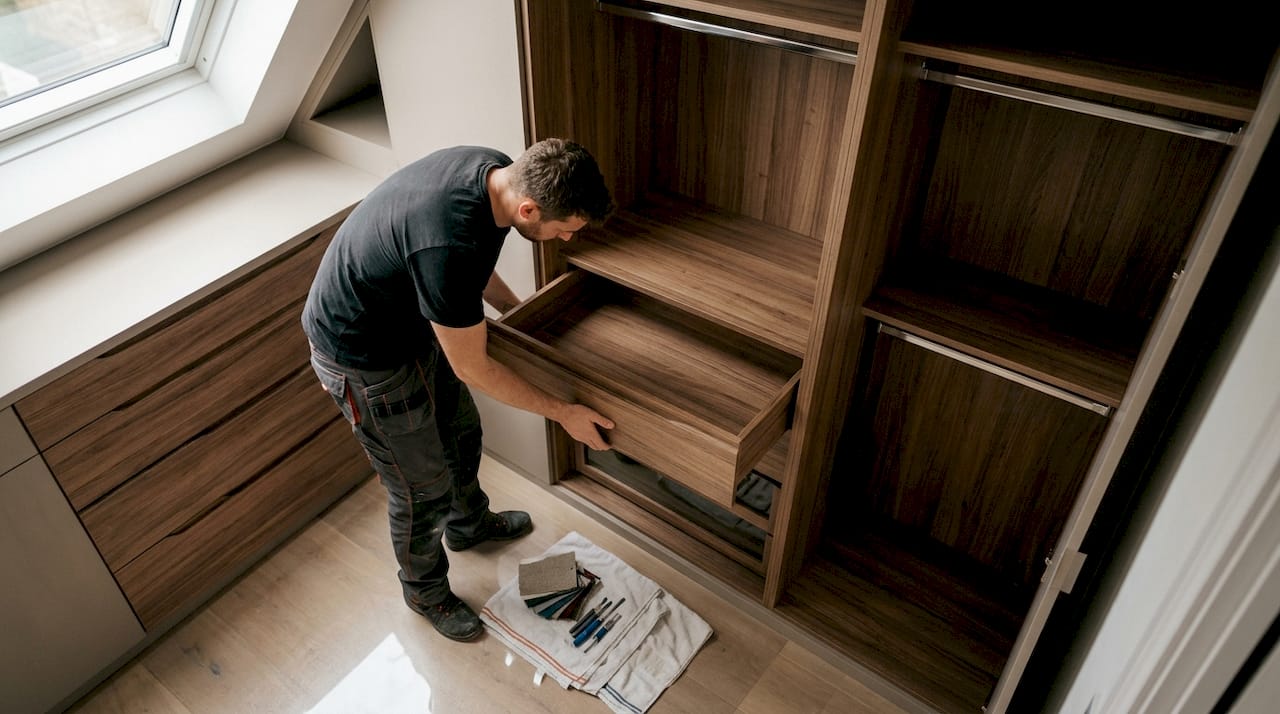
Timber and structural materials
Kiln-dried wood at 8–10% moisture content is the industry standard for structural components in luxury furniture. Wood at this moisture level is dimensionally stable, which means it resists warping, splitting, and shrinkage after installation. In London’s humid climate, using undried or improperly seasoned timber is one of the most common causes of premature furniture failure.
Hardwoods such as oak, walnut, and ash are the most widely used species in bespoke furniture techniques. Each species carries distinct grain patterns, density ratings, and finishing characteristics. Walnut, for example, accepts oil finishes exceptionally well and develops a rich patina over decades. Oak offers greater structural density, making it the preferred choice for load-bearing frames and wardrobe carcasses.
Large artisanal workshops turn over their lumber inventory approximately every 2.5 months, which reflects both the volume of production and the commitment to using freshly dried, well-managed stock. Responsible sourcing from sustainably managed forests is now a baseline expectation in the luxury tier. You can read more about responsible material sourcing and how it affects finished quality.
Fabrics, leather, and hardware
Upholstery materials require the same level of scrutiny as structural timber. Full-grain leather, performance-grade linen, and woven velvets are the standard choices for luxury seating and panel work. Each material is assessed for tensile strength, colourfastness, and compatibility with the chosen frame finish.
Hardware selection covers hinges, drawer runners, handles, and locking mechanisms. In bespoke wardrobe production, soft-close drawer runners and concealed hinges are specified by default. Poorly matched hardware is immediately visible and undermines the perceived quality of an otherwise well-made piece.
| Material category | Specification standard | Purpose |
|---|---|---|
| Structural timber | Kiln-dried, 8–10% moisture | Frame stability and longevity |
| Hardwood species | Oak, walnut, ash | Joinery, carcass, and surface panels |
| Upholstery fabric | Full-grain leather or performance linen | Seating panels and decorative surfaces |
| Hardware | Soft-close, concealed fittings | Functional durability and clean aesthetics |
| Finishing agents | Oils, lacquers, waxes | Surface protection and visual depth |
Pro Tip: Always request a timber moisture reading certificate from your maker before production begins. A single sheet of paper confirms the structural integrity of every component that follows.
How is luxury furniture designed from concept to engineering model?
Design development in bespoke furniture is a collaborative process, not a solo creative act. The maker and the client work together to translate a brief into a precise, buildable specification. This dialogue is what separates truly bespoke furniture techniques from made-to-order catalogue pieces.
The process follows a clear sequence:
- Initial client consultation. The maker captures the brief in full: dimensions, intended use, existing room palette, preferred materials, and any functional requirements such as internal wardrobe lighting or cable management in a media wall.
- Sketch and concept development. Rough sketches are produced to test proportions and visual balance. These are shared with the client for early feedback before any detailed work begins.
- CAD engineering model. CAD models are essential for accounting for wood movement, ensuring structural longevity in the finished piece. Wood expands and contracts with seasonal humidity changes. A CAD model builds tolerances into every joint and panel gap so the piece performs correctly across all seasons.
- Material and finish sampling. Sampling finishes and hardware before production protects the final appearance and prevents irreparable errors. A finish that looks correct on a small sample board can read very differently across a full wardrobe door panel.
- Client sign-off. The client approves dimensions, materials, grain direction, and hardware before a single component is cut. This approval stage is a contractual checkpoint, not a formality.
The engineering model stage is where most clients are surprised. CAD models account for wood’s natural expansion and contraction to prevent cracking, a detail that clients focused on aesthetics rarely consider. A 2.4-metre wardrobe panel in solid oak can move by several millimetres across a year. Ignoring that movement produces cracked joints within 18 months.
Pro Tip: Ask your maker to show you the CAD model before sampling begins. If they cannot produce one, the engineering stage has been skipped, and that shortcut will show up in the finished piece.
The custom furniture design process at a West London level follows exactly these stages, from showroom consultation through sampling and engineering to final delivery.
What craftsmanship techniques are used during production?
Production is where artisanal furniture making becomes visible. The techniques used at this stage determine whether a piece lasts a decade or a lifetime. The best workshops combine traditional hand skills with modern precision machinery.
Traditional joinery methods
Dovetail joints, mortise and tenon connections, and hand planing are the three defining techniques of fine woodworking. Dovetail joints interlock mechanically, meaning they resist pulling forces without relying solely on adhesive. Mortise and tenon joints transfer load across a large glued surface area, making them the standard for chair legs, frame rails, and wardrobe carcass construction.
Hand planing produces a surface that no machine can replicate. A hand-planed face has microscopic ridges that accept stain and oil more evenly than a sanded surface. The result is a richer, more consistent colour across the finished piece.
Marquetry is the technique of inlaying thin veneers of contrasting wood to create decorative patterns. Contemporary luxury furniture combines traditional skills like marquetry and joinery with modern minimalist designs, which means these historic techniques are being applied to clean, architectural forms rather than ornate period styles.
Modern production methods
CNC (computer numerical control) machines cut components to tolerances of less than one millimetre. This precision is particularly valuable for wardrobe carcasses, where consistent panel dimensions are critical for a flush, gap-free installation. CNC cutting does not replace hand skills. It handles repetitive precision work so that the artisan’s time is spent on joinery, finishing, and assembly.
Upholstery construction
Upholstery engineering with reinforced seams and backing strips ensures leather or fabric longevity under load. A backing strip distributes tension across the full width of a panel rather than concentrating stress at the seam. Upholstery engineering uses backing strips and reinforced seams to prevent material deformation and maintain a single, stable surface over time.
| Technique | Method | Outcome |
|---|---|---|
| Dovetail joinery | Hand-cut interlocking tails and pins | Mechanical resistance to pulling forces |
| Mortise and tenon | Glued socket and tongue joint | High load transfer across frame connections |
| CNC cutting | Computer-controlled panel shaping | Sub-millimetre dimensional consistency |
| Hand planing | Manual surface preparation | Even stain and oil absorption |
| Upholstery backing strips | Reinforced seam engineering | Prevents fabric deformation under load |
How is finishing and quality control executed for enduring luxury?
Finishing is the stage most clients underestimate. It accounts for a significant portion of total production time and determines how the piece looks and performs for decades.
The sequence for a high-quality finish runs as follows:
- Surface preparation. All panels are sanded through progressive grits, typically finishing at 240 grit for painted surfaces and 180 grit for oiled or waxed timber.
- First coat application. Oils, lacquers, or waxes are applied in a dust-controlled, heated environment. Finishing with oils, lacquers, or waxes in controlled environments requires patience for best results. Temperature and humidity affect how each product penetrates and cures.
- Curing period. Each coat must cure fully before the next is applied. In London’s humid climate, curing times are longer than manufacturers’ stated minimums. Rushing this stage produces a finish that feels soft, marks easily, and loses adhesion within months.
- Cutting back between coats. A light cut with fine wire wool or a grey abrasive pad between coats removes dust nibs and creates a mechanical key for the next layer.
- Final coat and burnishing. The last coat is applied and then burnished by hand to the specified sheen level, from matt through to high gloss.
Quality control follows finishing and covers every functional and structural element. Furniture assembly includes rigorous multi-point checks of frame, upholstery, hardware, and fit before shipping. These checks confirm frame integrity, joinery tightness, fabric tension, drawer runner alignment, and door swing. Any defect identified at this stage is corrected before the piece leaves the workshop.
Disciplined finishing and tight tolerances eliminate surprises and guarantee durability over decades. This is the standard that separates luxury furniture from premium furniture. The difference is not visible on the day of delivery. It becomes apparent after five years of daily use.
Pro Tip: Request a curing schedule from your maker before delivery is confirmed. If the finish has not had adequate time to harden, moving the piece will cause surface damage that cannot be repaired without stripping and refinishing.
What logistical steps ensure a successful delivery and installation?
Delivery and installation are the final stages of the luxury furniture crafting process, and they carry as much risk as any production step. A perfectly made piece can be damaged in transit or installed incorrectly, and either outcome undermines everything that preceded it.
The key logistical steps in a professional bespoke delivery are:
- Custom packaging. Each component is wrapped in furniture blankets and secured in bespoke timber crates or padded frames. Standard cardboard packaging is not adequate for finished luxury surfaces.
- Climate-controlled transport. For pieces travelling long distances or during extreme weather, climate-controlled vehicles prevent condensation and temperature-related movement in freshly finished timber.
- On-site assembly by the making team. The craftspeople who built the piece carry out the installation. They understand the tolerances, the joinery, and the finish. A third-party installation team does not.
- Client walkthrough during installation. The client is present as each section is assembled and positioned. This is the point at which minor adjustments to alignment, height, or positioning are made. Adjustments after installation are significantly more disruptive.
- Post-installation sign-off. The client formally approves the completed installation. Any snagging items are logged and resolved within an agreed timeframe.
At Finest Furniture Studio, our fitted wardrobes and bespoke storage installations are completed within 7–12 days, and we remove and dispose of any existing furniture as part of the service. Our 10-year quality guarantee covers the full installation, not just the materials. Client-led furniture design means the client remains central to every decision, including the final approval at installation.
Key takeaways
The luxury furniture crafting process succeeds only when material science, engineering precision, and artisanal skill are applied consistently across every stage from consultation to installation.
| Point | Details |
|---|---|
| Material specification matters first | Kiln-dried timber at 8–10% moisture content is the non-negotiable baseline for structural stability. |
| CAD engineering prevents failure | Digital models account for wood movement, preventing cracking and joint failure within the first years of use. |
| Sampling protects the final result | Testing finishes and hardware before full production eliminates costly errors that cannot be undone. |
| Finishing requires time, not just skill | Adequate curing periods in controlled environments determine how a surface performs over decades. |
| Installation is part of the craft | On-site assembly by the making team and a formal client sign-off complete the process correctly. |
Why the client relationship defines the finished piece
I have spent years watching bespoke furniture projects succeed and fail, and the single most consistent predictor of a great outcome is the quality of the conversation between maker and client before a single component is cut.
The success of bespoke furniture lies in the collaborative relationship between maker and client, creating functional art that fits unique needs. That is not a sentiment. It is a practical observation. A client who cannot articulate how they use a wardrobe will receive a wardrobe that does not suit them, regardless of how well it is built.
What I find most interesting is the tension between instinct and engineering. Experienced makers develop strong instincts about proportions, grain direction, and finish combinations. Those instincts are valuable. But instinct without a CAD model and a moisture meter is guesswork dressed up as craft. The best work happens when both are present.
The finishing stage is where patience becomes a professional standard. I have seen beautifully jointed pieces leave workshops with finishes that were rushed by two days. Those pieces come back within a year with surface failures that require a full strip and refinish. The cost of that repair always exceeds the cost of waiting. Patience in finishing is not a virtue. It is an engineering requirement.
The pieces that clients treasure for decades are rarely the most ornate. They are the ones where every decision, from timber species to hardware weight, was made deliberately and in dialogue with the person who will live with the result. That is what investing in luxury furniture actually means. It is not about price. It is about the quality of every decision made along the way.
— Aureliu
Finest Furniture Studio: bespoke fitted wardrobes across West London
At Finest Furniture Studio, we apply the full luxury furniture crafting process to every bespoke wardrobe, TV media wall, and fitted storage solution we produce. Every project begins with a free design visit, where we capture your brief, assess your space, and discuss materials, finishes, and internal configurations in detail.
We work across Richmond, Wimbledon, Putney, Chiswick, Fulham, Chelsea, Kingston, Twickenham, Barnes, and Hammersmith, as well as Central London and surrounding areas including Walton-on-Thames, Guildford, and Reading. Our installations are completed within 7–12 days, and we remove and dispose of your existing furniture at no additional charge. Every installation carries a 10-year quality guarantee.
Explore our bespoke wardrobes West London guide to see how we approach each project, or contact us directly for a free design consultation. Call or WhatsApp us on 07468 150807, or visit us at 124 City Road, Kemp House, London, EC1V 2NX.
FAQ
What does the luxury furniture crafting process involve?
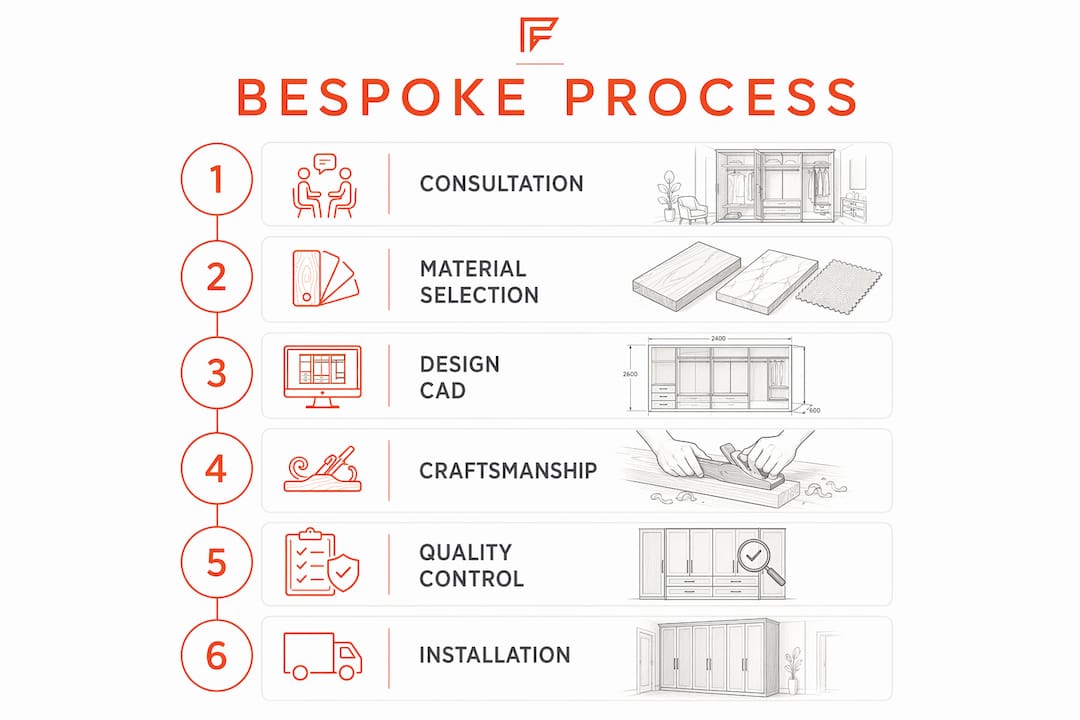
The luxury furniture crafting process covers six stages: client consultation, material selection, CAD design and engineering, production using traditional and modern techniques, finishing in controlled conditions, and on-site installation with client sign-off.
How long does bespoke furniture take to produce?
A bespoke production cycle typically spans 8–12 weeks from consultation to delivery, covering design, material sourcing, production, curing, and installation.
Why is kiln-dried wood specified for luxury furniture?
Kiln-dried timber at 8–10% moisture content is dimensionally stable, which prevents warping, splitting, and joint failure after installation, particularly in humid climates like London.
What is the role of CAD in bespoke furniture design?
CAD engineering models account for wood’s natural seasonal movement, building tolerances into every joint and panel so the finished piece performs correctly across years of use without cracking.
How does Finest Furniture Studio guarantee quality?
Finest Furniture Studio backs every bespoke installation with a 10-year quality guarantee, completes fitting within 7–12 days, and removes existing furniture as part of the service, covering wardrobes, media walls, and loft storage across West London.

