
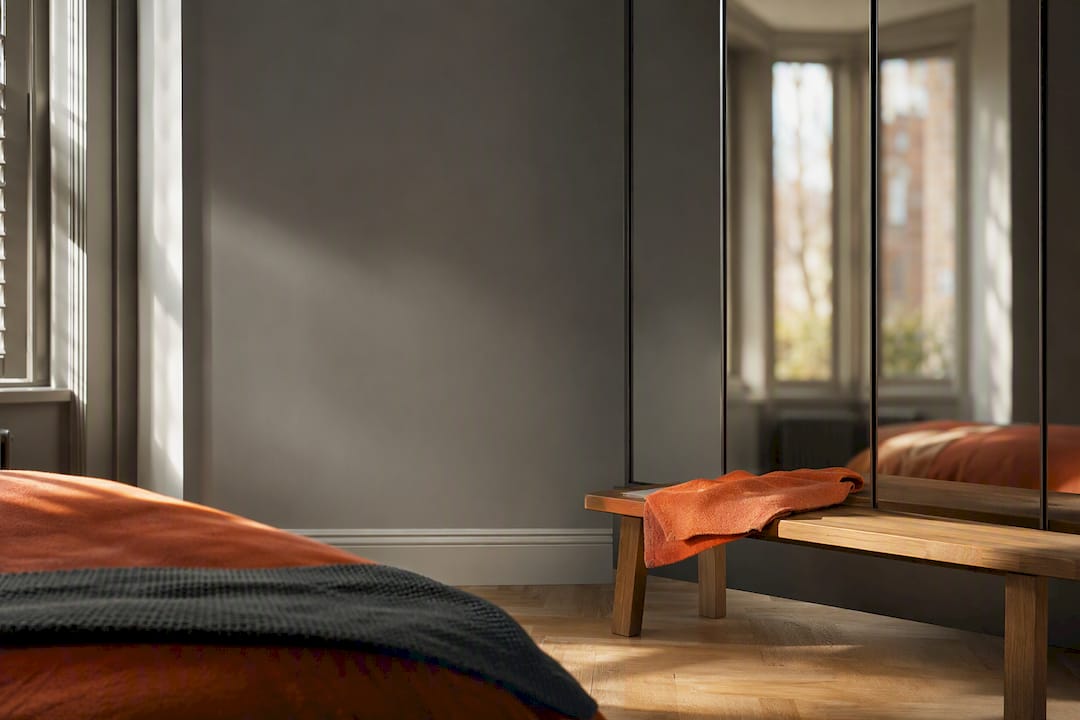
For most bedrooms, made-to-measure sliding mirrored doors are the strongest choice: they save the swing space hinged doors demand, double as a full-length mirror, and bounce light into rooms that never get enough of it. The main trade-offs are upkeep (mirrors show fingerprints and dust faster than panel doors) and reflections at night, which is why mixed-panel configurations are worth considering in smaller or light-sensitive bedrooms.
TL;DR:
- Sliding mirrored doors are ideal for small bedrooms because they do not require swing space and maximize light reflection.
- Toughened safety glass is a must for mirrored wardrobe doors, with tinted options offering room-specific benefits to manage glare and warmth.
- Accurate site measurements, including floor level, wall squareness, and obstructions, are essential for perfect fitting and avoiding costly remakes.
- The cost of mirrored doors varies by manufacture, glass type, frame finish, and interior fittings, with bespoke options offering greater control over design and quality.
- Proper installation, including site surveys and quality hardware, outweighs finish aesthetics in long-term performance and stability.
Table of Contents
- Sliding vs hinged mirrored wardrobe doors: which suits your room?
- What glass and safety specification should you insist on?
- How do you measure for made-to-measure mirrored doors?
- What affects the cost of mirrored wardrobe doors?
- How do you choose a supplier and what should you ask?
- What does a bespoke fitter check that most shoppers miss?
- Why do mirrored doors fog, scratch, or drift out of alignment?
- Do mirrored wardrobe doors raise privacy or security concerns?
- How do mirrored doors compare with panelled and glass alternatives?
- Why the “mirror vs panel” debate misses the real question
- Finest Furniture Studio: bespoke mirrored doors, fitted properly
- Sources
- FAQ
Sliding vs hinged mirrored wardrobe doors: which suits your room?
The choice between sliding and hinged comes down to floor space and how you use the room. Hinged mirrored doors need a clear arc to swing open, which eats into a bedroom that’s already tight on floor space. Sliding mirrored doors run on a track and need no swing clearance at all, which is why they’re particularly effective in smaller bedrooms, where every square foot around the bed counts.
Full mirrored doors give you the most light-reflecting surface and the largest usable mirror, but a wall of glass can feel visually heavy in a compact room. Mixed-panel configurations, combining mirror with painted or wood-effect panels, soften that effect while keeping at least one full-length mirror section. This is a frequent recommendation for balancing function and aesthetics in rooms where a fully reflective wall would dominate.
Frame and finish choices shape the final look as much as the glass itself:
- Aluminium and chrome frames suit modern, minimalist bedrooms and reflect light around the edges.
- Black frames add contrast against pale walls and suit a more contemporary scheme.
- Wood-effect frames (oak, walnut) work well in traditional or Shaker-style rooms.
- Tinted mirror glass in silver, grey, or bronze softens harsh reflections and adds warmth.
Retailers and made-to-measure suppliers both commonly stock sliding and hinged mirrored wardrobes in various sizes, though bespoke sliding systems with a choice of frame colours give you far more control over the finished look than an off-the-shelf kit.
What glass and safety specification should you insist on?
Ask for toughened safety glass on every mirrored door, without exception. Toughened glass is heat-treated to be several times stronger than standard glass, and if it does break, it crumbles into small, blunt fragments rather than sharp shards. That single specification detail is the one most homeowners forget to ask about, and the one that matters most if a door ever gets knocked.
Mirror tinting changes how a room feels day to day. Silver tint gives the truest reflection and brightest bounce of light. Grey tint softens glare in south-facing rooms. Bronze tint adds warmth to a room with cooler wall colours.
Beyond the glass itself, check the backing and edges:
- Backed and sealed mirror glass resists moisture at the edges, reducing the chance of the silvering degrading over time.
- Polished or bevelled edges cut down on chipping during use.
- Wipe mirrored doors with a soft, lint-free cloth and a glass-safe cleaner rather than abrasive products.
Pro Tip: Ask your supplier for written confirmation that the mirror is CE-marked toughened glass, not just “safety glass” in general terms. The two are not always the same thing, and a vague answer here is a warning sign.
Cheap mirrors often show a slightly greenish tint, a wavy or distorted reflection near the edges, or thin, unsealed backing that lets moisture in within a year or two.
How do you measure for made-to-measure mirrored doors?
Getting the measurements right the first time avoids delays and remakes. Here’s the order to work through:
- Measure the total opening width at three points (top, middle, bottom) for sliding doors, since walls are rarely perfectly straight.
- Measure floor-to-ceiling height at both sides of the opening, noting any slope.
- Note skirting board depth and any radiators, cornices, or light switches that sit inside or near the opening.
- For hinged doors, measure the swing clearance required for each door and allow extra room for handles.
- Check the floor for unevenness with a spirit level. This determines whether the frame or track needs adjustable feet or shims.
- Record any obstructions on a simple sketch, not just as numbers, so nothing gets missed when the order is placed.
A buyer-supplied measure is fine for getting an estimate, but most reputable suppliers still send someone to confirm measurements on-site before manufacture begins. A proper site survey catches sloped floors, non-square openings, and skirting depths that a tape measure alone can miss, and it’s the difference between doors that fit first time and a costly remake.
What affects the cost of mirrored wardrobe doors?
Price depends on several factors that vary between suppliers, so it’s worth understanding what you’re actually paying for before comparing quotes:
- Manufacture method: made-to-measure costs more than an off-the-shelf kit but eliminates gaps and fitting compromises.
- Glass type and tint: toughened, tinted, or decorative glass adds cost over standard mirror.
- Frame finish: chrome and premium wood-effect finishes typically cost more than basic white or silver aluminium.
- Number of panels: mixed-panel doors with multiple materials cost more to manufacture than a single mirror sheet.
- Interior fittings: shelving, hanging rails, and drawer units add to the total beyond the doors themselves.
- Installation labour: professional fitting, particularly for sliding tracks, is a significant part of the final price.
As a rough guide, a basic DIY sliding mirror kit sits at the lowest end of the market, a standard made-to-measure sliding mirrored door sits in the middle band, and a fully bespoke fitted mirrored wardrobe with custom interior fittings sits at the top. These bands are illustrative rather than fixed, since finish and size shift the number considerably.
Budget for extras too: a site survey fee, delivery, disposal of the old wardrobe, and occasionally floor or wall preparation if the opening isn’t square. A supplier offering a genuine multi-year warranty and professional installation, rather than a delivery-only kit, tends to represent better value once you factor in the cost of fixing a badly fitted door later.
How do you choose a supplier and what should you ask?
Vet any supplier against three things: fit for your specific space, quality of materials and hardware, and installation with proper aftercare. A supplier that scores well on all three is worth paying slightly more for.
Ask these questions directly at quote stage:
- Is the mirror toughened, and can you confirm that in writing?
- What is the warranty on the sliding track and door mechanism?
- Do you include removal and disposal of my old wardrobe?
- What is the current lead time from order to installation?
- What exactly does the guarantee cover, and for how long?
Treat vague answers, no fixed lead time, or reluctance to confirm glass specification as red flags. Ask for photos of previous installations, or check independent reviews. Checking a platform like Trustpilot gives you a genuine read on how a supplier handles delivery problems and aftercare, not just their showroom pitch.
Pro Tip: If a bedroom faces a busy street or a neighbour’s window, ask about mixed-panel layouts at the quote stage rather than after installation. It’s far cheaper to swap one panel for a solid finish during design than to retrofit privacy later.
What does a bespoke fitter check that most shoppers miss?
Made-to-measure capability means very little without solid installation behind it. On the sites Finest Furniture Studio fits, installation typically runs within seven working days of final measurement, backed by a 10-year guarantee on workmanship, which is unusually long for fitted wardrobe furniture.
A recent example: a small bedroom in a converted terrace had a single window and a bed positioned directly opposite the wardrobe run. A full mirror wall would have thrown headlight glare from the street straight across the bed at night. Switching to a mixed-panel layout, mirror on the two end doors and a matt panel in the centre, kept the light-bouncing benefit for dressing while removing the glare problem entirely.
A proper site survey checks more than width and height:
- Floor level across the full run, not just at one point.
- Wall squareness, since a few degrees out changes how doors align.
- Skirting board profile and depth, which affects the frame’s finished sit against the wall.
- Power points or radiators that interior fittings need to clear.
Why do mirrored doors fog, scratch, or drift out of alignment?
Fogging on mirrored wardrobe doors is almost always a temperature or ventilation issue, not a fault with the glass itself. Cold bedroom walls combined with warm, moist air (drying laundry nearby, for instance) cause condensation to form on the mirror surface, exactly as it would on a cold window. Improving room ventilation or avoiding drying clothes near the wardrobe usually solves it.
Scratches typically come from jewellery, belt buckles, or grit trapped in cleaning cloths. A soft microfibre cloth and a dedicated glass cleaner prevent most of the fine scratching that builds up over years of casual wiping. Deep scratches can’t be polished out of toughened glass safely, so prevention matters more than cure here.
Alignment problems on sliding doors are usually down to the track, not the door itself. Dust and hair build up in the bottom track over time and cause doors to catch or run unevenly. A quick vacuum of the track every few months, along with checking the top guide rollers haven’t worked loose, resolves most sticking issues. If a door has started dragging on one side only, the floor beneath the track has often settled slightly, which is a job for a professional adjustment rather than a DIY fix.
Persistent fogging between two layers of glass, rather than on the surface, points to a failed seal in a double-glazed mirror unit, which needs replacing rather than cleaning.
Do mirrored wardrobe doors raise privacy or security concerns?
Mirrored doors don’t create a security risk in the way people sometimes assume; a mirror is opaque from the reflective side and gives nothing away about what’s stored behind it, unlike glass-fronted or glazed cabinet doors. If anything, a fully mirrored run looks less like storage and more like a design feature, which can work in your favour for insurance purposes since it doesn’t visibly signal valuables.
The real consideration is privacy within the room itself, not security from outside it. A large mirror positioned opposite a window can reflect the room back at anyone glancing in from outside after dark, particularly on the ground floor. Positioning the wardrobe run away from direct sightlines to windows, or choosing a mixed-panel layout with mirror sections angled away from the window wall, addresses this without sacrificing the light benefit entirely.

For shared or family bathrooms fitted with mirrored storage, similar logic applies: a mirror facing a window at night can feel exposing even in an upstairs room, and net curtains or blinds solve it more simply than swapping the door type. It’s a design consideration worth raising at the quote stage rather than a genuine safety issue, and one a fitter will usually flag during a site visit if they spot a window directly opposite the proposed run.
How do mirrored doors compare with panelled and glass alternatives?
Mirrored doors, panelled doors, and glass-fronted doors each solve a different problem, and the right choice depends on what the room needs most. Panelled doors (wood, painted MDF, wood-effect laminate) give you a calmer, less visually busy bedroom and are easier to keep looking clean between wipes, since they don’t show fingerprints or dust the way glass does.
Mirrored doors win decisively on light and the practical bonus of a full-length mirror built into the storage itself, removing the need for a separate freestanding mirror in a room where floor space is already tight. Glass-fronted doors, less common on wardrobes than on display cabinets, offer a middle ground visually but rarely make sense for clothes storage since they show the contents rather than reflecting the room.
For functionality, sliding mirrored doors edge ahead of both alternatives in small bedrooms purely on space saved. For pure aesthetics, the decision is more personal: a mirrored run suits a room built around light and a sense of scale, while a panelled run suits a room where a calmer, more textured look matters more than the mirror function. Mixed-panel doors remain the practical middle path, giving you the mirror where you want it and a solid, low-maintenance finish everywhere else.
Why the “mirror vs panel” debate misses the real question
Most advice on this topic frames mirrored doors and panelled doors as a straight either/or choice, as though one is universally better. That framing is lazy. The right question isn’t mirror versus panel, it’s how much reflective surface a specific room can carry before it starts working against you, whether that’s glare at night or a room that feels colder than it should.
Conventional wisdom also underplays how much the track and hardware matter compared to the glass itself. Homeowners fixate on mirror quality and frame colour, understandably, since that’s what they see every day. But a door with beautiful glass on a cheap, unadjusted track will feel worse to live with within a year than a modest mirror on a properly fitted, soft-close system. Fit and installation quality outlast finish choices in how a wardrobe actually performs day to day.
If there’s one thing to prioritise first, it’s the site survey, not the showroom sample. A sample tells you what the glass looks like under shop lighting. A survey tells you whether your floor, walls, and skirting will let that door glide properly for the next decade.
— Aureliu
Finest Furniture Studio: bespoke mirrored doors, fitted properly
Off-the-shelf kits and generic retail wardrobes get you a mirrored door, but rarely a door built to your exact opening, your skirting depth, and your room’s light. Finest Furniture Studio designs and fits made-to-measure sliding mirrored doors around the space you actually have, with soft-close mechanisms as standard and a 10-year guarantee on workmanship behind every installation.

Visit the fitted wardrobes page to see mirrored panel options, or the sliding wardrobes page for track and frame choices. A free design visit includes a proper site survey, so measurements are confirmed before manufacture, and typical installation runs within seven working days once your design is finalised. Removal and disposal of old wardrobes may be included; please confirm directly with the supplier.
The service area covers various parts of London. Contact us for a free design visit by message or call on 07468 150807, or reach us on WhatsApp. You’ll find us at 124 City Road, Kemp House, London, EC1V 2NX.
Sources
- Pros and cons of sliding wardrobes
- Mirrored wardrobe
- Mirrored vs plain wardrobe doors: pros and trade-offs
- Slide Wardrobes Direct reviews on Trustpilot
FAQ
What are the drawbacks of mirrored closet doors?
Mirrored closet doors show fingerprints and dust more visibly than panel doors and need more frequent cleaning to stay looking sharp. They can also reflect ambient or street light at night, which some light-sensitive sleepers find disruptive, though mixed-panel layouts largely solve this.
How much do mirrored wardrobe doors cost?
Cost varies with manufacture method, glass type, frame finish, and installation, from basic DIY sliding kits at the lower end to fully bespoke fitted mirrored wardrobes at the top. Finest Furniture Studio provides pricing during a free, no-obligation design visit rather than a fixed published rate, since every made-to-measure job differs.
Are mirrored wardrobe doors dated?
Mirrored doors are far from dated when specified well; modern frame finishes like matt black, chrome, or wood-effect and mixed-panel configurations keep them looking current. The style that reads as outdated is the plain, unframed mirror wall popular in previous decades, not the mirrored door as a category.
Can you buy just wardrobe doors?
Yes, replacement mirrored doors can be bought separately from a full wardrobe carcass, provided the existing frame or opening is measured accurately. For a properly fitted result, a professional site survey confirming the opening’s exact width, height, and floor level is strongly advised before ordering replacement doors alone.

