
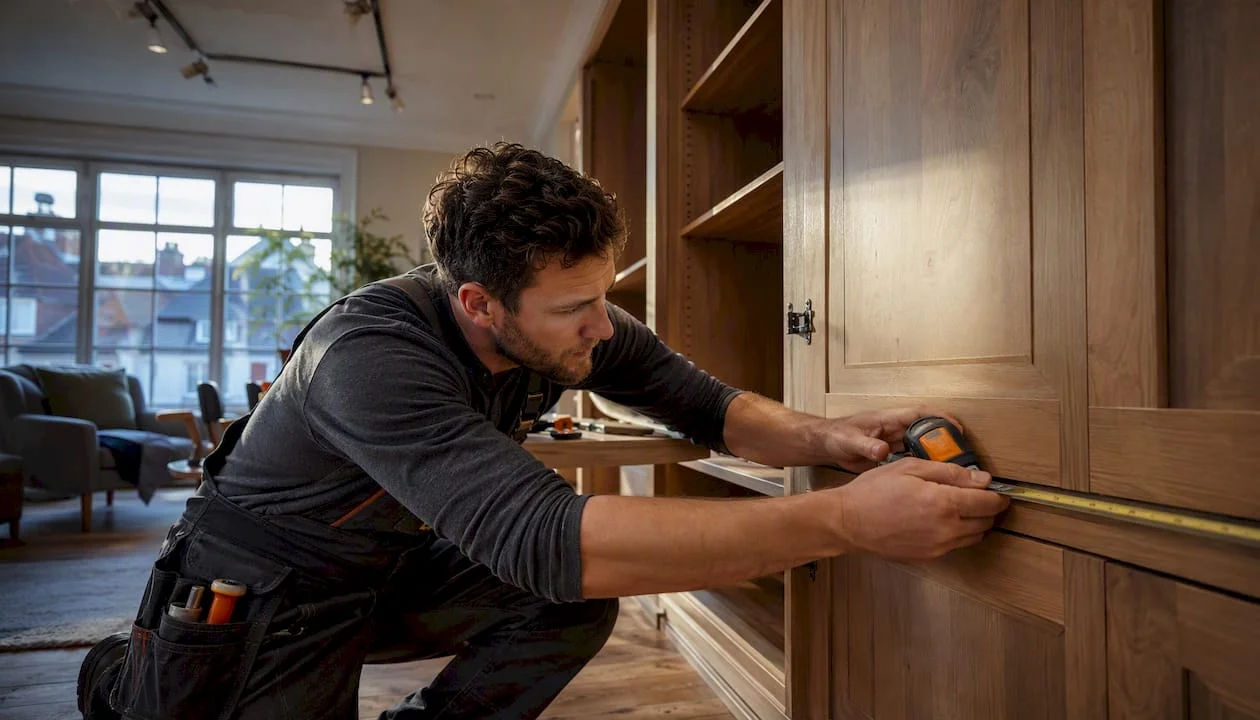
For a London homeowner wanting a genuinely eco-conscious fitted wardrobe, the single best approach is a bespoke unit built from FSC-certified hardwood or reclaimed timber, with engineered bamboo shelving, low-VOC water-based finishes, and a modular interior designed to last decades rather than years. That combination delivers the lowest lifetime environmental cost, the best indoor air quality, and a piece that can be repaired or reconfigured rather than replaced.
Three things to demand from any maker you brief:
- Certified materials: FSC certification or verified reclaimed timber provenance — ask to see the certificate, not just the claim.
- Modular interiors: adjustable shelving, replaceable drawer fronts, and serviceable rails so the wardrobe adapts as your needs change.
- Low-VOC finishes: water-based polyurethanes or natural oils rather than solvent lacquers, protecting both indoor air quality and the timber itself.
To book a free design visit with Finest Furniture Studio, call or WhatsApp 07468 150807, or visit the studio at 124 City Road, Kemp House, London, EC1V 2NX.
Table of Contents
- Why choosing a sustainable bespoke wardrobe is worth the investment
- Which sustainable materials work best for a bespoke wardrobe?
- Which design choices make a bespoke wardrobe genuinely sustainable?
- What should London homeowners expect for costs, lead times and warranty?
- How to brief a bespoke maker and what to ask about sustainability
- Sustainable configurations by room type and London home
- Key takeaways
- How we approach sustainable bespoke wardrobes at Finest Furniture Studio
- Your next step towards a sustainable bespoke wardrobe in London
- Useful sources and further reading
- FAQ
Why choosing a sustainable bespoke wardrobe is worth the investment
A bespoke wardrobe built with lifecycle thinking costs more upfront than a flat-pack unit. Over ten or twenty years, it almost always costs less. Cheap replaceable wardrobes go to landfill; a well-made fitted wardrobe in FSC-certified walnut or reclaimed oak stays in place, gets repaired, and often adds measurable value to a London property.

Reclaimed teak and FSC-certified walnut deliver rich patina and long service life comparable with traditional hardwoods — which dispels the persistent idea that sustainable means lower quality. The lifecycle picture covers four stages: where the material originates, the carbon cost of manufacturing and transporting it to your home, how repairable the finished piece is, and what happens at end-of-life. A regenerative approach to furniture design prioritises local sourcing and repairability at every one of those stages.
Pro Tip: Ask your maker for a repair and refurbishment policy in writing before you sign. Makers who offer reupholstery or refurbishment services to prolong product life are demonstrating a genuine commitment to sustainability, not just using it as a marketing phrase.
Which sustainable materials work best for a bespoke wardrobe?
FSC-certified hardwoods, engineered bamboo, and reclaimed timber are the three materials worth specifying for a London bespoke wardrobe. Each suits different budgets, aesthetics, and room conditions.
Engineered bamboo matures in 3–5 years versus 30–80 years for most hardwoods, and its panels are strong, dimensionally consistent, and naturally antibacterial — ideal for wardrobe interiors and shelving. Reclaimed timber diverts material from landfill and requires less energy to prepare for reuse than new timber production, while bringing genuine character to a piece. FSC-certified hardwoods offer the most predictable grain and finish, making them the preferred choice when a timeless, painted or stained look is the priority.
For finishes, water-based polyurethanes and natural oils often outperform older solvent lacquers for longevity and emit significantly lower VOC levels. Recycled metal hardware — hinges, rails, and handles — rounds out a genuinely low-impact specification.
| Material | Sustainability credentials | Durability | Carbon/transport impact | Adaptability | Finish options | Typical cost band | Lead time |
|---|---|---|---|---|---|---|---|
| FSC-certified hardwood | FSC certified | Very high | Moderate (UK-sourced preferred) | High with modular joinery | Paint, stain, oil, lacquer | Mid to premium | 4–8 weeks |
| Engineered bamboo | Rapidly renewable | High | Low–moderate | High (consistent panels) | Natural, stained, lacquered | Entry to mid | 3–6 weeks |
| Reclaimed timber | Diverts from landfill | High (species-dependent) | Low (local reclaim) | Moderate | Oil, wax, natural finishes | Mid | 4–8 weeks |
| Low-VOC MDF alternative | CARB2/E1 rated boards | Moderate | Moderate | High | Paint, wrap, veneer | Entry to mid | 3–5 weeks |
| Recycled metal hardware | Recycled content | Very high | Low | High | Brushed, powder-coated | Low (add-on) | With unit |
Material callout: Engineered bamboo is the strongest choice for interior shelving and drawer boxes where consistency matters. Reclaimed timber suits carcasses and door frames where character grain is a design asset. FSC-certified hardwoods are the go-to when a flawless painted or stained finish is non-negotiable.
Which design choices make a bespoke wardrobe genuinely sustainable?
Durable joinery and modular interiors matter as much as material choice. A wardrobe built with mortise-and-tenon or dovetail joints will outlast one assembled with cam locks and dowels by decades. That longevity is the single most powerful sustainability lever available to a homeowner.
Adjustable shelving, replaceable drawer fronts, and serviceable hanging rails mean the interior can evolve without replacing the carcass. CAD-optimised cutting layouts reduce offcuts during manufacture; responsible workshops repurpose those offcuts into drawer backs, back panels, or smaller components rather than sending them to waste. Ask any maker you consider how they handle offcuts — it is a quick, reliable indicator of how seriously they take production sustainability.
Pro Tip: Specify a painted or oiled finish over a high-gloss lacquer if you want the wardrobe to be renewable. A natural oil finish can be refreshed with a single coat in an afternoon; a high-gloss lacquer requires full stripping and respraying. That difference in repairability is worth more over twenty years than the aesthetic gap between the two.
What should London homeowners expect for costs, lead times and warranty?
Bespoke sustainable wardrobes in London fall into different price bands. Entry-level units in low-VOC MDF or engineered bamboo start from a few thousand pounds for a single bedroom alcove. Mid-range commissions in FSC-certified hardwood or reclaimed timber cost more, while premium walk-in wardrobes with solid hardwood carcasses, custom joinery, and full interior fittings are the highest investment. Material choice, internal fittings, and whether the brief is a reach-in or walk-in configuration are the primary price drivers.
Timeline overview: Measurement and design consultation (week 1) → material selection and manufacture (weeks 2–5 typically) → delivery and installation (1–2 days on site). Finest Furniture Studio’s typical installation completes within 7–12 days of the design sign-off, which is notably faster than the industry norm.
Key things to confirm before signing any contract:
- Warranty duration: a 10-year guarantee is a meaningful trust signal and rare in the fitted furniture sector.
- Aftercare policy: confirm whether the maker offers repair, adjustment, or refurbishment services post-installation.
- Old wardrobe removal: Finest Furniture Studio removes and disposes of your existing wardrobe as part of the service, removing a practical headache for homeowners.
How to brief a bespoke maker and what to ask about sustainability
State your brief clearly before the first design visit. Tell the maker your budget range, preferred materials (FSC, reclaimed, or bamboo), desired lifespan, and your preference for a repairable or modular interior. That framing filters out makers who cannot meet your specification before you invest time in detailed quotes.
Checklist for your site visit:
- Room photos showing the full wall, ceiling height, and any alcoves, slopes, or obstructions.
- Rough measurements (the maker will verify, but having them speeds the conversation).
- A written list of what you need to store: hanging lengths, folded items, shoes, accessories.
- Preferred finish and door style (shaker, slab, wood-effect, mirrored).
- Any accessibility requirements or specific interior layout preferences.
- Your preference for disposal of the existing wardrobe.
Questions to ask every supplier:
- Can you provide FSC certificates or reclaimed timber provenance documentation?
- What is your offcut policy — are offcuts repurposed or discarded?
- What VOC rating do your finishes carry, and can I see a sample?
- What does your repair and refurbishment service cover, and for how long?
- What warranty do you offer, and what does it explicitly include?
Request material samples and, where possible, a past project reference in a similar material. A maker confident in their sustainability credentials will provide both without hesitation. For interior layout ideas before your visit, reviewing configuration options helps you arrive with a clearer brief.
Sustainable configurations by room type and London home
The right material and layout combination shifts depending on the room and the property type. Here are the most common scenarios for London homeowners:
-
Alcove wardrobes (Fulham, Chelsea, Putney terraces): FSC-certified hardwood carcass with a painted shaker door, adjustable shelving, and a natural oil finish. Ideal for Victorian and Edwardian alcoves flanking a chimney breast. Cost band: mid.
Fitted wardrobes that make space work harder are particularly well suited to these proportions. -
Loft and sloped wardrobes (Wimbledon, Ealing, Richmond conversions): Engineered bamboo shelving within an FSC-certified hardwood frame, with a low-VOC lacquer finish to handle the temperature variation typical of loft spaces. The consistent panel dimensions of bamboo make it easier to fit around angled ceilings. Cost band: mid to premium.
-
Under-stairs storage (Hammersmith, Twickenham, Kingston terraces): Reclaimed timber carcass with engineered bamboo shelves and a moisture-resistant natural oil finish. Reclaimed timber’s character grain suits the informal nature of hallway storage, and its lower embodied energy makes it the most sustainable choice for this application. Bespoke under-stairs storage in these areas often doubles as coat and shoe storage.
-
Small bedroom wardrobes (Brixton, New Malden, Chiswick flats): Low-VOC MDF carcass with engineered bamboo drawer boxes and a painted finish in a light tone to keep the room feeling open. Modular wardrobe design is particularly valuable here, allowing the interior to be reconfigured as storage needs change.
-
Walk-in wardrobes (Richmond, Wimbledon, Chelsea): FSC-certified walnut or oak carcass with full interior fittings, recycled metal rails and handles, and a natural oil finish. The investment is highest here, but the longevity and resale value contribution in these areas justify the premium. Cost band: premium.
Key takeaways
A bespoke fitted wardrobe built from FSC-certified hardwood or reclaimed timber, with engineered bamboo interiors, low-VOC finishes, and a modular layout, delivers the best combination of sustainability, longevity, and value for London homeowners.
| Point | Details |
|---|---|
| Certified materials first | Demand FSC certificates or reclaimed timber provenance before agreeing any specification. |
| Modular interiors extend lifespan | Adjustable shelving and replaceable fronts mean the wardrobe adapts rather than gets replaced. |
| Low-VOC finishes protect your home | Water-based polyurethanes and natural oils lower emissions and can be renewed without full stripping. |
| Warranty signals quality | A 10-year guarantee is rare in the fitted furniture sector and a reliable indicator of build confidence. |
| Finest Furniture Studio | Offers UK-made bespoke wardrobes with a 7–12 day typical installation and a 10-year guarantee across London. |
How we approach sustainable bespoke wardrobes at Finest Furniture Studio
The conventional wisdom in fitted furniture is that sustainability is a premium add-on — something you pay extra for and accept visual compromise in return. That framing is wrong, and it has been wrong for some time. Sustainable materials no longer require visual compromise; engineered bamboo and reclaimed hardwoods now meet the same aesthetic expectations as virgin timber, and in many cases exceed them.
What actually matters is not whether a maker uses the word “sustainable” in their brochure, but whether their process reflects lifecycle thinking at every stage. That means specifying materials with verifiable credentials, optimising cutting layouts to minimise waste, choosing finishes that protect the timber without harming the room’s air quality, and standing behind the finished piece with a warranty that means something. A 10-year guarantee is not a marketing phrase — it is a commitment to the quality of the joinery, the materials, and the installation.
At Finest Furniture Studio, every commission begins with a detailed consultation, moves through material selection with certificates available on request, and is manufactured and installed by our own team. Our typical installation completes within 7–12 days. We also remove and dispose of your existing wardrobe, so the transition is straightforward.
Your next step towards a sustainable bespoke wardrobe in London
Finest Furniture Studio gives London homeowners a faster, more personal route to a genuinely sustainable fitted wardrobe than a standard joinery quote process. Every wardrobe is handcrafted in the UK, installed within 7–12 days of sign-off, and backed by a 10-year guarantee. We remove and dispose of your old wardrobe as part of the service.

Whether you are planning an alcove wardrobe in Fulham, a loft conversion in Wimbledon, or a walk-in in Richmond, we offer a free design visit with no obligation. View our bespoke wardrobe services for West London or our built-in wardrobes London guide to see what is possible for your home. Call or WhatsApp 07468 150807, or visit us at 124 City Road, Kemp House, London, EC1V 2NX to arrange your free consultation.
Useful sources and further reading
The following sources informed the material guidance, lifecycle thinking, and production practices covered in this guide. When briefing any maker, ask them to provide equivalent documentation for their own process.
- How Sustainable Materials Elevate Bespoke Wardrobe Design, GardenAdvice.co.uk — covers material quality comparisons, low-VOC finish performance, and the case for reclaimed and FSC-certified timbers.
- Sustainable Choices for Fitted Wardrobes, A. C. Lambert & Son — practitioner evidence on engineered bamboo, reclaimed timber, CAD-optimised cutting, and offcut repurposing.
- Nested Living, regenerative furniture and interiors — regenerative design principles covering lifecycle, local sourcing, and repairability.
- Asnew, sustainable furniture made in England — repair and refurbishment services as a model for aftercare policy.
- Eco-friendly home decor ideas, Noble Abode — broader sustainable home context for homeowners considering a whole-room approach.
Request FSC certificates, VOC data sheets, and past project references from any maker before committing to a specification. A credible maker will provide all three without hesitation.
FAQ
What materials make a bespoke wardrobe sustainable?
FSC-certified hardwoods, engineered bamboo, and reclaimed timber are the three most credible choices. Pair them with low-VOC water-based finishes and recycled metal hardware for a fully considered specification.
How long does a bespoke sustainable wardrobe take to install in London?
Lead times typically run 3–8 weeks from design sign-off to delivery, depending on material and complexity. Finest Furniture Studio’s installation phase completes within 7–12 days once manufacture is complete.
Is a 10-year guarantee standard for fitted wardrobes?
No. A 10-year guarantee is rare in the fitted furniture sector and signals genuine confidence in materials and joinery. Always ask for the warranty terms in writing before signing a contract.
Does reclaimed timber cost more than new FSC-certified wood?
Reclaimed timber is typically priced in the mid range, similar to FSC-certified hardwoods. The cost varies by species and availability, but it is rarely more expensive than premium virgin hardwood and often less so.
Can a bespoke wardrobe be reconfigured after installation?
Yes, if it is built with a modular interior. Adjustable shelving, replaceable drawer fronts, and serviceable rails allow the interior to be adapted without replacing the carcass, which is the key sustainability advantage of bespoke over flat-pack.

