
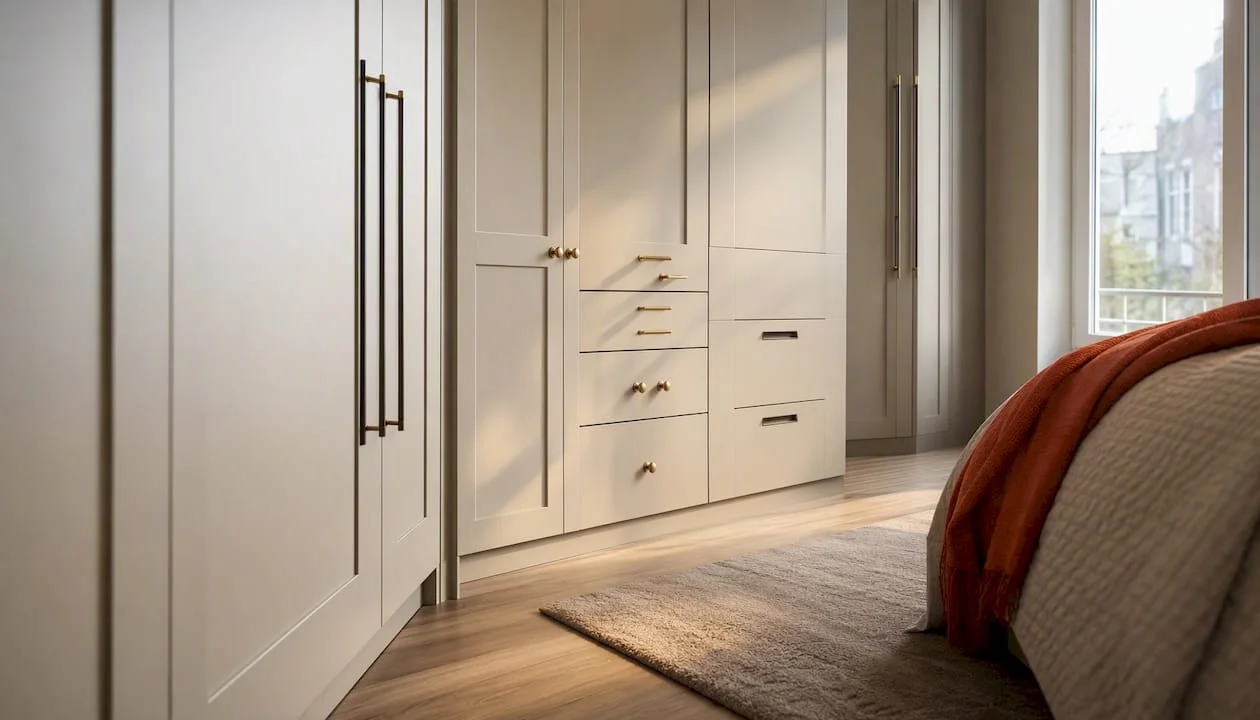
The most common wardrobe handle types are bar pulls, T-bar handles, slim tubular pulls, knobs, cup/pocket pulls, recessed grip pulls, drop/swan-neck handles, and handleless options such as J-profiles and push-to-open systems. For most modern fitted wardrobes, bar pulls and handleless profiles lead on style; knobs and cup pulls suit traditional or compact doors best.
Here is a quick visual shortlist of what you will find in the sections below:
- Bar and T-bar pulls — long, linear, suits Shaker and modern doors
- Slim tubular pulls — minimal, cylindrical, ideal for contemporary schemes
- Knobs — compact, classic, best for smaller doors and drawers
- Cup and pocket pulls — recessed into the door face, great for sliding wardrobes
- Recessed grip pulls — flush-fitted, clean look, common on sliding doors
- Drop and swan-neck handles — arched or looped, traditional character
- Handleless J-profiles — machined edge, no visible hardware, ultra-modern
- Push-to-open systems — touch-latch mechanism, completely hardware-free
Key takeaways
Choosing the right wardrobe handle type means matching the profile to door size, fixing specification, and room hardware, not just selecting a finish you like in isolation.
| Point | Details |
|---|---|
| Match profile to door size | Use bar pulls (128mm–320mm centres) on wide doors; knobs and short pulls suit doors under 400mm. |
| Measure fixing centres first | Common sizes are 96mm, 128mm, 160mm, 192mm, 224mm, and 320mm; measure before ordering to avoid re-drilling. |
| Set handles at the right height | Adults: 900–1100mm from the floor; children: 750–900mm; tall users: 1100–1200mm. |
| Match finish to room hardware | Coordinate handle finish with at least two other metal elements in the room for a cohesive scheme. |
| Finest Furniture Studio | Offers integrated handleless and Shaker options as part of bespoke fitted wardrobe projects across London, with a 10-year guarantee. |
Table of Contents
- 1. Bar handles and T-bar pulls: the most versatile wardrobe handle type
- 2. Slim tubular pulls suit minimal and handleless-adjacent schemes
- 3. Knobs: the right choice for smaller doors and classic styles
- 4. Cup and pocket pulls work best on sliding wardrobe doors
- 5. Recessed grip pulls deliver a flush, handleless look
- 6. Drop and swan-neck handles add traditional character
- 7. Handleless J-profiles and push-to-open systems: the bespoke option
- 8. Materials and finishes: how look and maintenance differ
- 9. Sizing, fixing centres, and what to check before you buy
- 10. Where to fit handles: recommended heights and alignment
- 11. How to choose between knobs and pulls for your wardrobe
- 12. Quick DIY installation checklist for fitting wardrobe handles
- 13. Cleaning and upkeep for different handle materials
- 14. When bespoke or integrated handle solutions make sense
- 15. An honest perspective on handle choices for fitted wardrobes
- Finest Furniture Studio: bespoke wardrobes with the right hardware from day one
- Sources
- FAQ
1. Bar handles and T-bar pulls: the most versatile wardrobe handle type
Bar handles are the single most popular choice across fitted wardrobes in London homes, and for good reason. A straight bar, fixed at both ends, works equally well on a painted Shaker door in Richmond or a matt-lacquered slab door in Chelsea. Bar handles commonly come in fixing-centre sizes from about 96mm up to 320mm; measure your existing hole centres before ordering to avoid re-drilling finished doors.
T-bar handles follow the same principle but add a perpendicular foot at each end, giving a slightly more architectural silhouette. Both profiles are available in every major finish and suit wardrobes from floor-to-ceiling alcove builds in Putney to freestanding pieces in a Wimbledon dressing room.
2. Slim tubular pulls suit minimal and handleless-adjacent schemes
Slim tubular pulls are a step between a traditional bar handle and a fully handleless door. The cylindrical profile sits close to the door face and casts almost no shadow, which keeps the visual weight low. They work particularly well on matt-finish MDF doors in neutral tones, where a chunkier bar handle would compete with the surface rather than complement it.

Fixing centres for slim pulls typically run from 96mm to 192mm, so they suit narrower door panels and drawer fronts more naturally than wide bar handles. Pair them with a brushed nickel or satin brass finish to add warmth without bulk.
3. Knobs: the right choice for smaller doors and classic styles
Knobs suit smaller doors and a classic look, while pulls are generally easier to operate on larger wardrobe doors and give a more modern aesthetic. A single-fixing knob on a painted wardrobe door in a Chiswick Victorian terrace reads as intentional and period-appropriate; the same knob on a 600mm-wide slab door looks undersized and awkward.
Ceramic and porcelain knobs add a tactile, handmade quality that suits painted or wood-effect wardrobes. Solid brass knobs develop a gentle patina over time, which many homeowners in older London properties actively prefer. For children’s wardrobes, a smooth, rounded knob with no sharp edges is a practical and safe choice.
4. Cup and pocket pulls work best on sliding wardrobe doors
Cup pulls are recessed into the door face rather than projecting from it, which makes them the natural choice for sliding wardrobe doors where a projecting handle would catch on the adjacent panel. The traditional cup shape has a long history in kitchen cabinetry, but it translates well to wardrobe doors in country-style or painted schemes.
Pocket pulls are a flatter, more contemporary version of the same idea. Both require a shallow recess routed into the door face, so they are better specified at the point of manufacture rather than retrofitted to a finished door. For sliding door wardrobes, cup and pocket pulls are often the most practical hardware solution available.
5. Recessed grip pulls deliver a flush, handleless look
Recessed grip pulls go a step further than cup pulls: the entire handle sits within a machined pocket, leaving the door face completely flat when closed. They are common on sliding wardrobes where a truly minimal aesthetic is the goal, and they work well on lacquered or high-gloss doors where any projecting hardware would interrupt the reflective surface.
The trade-off is fabrication complexity. Routing a clean recess into MDF or laminate requires precision, and a poorly cut pocket will show at the edges. On bespoke fitted wardrobes, this work is done in the workshop before installation; on flat-pack units, retrofitting is rarely clean.
6. Drop and swan-neck handles add traditional character
Drop handles hang from two fixing points and swing freely, producing a gentle sound when the door closes. Swan-neck handles follow a curved profile between the two fixings, sitting proud of the door face in an arched shape. Both profiles have strong period associations: they suit painted wardrobes in Edwardian or Victorian homes across Hammersmith, Barnes, and Dulwich.
Fixing centres for drop and swan-neck handles typically run from 64mm to 128mm, so they suit narrower door panels well. Antique brass and oil-rubbed bronze are the most common finishes, though matt black versions have grown popular in more contemporary takes on the traditional style.
7. Handleless J-profiles and push-to-open systems: the bespoke option
Bespoke fitters can offer integrated handle solutions such as J-profiles and machined recesses or push-to-open systems that aren’t practical on many flat-packed units. A J-profile is a machined aluminium or timber edge that wraps the door, creating a finger-pull channel along the full height of the panel. Push-to-open uses a touch-latch mechanism: press the door, it springs open, no hardware visible at all.
Both options require precise fabrication and are best specified as part of a bespoke fitted wardrobe project. The aesthetic payoff is significant: a run of handleless wardrobes across an alcove in a Fulham or Ealing home reads as genuinely architectural rather than simply furnished. One practical note: machined J-profile pockets can reduce the structural integrity of thinner door panels, so door thickness should be confirmed with your fitter before specifying this option. You can explore the full range of handleless and Shaker door designs to see how each profile looks in a fitted context.
8. Materials and finishes: how look and maintenance differ
The finish you choose affects how a handle feels in the hand, how it ages, and how much upkeep it needs. Here is a concise breakdown of the most common options:
- Solid brass — warm, golden tone; polishable; develops a natural patina over years. Clean with warm soapy water and a soft cloth. Avoid abrasive cleaners, which strip the surface.
- Brass-plated — similar appearance to solid brass at lower cost; the plating can wear through at contact points over time. Wipe regularly to prevent moisture sitting on the surface.
- Chrome — cool, reflective, highly durable. Shows fingerprints readily; a microfibre cloth keeps it clean without scratching.
- Brushed/satin nickel — warm silver tone with a matte texture that hides fingerprints well. One of the lowest-maintenance finishes available.
- Matt black — bold, contemporary, suits modern and industrial schemes. Prone to showing dust and light scratches; wipe with a damp cloth only, no abrasive products.
- Bronze/oil-rubbed bronze — dark, warm, period-appropriate. The living finish deepens with use; clean gently to preserve the patina rather than restore brightness.
- Stainless steel — highly durable, corrosion-resistant, cool tone. Clean with a stainless-steel-specific cleaner to avoid streaking.
- Wood — warm, tactile, suits natural or Scandi-style wardrobes. Wipe dry immediately after contact with moisture; treat annually with a light oil.
- Painted ceramic/porcelain — decorative, handmade quality. Handle with care; ceramic chips if knocked hard. Clean with a damp cloth only.
When choosing between wardrobe handles in brass vs black, consider the existing metalwork in the room: tap fittings, light switches, curtain poles, and bed frames. Mixing warm and cool metals in the same room tends to read as accidental rather than considered. Matching your handle finish to at least two other hardware elements in the space ties the scheme together.
9. Sizing, fixing centres, and what to check before you buy
Getting the measurements right before ordering is the single most important step. A handle that arrives with the wrong fixing-centre spacing means re-drilling finished doors, which risks splitting MDF or laminate and leaves visible holes.
Some modular wardrobe doors are supplied without pre-drilled handle holes; always check door thickness, fixing type, and screw length before fitting handles. The most common centre-to-centre measurements are 96mm, 128mm, 160mm, 192mm, 224mm, and 320mm. Bar handles are typically sold by their total length, with the fixing-centre measurement stated separately; always use the fixing-centre figure, not the overall length, when checking compatibility.
Key checks before you order:
- Measure existing hole centres precisely (use a steel rule, not a tape measure, for accuracy)
- Confirm door thickness: standard MDF wardrobe doors are typically 18mm; solid timber doors can be 20mm–22mm
- Check screw length: the screw must pass through the door and engage the handle thread without protruding on the other side
- M4 machine screws are the most common fixing type for wardrobe handles in the UK
- Verify whether holes are pre-drilled or whether you will need to drill from scratch
- For bespoke or fitted doors, confirm fixing compatibility with your installer before ordering
Pro Tip: Before drilling any finished door, mock up the handle position using masking tape and a pencil mark. Check alignment across the full door run with a spirit level before committing to a single hole.
For a full pre-purchase checklist, the wardrobes buying guide covers compatibility checks in detail.
10. Where to fit handles: recommended heights and alignment
Handle height is one of the most overlooked decisions in wardrobe planning, yet it determines daily comfort for every person who uses the wardrobe. A useful rule is 900–1100mm from the floor for most adults, with lower heights for children (750–900mm) and higher for tall users (1100–1200mm).

For children’s wardrobes, positioning handles at 750–900mm keeps them accessible without requiring a stretch. If you are planning a wardrobe that grows with your child, consider fitting handles at the lower end of the adult range from the outset so the wardrobe remains functional as they grow.
Alignment rules for multi-door wardrobes:
- Set all handles at the same height across the full door run; use a laser level or a long straightedge
- On hinged doors, position the handle near the opening edge, roughly one-third from the top or bottom of the door
- On sliding doors, centre the handle vertically on the door panel; edge placement can interfere with the sliding track
- For Shaker doors with a raised centre panel, align the handle with the lower rail of the panel for visual balance
- On tall floor-to-ceiling wardrobes, a handle positioned at 1000mm reads as centred even when the door height is 2400mm
A consistent handle line across a multi-door wardrobe creates a strong horizontal datum that makes the whole piece read as intentional and well-designed. See the bedroom wardrobe layout guide for practical door-access notes that affect handle placement decisions.
11. How to choose between knobs and pulls for your wardrobe
The knob-vs-pull decision comes down to three factors: door size, ergonomics, and the overall aesthetic of the room.
Knobs suit smaller doors and a traditional look, while pulls are generally easier to operate on larger wardrobe doors and give a more modern aesthetic. Wide, heavy doors benefit from a long pull because the leverage is distributed across a wider grip; a knob on the same door requires a pinching action that becomes tiring with repeated use.
Practical decision guide:
- Door width under 400mm: a knob or short pull (96mm centres) works well
- Door width 400mm–600mm: a 128mm–160mm pull offers better leverage
- Door width over 600mm: use a 192mm–320mm bar pull for comfortable operation
- Mixing knobs on drawers and pulls on wardrobe doors is a widely used and visually coherent approach
- Match handle scale to door proportion: a 320mm bar on a narrow door looks oversized; a 64mm knob on a wide slab door looks lost
Budget note: Knobs typically start from around £3–£8 each for plated options; solid brass or ceramic versions run from £10–£30 each. Bar pulls in chrome or satin nickel start from around £8–£15 per handle; solid brass or designer pulls can reach £40–£80 each. Spending more on handles for the most-used doors and saving on drawer knobs is a sensible approach that most fitted wardrobe clients take. For broader home organisation hardware matching, coordinating handle style across wardrobes, drawers, and storage units gives the most cohesive result.
12. Quick DIY installation checklist for fitting wardrobe handles
Fitting wardrobe handles is a straightforward DIY task when you follow the steps in order. Rushing the marking stage is where most mistakes happen.
Step-by-step installation:
- Measure and mark — use a steel rule to mark the fixing-centre positions precisely; double-check against the handle’s own hole spacing
- Check for level — use a spirit level or laser level to confirm the mark is horizontal before drilling
- Apply masking tape — place masking tape over the drill point to prevent the drill bit from skating on laminate or painted surfaces, and to protect the finish from chipping
- Drill pilot holes — use a drill bit slightly smaller than the screw diameter; drill slowly and keep the bit perpendicular to the door face
- Check screw length — hold the screw against the door thickness before fitting; it should engage the handle thread fully without protruding
- Fit and hand-tighten — insert screws from the back of the door and hand-tighten before using a screwdriver
- Check alignment across all doors — before final tightening, stand back and verify all handles sit at the same height across the full run
- Final tighten — tighten firmly but do not overtighten; overtightening on MDF can strip the thread or crack the door face
Tools required: steel rule, pencil, spirit level or laser level, masking tape, cordless drill, drill bits (typically 4mm for M4 fixings), cross-head screwdriver.
Common pitfalls: misaligned holes from measuring each door independently rather than using a template; wrong screw length causing protruding fixings on the door interior; overtightening on thin MDF.
Pro Tip: Cut a simple cardboard template with the fixing-centre holes punched through it. Use the same template on every door in the run to guarantee consistent positioning without re-measuring each time.
13. Cleaning and upkeep for different handle materials
A brief annual routine keeps handles looking their best and prevents fixings from working loose.
Material-specific cleaning:
- Brass (solid or plated): warm water and mild washing-up liquid; dry immediately. For solid brass, a brass polish restores shine; for plated, avoid polish as it accelerates wear.
- Chrome: microfibre cloth with warm water; a drop of washing-up liquid removes fingerprints. Never use abrasive pads.
- Satin/brushed nickel: damp cloth only; wipe in the direction of the brushing to avoid cross-scratching.
- Matt black: damp cloth, no abrasives, no bleach-based cleaners. Abrasives remove the coating and leave shiny patches.
- Stainless steel: stainless-steel cleaner or a damp cloth with a small amount of white vinegar; dry thoroughly to prevent water marks.
- Wood: wipe dry immediately after any moisture contact; apply a light furniture oil once a year.
- Ceramic/porcelain: damp cloth only; avoid knocking against adjacent hardware.
Annual maintenance checklist:
- Check all fixings and re-tighten any screws that have worked loose (common on frequently used doors)
- On drop handles, apply a small amount of light machine oil to the pivot points if the swing has stiffened
- Inspect plated finishes for wear at contact points; a worn plated handle is generally more cost-effective to replace than to restore
When a finish has worn through to the base metal, restoration is rarely worth the effort on plated hardware. Solid brass and stainless steel are the exceptions: both can be professionally polished back to near-original condition.
14. When bespoke or integrated handle solutions make sense
For fitted wardrobes in London homes, particularly in alcoves, loft conversions, or rooms with non-standard dimensions, the standard off-the-shelf handle range often falls short. Bespoke fitters can offer integrated handle solutions such as J-profiles and machined recesses or push-to-open systems that aren’t practical on many flat-packed units.
Reasons to choose an integrated or bespoke handle solution:
- Unusual door thickness that standard screw lengths cannot accommodate
- A desire for a fully handleless aesthetic across a multi-door run
- Matched finishes across wardrobes, drawers, and media walls in the same room
- Complex alcove or loft shapes where standard hardware would look mismatched
- Sliding wardrobe doors where projecting handles are not practical
Finest Furniture Studio offers handleless and Shaker door options as part of its bespoke fitted wardrobe service, with the handle profile specified as part of the overall design rather than added as an afterthought. For homeowners in Richmond, Wimbledon, Putney, and across West London, this integrated approach means the hardware, door material, and fixing type are all confirmed before a single hole is drilled on site.
The 10-year guarantee that Finest Furniture Studio provides covers the workmanship of the full installation, including handle fixings, which is a meaningful assurance when bespoke machined profiles are involved.

15. An honest perspective on handle choices for fitted wardrobes
Most articles on wardrobe handle types treat the decision as purely aesthetic. In practice, the handle is where the door’s engineering meets the user’s hand every single day, and getting it wrong is more disruptive than most homeowners anticipate.
The most common mistake we see in London homes is choosing a handle that looks right in isolation but is wrong for the door size or the fixing specification. A beautiful drop handle in antique brass on a 600mm-wide painted door can look stunning in a product photo and feel loose and rattling within six months if the fixing centres are too narrow for the door’s weight. Conversely, a long 320mm bar pull on a narrow 350mm door panel looks proportionally absurd, regardless of finish quality.
The second overlooked factor is the relationship between handle profile and door operation. On a sliding wardrobe, a projecting bar handle is not just an aesthetic choice; it is a functional problem. On a heavy hinged door, a knob is not just traditional; it is genuinely harder to use repeatedly. Matching the handle profile to how the door actually moves is a more reliable starting point than matching it to a mood board.
For bespoke fitted wardrobes, we always recommend specifying the handle as part of the initial design brief, not selecting it after the doors are made. The fixing type, door thickness, and edge profile all affect which handles are physically compatible, and retrofitting the wrong choice to a finished bespoke door is an expensive correction.
Finest Furniture Studio: bespoke wardrobes with the right hardware from day one
Getting the handle right is far easier when the wardrobe is designed around it from the start. Finest Furniture Studio designs and installs custom-made fitted wardrobes across West London, covering Richmond, Wimbledon, Putney, Chiswick, Fulham, Chelsea, Ealing, Twickenham, Barnes, Hammersmith, and surrounding areas. Every project includes a free design visit where handle profile, fixing type, and door specification are confirmed together, not treated as separate decisions.

Installations are typically completed within 7–12 days, and every fitted wardrobe comes with a 10-year workmanship guarantee. We also remove and dispose of your old wardrobe as part of the service, so there is no skip hire or clearance to arrange. For homeowners in Richmond specifically, the bespoke fitted wardrobes Richmond page covers local project examples and design options in detail.
Call or WhatsApp 📞 07468 150807, or visit us at 124 City Road, Kemp House, London, EC1V 2NX to book your free design visit.
Sources
- Wardrobe Door Handles: How to Choose the Right Style & Fit
- How high should wardrobe handles be? – Dowsing & Reynolds
- Modular Wardrobe Buying Guide | Wickes
- How to fit wardrobe handles | Decor & Decor
FAQ
Are there different types of wardrobe handles?
Yes. The main wardrobe handle types are bar pulls, T-bar handles, slim tubular pulls, knobs, cup pulls, recessed grip pulls, drop/swan-neck handles, and handleless options such as J-profiles and push-to-open systems.
What is the difference between knobs and pulls for wardrobes?
Knobs use a single fixing point and suit smaller doors and traditional styles; pulls fix at two points, offer better leverage on larger doors, and give a more modern look.
How high should wardrobe handles be fitted?
The recommended height is 900–1100mm from the floor for most adults, 750–900mm for children, and 1100–1200mm for taller users, with all handles aligned at the same height across a multi-door run.
What fixing-centre sizes do wardrobe handles come in?
The most common centre-to-centre measurements are 96mm, 128mm, 160mm, 192mm, 224mm, and 320mm; always measure your existing hole spacing before ordering to confirm compatibility.
When does a handleless wardrobe make sense?
A handleless solution, such as a J-profile edge or push-to-open system, suits sliding wardrobes, contemporary fitted schemes, or bespoke alcove builds where projecting hardware would be impractical. Finest Furniture Studio offers these as part of its bespoke fitted wardrobe service across London.

