

Multi-purpose furniture is defined as any piece designed to perform two or more distinct functions within a single footprint, making it the most practical solution for compact UK homes and rentals. The industry term is “multifunctional furniture,” and both names refer to the same category. A sofa bed, a storage ottoman, or an extendable dining table each serve this purpose. Homes with less clutter feel up to 20% more spacious, and that figure alone explains why multifunctional furniture has moved from a niche choice to a mainstream necessity in cities like London, where square footage is expensive and often limited. Whether you rent a one-bedroom flat in Wimbledon or own a Victorian terrace in Putney, the right furniture choices can genuinely change how your home feels to live in.
What is multi-purpose furniture and what types exist?
Multi-purpose furniture covers a wide range of pieces, each solving a specific space problem. The most common types include sofa beds, extendable dining tables, storage ottomans, murphy beds, and modular shelving systems. Each category uses a different mechanical approach to deliver two or more functions from one piece.
Sofa beds
A quality sofa bed uses a click-clack or pull-out mechanism with a minimum 12cm mattress for genuine comfort in both seating and sleeping modes. The best models require minimal physical effort to convert, which matters when you are hosting guests at 11PM. Cheap versions compromise on mattress depth or hinge quality, and both failures become obvious within months.
Extendable dining tables
Extendable tables are the most versatile dining solution for small kitchens and open-plan living areas. Furl’s expanding tables, for example, serve as both a breakfast bar and a full dining table, adapting to daily meals and dinner parties without requiring a second piece of furniture. The mechanism is the critical factor: look for smooth, self-locking leaf extensions rather than loose inserts that shift under pressure.
Storage ottomans and benches
Storage ottomans serve as seating, a footrest, and a concealed storage unit simultaneously. They work particularly well in living rooms and hallways where surface clutter accumulates fastest. Closed storage in entryways and living spaces slows visual clutter accumulation significantly in small homes, which is why ottomans with lids outperform open baskets in practice.
Modular furniture
Modular furniture is ideal for renters because it reconfigures and moves between properties, lowering long-term costs despite a higher initial price. A modular sofa can become an L-shape in one flat and a straight two-seater in the next. This adaptability makes it the most financially sensible choice for anyone who moves every two to three years.
| Type | Primary function | Secondary function | Best room |
|---|---|---|---|
| Sofa bed | Seating | Guest sleeping | Living room |
| Extendable table | Dining | Workspace or breakfast bar | Kitchen or dining area |
| Storage ottoman | Seating or footrest | Hidden storage | Living room or hallway |
| Murphy bed | Sleeping | Wall panel or desk space | Bedroom or studio |
| Modular shelving | Storage | Room divider | Any room |
Pro Tip: Measure between skirting boards, not wall to wall. Older UK homes, particularly Victorian terraces, have irregular walls that can make a piece appear to fit on paper but sit awkwardly in reality.
What are the key benefits of versatile furniture for small homes?
The benefits of multifunctional furniture extend beyond saving floor space. They touch on lifestyle flexibility, financial efficiency, and even mental well-being.
- Space saving. One piece replacing two or three items frees floor area that makes rooms feel open and liveable. The perceived spaciousness this creates is measurable and consistent.
- Flexibility. Household needs shift. A home office doubles as a guest room, or a studio flat needs to host a dinner party. Multifunctional pieces adapt without requiring new purchases.
- Sustainability. Properly designed pieces reduce costly replacements and promote a less disposable approach to furnishing. Buying one well-made piece instead of three cheap ones produces less waste over a decade.
- Cost efficiency. The upfront cost of a quality multifunctional piece is almost always lower than buying separate items for each function. A storage bed, for instance, replaces both a standard bed frame and a chest of drawers.
- Mental well-being. Clutter is a documented source of low-level stress. Furniture that contains and conceals reduces visual noise, which contributes to a calmer home environment.
“Small space restrictions are creative opportunities, not limitations. Multifunctional furniture, used alongside flexible architectural elements like sliding doors or glass screens, turns a compact flat into a genuinely adaptable home.”
Interior designer Tasha Freeman, as cited by Domus Nova
Design experts reinforce this point directly. The principle that furniture must “earn its footprint” by solving a specific functional problem is now standard advice among UK interior professionals. Buying a space-saving item without a clear purpose defeats the entire point of the category.
How to choose high-quality multi-functional furniture
Choosing well means looking past marketing language and evaluating the mechanics, materials, and repairability of each piece.
Evaluate the mechanism first
The mechanism is the most failure-prone part of any multifunctional piece. True multifunctional furniture is defined by robust mechanics and usability; poor hardware undermines its purpose entirely. Test the conversion in the showroom. If it requires two people or significant force, it will be used less and less until it stops being used at all.
Check load ratings and materials
A storage ottoman rated for 80kg of seated weight will outlast one rated for 40kg, even if both look identical. Solid wood frames, metal hinges, and high-density foam all signal durability. MDF with plastic fittings signals the opposite.
Prioritise repairability
Multifunctional furniture designed with quality materials promotes repairability and long-term use, reducing the disposable furniture cycle that costs more over time. Ask whether replacement parts are available. A sofa bed with a proprietary mechanism that cannot be serviced is a liability after year three.
Watch for misleading claims
The phrase “space-saving” appears on products that save very little space. A folding chair stored in a cupboard is not multifunctional furniture. The definition requires a single piece to perform two or more functions simultaneously or with minimal effort, not simply to be foldable.
Common pitfalls to avoid:
- Oversized pieces bought “just in case.” Oversized items waste up to 30% of their footprint in small rooms and restrict movement.
- Pieces without a designated permanent position. Temporary furniture becomes clutter when it has no fixed home.
- Mechanisms that require tools or significant effort to operate daily.
- Furniture with no visible legs. Pieces that sit flush to the floor make rooms feel smaller, not larger.
Pro Tip: Floating furniture 10–15cm from walls with visible legs increases perceived floor space. The shadow depth created beneath the piece visually enlarges the room, particularly effective in rooms under 12 sqm.
How to integrate multi-purpose furniture in small UK homes
Planning is the difference between a room that functions well and one that simply contains furniture. The process works best when approached in a specific order.
- Draw an accurate floor plan. Include door swings, radiator positions, window sills, and socket locations. In older UK homes, measure between skirting boards rather than wall to wall to account for plaster irregularities.
- Place the largest multifunctional piece first. This is usually a sofa bed, a storage bed, or a fitted wardrobe with integrated storage. Everything else arranges around it.
- Maintain at least 45cm of clearance around each piece. This is the minimum for comfortable movement in rooms under 12 sqm. Anything tighter creates a corridor effect that makes the room feel smaller than it is.
- Zone the room with furniture, not walls. A modular shelving unit or a sofa positioned perpendicular to the wall creates distinct living and sleeping zones in a studio without closing off light.
- Use sliding doors or glass screens to separate zones. Bespoke sliding doors and glass screens increase perceived volume and functionality in small spaces, particularly in open-plan layouts where visual separation is needed without physical barriers.
For homeowners and renters across Richmond, Wimbledon, Putney, Kingston, Chiswick, Fulham, Chelsea, Ealing, Twickenham, Barnes, and Hammersmith, bespoke fitted furniture offers a significant advantage over off-the-shelf pieces. A fitted wardrobe built to the exact dimensions of an alcove, a loft conversion, or an under-stairs space uses every centimetre that a freestanding piece cannot reach. This is where personalised furniture design moves from a luxury to a practical necessity.
The same logic applies to media walls. A bespoke TV media wall with integrated shelving and concealed cable management replaces a television unit, a bookcase, and a storage cabinet in one fitted solution. For living rooms in Central London or New Malden where floor space is at a premium, this approach delivers more storage per square metre than any combination of freestanding pieces.
Upholstered pieces like sofa beds and storage ottomans also require ongoing care to maintain their appearance and function. Proper upholstery maintenance extends the life of fabric and foam significantly, which matters when the piece is doing double duty every day.
Key takeaways
Multi-purpose furniture is the most practical investment for small UK homes because it delivers more function per square metre than any equivalent number of single-use pieces.
| Point | Details |
|---|---|
| Definition matters | Multi-purpose furniture performs two or more functions from one footprint, not simply folds or stacks. |
| Mechanism quality is critical | Poor hardware fails quickly; always test conversion ease before purchasing. |
| Modular suits renters best | Modular furniture reconfigures between properties, reducing replacement costs over time. |
| Plan before you buy | Draw an accurate floor plan and place the largest piece first to avoid clearance errors. |
| Bespoke fills the gaps | Fitted solutions in alcoves, lofts, and awkward corners use space that freestanding furniture cannot reach. |
Why I think most people are still thinking about this the wrong way
Working with homeowners across London, from Hammersmith to Richmond, I have noticed a consistent pattern. Most people approach multifunctional furniture as a compromise. They buy a sofa bed because they cannot afford a second bedroom, or they choose a storage ottoman because they have run out of cupboard space. The furniture becomes a consolation prize rather than a deliberate design decision.
That framing produces poor results. When you choose a sofa bed because it is the best sofa for your living room and it happens to sleep guests, you make a completely different decision. You spend more on the mechanism, more on the mattress depth, and more on the fabric. The piece lasts longer and works better in both modes.
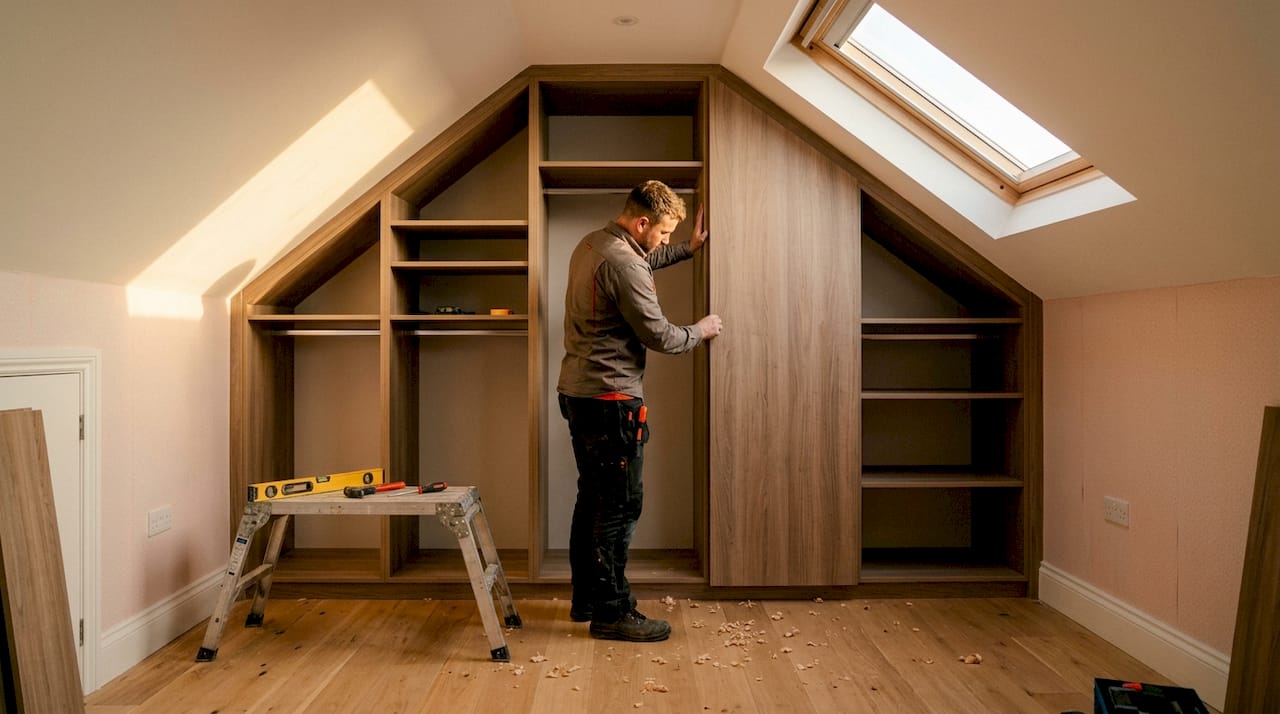
The same principle applies to fitted wardrobes and media walls. A bespoke fitted wardrobe in a Wimbledon loft conversion is not a compromise. It is the only solution that uses the sloped ceiling, the awkward corner, and the full height of the room simultaneously. Off-the-shelf furniture simply cannot do that.
The designers I respect most treat every spatial constraint as a brief. Tasha Freeman’s observation that restrictions are creative opportunities is not optimism for its own sake. It is a practical working method. The constraint forces a better solution than an unconstrained room would ever produce.
My honest advice: stop buying furniture to fill a room and start buying furniture to solve a problem. Define the problem precisely, measure the space accurately, and then choose the piece that solves it with the least footprint and the best build quality. That approach will serve you far better than any list of “must-have” multifunctional pieces.
— Aureliu
Bespoke fitted furniture from Finest Furniture Studio
At Finest Furniture Studio, we design and manufacture bespoke fitted wardrobes, TV media walls, and built-in storage solutions for homes across London, including Richmond, Wimbledon, Putney, Fulham, Chelsea, and Ealing. Every project begins with a free design visit, where we measure your space accurately and discuss exactly how the furniture will work within your layout.
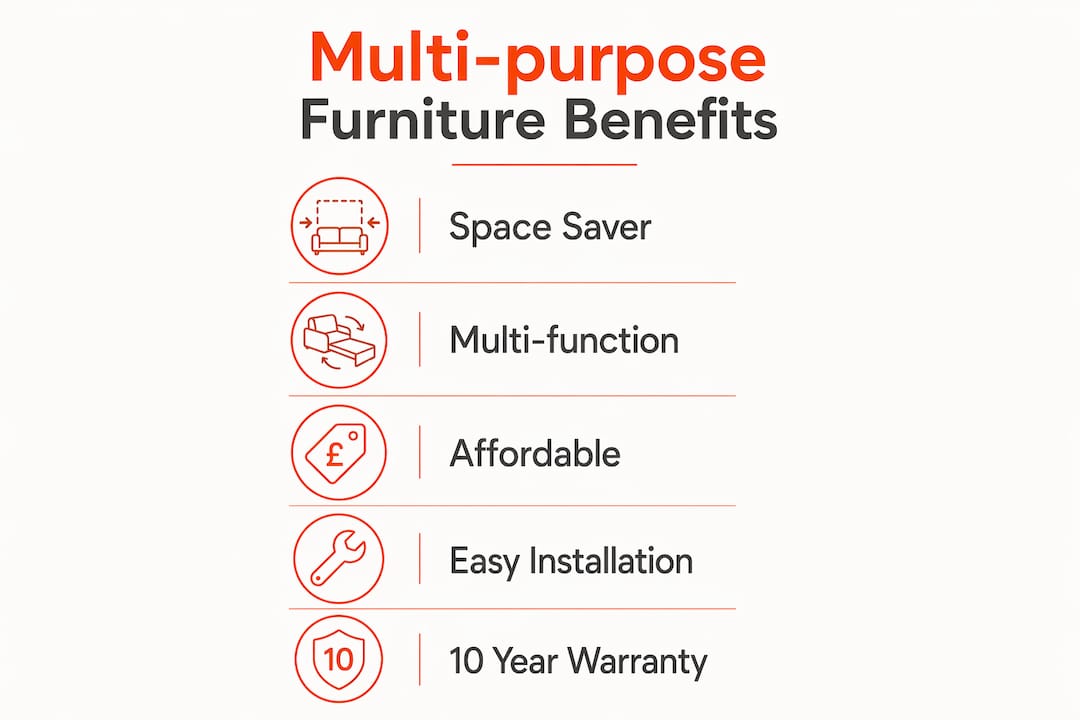
Our fitted wardrobes carry a 10-year quality guarantee and are installed within 7–12 days. We also remove and dispose of your old wardrobe at no additional charge. Whether you need a bespoke wardrobe for a West London home, a loft conversion solution, or a media wall with integrated storage, we will design it to fit your space precisely. Call or WhatsApp us on 07468 150807, or visit us at 124 City Road, Kemp House, London, EC1V 2NX.
FAQ
What is the definition of multi-use furniture?
Multi-use furniture, also called multifunctional furniture, is any piece designed to perform two or more distinct functions within the same physical footprint, such as a sofa bed or a storage ottoman.
What are the most common types of multi-purpose furniture?
The most common types include sofa beds, extendable dining tables, storage ottomans, murphy beds, and modular shelving systems, each solving a specific space problem in small homes.
Is modular furniture a good choice for renters?
Modular furniture is the best choice for renters because it reconfigures between properties and adapts to different room layouts, reducing the need to buy new furniture with each move.
How do I avoid buying poor-quality multifunctional furniture?
Test the conversion mechanism in person, check load ratings, confirm that replacement parts are available, and avoid pieces with plastic fittings or MDF frames, which fail faster under daily use.
How does bespoke fitted furniture complement multi-purpose pieces?
Bespoke fitted wardrobes and media walls use space that freestanding furniture cannot reach, such as alcoves, loft slopes, and under-stairs areas, making them the most space-efficient solution for small UK homes.

