








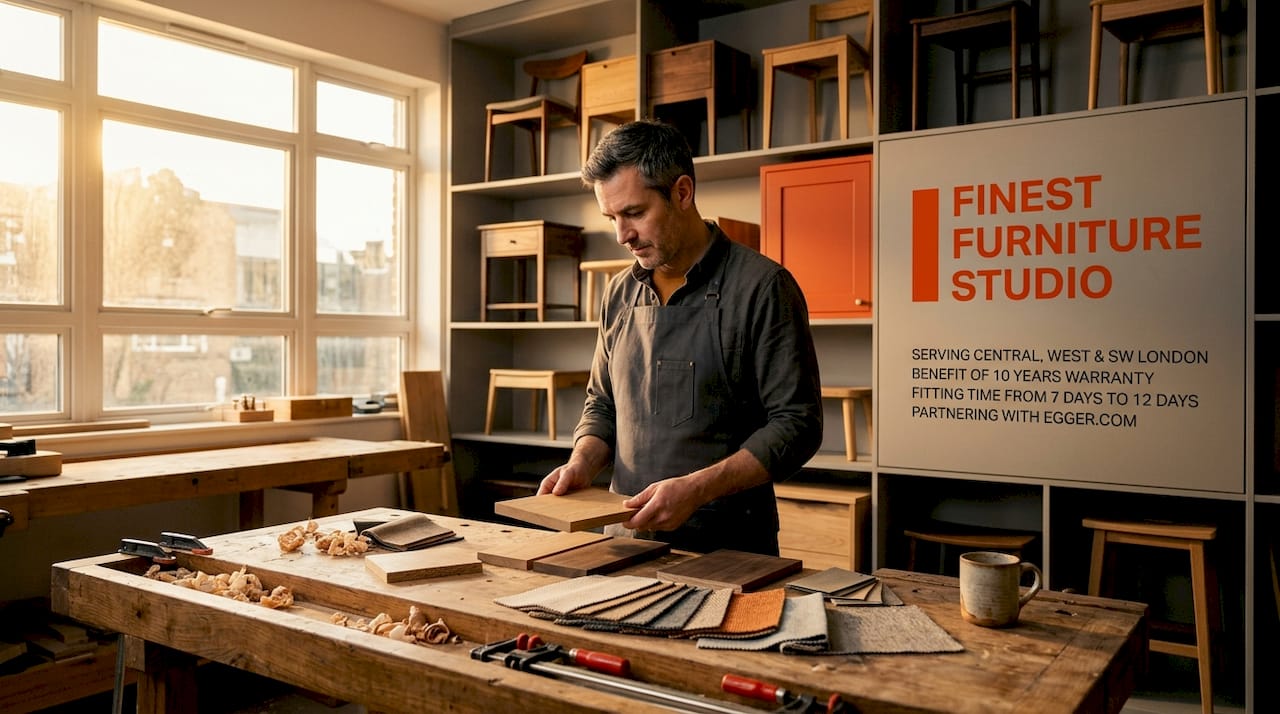
Most homeowners ordering bespoke furniture focus almost entirely on dimensions, finishes, and aesthetics. That is understandable. But the role of materials in bespoke furniture is what ultimately determines whether a piece lasts a decade or a lifetime, whether it holds its beauty under daily use, and whether it can be repaired rather than replaced. Material choice shapes durability, maintenance requirements, environmental impact, and long-term value in ways that no amount of clever design can compensate for. This article covers the materials that matter most, how to assess their quality, and how to make choices you will not regret.
Table of Contents
- Key takeaways
- The primary materials in bespoke furniture
- Durability and performance: what the metrics mean
- Sustainability in material selection
- Matching materials to function and lifestyle
- My perspective on getting materials right
- Bespoke furniture for London homes: how we can help
- FAQ
Key takeaways
| Point | Details |
|---|---|
| Materials define longevity | The species, grade, and sourcing of timber directly determine how a bespoke piece performs over years of use. |
| Durability metrics matter | Upholstery rub counts and wood hardness values give you objective measures to compare materials before committing. |
| Sustainability has real value | Responsibly sourced wood acts as a long-term carbon store, making it a genuinely sound ecological choice. |
| Match materials to lifestyle | High-traffic rooms need harder timbers and higher-rated fabrics; decorative pieces can prioritise character over resilience. |
| Transparency signals quality | Makers who specify materials in full, including joinery methods and finishes, are the ones worth trusting. |
The primary materials in bespoke furniture
Understanding the material categories available to you is the foundation of any good furniture decision. At Finest Furniture Studio, we find that clients who understand what goes into a piece make far more confident choices and are far more satisfied with the results.
Solid hardwoods
Oak, walnut, and teak remain the most widely chosen timbers for bespoke furniture, and for good reason. Oak offers exceptional hardness, a pronounced grain that takes stain and oil beautifully, and a proven track record spanning centuries of use in British homes. Walnut is softer by comparison but prized for its deep chocolate tones and fine, consistent grain. Teak is particularly resistant to moisture and warping, which makes it a strong candidate for fitted furniture in bathrooms or kitchens.
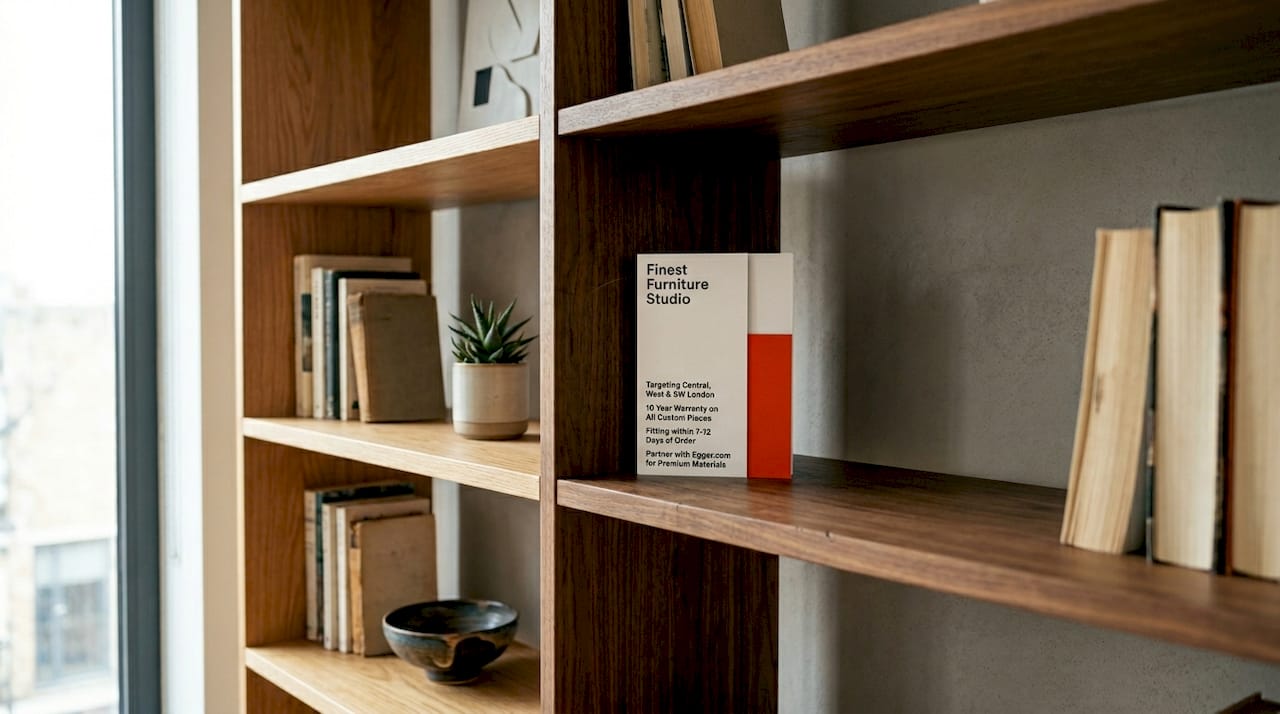
The custom furniture design process begins with timber selection, not just design drawings. That sequencing matters because certain design features are only possible with certain species.
Engineered woods
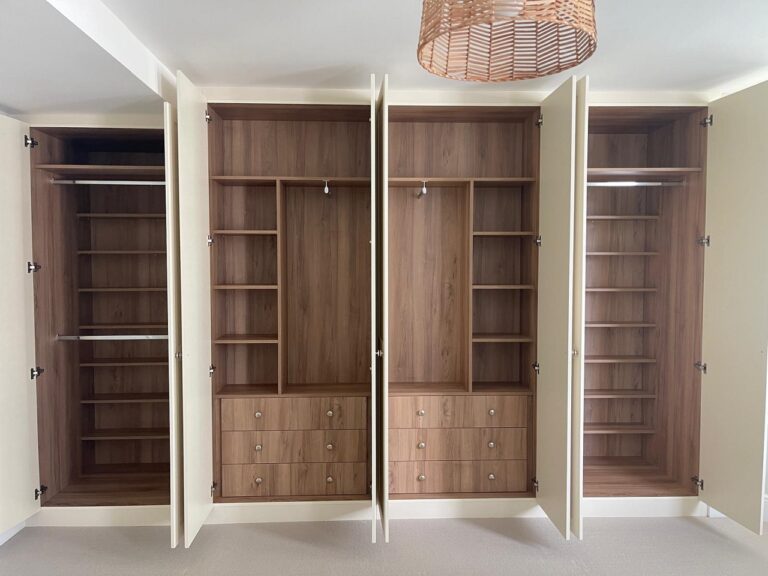
MDF and plywood are not inferior materials. They are different materials with a specific role. MDF takes paint exceptionally well and holds a sharp routed edge, which makes it the preferred substrate for painted cabinetry. Plywood offers superior structural integrity and holds screws more reliably than MDF, making it the better choice for carcass construction and load-bearing shelves.
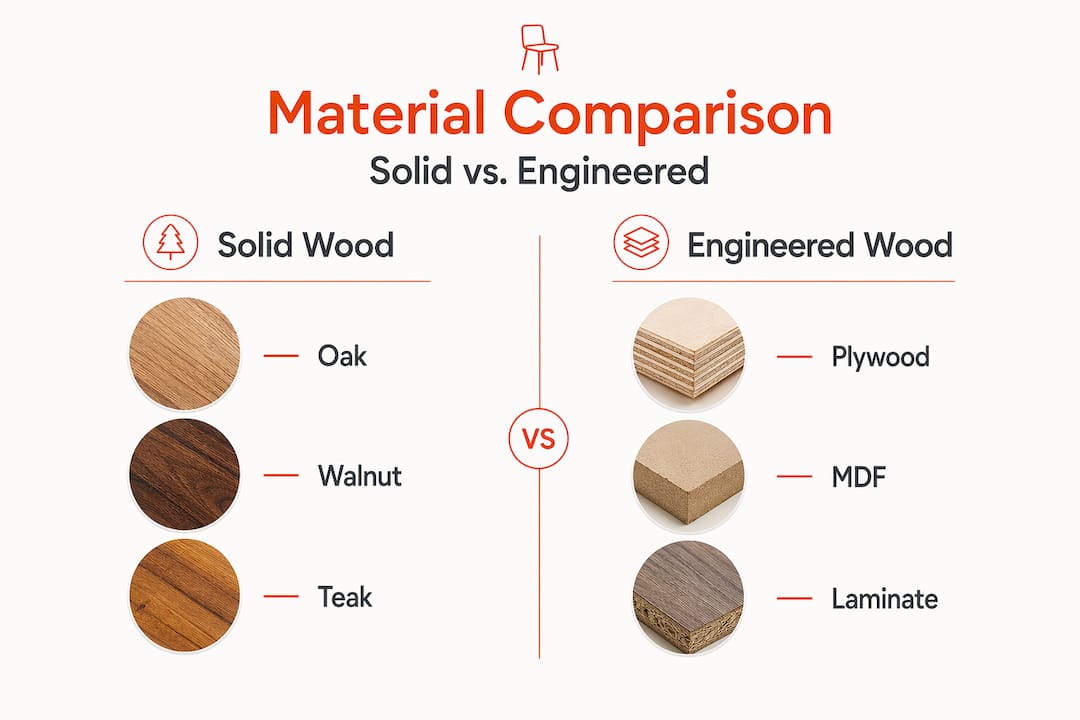
Where engineered woods fall short is in repairability. Surface damage to MDF cannot be spot-repaired the way solid timber can. Over time, that distinction matters.
Metals, composites, and upholstery
Powder-coated steel and brushed brass appear frequently in bespoke furniture as structural frames and decorative details. They add visual weight and rigidity without adding bulk. Composites, including boards that blend recycled plastic with wood residues, are gaining ground as a lower-impact alternative to virgin engineered boards.
For upholstered pieces, fabric grade is a specification in its own right. Performance fabrics woven from tightly twisted yarns, often labelled as Grade C or above, handle daily use far better than loosely woven decorative textiles.
| Material | Key strength | Key limitation | Best application |
|---|---|---|---|
| Solid oak | Hardness, longevity, repairability | Higher cost | Wardrobes, cabinetry, dining furniture |
| Solid walnut | Rich aesthetics, fine grain | Softer, higher price | Bedroom and living room furniture |
| MDF | Smooth finish, paint-ready | Cannot be spot-repaired | Painted cabinetry and door panels |
| Plywood | Structural strength, screw-hold | Less refined appearance | Carcasses and internal frames |
| Powder-coated steel | Rigidity, modern aesthetic | Can feel cold | Structural frames, handles |
| Recycled composite | Lower environmental impact | Limited surface options | Internal panels and backs |
Durability and performance: what the metrics mean
Design-conscious homeowners often focus on how a material looks in a showroom. What matters equally is how it performs in a home that is actually lived in.
Hardness and wear resistance in timber
The Janka hardness scale measures the force required to embed a small steel ball into a wood sample. White oak registers around 1,360 lbf (pounds-force), while European walnut sits closer to 1,010 lbf. For fitted furniture that sees daily contact, such as wardrobe interiors, drawer fronts, and shelving, higher Janka values translate directly to better scratch and dent resistance.
Teak sits at roughly 1,155 lbf but also contains natural silica, which blunts cutting tools and complicates machining. A good craftsman will factor that in. A cheaper one will not.
Finishes and their long-term impact
Material finishing systems involve real trade-offs. Oil finishes penetrate the wood grain and allow for easy spot repairs. If a surface gets scratched, you re-oil the affected area and the damage largely disappears. Lacquer and film finishes create a harder, more resistant surface but are far more difficult to repair if chipped or scratched through.
UV-stable finishes deserve particular attention in London homes with large windows. Un-stabilised resins and some lacquers will yellow noticeably over time when exposed to direct sunlight. Specifying UV-stabilised coatings adds modest cost but prevents visible degradation over a five to ten year period.
Pro Tip: Ask your maker to confirm whether their topcoat is UV-stabilised. If they cannot answer immediately, that tells you something important about how closely they manage their material specifications.
Upholstery durability: the Martindale rub test
For any upholstered bespoke furniture, the Martindale abrasion test is the standard durability measure used across the UK and Europe. The test applies friction in a multidirectional figure-eight motion until the fabric shows visible wear or thread breakage.
For domestic use, 15,000 to 40,000 rubs covers most household applications. Fabrics rated at 40,000 rubs and above enter contract-grade territory, which is appropriate for seating in high-use areas such as a family living room or a home with young children. Fabrics rated at 80,000 rubs and above are specified for commercial environments and are typically over-specified for residential use.
Critically, rub count specifications should align with actual use and aesthetic requirements. Over-specifying leads to choosing technically impressive but visually unsuitable fabrics. A silk-blend cushion cover on a decorative bedroom chair does not need a 40,000-rub rating. A corner sofa in a household with teenagers and a dog almost certainly does.
Sustainability in material selection
The environmental credentials of bespoke furniture materials are no longer a secondary consideration. A growing number of homeowners in areas such as Richmond, Wimbledon, and Chelsea are making sustainability a genuine criterion in their purchasing decisions, and the material facts support that approach.
- Timber sourced from sustainably managed forests carries a markedly lower carbon footprint than steel, aluminium, or petroleum-based composites. Sustainable wood furniture significantly reduces net carbon impact by locking CO₂ into the piece for the duration of its life.
- PEFC and FSC certifications are the most reliable indicators of responsible sourcing. When a maker cannot tell you where their timber comes from, that absence of information is itself a red flag.
- Circular economy approaches are producing commercially viable board materials. Research shows that waste-based boards incorporating recycled plastic waste demonstrate lower environmental impacts and comparable performance to virgin engineered boards.
- Upholstery fabrics carry their own environmental footprint. Synthetic performance fabrics often rely on virgin petrochemical fibres, while natural options such as wool and linen biodegrade at end of life. Recycled polyester fabrics offer a middle ground with lower embodied energy.
- Water-based finishes and low-VOC (volatile organic compound) lacquers reduce off-gassing during and after installation, which matters for indoor air quality as well as environmental impact.
“Choosing wood from sustainably managed forests doesn’t just reduce your environmental impact. It actively stores carbon for the lifetime of the piece, making bespoke wooden furniture one of the more climate-positive purchases a homeowner can make.” — PEFC
The guide to bespoke West London interiors at Finest Furniture Studio covers how we approach eco-friendly sourcing in practice, which is a useful reference if you are weighing up sustainability as part of your brief.
Matching materials to function and lifestyle
The best material for bespoke furniture is not a fixed answer. It depends entirely on how the piece will be used, who will use it, and how much maintenance you are realistically prepared to commit to. Here is how to think through that practically.
-
Map the room’s intensity of use. A master bedroom wardrobe in a household of two adults sees different wear than a family utility room or a teenager’s fitted storage. Higher traffic demands harder timbers, more resilient finishes, and upholstery rated to at least 30,000 Martindale rubs.
-
Consider your maintenance commitment honestly. Oil-finished solid oak looks magnificent and is easy to spot-repair, but it needs re-oiling annually. Lacquered MDF cabinetry requires almost no maintenance but cannot be refinished if damaged. Neither is wrong. They are different contracts with the material.
-
Assess repairability as a long-term criterion. Good joinery and finish choice directly enables easier repair and upkeep over decades. Solid timber drawers with hand-cut dovetails can be reglued and restored. Dowelled MDF carcasses generally cannot. For pieces intended to last twenty years or more, this distinction shapes the entire specification.
-
Separate trend-led choices from structural decisions. It is perfectly reasonable to choose a trending colour for a paint finish, knowing it can be repainted. It is not wise to choose a structurally inadequate timber because it is fashionable. Treat the material specification as the permanent decision and the surface treatment as the flexible one.
-
Ask your maker to be explicit about specifications. Material transparency in bespoke furniture manufacturing is a quality indicator in itself. Makers who can tell you the timber species, board grade, finish system, upholstery rub count, and joinery method are working to a standard. Those who cannot are working to a price.
Pro Tip: Request a cut sample of both the timber and any upholstery fabric before signing off a specification. Colours read differently under showroom lighting versus the natural light in your home, and texture can be deceptive at a distance. This single step prevents the majority of post-installation disappointments.
The bespoke furniture design process we use at Finest Furniture Studio builds these material conversations into the first consultation, so nothing is left to assumption.
My perspective on getting materials right
I have spent years working closely with clients on fitted furniture and bespoke wardrobes across London, and the pattern I see repeatedly is this: the clients who focus only on the visual design are the ones most likely to call with concerns eighteen months later. The clients who took time to understand what their piece was made from, and why, are the ones who send referrals.
What I have learned is that material specifications trump aesthetics in almost every long-term satisfaction scenario. A beautifully designed wardrobe with a poor-grade board interior will develop loose hinges, sagging shelves, and swollen panels within a few years. A simpler design executed in properly graded materials will outlast it by decades.
The point I keep returning to with clients is this: bespoke furniture is a significant investment. The value of that investment is not protected by the design alone. It is protected by the materials underneath. Ask your maker to walk you through the material specification in the same detail they walk you through the design. If they cannot do that with confidence, find a maker who can.
Sustainability is also becoming a genuine client priority rather than a marketing afterthought, and I think that shift is well-grounded. Specifying PEFC-certified timber and low-VOC finishes adds modest cost and meaningful environmental value. For clients in areas like Wimbledon, Barnes, and Chiswick, where homes are long-term investments, that provenance matters.
— Aureliu
Bespoke furniture for London homes: how we can help
At Finest Furniture Studio, material quality is not a selling point. It is a baseline. Every bespoke wardrobe and fitted storage solution we create for clients across Richmond, Chelsea, Wimbledon, Fulham, and Ealing is specified with the same rigour we have described in this article.
We offer a free design visit where we assess your space, discuss your lifestyle, and walk you through material options in detail. Our installations complete in 7 to 12 days, and every piece comes with a 10-year guarantee. We also remove and dispose of your existing wardrobe as part of the service, so the transition is genuinely straightforward. If you are exploring custom wardrobes in West London and want a team that can speak to both design and material quality with equal authority, we would be glad to hear from you. Call or WhatsApp us on 07468 150807, or visit us at 124 City Road, Kemp House, London, EC1V 2NX.
FAQ
What is the best timber for bespoke fitted wardrobes?
Oak is the most widely recommended timber for bespoke fitted wardrobes due to its hardness, durability, and ability to be refinished. Walnut is an excellent choice where richer colouring is the priority, though it requires more careful daily handling.
How does the Martindale rub test relate to domestic furniture?
The Martindale test measures upholstery fabric durability through repeated abrasion cycles. For most domestic applications, a rating of 15,000 to 40,000 rubs is appropriate, with higher ratings needed only for particularly heavy use.
Why does material sourcing matter for bespoke furniture?
Sustainably sourced timber locks CO₂ for the life of the piece and carries a far lower carbon footprint than metals or plastics. PEFC or FSC certification is the most reliable way to verify responsible sourcing.
Can I repair solid wood bespoke furniture if it gets damaged?
Yes. Oil-finished solid timber allows for spot repairs that are largely invisible once completed. Film-finished surfaces and engineered boards are considerably harder to repair without visible evidence of the damage.
How do I know if a bespoke furniture maker is specifying quality materials?
Ask them to provide a written material specification covering timber species and grade, board type, finish system, joinery method, and upholstery rub count if applicable. Material transparency is one of the clearest markers of a quality-led maker.