
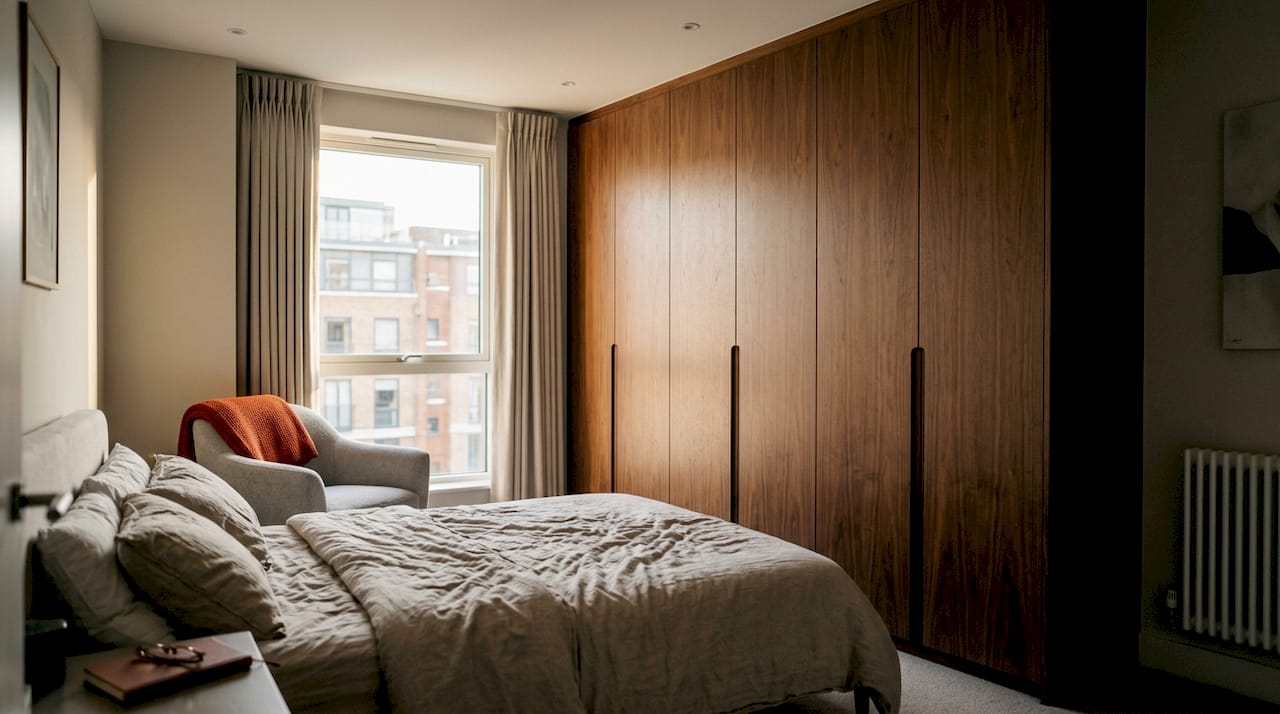
Home storage solutions are purposefully designed systems and structures built into a home to organise belongings, reduce clutter, and make the most of every available metre. Knowing what to know about home storage solutions before you plan a room or renovation can save you thousands of pounds and years of frustration. 65% of homeowners cite insufficient storage as their main design frustration, and that dissatisfaction directly reduces daily comfort and home satisfaction. Retrofitting storage after a build or renovation costs significantly more and delivers far less than planning it from the start. At Finest Furniture Studio, we work with homeowners across Richmond, Wimbledon, Putney, and greater London to get this right the first time.
What to know about home storage solutions before you plan
Effective home storage is not about buying more units. It is about treating storage as a structural element of your home, planned before furniture, finishes, or décor are chosen. Storage zones should be fixed on the layout plan before any other design decisions are made. That sequence prevents the most common and costly mistake in home organisation: adding storage as an afterthought.
The industry term for this approach is storage-first planning, and it applies whether you are fitting out a new build in Kingston or reorganising a Victorian terrace in Chiswick. The principle is the same. Decide where things live before you decide how the room looks.
The four-step planning sequence
Follow this sequence to plan personalised home storage effectively:
-
Audit your possessions by volume. Count cubic metres of clothing, equipment, and seasonal items, not individual objects. A storage audit typically takes one afternoon but informs every design decision that follows. Measuring by volume, not item count, prevents mismatched unit sizes.
-
Set a realistic storage budget. Allocate your budget before you choose finishes or furniture. Built-in solutions cost more upfront than freestanding units but deliver far better long-term value. Retrofitting storage costs an average of £8,000–£15,000 and is 60–75% less cost-effective than planning storage during construction.
-
Allocate 12–18% of your floor area to storage zones. This is the professional benchmark. A 60 sq metre flat should dedicate 7–11 sq metres to storage across all rooms. Most homeowners underestimate this figure significantly.
-
Choose your storage forms last. Only after completing steps one through three should you select fitted wardrobes, media walls, alcove units, or freestanding furniture. Choosing form before function produces attractive rooms that do not work.
Pro Tip: Plan your storage zones on a floor plan sketch before you visit any showroom or browse any catalogue. Knowing your required volume and zone locations means every conversation with a designer starts from a position of clarity, not guesswork.
What types of home storage solutions deliver the best results?
The best home storage ideas share one characteristic: they are built into the architecture rather than placed against it. Built-in storage solutions blend storage with design, keep sightlines clean, and remove the need for freestanding units that consume floor space without contributing to the room’s character.
Bespoke fitted wardrobes
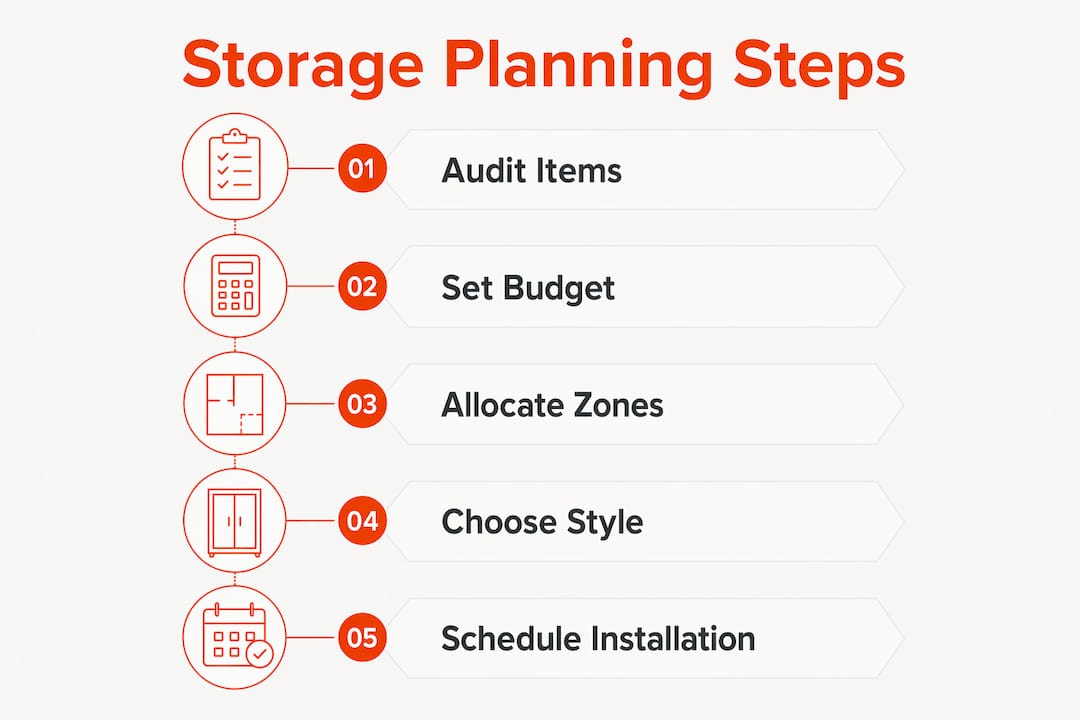
Bespoke fitted wardrobes are the single most impactful storage upgrade available to a bedroom. They use the full height and width of a wall, including awkward corners and sloped ceilings, which freestanding units cannot do. A well-designed fitted wardrobe in a Wimbledon or Richmond bedroom can double usable hanging and shelving space compared with a standard freestanding alternative. The custom bedroom storage process at Finest Furniture Studio begins with a free design visit, ensuring every centimetre is accounted for.
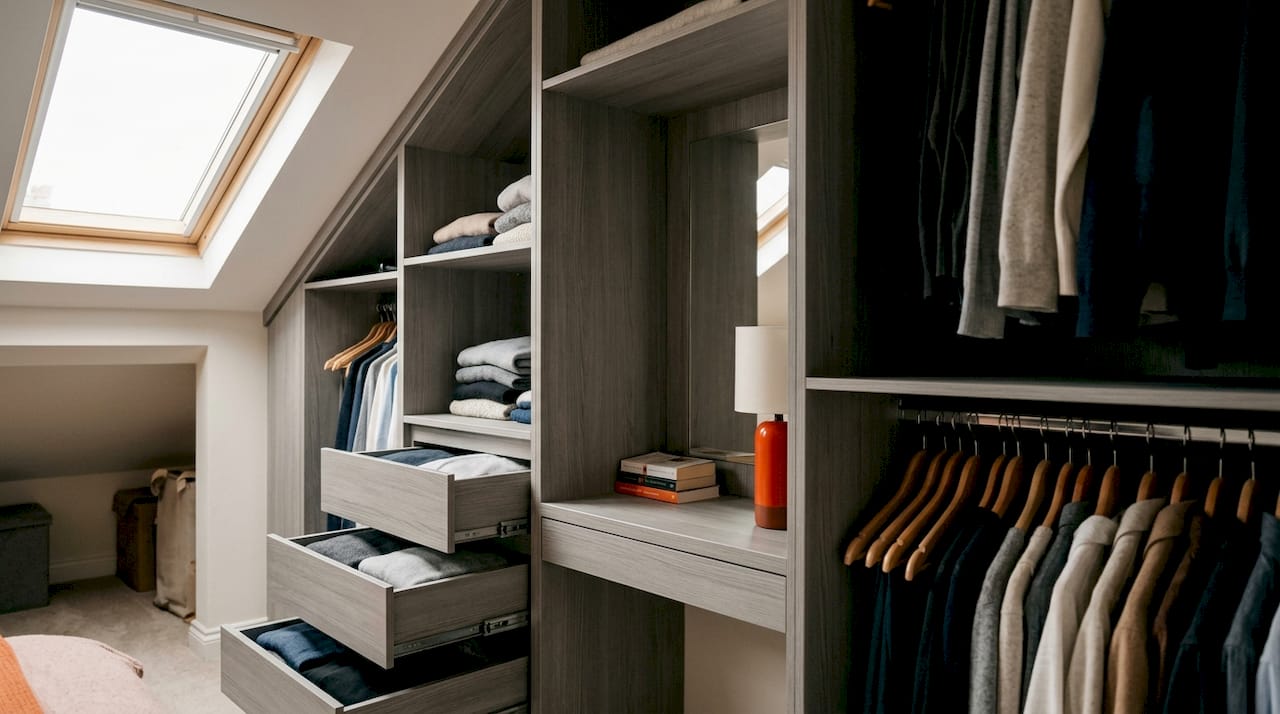
Shaker-style fitted wardrobes suit period properties in Barnes and Fulham. Modern high-gloss or wood-effect finishes work well in new builds across Ealing and Hammersmith. The finish matters less than the internal configuration. Hanging rails, pull-out drawers, shoe racks, and adjustable shelving should all be specified to match your actual wardrobe contents, not a generic template.
Integrated media walls
A media wall with storage serves two purposes simultaneously: it houses your television and AV equipment while providing closed and open storage for books, display items, and everyday objects. This dual function makes it one of the most space-efficient solutions available in living rooms where floor area is limited. In Chelsea and Fulham homes, where living rooms are often long and narrow, a full-width media wall transforms the room’s proportions and eliminates the need for separate sideboards or shelving units.
Other high-impact storage types
- Coat closets and entry storage: Professional standards recommend a minimum 15–20 sq ft coat closet at the entry to prevent clutter migration from coats, shoes, and bags into living areas. A bench, hooks, and cubbies at the front door are not luxuries. They are functional necessities.
- Utility room storage: Fitted shelving and cabinetry in a utility room keeps cleaning products, laundry, and household supplies out of kitchens and living spaces.
- Garage organisation: Wall-mounted racking and overhead storage units reclaim floor space and make garages genuinely usable as workshops or hobby rooms.
- Walk-in wardrobes: Where space permits, a walk-in wardrobe design creates a dedicated dressing room that keeps the main bedroom clear and calm.
Pro Tip: When choosing between freestanding, modular, and built-in units, apply this rule: if the storage will stay in the room for more than five years, build it in. If it needs to move with you, choose modular. Freestanding units are best reserved for display, not primary storage.
How do you optimise small and awkward spaces for storage?
Small and awkward spaces are where bespoke storage solutions deliver their greatest advantage. Standard off-the-shelf units are designed for standard rooms. London homes, particularly loft conversions in Ealing, Victorian terraces in Twickenham, and period flats in Brixton, rarely have standard rooms. Custom alcove, loft, and understairs storage solutions are the most efficient way to reclaim space that generic furniture simply cannot reach.
Alcove storage
Alcoves on either side of a chimney breast are among the most underused spaces in British homes. A fitted alcove unit, built floor to ceiling, can provide as much storage as a full wardrobe while occupying space that would otherwise hold a small bookshelf or nothing at all. Maximising alcove storage requires precise measurement and a design that accounts for the depth variation common in older properties.
Loft and sloped ceiling wardrobes
Loft conversions create bedrooms with sloped ceilings that defeat standard furniture entirely. A bespoke loft wardrobe follows the roofline, using every centimetre of height where it exists and incorporating lower drawers and shelving where the ceiling drops. Homeowners in Ealing and Hammersmith with loft conversions consistently report that a fitted wardrobe is the single change that makes the room feel finished and functional.
Understairs storage
The space beneath a staircase is one of the most versatile storage zones in a home. A well-designed understairs storage solution can house a home office, a coat cupboard, a wine rack, or a combination of all three. The key is to design the internal layout before the door or panel is fitted, not after.
The following principles apply to all compact home storage planning:
- Use vertical space fully. Shelving that stops at eye level wastes the most valuable storage zone in the room.
- Fit storage early in any renovation. Electrical sockets, lighting, and structural elements must be coordinated with built-in units before walls are finished.
- Prioritise access. Storage you cannot reach easily becomes storage you do not use.
- Choose sliding doors over hinged doors in tight rooms. Sliding doors require no swing clearance and keep narrow corridors and bedrooms navigable.
| Space type | Best storage solution | Key benefit |
|---|---|---|
| Alcove beside chimney breast | Floor-to-ceiling fitted unit | Maximises unused recess depth |
| Loft conversion bedroom | Bespoke sloped ceiling wardrobe | Follows roofline, no wasted angles |
| Understairs area | Custom fitted cupboard with internal layout | Converts dead space into functional storage |
| Narrow bedroom | Sliding door fitted wardrobe | Eliminates door swing, preserves floor area |
What are the most common home storage mistakes?
The most damaging storage mistake is treating storage as an add-on rather than as design infrastructure. Treating storage as infrastructure prevents inefficient unit buying and supports natural daily flow through the home. When storage is planned last, homeowners end up with rooms full of freestanding units that block natural light, interrupt sightlines, and still fail to hold everything they need.
Failing to coordinate with electrical and lighting
Built-in storage requires early collaboration with electricians. Planning storage walls as structural elements during layout prevents last-minute conflicts with sockets, switches, and lighting circuits. A fitted wardrobe with integrated LED lighting, for example, needs power routed to the correct wall before plastering begins. Retrofitting this after the fact is expensive and disruptive.
Ignoring household routines
Storage aligned with daily habits creates organisation that maintains itself. Storage that ignores routines creates clutter within weeks. Map your storage zones by use frequency. Items used daily belong at eye level and arm’s reach. Items used seasonally belong in higher or deeper storage. This principle applies to every room, from the kitchen to the bedroom.
Neglecting entry storage
Coordinated entryway storage including benches, hooks, and cubbies prevents coats, shoes, and bags from migrating into living areas. The entry is the first and last point of contact with the home every day. A poorly designed entry creates clutter that spreads through the entire house.
The most common mistakes to avoid are:
- Choosing furniture before measuring storage volume requirements
- Buying freestanding units as a temporary fix that becomes permanent
- Ignoring vertical space above 180cm
- Failing to plan for evolving needs, such as children growing up or working from home
- Treating the loft, understairs, and alcoves as dead space rather than prime storage zones
Pro Tip: When planning storage for a growing family, build in 20% more capacity than you currently need. Storage needs increase over time, and a fitted unit designed with adjustable shelving and removable rails adapts far more easily than one built to a fixed specification.
Key takeaways
Effective home storage is built into the architecture from the start, planned by volume and zone before any furniture or finish is chosen.
| Point | Details |
|---|---|
| Plan storage before finishes | Fix storage zones on your floor plan before choosing furniture, paint, or flooring. |
| Audit by volume, not items | Measure cubic metres of belongings to avoid mismatched unit sizes and wasted space. |
| Allocate 12–18% of floor area | This professional benchmark prevents under-specifying storage in any room size. |
| Bespoke beats freestanding | Built-in wardrobes and media walls use architecture fully and deliver lasting value. |
| Awkward spaces are opportunities | Alcoves, lofts, and understairs areas yield the highest return from bespoke fitted storage. |
Why I think most homeowners plan storage too late
Having worked with hundreds of homeowners across London, from Richmond to Brixton and Walton-on-Thames to Woking, I have seen the same pattern repeat itself. The kitchen gets planned meticulously. The bathroom gets a detailed specification. Storage gets whatever space is left over.
The result is always the same. Beautiful rooms that do not function. Bedrooms with freestanding wardrobes pushed against radiators. Living rooms with shelving units blocking windows. Hallways stacked with bags and coats because there is nowhere logical to put them.
What I have found actually works is treating storage as the first design decision, not the last. When a homeowner in Wimbledon tells me they want a fitted wardrobe, my first question is never about finish or door style. It is about what they own and how they live. That conversation changes everything. A wardrobe designed around actual clothing volume and daily dressing habits works in a way that a standard unit never can.
The other thing I have observed is that bespoke fitted wardrobes and integrated media walls consistently produce the strongest reaction from homeowners after installation. Not because they look impressive, though they do, but because they make the home feel genuinely easier to live in. Organisation stops being a daily effort and becomes the natural result of the space itself.
If you are planning a renovation in Twickenham, Chiswick, or anywhere across greater London, I would encourage you to put storage on the agenda before you choose a single tile or paint colour. The rooms that work best are the ones where storage was never an afterthought.
— Aureliu
Finest Furniture Studio: bespoke fitted storage for London homes
Finest Furniture Studio designs and installs bespoke fitted wardrobes, integrated media walls, loft wardrobes, and alcove storage solutions across Richmond, Wimbledon, Putney, Kingston, Fulham, Chelsea, and greater London. Every project begins with a free design visit, where we measure your space, discuss your storage needs, and produce a design tailored to your home’s architecture and your daily routine.
Fitting is completed within 7–12 days, and every installation is backed by a 10-year quality guarantee. We also remove and dispose of your old wardrobe as part of the service. Whether you have a loft conversion in Ealing, an alcove in Barnes, or a living room in Hammersmith that needs a media wall with storage, we have the experience to make it work. Call us on 07468 150807, message us on WhatsApp, or visit us at 124 City Road, Kemp House, London, EC1V 2NX to arrange your free design visit.
FAQ
What is the most important thing to know about home storage solutions?
Plan storage zones on your floor plan before choosing any furniture or finishes. Allocating 12–18% of your floor area to storage from the outset prevents costly retrofits and ensures every room functions as well as it looks.
How do I plan personalised home storage effectively?
Start by auditing your possessions by volume, then set a storage budget, allocate floor area to storage zones, and only then choose your storage forms. This sequence ensures your storage is sized and positioned to match how you actually live.
Are bespoke fitted wardrobes worth the cost?
Bespoke fitted wardrobes use the full height and width of a wall, including awkward angles and recesses, which freestanding units cannot. They deliver more usable storage per square metre and add lasting value to the property.
What are the best storage solutions for small spaces?
Custom alcove units, loft wardrobes with sloped ceiling profiles, and understairs fitted cupboards are the most effective options for compact London homes. Sliding door wardrobes also preserve floor area in narrow bedrooms where hinged doors are impractical.
How long does fitted wardrobe installation take?
Finest Furniture Studio completes fitted wardrobe and storage installations within 7–12 days. The process includes a free design visit, bespoke manufacture, and full installation with removal of any existing furniture.