








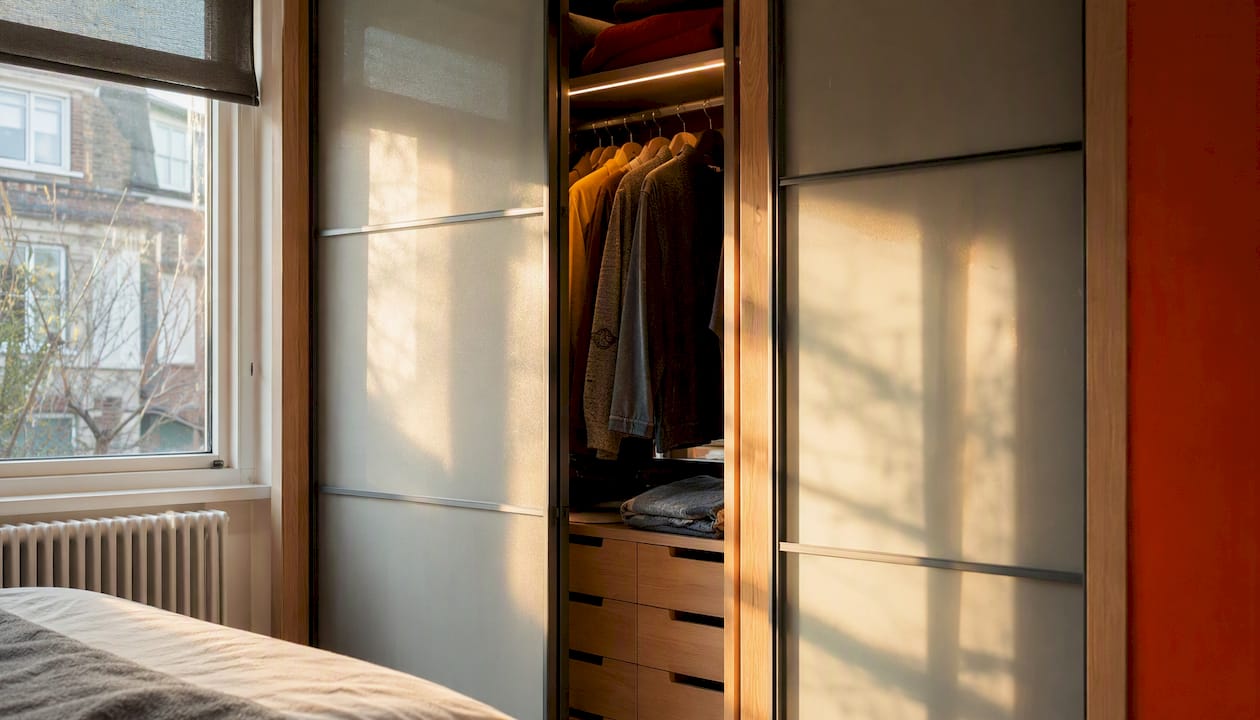
Frosted or satin glass is the best all-round choice for glass wardrobe door privacy. It softens natural light, hides clothing and clutter behind a clean, diffused panel and suits most bedroom styles from contemporary to Shaker. Reeded (fluted) glass is the right call when you want texture and semi-privacy with a premium look. Tinted or smoked glass adds a subtle screen with a modern edge, while clear glass and mirror panels suit rooms where concealment is secondary to brightness or visual space. If you are unsure which frost level or finish works in your specific room, request physical samples and arrange a site survey with a made-to-measure fitter such as Finest Furniture Studio before committing.
- Best for full privacy: frosted or satin glass (high opacity, good light diffusion)
- Best for semi-privacy with texture: reeded or fluted glass (obscures detail, preserves form)
- Best for brightness over concealment: clear glass or mirror panels
- Best for a modern tinted screen: smoked or grey-tinted glass
- Retrofit option: frosted privacy film on existing clear panels
Key takeaways
Frosted or satin glass delivers the best balance of privacy and natural light for most UK bedrooms, and a made-to-measure installation with a site survey is the most reliable way to get the finish right.
| Point | Details |
|---|---|
| Best finish for full privacy | Frosted or satin glass hides contents completely while still transmitting diffused natural light. |
| Best for semi-privacy with texture | Reeded or fluted glass scatters light and obscures detail, with a premium textured appearance. |
| Retrofit vs replace | Use removable frosted film for rented properties; commission made-to-measure glass doors for long-term renovations. |
| Safety specification | Always confirm toughened or safety-backed glass to meet UK standards before signing any contract. |
| Finest Furniture Studio | Offers made-to-measure glass wardrobe doors with a 10-year guarantee, 7–12 day installation, and free design visit across London. |
Table of Contents
- How does glass finish affect privacy in wardrobe doors?
- What retrofit options can improve privacy on existing glass doors?
- How does the door system change privacy and room layout?
- What frame and glass specification should you ask for?
- What do glass wardrobe doors typically cost in the UK?
- What should you ask a fitter before signing a contract?
- Why Finest Furniture Studio is the right choice for privacy-focused glass wardrobes
- How we can help you get the right result
- Useful sources
- What the right finish looks like in a small London bedroom
- FAQ
How does glass finish affect privacy in wardrobe doors?
Glass finish is the single biggest variable in the privacy equation. The same door frame fitted with clear glass versus satin-frosted glass produces a completely different result in terms of what you can see, how much light enters the room, and how the wardrobe reads from across the bedroom.
Clear glass
Privacy level: none. Clear glass transmits virtually all natural light and leaves wardrobe contents fully visible. It suits walk-in wardrobes where the interior is styled as a display, or rooms where the owner wants maximum brightness and is comfortable with full visibility. Fingerprints and smears show immediately on clear panels, so daily wiping is part of the routine.
Frosted and satin glass
Privacy level: high. Frosted glass wardrobe doors soften light, hide clutter and strike the most popular balance between a bright room feel and genuine concealment. Satin finishes sit at the lighter end of the opacity range; heavy-etched frosted panels approach near-opaque. Both hide clothing shapes effectively. Satin and frosted finishes also disguise fingerprints far better than clear or mirrored glass, making them a practical choice for family bedrooms.
Reeded and fluted glass
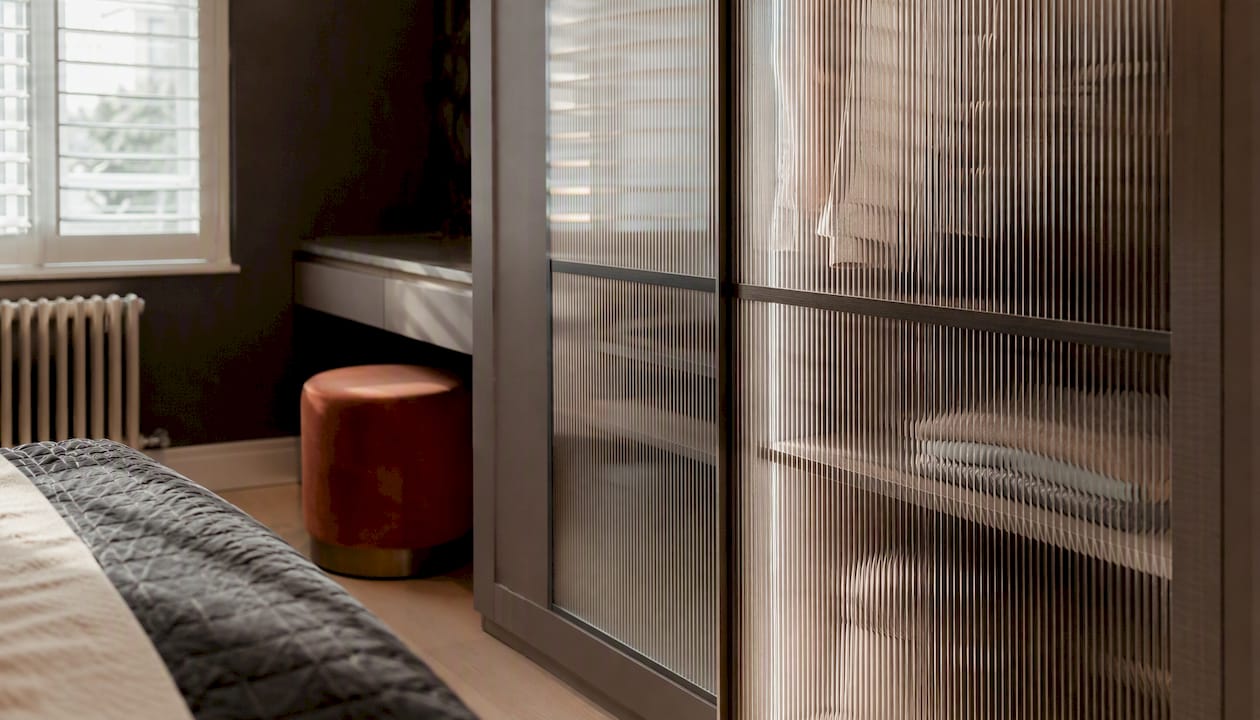
Privacy level: medium. Reeded glass scatters light through its vertical ridges, obscuring detail while preserving the general outline of what is behind the panel. It is often recommended for walk-in wardrobes where a premium textured look is wanted alongside semi-privacy. The ribbed surface adds visual interest that plain frosted glass cannot match, though it does collect dust in the grooves and needs a soft brush during cleaning.
Tinted and smoked glass
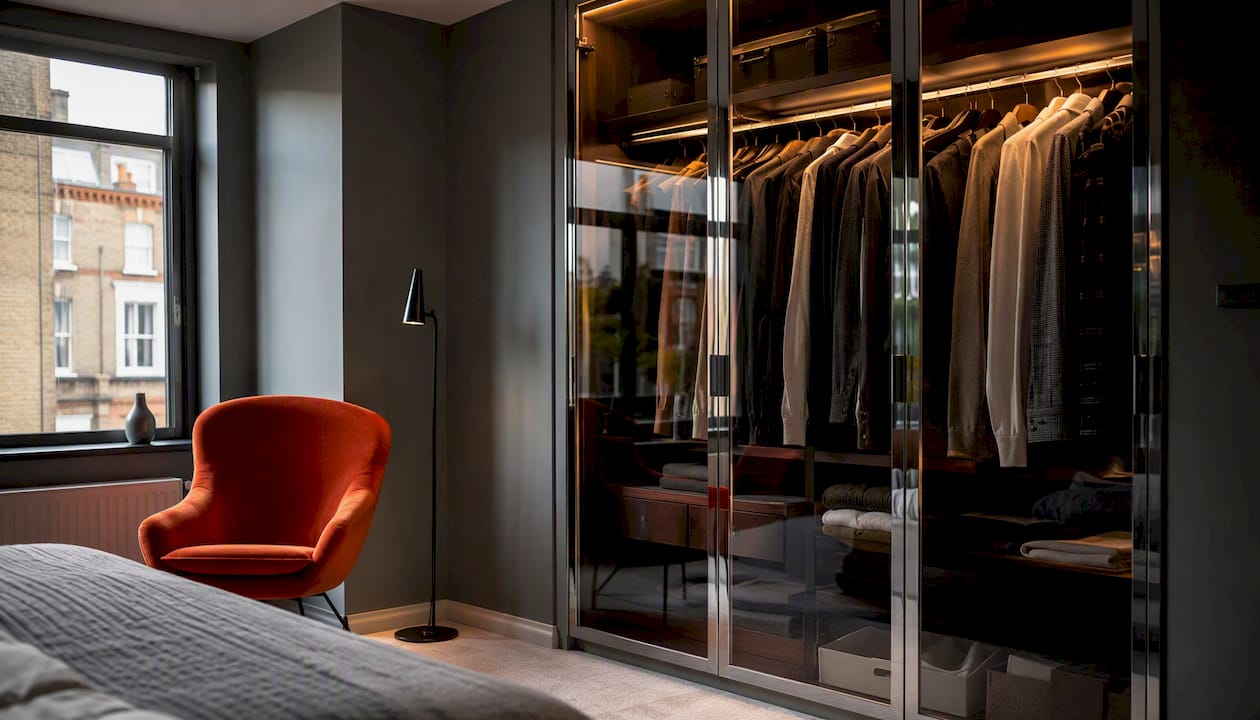
Privacy level: low to medium. Grey, bronze, or smoked tints reduce visibility without eliminating it entirely. In bright daylight, a tinted panel provides a reasonable screen; in a lit room at night, the effect diminishes. Aluminium-framed systems commonly support grey and bronze tints alongside frosted and reeded options, giving designers a wide palette to work with.
Mirror and frosted-mirror glass
Privacy level: high (from outside the wardrobe). Standard mirror panels conceal contents completely and make rooms appear larger and brighter. The trade-off is that plain mirror shows every fingerprint and smear. Frosted-mirror variants combine the space-expanding quality of mirror with a softer surface that hides marks better, making them easier to maintain in a busy household.
Pro Tip: Pair a high-opacity frosted or satin panel with internal LED strip lighting inside the wardrobe. The warm glow through the glass looks intentional and elegant rather than exposing, and it makes finding clothes at night far easier without needing to open the doors.
Privacy vs light at a glance: frosted/satin gives the best all-round balance; reeded sits just below for semi-privacy with texture; tinted offers a modern screen; mirror conceals fully but reflects rather than transmits light; clear glass sacrifices privacy entirely for brightness.
What retrofit options can improve privacy on existing glass doors?
Replacing glass panels is not always necessary or practical. Several retrofit solutions can raise the privacy level of existing clear or lightly tinted wardrobe doors at a fraction of the cost of a full replacement.
Film and vinyl options
- Etched-effect frosted film — the most popular retrofit. Applied directly to the glass surface, it mimics the look of acid-etched or sandblasted glass and provides high privacy. Permanent adhesive versions last several years; static-cling versions are removable without residue, which makes them suitable for rented properties.
- Sandblasted-effect vinyl — slightly thicker than standard frosted film, with a more opaque finish. Better for panels where near-complete concealment is needed.
- Opaque vinyl — available in solid colours or patterns. Provides complete privacy but blocks all light transmission. Useful for a single panel in a shared room where one section needs full screening.
- Removable window clings and static vinyl — no adhesive, no damage to glass. The best choice for tenants or anyone who wants a reversible solution.
Pro Tip: Before cutting film to size, clean the glass thoroughly with isopropyl alcohol and allow it to dry completely. Any residue or moisture trapped beneath the film causes bubbling within weeks.
For rented properties, removable static films are the most practical route. For long-term renovations, permanent frosted glass panels from a made-to-measure supplier deliver a cleaner result and a longer service life.
How does the door system change privacy and room layout?
The door mechanism affects not just how a wardrobe opens but how much of the interior is exposed at any given moment, and how well the panels seal at the edges.
Sliding doors
Sliding wardrobe systems are the most common choice for bedrooms where floor space is limited. Panels overlap rather than swing out, so there is no clearance zone in front of the wardrobe. The privacy consideration with sliding doors is the edge gap: the small vertical gap between panels when they are closed. On a well-fitted made-to-measure system this gap is minimal, but on cheaper off-the-shelf tracks it can be wide enough to reveal a strip of clothing. A site survey and precise measurement eliminate this problem. Finest Furniture Studio’s bespoke sliding doors is configured specifically for tight rooms where both fit and privacy matter.
Hinged doors
Hinged panels provide a better edge seal when closed because the door sits flush against the frame or carcass. When open, however, the entire wardrobe interior is exposed. Hinged doors need a clear swing zone in front of the wardrobe, which rules them out for many smaller London bedrooms. Where space allows, they offer the most complete closure and the cleanest sight line when shut.
Bi-fold and pocket doors
Bi-fold panels fold back on themselves, which means they stack into a compact accordion when open. They work well in medium-sized rooms where a full swing is not possible but a sliding overlap is not wanted. Pocket doors slide entirely into a cavity within the wardrobe carcass, making them invisible when open and providing a clean, uninterrupted panel face when closed. Both systems require adequate headroom and a level floor for the track to function correctly.
Installation note: a common pitfall with sliding and bi-fold tracks is an uneven floor. Even a few millimetres of variation causes panels to stick, drag, or fail to stack correctly. Always measure floor levelness with proper levelling tools during the site survey — this single check prevents the majority of post-installation complaints.
What frame and glass specification should you ask for?
Frame material and glass specification determine how the finished wardrobe looks, how long it lasts, and whether it meets UK safety requirements.
Aluminium vs timber frames
Aluminium profiles are the standard choice for modern sliding wardrobe systems. They are slim, durable, resistant to warping, and available in a wide range of powder-coated colours. Thin-profile aluminium frames maximise the glass area and give a frameless appearance from a distance. Timber frames suit traditional or Shaker-style wardrobes and can be painted or stained to match existing joinery, though they require more maintenance and are more susceptible to humidity in bathrooms or poorly ventilated rooms.
Safety glass requirements
All glass used in domestic wardrobe doors in the UK should be toughened (tempered) safety glass or safety-backed with a protective film. Toughened glass, when broken, fractures into small, blunt fragments rather than sharp shards. Made-to-measure glass sliding wardrobe doors are manufactured in safety-backed glass to comply with UK safety standards. For hinged doors, edge protection is particularly important because the exposed edges of a hinged panel are more likely to be contacted during daily use.
- Always confirm the glass grade and thickness in writing before signing a contract.
- Ask whether the panels carry a safety backing film in addition to toughening.
- For panels above 1.5 m in height, confirm the weight per panel and whether the track or hinge specification is rated for that load.
- Request confirmation that the installation meets the requirements of BS 6206 (safety glazing) or its successor standard.
Safety callout: never accept a quote that does not specify toughened or safety-backed glass for wardrobe panels. This is not a premium upgrade — it is the baseline for domestic safety in the UK.
What do glass wardrobe doors typically cost in the UK?
Cost varies significantly depending on whether you are retrofitting film, replacing panels, or commissioning a fully bespoke made-to-measure installation.
| Option | Typical cost range | Approximate lead time |
|---|---|---|
| DIY frosted film (self-fit) | Cost varies according to size and supplier | Same day |
| Professional film application | Cost varies according to size and supplier | 1–3 days |
| Made-to-measure sliding glass doors | Cost varies by specification and size | 2–6 weeks |
| Bespoke framed hinged glass doors | Cost varies by specification and size | 3–7 weeks |
| Premium patterned or tinted glass panels | Cost varies by specification and size | 4–10 weeks |
The bespoke made-to-measure process typically follows these steps:
- Site survey: a fitter visits to measure the space, check floor levelness, headroom, and wall alignment, and discuss finish options with physical samples.
- Sample selection: glass finish, frame colour, and handle style are confirmed against the room’s actual lighting conditions.
- Production: panels are cut, toughened, and finished to the exact specification.
- Installation: fitting typically takes place within a 7–12 day window from order confirmation at Finest Furniture Studio, which is notably faster than many bespoke suppliers.
For small bedrooms in London, sliding glass door systems often represent the best value per square metre of storage gained, because they require no swing clearance and can be fitted floor to ceiling.
What should you ask a fitter before signing a contract?
Choosing the right installer matters as much as choosing the right glass. A poor installation undoes the best materials.
- Is the quote made-to-measure? A standard-size door fitted into a non-standard opening will have gaps, misaligned tracks, or panels that bind.
- Will you carry out a site survey before quoting? Any reputable fitter surveys in person. A quote issued from photos or rough measurements alone is a red flag.
- Can I see physical sample panels? Samples viewed in your own room under your own lighting are the only reliable way to judge frost level and frame colour.
- What glass grade and thickness are you specifying? The answer should reference toughened or safety-backed glass as standard.
- What is the warranty term? A 10-year workmanship guarantee is available from Finest Furniture Studio and is rare in the industry. Anything shorter than five years warrants scrutiny.
- Will you remove and dispose of the existing wardrobe? Not all fitters include this. Finest Furniture Studio does, which simplifies the project considerably.
Pro Tip: When comparing quotes, ask each fitter to itemise the glass specification, frame profile, track system, and installation labour separately. A single lump-sum quote makes it impossible to compare like for like.
Red flags to avoid
- Vague warranty wording (“we guarantee our work”) with no defined term or scope.
- No sample panels offered or available.
- Refusal to conduct a site survey before quoting.
- Unrealistically short lead times (under one week for bespoke glass manufacture).
- No clear policy on disposal of the existing wardrobe.
Why Finest Furniture Studio is the right choice for privacy-focused glass wardrobes
Finest Furniture Studio designs and installs made-to-measure wardrobes across London, with a particular focus on bespoke sliding systems for bedrooms where space and privacy both matter. Every project begins with a free design visit and site survey, during which physical glass samples are brought to the room so you can judge frost level and frame finish against your actual lighting conditions. This is the step that most homeowners underestimate, and it is the one that most reliably produces a result they are happy with long-term.
The service covers Richmond, Wimbledon, Putney, Kingston, Chiswick, Fulham, Chelsea, Ealing, Twickenham, Barnes, Hammersmith, and surrounding areas including New Malden, Brixton, Walton-on-Thames, and Woking.
- 10-year workmanship guarantee on all installations.
- 7–12 day installation window from order confirmation, faster than most bespoke suppliers.
- Removal and disposal of the existing wardrobe included as standard.
- Full range of glass finishes: frosted, satin, reeded, tinted, mirror, and frosted-mirror, all in toughened safety glass.
- Sliding, hinged, bi-fold, and pocket door systems available, configured to your room’s exact dimensions.
Our approach: we bring samples to your room because the same frosted panel looks entirely different in a north-facing Richmond bedroom than it does in a south-facing Chelsea flat. Getting that judgement right at the survey stage is what separates a wardrobe you love from one you tolerate.
For a free design visit, call or WhatsApp 07468 150807, or visit us at 124 City Road, Kemp House, London, EC1V 2NX.
How we can help you get the right result
Finest Furniture Studio offers a straightforward route from first enquiry to finished wardrobe. The process starts with a free design visit where we survey your space, discuss your privacy and light priorities, and show you physical glass samples in situ. From there, we produce a written quote with a full specification breakdown, manufacture your panels in toughened safety glass, and install within a 7–12 day fit window.
Our bespoke wardrobe service for West London homes covers Richmond, Wimbledon, Putney, Kingston, Chiswick, Fulham, Chelsea, Ealing, Twickenham, Barnes, and Hammersmith, with a 10-year workmanship guarantee and full disposal of your existing wardrobe included. For homeowners in Richmond specifically, our bespoke fitted wardrobes Richmond page covers local project examples and finish options in detail.
Call or WhatsApp 07468 150807 to book your free design visit, or message us through the website to get started.
Useful sources
- Finest Furniture Studio — bespoke wardrobe services
- Sliding wardrobe door styles — 2026 London guide
- Glass types for wardrobe doors — Glassique
- Glass sliding wardrobe doors — Wardrobe Doors Direct
- The luxury of glass interior doors
What the right finish looks like in a small London bedroom
The most common mistake we see in London bedrooms is choosing a glass finish from a brochure photograph rather than from a physical sample held up in the actual room. A satin panel that looks warm and opaque in a south-facing Chelsea flat can appear almost transparent in a north-facing Putney bedroom on a grey afternoon. That gap between expectation and reality is where most wardrobe regrets originate.
The practical answer for small rooms is nearly always a frosted or satin sliding system. It keeps the floor plan open, bounces light around the room and conceals the wardrobe interior without making the space feel closed in. Where clients want something more distinctive, reeded glass is the upgrade worth considering: the texture catches light differently throughout the day and gives the wardrobe a presence that plain frosted glass cannot match. Pair either finish with internal LED strips, and the result reads as a deliberate design feature rather than a storage solution.
One sentence of honest advice: do not skip the site survey. Seeing samples in your own room, under your own light, is the single step that most reliably produces a result you will still be pleased with in five years.
FAQ
What glass finish gives the most privacy on wardrobe doors?
Frosted or satin glass provides the highest privacy level while still transmitting diffused natural light. Heavy-etched frosted panels approach near-opaque and are the standard recommendation for bedroom wardrobes.
Can you add privacy to existing clear glass wardrobe doors?
Yes. Etched-effect frosted film or static-cling vinyl applied directly to the glass surface raises privacy significantly without replacing the door. Removable static films are the best option for rented properties.
How do you stop people seeing through sliding glass wardrobe doors?
Choose a frosted, satin, or reeded glass finish when ordering, or apply a frosted privacy film to existing clear panels. Ensuring the sliding panels overlap correctly and that edge gaps are minimal also reduces visibility at the joins.
Is toughened glass required for wardrobe doors in the UK?
Toughened or safety-backed glass is the standard specification for domestic wardrobe panels in the UK and should be confirmed in writing with any installer before work begins.
How long does a made-to-measure glass wardrobe installation take?
The full process from site survey to installation typically takes 2–6 weeks for a standard made-to-measure sliding system. Finest Furniture Studio completes the installation itself within a 7–12 day fit window from order confirmation.