
Table of Contents
- What Makes a Fitted Wardrobe Last: Quality Indicators That Matter
- Bespoke Wardrobe Material Comparison: What Performs Best
- How Long Do Fitted Wardrobes Last: Realistic Timescales
- Fitted Wardrobe Installation Standards UK: What Professional Work Looks Like
- Fitted Wardrobe Cost Breakdown 2026: Where Your Money Goes
- Red Flags: Signs of Poor Workmanship and Low-Grade Materials
- Sustainable Sourcing and Longevity: Building Wardrobes That Last
- Your Fitted Wardrobe Quality Checklist: The Complete Evaluation Framework
Last Updated: August 9, 2026
What Makes a Fitted Wardrobe Last: Quality Indicators That Matter
A fitted wardrobe quality checklist protects you against poor construction, cheap materials, and installation shortcuts. Longevity depends on three things: carcass construction, hardware, and installation standards.
Most people focus on aesthetics, but durability depends on what’s inside the carcass, how doors track, and whether installation crews measured properly and checked wall plumb. At Finest Furniture Studio, we’ve developed a checklist focusing on structural and mechanical elements that determine real durability.
Carcass Construction and Frame Integrity
The carcass is your wardrobe’s skeleton. Quality uses 18mm or thicker board with proper internal bracing. Cheaper wardrobes use 16mm board with minimal support, causing the frame to flex when doors open and close, gradually twisting until doors stop closing properly.
Look for dowelled and glued construction rather than staples or cam-locks alone. The best manufacturers combine dowels and glue with cam-locks for structural integrity with redundancy, if one fastening method weakens, others still hold.
Check whether the back panel is solid or frame-and-backing. Solid backs prevent the carcass from racking sideways; frame-and-backing saves money but sacrifices rigidity. Internal bracing should run both horizontally and vertically to prevent outward bowing and twisting, especially in floor-to-ceiling wardrobes bearing hanging clothes weight.
Hardware Quality: Hinges, Runners, and Soft-Close Mechanisms
Hardware separates wardrobes that function smoothly for twenty years from those squeaking, sticking, or binding within three.
Quality hinges are steel with ball-bearing pivot points, not friction surfaces. Ball-bearing hinges stay smooth; friction hinges wear and develop play. Soft-close dampers should use sealed hydraulic systems that can’t leak or degrade. Test by opening the door halfway and letting go, it should close smoothly without slamming.
Drawer runners matter critically. Full-extension runners with metal-on-metal ball bearings last far longer than plastic designs. Check weight ratings match your actual load. Soft-close drawer dampers should slow drawers smoothly and silently; jerky or noisy closing indicates poor quality.
Bespoke Wardrobe Material Comparison: What Performs Best
Your material choice affects durability, appearance, maintenance, and cost.
Solid Wood vs. MFC: Durability and Longevity
Solid wood is premium for longevity but expands and contracts with humidity. Quality construction accounts for this through floating panels and careful joinery. Solid wood can be refinished and repaired, a damaged door can be sanded and restained. However, it’s significantly more expensive.
MFC (melamine-faced chipboard) offers consistency and stability. The melamine facing resists moisture better than bare wood, and the chipboard core doesn’t expand and contract. Doors stay straight and drawers stay aligned. The trade-off is real: MFC lasts fifteen to twenty years if built well, but once the melamine facing is damaged through scratches, impact, or water exposure, it can’t be repaired.
Plywood is a middle ground, more stable than solid wood, more durable than chipboard, and less expensive than solid wood.
Finishes and Protective Coatings
Lacquer finishes are durable and easy to clean but show fingerprints and dust. Matte lacquer hides marks better than gloss. Quality lacquer applies multiple thin coats, each sanded between applications. Cheap lacquer is often a single thick coat, prone to peeling.
Melamine facing is extremely durable in normal use but can’t be repaired if damaged. Paint finishes require proper surface preparation and multiple coats; a single coat will chip and peel.
How Long Do Fitted Wardrobes Last: Realistic Timescales
Fitted wardrobes last between ten and thirty years depending on quality, use, and maintenance.
Poorly built wardrobes show problems within five years: binding doors, sticking drawers, and sagging structure. Mid-range wardrobes last twelve to fifteen years before significant wear appears. Quality wardrobes built with solid construction, good materials, and proper installation last twenty to thirty years. Key variables are material quality, construction standards, installation precision, and usage intensity.
Fitted Wardrobe Installation Standards UK: What Professional Work Looks Like
Installation quality determines whether your wardrobe functions properly and lasts as long as it should. Poor installation compromises even well-built wardrobes.
Site Survey and Room Geometry Measurement
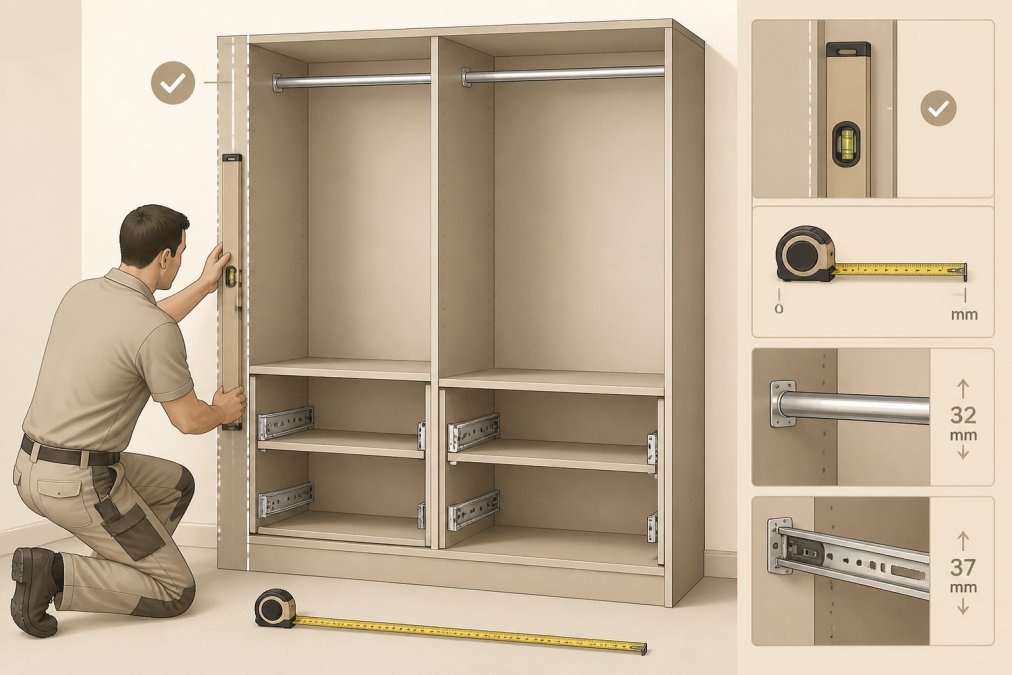
Professional installation begins with detailed site survey, precise measurement and assessment, not a quick look. The surveyor checks whether walls are plumb and floors are level. Most rooms have slight variations that must be accounted for during design and installation.
The surveyor identifies obstacles: radiators, sockets, switches, pipework, structural elements, ceiling height, and architectural features. Measurements are taken at multiple points, top, middle, and bottom for walls, to catch variations in straightness. A quality survey takes 30-45 minutes.
Technical Groundwork: Electrics, Flooring, and Plumb Walls
Electrical sockets and switches must be repositioned or removed if covered by the wardrobe. This requires a qualified electrician and must happen before installation. A wardrobe over a live socket is a fire hazard and building regulation violation.
Flooring must be level and solid. Uneven floors prevent proper wardrobe seating and cause door binding. Walls must be checked for plumb; significantly out-of-plumb walls may require tapered wardrobe sides or shimming. Uneven plaster should be stripped back so the wardrobe sits flush with no gaps.
Post-Installation Snagging Checklist
Once installed, detailed inspection should occur before sign-off. Check that all doors open and close smoothly without binding or rubbing. Soft-close mechanisms should engage smoothly. Check that all drawers open fully and slide smoothly without sticking or binding.
Use a spirit level on the top, bottom, and sides, there should be no visible gaps between wardrobe and walls or floor. Tighten any loose handles or hardware. Inspect the finish for significant damage. Check that internal components, hanging rails, shelves, baskets, are secure and level. Document any issues with photographs and provide a written list to the installer.
Fitted Wardrobe Cost Breakdown 2026: Where Your Money Goes
Understanding cost breakdown helps you understand what you’re paying for and where quality differences appear.
Design and Survey Costs
A thorough survey and design consultation takes time and expertise. Complimentary surveys, like those offered by Finest Furniture Studio, reduce costly installation mistakes. The design process involves creating detailed drawings, discussing options, and revising based on feedback.
Materials, Carcass, and Internal Configuration
Material cost is the largest component. A simple wardrobe with basic MFC carcass and standard internal configuration costs less than one with solid wood carcass, premium finish, and complex internal configuration with multiple drawer heights, shelving, and specialized storage.
Internal configuration adds cost and value. Each element, multiple rails, shelf levels, drawer units, pull-out baskets, and specialized storage, adds cost but also functionality and organization. Customization for awkward spaces, sloping ceilings, alcoves, and understairs storage requires custom-built sections, increasing cost.
Labour and Installation Timescales
Labour cost depends on complexity and time required. Straightforward installations take one or two days; complex installations in awkward spaces with electrical work, floor preparation, and custom sections take longer.
The 7-day fitting service offered by Finest Furniture Studio is realistic for most installations, time from delivery to completion. Labour costs vary by location and access complexity.
| Cost Component | What It Covers | Typical Impact on Price |
|---|---|---|
| Design and Survey | Consultation, measurements, detailed drawings, revisions | 5-10% |
| Materials and Carcass | Board, facing, edging, internal components | 40-50% |
| Hardware | Hinges, runners, soft-close mechanisms, handles | 8-12% |
| Labour and Installation | Site preparation, assembly, fitting, adjustment | 25-35% |
| Warranty and Support | 10-year warranty, aftercare, adjustments | Included |
Red Flags: Signs of Poor Workmanship and Low-Grade Materials
Knowing what to look for helps you avoid wardrobes that deteriorate quickly or fail to meet expectations.
Installation Defects to Spot
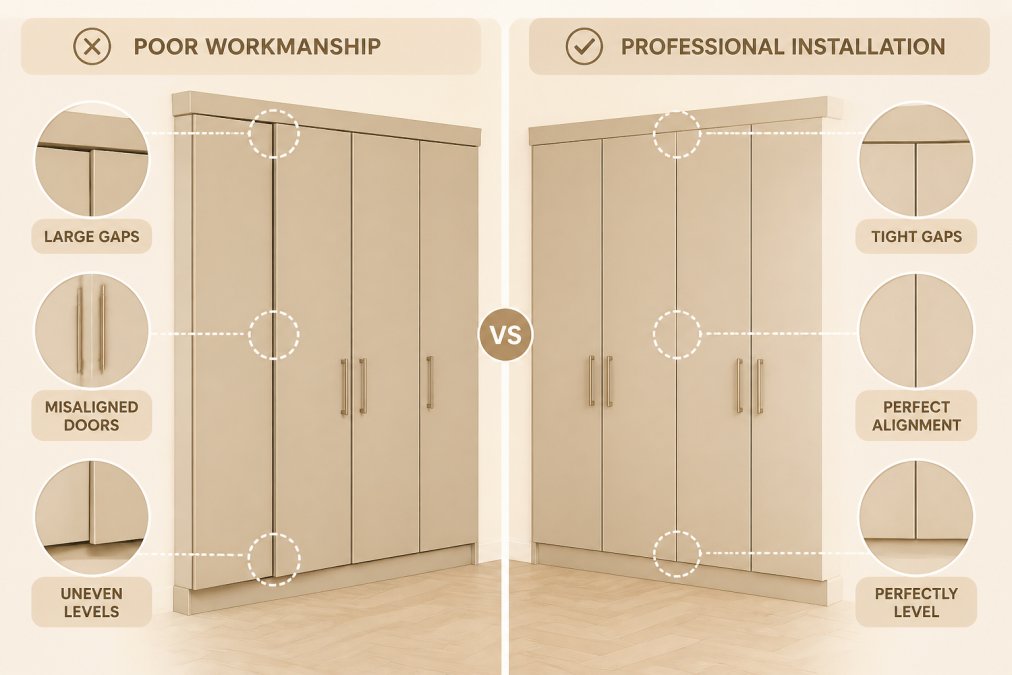
Visible gaps between wardrobe and walls or floor are red flags. Quality installation has minimal gaps covered by trim or filler. Doors that don’t hang straight or bind when opening indicate poor installation or out-of-square carcass. Drawers that don’t align with openings or stick indicate poor installation or low-quality runners. Visible fasteners, screws, dowels, or cam-locks on the wardrobe face indicate poor finishing.
Material Shortcuts and Hidden Costs
Thin carcass board (16mm instead of 18mm) compromises durability. Ask suppliers what thickness they use. MFC with thin or no back panel is a shortcut. Plastic hinges or runners instead of metal indicate low cost and durability. Soft-close mechanisms that don’t work properly or slow down after months indicate low-quality dampers.
Thin or poorly applied finishes chip and peel quickly. Quality finishes involve multiple coats with sanding between each. Hidden costs often emerge after purchase, electrical work, floor preparation, wall repair, or delivery add to the final bill. Transparent suppliers like Finest Furniture Studio provide clear upfront pricing with no hidden fees.
Sustainable Sourcing and Longevity: Building Wardrobes That Last
A wardrobe lasting thirty years is more sustainable than one lasting ten years, even if it costs more initially. Manufacturing and transporting a new wardrobe every decade has significant environmental impact.
Responsible sourcing means choosing suppliers using sustainably managed forests and recycled materials. FSC-certified wood indicates timber from responsibly managed sources. Durability is the most important sustainability factor. A wardrobe built to last uses less total material over its lifetime. Repairability matters, wardrobes with replaceable doors, runners, or hinges last longer than those with glued or welded components. Refurbishment extends wardrobe life by refreshing the finish, replacing worn hardware, or updating internal configuration.
Your Fitted Wardrobe Quality Checklist: The Complete Evaluation Framework
Use this framework to evaluate a fitted wardrobe before purchase and inspect the finished installation.
Pre-Purchase Evaluation
Examine carcass board thickness, ask whether suppliers use 16mm, 18mm, or thicker. 18mm is the minimum for lasting wardrobes. Check internal bracing by examining design drawings and asking about vertical and horizontal bracing. Inspect the back panel, ask whether it’s solid sheet or frame with backing. Solid is better.
Check hinge specification, ask what type is used and whether they’re ball-bearing. Metal ball-bearing hinges are standard for quality. Check drawer runner specification, full-extension metal runners with ball bearings are standard. Ask about weight rating and soft-close damper mechanism.
Examine finish samples and ask how many coats are applied and how the surface is prepared. Multiple thin coats are better than one thick coat. Ask about warranty, a 10-year warranty on carcass and mechanisms is standard for quality wardrobes.
During Installation Inspection
Check that site was properly prepared, ask whether electrical work was completed, floor was levelled, and walls were checked for plumb. Watch the installation process. Quality installers take time to measure, level, and adjust.
Check that the wardrobe is level and plumb using a spirit level. Open and close each door listening for smooth, quiet operation. Pull each drawer fully checking for smooth, quiet operation. Look for gaps between wardrobe and walls or floor. Small gaps are normal; large gaps are problems. Inspect the finish for significant damage.
Handover and Warranty Documentation
Obtain written warranty documentation specifying what’s covered, for how long, and how to claim. Get written confirmation of any snagging issues identified and how they’ll be resolved. Get contact information for aftercare support. Keep all documentation including design drawings, survey notes, and warranty certificates.
A fitted wardrobe is a significant home investment. This quality checklist helps you make an informed decision and protect that investment. Finest Furniture Studio offers complimentary design visits, transparent pricing with no hidden fees, and a 10-year warranty on all wardrobes. The team specializes in awkward spaces, understairs storage, sloping ceilings, and alcoves, and delivers installation within 7 days. Book a free design visit to see how a bespoke wardrobe can transform your home.
Frequently Asked Questions
What materials should I look for in a high-quality fitted wardrobe?
Solid wood or high-grade MFC (melamine-faced chipboard) with reinforced internal bracing forms the foundation. Check for soft-close mechanisms on doors and drawers, metal drawer runners rated for smooth operation, and quality hinges. Finishes matter: matt or lacquered surfaces resist fingerprints better than gloss. Ask suppliers whether they use FSC-certified materials, which indicate sustainable sourcing and responsible forestry practices.
How can I tell if a fitted wardrobe is built to last?
Examine the warranty length, 10 years typically indicates confidence in longevity. Inspect the carcass for solid construction without visible flexing or rattling when you press the frame. Check that internal configuration includes adjustable shelving, quality drawer runners, and reinforced corners. Ask how many years the supplier has been trading and request references from previous customers. Wardrobes with proper installation and high-quality materials should remain functional and attractive for 15-25 years.
What are the signs of poor-quality wardrobe installation?
Visible gaps between doors and frame, misaligned hinges, doors that don't close smoothly, or uneven flooring underneath indicate poor workmanship. Check that the wardrobe sits plumb against the wall with no rocking or movement. Poorly finished edges, visible screws, or uneven plinth alignment suggest corners were cut. Soft-close mechanisms should function silently; loud slamming means defective hardware. After installation, request a snagging checklist and ensure all defects are corrected before final handover.
How long do fitted wardrobes last if properly maintained?
Quality fitted wardrobes with solid wood or premium MFC construction typically last 15-25 years with proper care. Soft-close mechanisms and metal runners extend longevity by reducing wear. Regular cleaning, avoiding excessive moisture, and prompt repair of minor damage preserve appearance and function. A 10-year warranty covers manufacturing defects, but well-maintained wardrobes often outlast the warranty period significantly. Refurbishment, replacing doors or internal fittings, can extend life another 10 years without full replacement.
What should be included in a professional wardrobe installation contract?
Your contract must specify exact measurements, materials used (solid wood vs. MFC), finish types, and all internal configuration details. It should include a clear timeline, site preparation requirements, and labour costs. Warranty terms, covering defects and repairs, must be documented in writing with contact details for claims. The contract should outline what happens if walls are not plumb or electrics need rerouting, and whether the supplier handles remedial work. Request a detailed cost breakdown separating design, materials, and labour.
Do fitted wardrobes add value to a UK home?
Yes, fitted wardrobes enhance property appeal and can add value, particularly in smaller London homes where storage is a premium. Estate agents note that well-designed fitted storage increases perceived space and functionality, making homes more attractive to buyers. The return depends on quality and design, bespoke solutions tailored to awkward spaces like understairs or alcoves add more value than basic off-the-shelf units. High-quality finishes and professional installation ensure the wardrobe remains an asset rather than a liability when selling.
How do I distinguish between MFC and solid wood for fitted furniture?
Solid wood is heavier, feels warmer to touch, and shows natural grain variation. MFC is lighter, uniform in appearance, and typically more affordable. Inspect the edges: solid wood has real wood edges or quality edging; MFC shows the chipboard core with plastic or veneer edging. Ask the supplier directly about materials and request samples. Premium MFC can perform as well as solid wood if the core is thick (18mm+), bracing is reinforced, and finishes are high-quality. Solid wood offers superior longevity and refurbishment potential, but quality MFC remains durable for 15+ years.
This article was written using GrandRanker

