
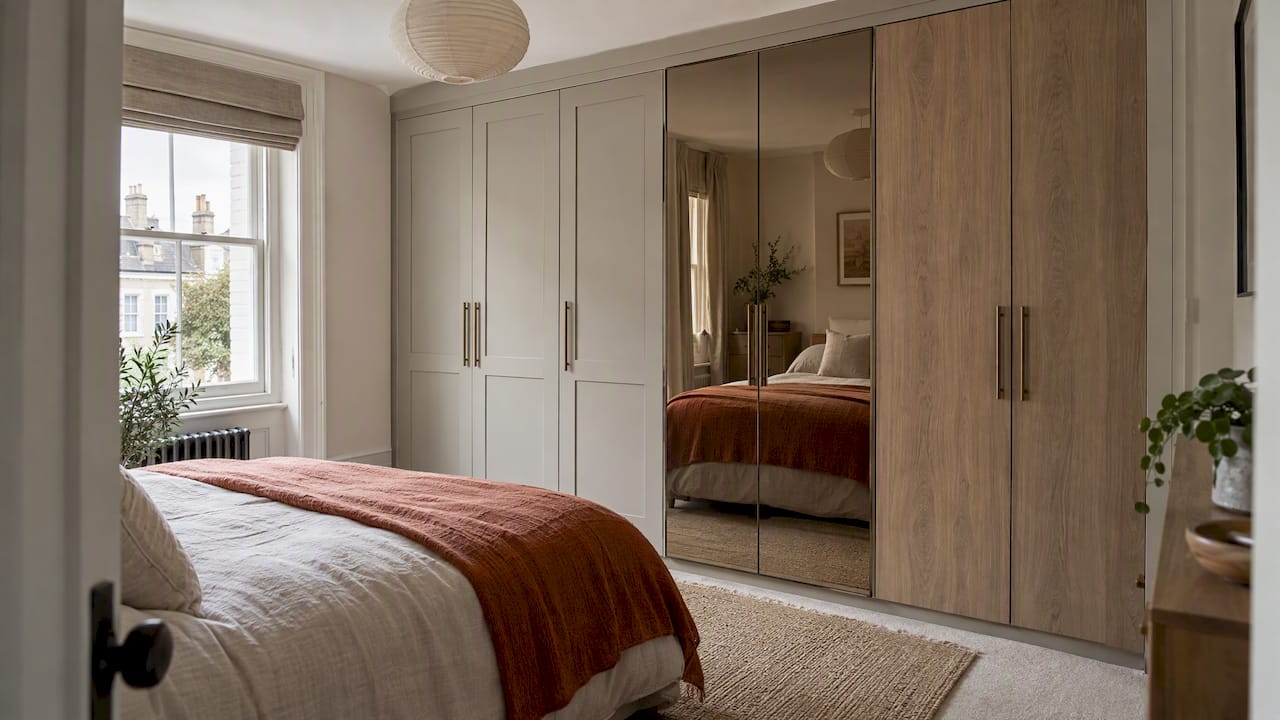
Mirrored wardrobes are not inherently dated: the mirror itself is a design-neutral surface. What reads as dated is the full-wall sliding door treatment with cheap, plain-silver glass from the 1990s and early 2000s. Keep mirrors where they earn their place, small or low-light rooms, and avoid long, uninterrupted mirror runs with generic frames and you get all the benefit without the outdated look.
TL;DR:
- Mirrored wardrobes are most effective when used in small, dark, or dressing room spaces rather than across entire walls with full-length silver panels.
- Hybrid designs that incorporate tinted, framed, or partial mirrors, combined with other materials, look more contemporary and suit modern warm interior styles.
- Proper anchoring, high-quality toughened or laminated glass, and regular cleaning are essential for safety, durability, and maintaining appearance over time.
- Bespoke, carefully specified mirrored solutions age better and integrate seamlessly with other finishes, avoiding the outdated feel of mass-produced, full-wall mirror panels.
- Mirror placement and scale should reflect room function and size, with partial or inset mirrors best suited to small or visually cluttered bedrooms.
Table of Contents
- Why some mirrored wardrobes read as dated
- When mirrored wardrobes still make good design sense
- How to make a mirrored wardrobe look contemporary
- Practical considerations: cleaning, safety and cost
- Design alternatives and hybrid approaches
- How bespoke design solves the dated-mirror problem
- The history behind mirrored wardrobes’ rise and fall
- Where mirrored wardrobes sit in 2026 interior trends
- Matching mirrored wardrobes to your room’s style and size
- Mirrors, mood and how a bedroom feels to live in
- Our take: keep what works, modernise the rest
- A modern mirrored wardrobe, built around your room
- FAQ
- Sources
Why some mirrored wardrobes read as dated
The archetypal culprit is wall-to-wall mirrored sliding doors with thin aluminium frames and plain silver glass, stretched floor to ceiling across an entire bedroom wall, as explained in the most timeless style of interior doors. Design commentary in 2026 confirms that this specific treatment, tied so closely to 1990s and early 2000s mass-market fitted furniture, is what readers picture when they ask whether mirrored wardrobes feel outdated, even though mirrored wardrobes themselves are not obsolete when they sit inside a considered, modern design.
The issue is repetition and scale. A single mirror panel adds light and depth. Six identical panels running wall to wall remove any sense of proportion from the room and turn a functional surface into the dominant feature, whether you wanted that or not.
- Full-height, full-width mirror runs leave no visual break for the eye to rest on.
- Plain silver glass with thin metal trim reads as generic rather than tailored.
- Cheap sliding gear often shows wear faster, reinforcing the dated impression over time.
Industry voices make the same point from the design side. One interior designer profiled by Kelling Designs frames the issue as one of application rather than material, treating mirror as a single component within a bespoke scheme rather than the whole door.
When mirrored wardrobes still make good design sense
Mirrors solve real problems in specific rooms, and those problems have not gone away just because the trend cycle has moved on.
- Small or narrow bedrooms benefit most directly: mirrored doors bounce available light and create visual depth that makes a tight room feel larger.
- North-facing or low-light bedrooms gain ambience from a mirrored surface that reflects whatever natural or lamp light is available, softening a room that would otherwise feel flat.
- Walk-through dressing areas get genuine everyday value from an integrated mirror, since you need one there regardless of door style.
- Tinted or paired mirror options let you keep these benefits while softening the reflection, which matters if you want the function without the harsh, showroom feel.
The common thread is purpose. A mirror that solves a lighting or space problem earns its place. A mirror that is there purely because it was the standard option in a catalogue does not.
How to make a mirrored wardrobe look contemporary
The fix is rarely to remove mirror altogether. It is to stop treating it as the default finish for every door and start treating it as one material among several.
- Mix mirror with painted panels, timber, rattan or stitched fabric inserts so the wall reads as considered joinery rather than one reflective sheet.
- Choose tinted grey or bronze mirror glass, or a framed mirror, rather than raw full-silver glass, which softens reflections and reduces the glare that makes older installations feel harsh.
- Break up long mirror runs with vertical mullions, inset lighting or textured panels between doors.
- Specify partial-height mirrors on alternate doors rather than full-height mirror on every panel.
- Keep the areas around the wardrobe tidy, since a mirrored surface reflects clutter as readily as it reflects light.
Pro Tip: If you are unsure how much mirror to specify, ask your designer for a sample board showing mirror beside your chosen frame and interior finish before committing to a full run.
Our guide to features that suit small bedrooms covers interior layouts that pair well with partial mirror doors, including concealed drawers that keep reflected surfaces free of visual noise.

Practical considerations: cleaning, safety and cost
A mirrored door is a long-term fixture, so the specification details matter more than they might for a painted panel.
- Toughened or low-iron glass costs more than standard mirror but resists marking and distorts colour less over years of use.
- Full-height mirrored doors should be properly anchored, with toughened or laminated glass specified to reduce the risk of a shattered panel in a high-traffic bedroom.
- Cleaning is straightforward with a standard glass cleaner and a microfibre cloth; avoid ammonia-heavy products on tinted or coated glass, which can dull the finish over time.
- Bespoke fitted mirrored doors cost more than modular off-the-shelf systems, largely because of glass quality, frame detailing and the installation time needed to fit panels precisely to an individual room.
Design alternatives and hybrid approaches
If you want the light and space benefits without a fully reflective wall, several finishes do a similar job without the mirror cliché.
- Obscure or frosted glass softens light while hiding what is behind it.
- High-gloss lacquer panels bounce light in a similar way to mirror, with a warmer, less clinical effect.
- Metallic panels, wallpapered inserts or upholstered fronts add character and texture to wardrobe doors while keeping full storage function behind them.
- Hybrid layouts place mirror only at the ends of a run, as a mirrored kickboard, or as a single mirrored “island” panel in a dressing room, concentrating the benefit where it is most useful.
Bespoke design is what makes these combinations work in practice, since a fitted specification lets you set exactly where mirror appears and where another finish takes over.
How bespoke design solves the dated-mirror problem
A tailored specification is what separates a mirrored wall that looks stuck in 2004 from one that looks considered in 2026. We build to the exact dimensions of your room, which means mirror panels sit alongside painted or timber-finish doors by design, not by accident, and tinted glass options are available where a softer reflection suits the scheme. Typical installation takes about a week, and workmanship usually comes with a long-term guarantee, both important for a mirrored door you plan to keep for many years.
When briefing a fitter, ask about the glass specification (toughened or laminated), the frame detail, finish samples you can see in person, and the lead time for your specific room.
The history behind mirrored wardrobes’ rise and fall
Mirrored sliding wardrobes became a fixture of British bedrooms through the 1980s and into the 1990s, when fitted furniture companies popularised floor-to-ceiling sliding systems as a space-saving answer to smaller suburban and new-build bedrooms. The appeal was practical: a single sliding mechanism replaced swing doors that needed clearance, and a mirrored face doubled as a full-length mirror without taking up extra floor space.
By the early 2000s, mirrored sliders had become close to standard in volume house-building and flat-pack fitted ranges, which is precisely why the look now reads as generic. Mass production favoured plain silver glass and basic aluminium trims because they were cheap to produce at scale, not because they were the most attractive option available. That commercial logic, rather than any flaw in mirror as a material, is what tied the finish so closely to a specific two-decade window.
Later in the 2000s and into the 2010s, tastes shifted towards matt and textured finishes, painted shaker-style fronts and warmer timber tones, partly as a reaction against the glossy, reflective look that had become so widespread. Mirror never disappeared from bespoke joinery during this period. It simply stopped being the default choice on every door, which is the distinction that still separates a dated installation from a considered one today.

Where mirrored wardrobes sit in 2026 interior trends
Current bedroom design leans towards warmth and texture: painted shaker fronts, natural timber tones, rattan and fabric inserts, and softer, matt finishes rather than high-gloss surfaces. Mirror has found its place within that shift rather than outside it, largely through tinted glass and partial applications that sit comfortably alongside these warmer materials instead of competing with them.
Tinted grey and bronze mirror glass has become a popular middle ground, since it keeps the light-bouncing benefit of a reflective surface while avoiding the stark, showroom quality of plain silver glass. Pairing a single mirrored door with a painted or timber neighbour is now a common specification in bespoke fitted wardrobes, rather than mirroring every panel in a run.
The broader trend towards hybrid, mixed-material doors also plays to mirror’s strengths. Where a flat-pack system of the 1990s offered one finish across the whole wall, a bespoke specification can place mirror exactly where it solves a problem, a dark corner, a narrow wall, a dressing area, and use a different finish everywhere else. That selective use is what current design favours over the blanket approach of earlier decades.
Matching mirrored wardrobes to your room’s style and size
The right amount of mirror depends heavily on the room you are fitting it into, more than on any fixed rule about what is fashionable.
In a small or box bedroom, a mirrored door (or two, on either side of a run) can make the room feel noticeably more open, since the reflected space reads as additional depth rather than a fixed wall. In a period property with existing cornicing, picture rails or panelled doors elsewhere, a fully mirrored run can look at odds with the room’s character, whereas a framed or partial mirror set into a painted surround tends to sit more naturally.
Larger bedrooms with good natural light have less functional need for mirror, so the decision there becomes more about whether you want a full-length mirror integrated into the wardrobe rather than freestanding. Dressing rooms and walk-in layouts are the clearest case for keeping mirror, since you need a mirror in that space regardless, and building it into the wardrobe run avoids a separate freestanding piece taking up floor space. Across all of these, the principle from earlier sections holds: mirror earns its place based on what the room needs, not on covering every available door.
Mirrors, mood and how a bedroom feels to live in
Beyond light and perceived space, a mirrored wardrobe changes how a bedroom feels to be in day to day, and that effect is worth weighing alongside the purely practical case. A well-placed mirror can make a room feel calmer and more finished, reflecting a considered scheme back at you rather than an empty wall. The same surface can feel the opposite way if it reflects an unmade bed, open drawers or a cluttered dressing table, which is part of why mirrored doors that reflect mess so often get blamed for feeling dated when the real issue is what is being reflected.
Positioning matters too. A mirror angled towards the bed rather than directly facing it tends to feel less exposing first thing in the morning, and many people prefer a mirror sited near a window or dressing area rather than opposite the bed itself. None of this is a reason to avoid mirror. It is a reason to think about placement and what sits in front of it, which is exactly the kind of detail a bespoke layout can account for in a way a standard flat-pack run cannot.
Our take: keep what works, modernise the rest
The verdict stands: mirror is not the problem, scale and finish are. A full silver mirror wall with thin aluminium trim will always read as a relic of a specific era, while a tinted or partial mirror set into mixed-material joinery will not.
Our practical rule: keep mirror where it does a job, small rooms, dark corners, dressing areas, and update the treatment everywhere else. For a fixture you will live with for a decade or more, a bespoke, well-specified solution ages far better than a generic one.
— Aureliu
A modern mirrored wardrobe, built around your room
We design fitted wardrobes, sliding doors and walk-in layouts around the exact dimensions and light levels of your bedroom, so mirror appears where it earns its place rather than across every door by default. Tinted mirror finishes, mixed-material panels and soft-close mechanisms come as standard across our fitted wardrobes, with typical installation completed within seven days and workmanship backed by a 10-year guarantee. We also take care of removing and disposing of the old wardrobe, so there is nothing left for you to manage once the new one is installed.

To get started, contact us for a free design visit: send a message or call 07468 150807 or WhatsApp, with rough room dimensions, a few photos of the space and any finishes you have in mind. We cover Wimbledon, Richmond, Putney, Kingston, Chiswick, Ealing, Twickenham, Chelsea, Fulham, Barnes, Hammersmith and across Central London, with our studio based at 124 City Road, Kemp House, London, EC1V 2NX.
FAQ
Is mirrored furniture still in style in 2026?
Mirrored furniture itself has not gone out of style; what has fallen out of favour is the full-wall, plain-silver sliding door treatment from the 1990s and 2000s. Tinted mirror glass and partial mirror panels mixed with other finishes are the current, more considered way to use the same material.
What is the difference between a wardrobe and a cupboard?
A wardrobe is specifically designed for hanging and storing clothing, usually with rails, shelves and sometimes drawers built in. A cupboard is a more general storage unit that can hold anything from linens to household items and does not necessarily include hanging space.
How much does it cost to replace a mirrored closet door?
Replacement cost depends mainly on glass quality, frame detailing and installation time, with toughened or low-iron glass and bespoke framing costing more than a basic modular panel. Because pricing varies by room and specification, the most accurate figure comes from a measured quote rather than a flat average.
What is a wardrobe mirror?
A wardrobe mirror is a mirrored panel built into one or more wardrobe doors, used both as a functional full-length mirror and as a way to bounce light and create visual depth in a bedroom. It can cover a full door or just part of one, depending on the design.
Are mirrored wardrobes still worth it for small bedrooms?
Yes, mirrored wardrobes remain one of the most practical choices for small or low-light bedrooms, since they reflect available light and make the room feel larger than it is. Choosing a tinted mirror or pairing it with another finish keeps that benefit while avoiding the dated, fully reflective look.
Sources
- This 90’s bedroom decor is making your bedroom look dated | Ideal Home
- Mirrored wardrobe in small bedrooms | House & Garden

