
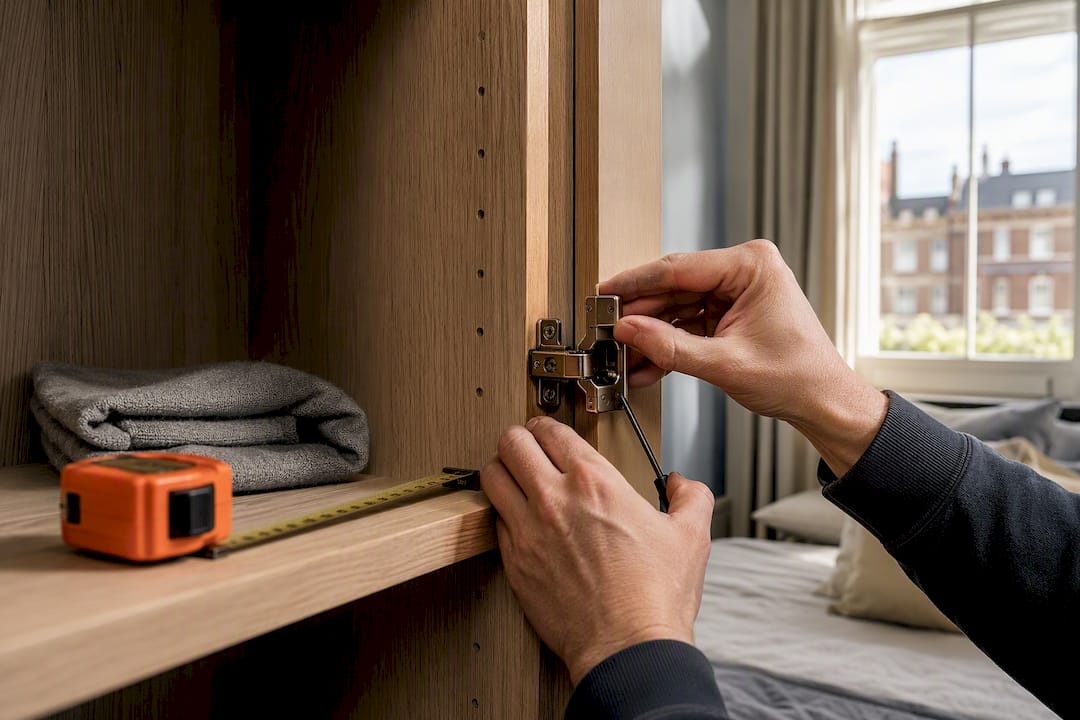
Built-in filing cabinets, in the sense that matters for a home renovation, are not the metal drawer units sold in office supply catalogues. They are custom filing drawers and cupboards built directly into fitted joinery, whether that is a run of fitted wardrobes, an under-stairs cupboard, or a dedicated home-office wall. The right route for most homeowners is to commission bespoke joinery sized to their paperwork and their room, rather than bolt on a freestanding unit. This kind of integrated filing is designed as part of fitted wardrobe and home-office work across London.
TL;DR:
- Built-in filing cabinets are designed to maximize space and can be integrated into under-stairs cupboards, fitted wardrobes, media walls, or home offices, with installation times typically around a week.
- Internal drawer sizes should be about 360mm for A4 files and approximately 400mm for foolscap, with precise measurements taken at multiple wall points to accommodate wall irregularities.
- Use of full-extension runners and anti-tilt interlocks enhances accessibility and safety, especially when multiple drawers are opened simultaneously, while material choices like veneered plywood or solid timber impact durability and appearance.
- Locking options vary from cam locks to concealed safes, and handles should match other furniture in the room to ensure a unified, high-quality finish.
- Proper planning and consultation with a reputable joiner are essential, with clear communication about lead times, warranties, and design specifications to avoid delays and substandard results.
Table of Contents
- Where should built-in filing cabinets go in your home?
- What size should filing drawers and banks be?
- Which materials and hardware actually last?
- How long does installation take and what drives the cost?
- How do you organise filing for daily use and security?
- What questions should you ask before commissioning a maker?
- A maker’s note on fit, finish and disruption
- How Finest Furniture Studio builds your filing into fitted joinery
- Sources
- FAQ
Where should built-in filing cabinets go in your home?
The location you choose shapes everything else, from drawer depth to how much filing you can realistically fit. Four spots come up again and again with clients across Wimbledon, Richmond, Chiswick and Kingston.
Understairs cupboards make excellent use of space that would otherwise sit empty, though headroom drops sharply towards the back, so drawer depth needs checking against the actual triangle of the stair, not just the widest point. Inside fitted wardrobes, filing sits discreetly behind wardrobe doors, which suits homeowners who want paperwork out of sight but still want it part of their main storage run. Media wall and shelving runs put filing on display, which works well for reference material you reach for often but is a poor choice for anything sensitive. Dedicated home-office joinery is the strongest option for households generating a lot of paper, since it can also house a printer, cabling and a proper desk return.
- Understairs: maximises dead space, but limited by roof pitch
- Fitted wardrobe: secure and hidden, shares space with clothing storage
- Media wall: visible and accessible, not suited to confidential files
- Home-office wall: highest capacity, best for daily-use paperwork
Fitted furniture generally uses every centimetre of an awkward corner or sloped ceiling far more effectively than a freestanding cabinet ever could, which is really the whole argument for going bespoke in the first place.
What size should filing drawers and banks be?
Getting the internal dimensions right is the difference between a drawer that works daily and one that jams within a year. These are the figures worth briefing to your joiner before a single cut is made.
- A4 filing needs an internal drawer width of roughly 360mm to sit flat without curling, plus clearance for the drawer face and runners.
- Foolscap filing, still common in older archives, needs closer to 400mm internally, so check which paper size your existing files actually use before ordering.
- Lateral filing (files sitting side by side, spines facing you) suits wide, shallow drawers and works well under a desk return or along a low run.
- Hanging filing (suspended in a frame, viewed from above) needs deeper drawers with full-extension runners so you can see right to the back.
- Anti-tilt spacing matters most when several drawers open at once. Your joiner should build in interlocks so only one heavy drawer opens at a time.
- Alcoves, sloped ceilings and understairs runs all need individual measuring. A survey should record exact widths at multiple points, not just an average.
A joiner will typically request precise measurements at floor, mid-height and ceiling level before drawing anything, because a few millimetres of variance across an old wall is normal and needs designing around rather than discovered on installation day.
Which materials and hardware actually last?
Specification choices affect both how the piece looks and how long it keeps working properly, and the two don’t always pull in the same direction.
- Painted MDF gives a smooth, factory-finish look and matches shaker or modern fitted wardrobe styles well, though sharp knocks can chip the paint over time.
- Veneered plywood shows real timber grain at a lower cost than solid wood, and holds up well in busy households.
- Solid timber offers the strongest joints and the most premium feel, at a higher price point.
- Full-extension runners let you see the entire drawer contents at once, which matters for filing far more than it does for clothing.
- Soft-close mechanisms stop drawers slamming, protecting both the joinery and the files inside.
- Lock types range from simple cam locks on individual drawers to a mortice lock across a whole bank, or a concealed safe insert for sensitive documents.
Pro Tip: Match handles and finger pulls across your filing drawers and your fitted wardrobes in the same room. It costs nothing extra at the design stage and it’s what makes built-in joinery look like one considered scheme rather than two separate projects bolted together.
How long does installation take and what drives the cost?
Most bespoke filing projects follow the same five stages, though how smoothly each one runs depends heavily on the complexity of your space.
- Survey. A designer measures the room, checks wall levels and confirms paper sizes and volume of filing you actually need to store.
- Drawings and specification. You approve a design, materials and hardware before manufacture starts, which is the point to change your mind, not after.
- Manufacture. Drawer boxes, carcasses and doors are built off-site to the exact dimensions taken at survey.
- Installation. Fitters install on site, working around existing skirting, sockets and stair angles.
- Snagging. A final check ensures drawers run smoothly and doors align before the team leaves.
Installation typically completes within about a week once manufacture is finished, though understairs and multi-room projects can run closer to 12 days depending on access and complexity. Cost is driven mainly by material choice, hardware specification, how awkward the site access is, and whether old furniture needs removing first, and The service includes removal and disposal of old wardrobes or cabinetry as part of the job. When comparing quotes, ask for an itemised breakdown of labour and materials separately, a firm lead time in writing, and the length of warranty on both the joinery and the installation work.
How do you organise filing for daily use and security?
The internal layout matters as much as the exterior finish, because filing that’s hard to use daily gets abandoned within months. Bespoke joiners typically mix open shelving, closed cupboards, deep drawers and lateral filing within the same run, rather than treating a cabinet as one uniform block.
- Choose lateral filing for high-volume archives you rarely touch, hanging files for active projects, and shallow pigeonholes for post and daily papers.
- Build in a printer niche with a pull-out shelf beneath deep drawers, plus cable routes and a power point positioned before manufacture, not after.
- Fit adjustable shelving and modular inserts so the space can flex as your filing needs change.
- Add locking drawers or a concealed safe for anything sensitive, kept visually discreet within the wardrobe or media wall run.
Concealed cable management and printer compartments are what separate joinery that looks good from joinery that actually gets used every day.
What questions should you ask before commissioning a maker?
A good survey conversation tells you almost everything about whether a maker can deliver on time and to the standard promised.
- Ask directly about lead times, the hardware brands they specify, and whether the warranty covers workmanship as well as materials.
- Treat vague timelines, no written warranty, or a refusal to visit site before quoting as clear red flags.
- Compare quotes on matched specifications first, then on price, since a cheaper quote with lighter hardware or a shorter warranty isn’t actually cheaper long term.
- A maker offering documented case studies, such as a compact home office fitted around 100 box files and multiple filing banks, shows they can handle genuine filing volume, not just wardrobe rails.
A maker’s note on fit, finish and disruption
Getting built-in filing right comes down to three things: the fit is exact, the finish matches the rest of the room, and the install doesn’t turn your home upside down for a fortnight. That’s the standard held on every project, backed by typical fast installation and a long-term guarantee on the workmanship. If you’re weighing up where filing should sit in your own home, request a design visit or look through case studies before deciding.
— Aureliu
How Finest Furniture Studio builds your filing into fitted joinery
There are other routes to solving a paperwork problem, from a freestanding cabinet in the corner to a flat-pack desk unit from a general retailer. Neither actually integrates with the rest of your room, and both leave you with another separate piece of furniture to work around. Finest Furniture Studio designs filing storage directly into fitted wardrobes, under-stairs joinery, and dedicated home-office and media wall builds, so the filing disappears into a single considered scheme rather than sitting apart from it.

Every project starts with a free design visit, where we survey your space and talk through paper volume, security needs and finish. Most installs complete within about a week, we take away and dispose of your old furniture as part of the job, and every piece carries a long-term guarantee on workmanship. If you’re in Richmond, Wimbledon, Putney, Chiswick, Kingston or anywhere else across West and Central London, book a free design visit or call 07468 150807 (WhatsApp welcome) to get a quote started.
Sources
- Bespoke Home Office Furniture for Productivity | Woodnote Bespoke Yorkshire — Woodnote Bespoke Cabinetry
- Bespoke home office & study joinery — Make Bespoke Studio
- Handcrafted bespoke office – Will Mundy Kitchens and Interiors
FAQ
What is the difference between built-in and freestanding filing cabinets?
Built-in filing cabinets are joinery made to fit a specific space, such as an under-stairs cupboard or fitted wardrobe, while freestanding cabinets are pre-made units placed anywhere in a room. Built-in versions use awkward space far more efficiently and can be matched to your existing finishes.
How much filing capacity can fit into a small room?
A well-planned bespoke office can hold a surprising amount. One case study fitted around 100 box files into a compact room using multiple filing banks and corner storage, showing what careful measuring can achieve.
How long does a built-in filing installation take?
Installation typically completes within about a week once manufacture is complete, with more complex understairs or multi-room projects sometimes taking longer depending on access and complexity. Timelines depend on site access, complexity and whether old furniture needs removing first.
Should I choose lateral or hanging filing?
Lateral filing suits wide, shallow drawers for archives you rarely open, while hanging files work better for active projects you access often. Most bespoke joiners mix both within the same drawer bank depending on how each section gets used.
What warranty should I expect on bespoke filing joinery?
A reputable maker should offer a written warranty covering both materials and workmanship. Some makers provide long-term guarantees on fitted joinery, including built-in filing integrated within wardrobes and home-office storage.

