
Table of Contents
- Measure Your Available Space Accurately
- Choose Between Open Shelving and Closed Cabinetry
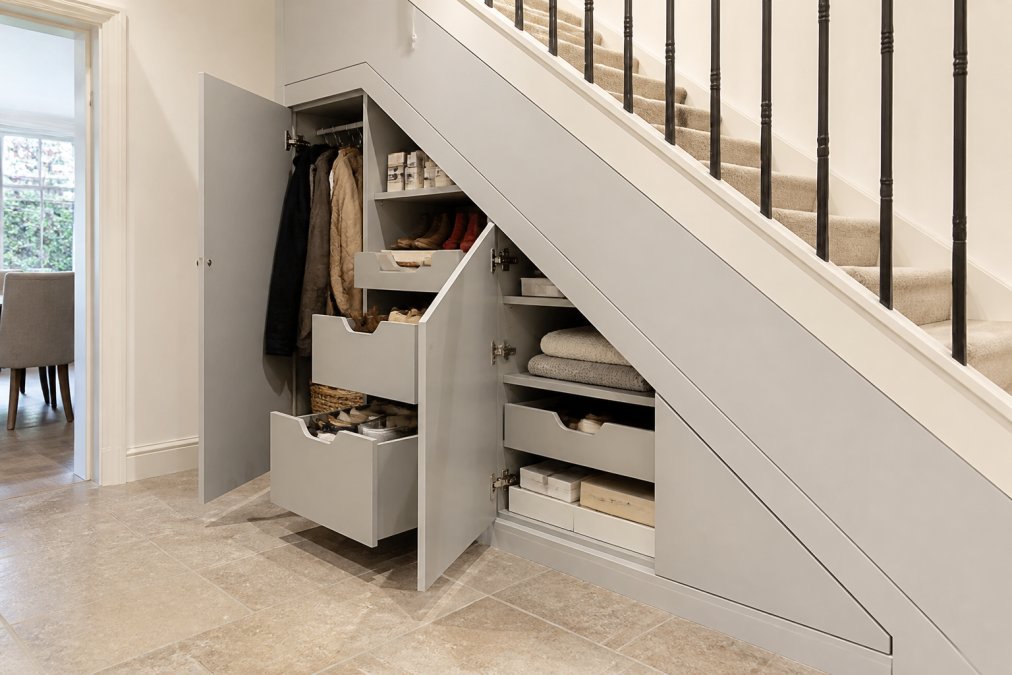
- Install Bespoke Understairs Cupboards for Maximum Fit
- Add Custom Understairs Shelving Ideas to Suit Your Needs
- Incorporate Understairs Pull-Out Drawers for Easy Access
- Use Vertical Height and Dead Space
- Plan for Lighting, Ventilation, and Accessibility
- Budget Planning for Understairs Storage Solutions
- Frequently Asked Questions
Last Updated: September 18, 2026
Measure Your Available Space Accurately
Maximize understairs storage space by measuring precisely. Record three numbers: width at the base, height at the tallest point, and depth from front to back using a metal tape measure. Take photos from multiple angles in natural light to identify shadows and moisture issues.
Account for Slope and Clearance
Measure clearance at 30cm intervals going deeper into the space, noting where headroom drops below 1.5 metres. Check for pipes, electrical conduits, and radiators, these determine where shelves can go.
Check Load-Bearing Capacity
Consult your building plans to check load-bearing capacity. If unavailable, hire a surveyor to determine what weight the space can hold and where reinforcement may be needed.
Choose Between Open Shelving and Closed Cabinetry
Open shelving and closed cabinetry serve different purposes. The choice depends on what you store and how often you access it.
Open shelving costs less, installs faster, and suits frequently used items, though dust accumulates. Closed cabinetry hides clutter, protects contents, and works better for seasonal items and supplies.
When Open Shelving Works Best
Open shelving suits frequently used items like books and sports equipment, and decorative storage in kitchens and living rooms. Internal lighting is essential, without it, deep shelves disappear into shadow.
When Closed Cabinetry Is the Better Option
Closed cabinetry suits rarely accessed items and damp environments, where doors reduce dust and humidity damage. It creates a finished, polished look that matches your home’s aesthetic.
Install Bespoke Understairs Cupboards for Maximum Fit
Bespoke understairs cupboards solve the slope problem that off-the-shelf units cannot. Custom joinery follows your staircase’s exact contours, fitting perfectly and lasting decades. Finest Furniture Studio specializes in bespoke understairs cupboards designed to maximize awkward spaces and transform wasted space into functional storage.
Why Bespoke Beats Off-the-Shelf
Bespoke cupboards are built to your exact measurements, fitting perfectly and aligning with your staircase. Custom joinery uses quality materials and lasts decades, while mass-produced units often fail quickly.
Hinged Doors vs. Sliding Access
Hinged doors swing outward. They require clearance in front of the cupboard. If your understairs space opens into a narrow hallway, hinged doors may obstruct traffic.
Sliding doors move horizontally along a track. They require less clearance but take up horizontal wall space. Sliding doors work better in tight spaces where swing room doesn’t exist.
Hinged doors are easier to repair. Sliding tracks can jam, especially if dust accumulates. Hinged doors are also more familiar to most people. They feel more intuitive to open and close.
Consider your daily use. If you access the cupboard frequently, hinged doors feel more natural. If space is tight, sliding doors solve the problem.
Add Custom Understairs Shelving Ideas to Suit Your Needs
Custom understairs shelving ideas range from simple fixed shelves to complex modular systems. The best approach depends on what you store and how you organize.
Shelving transforms dead space into organized storage. Fixed shelves work for heavy items. Adjustable shelves adapt as your needs change. Both approaches maximize the vertical height that the slope creates.
Fixed Shelving for Heavy Items
Fixed shelves support heavier loads than adjustable ones. They’re built into the structure, distributing weight across the entire cupboard frame. Use fixed shelves for books, tools, kitchen equipment, and anything dense.
Fixed shelves also look cleaner. There are no visible brackets or adjustment holes. The shelves appear seamlessly integrated into the cupboard. This creates a polished, intentional appearance.
Fixed shelves cost slightly less to install. Once positioned, they require no adjustment hardware. Installation is straightforward: mount the shelf and secure it permanently.
Adjustable Shelving for Flexibility
Adjustable shelves move up and down as your storage needs change. They’re ideal for items that vary in height or for storage that evolves over time. You can reorganize without rebuilding the cupboard.
Adjustable shelves use shelf pins or metal brackets. Pins slot into pre-drilled holes in the cupboard sides. This system is reversible. You can reposition shelves in minutes without tools.
Adjustable shelving costs slightly more due to the hardware and precision drilling required. The flexibility justifies the cost for most homeowners. As your life changes, your storage adapts with it.
Incorporate Understairs Pull-Out Drawers for Easy Access
Pull-out drawers solve the reach problem. Understairs spaces slope, making the back difficult to access. Pull-out drawers bring contents forward, eliminating the need to crouch or stretch.
Drawers also organize better than open shelves. Items stay contained and protected. Drawers hide clutter while keeping everything within arm’s reach.
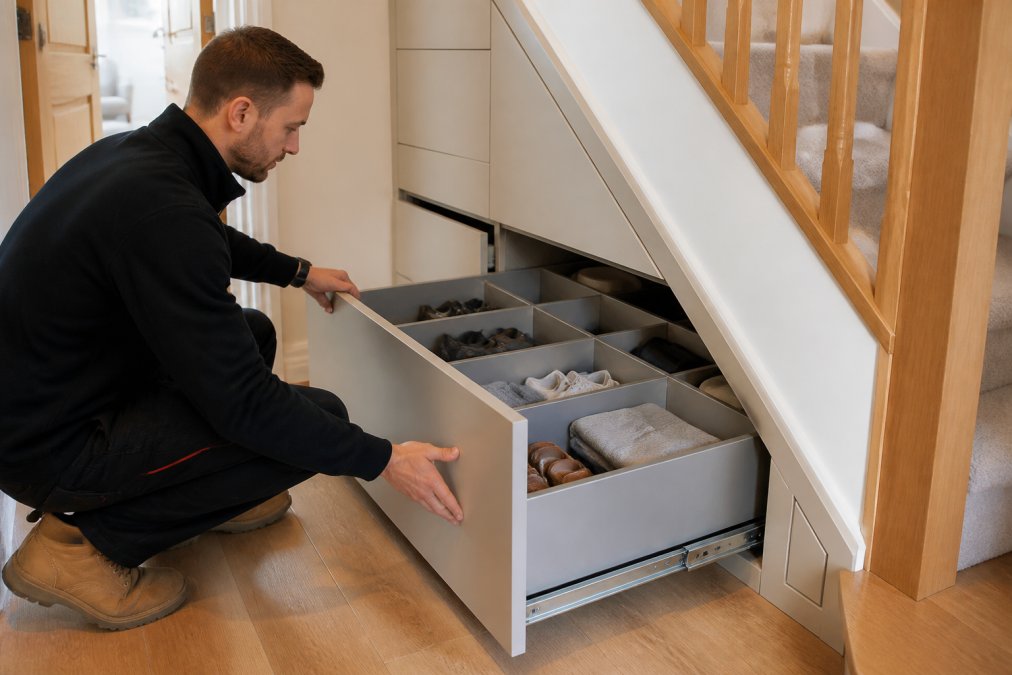
These versatile drawer systems also provide the structural stability required to support a custom under stair wine rack, transforming an awkward void into a sophisticated display for your collection.
Choosing the Right Drawer Runners
Drawer runners are the mechanism that lets drawers slide smoothly. Quality matters enormously. Cheap runners stick, jam, and fail quickly. Good runners last for thousands of open-close cycles.
Ball-bearing runners are the standard for quality drawers. They roll on ball bearings, creating smooth, effortless movement. They support heavy loads without strain. Ball-bearing runners cost more but are designed for durability.
Soft-close runners add a feature: drawers close slowly and quietly. They prevent slamming and reduce noise. Soft-close runners cost more but improve the user experience significantly. If you have young children, soft-close drawers prevent finger injuries.
Measure your drawer depth before choosing runners. Runners come in standard lengths: 30cm, 40cm, 50cm, and beyond. Match the runner length to your drawer depth for smooth operation.
Maximizing Depth Without Wasting Space
Deeper drawers hold more but become harder to reach into. The sweet spot is usually 40-50cm deep. At this depth, you can reach the back without leaning in too far.
Divide deep drawers into sections. Use internal dividers to create compartments. This prevents items from sliding around and makes finding things easier. Compartments also prevent the “black hole” effect where items disappear at the back.
Organize by frequency of use. Put daily-use items in the front. Seasonal or occasional items go deeper. This simple rule saves time and reduces frustration.
Use Vertical Height and Dead Space
The space under stairs slopes upward. This creates vertical height at the front and minimal clearance at the back. Smart design uses every centimetre of that height variation.
Tall items go at the front where headroom is generous.
Floor-to-Ceiling Solutions Under Sloped Ceilings
Reach upward. Most understairs spaces have unused vertical space above shoulder height. Floor-to-ceiling cupboards capture this space, doubling or tripling storage capacity.
Creating Nook and Cranny Storage
Corners and tight angles seem unusable. They’re not. Angled shelves, rotating carousel units, and wedge-shaped cupboards fit perfectly into these spaces.
Plan for Lighting, Ventilation, and Accessibility
Lighting transforms understairs storage from dark and claustrophobic to functional and pleasant. Ventilation prevents moisture damage. Accessibility ensures you can actually use what you store.
Internal Lighting Solutions
Dark understairs spaces hide their contents. You’ll forget what you stored. Lighting solves this completely.
Moisture Control and Ventilation
Understairs spaces trap moisture. Poor air circulation leads to damp, mould, and musty smells. Ventilation prevents these problems.
Ergonomic Reach and Accessibility
Design for your actual reach, not theoretical reach. Most people comfortably reach items between waist height and eye level. Items outside this zone require bending, stretching, or a step stool.
Budget Planning for Understairs Storage Solutions
Budget planning requires understanding the cost drivers. Materials, labour, complexity, and finishes all affect the final price.
Budget-Tier vs. Premium-Tier Options
Budget-tier storage uses basic materials and simple designs. Shelves are straight. Doors are flat. Finishes are standard. Budget solutions cost less upfront but often disappoint long-term. They feel flimsy and look unfinished.
Hidden Costs to Plan For
Installation labour is a major cost. Complex designs take longer to install. Budget extra time if your understairs space is particularly awkward.
Frequently Asked Questions
What is the best storage option for maximizing understairs storage space?
The best option depends on your space constraints and how you’ll use it. Bespoke understairs cupboards offer maximum flexibility because they’re custom-built to fit your exact dimensions, including sloped ceilings and awkward angles. Pull-out drawers work well for frequently accessed items, whilst fixed shelving suits heavier, less-frequently-used goods. A combination approach, cupboards below with shelving above, often maximizes both capacity and usability. Consider your daily access needs, the weight of items you’ll store, and whether you prefer items hidden or visible.
Is it worth converting understairs space to storage?
Yes, for most homes. Understairs space is typically unused dead space that can store a significant portion of a household’s seasonal items, shoes, coats, and cleaning supplies. The conversion cost is usually modest compared to the storage gained, and it increases your home’s organization and property appeal. The investment becomes especially worthwhile if you’re moving into a smaller home or working from home and need dedicated office storage. A professional assessment will clarify whether your space’s structural integrity supports shelving or cabinetry.
What are the benefits of bespoke understairs cupboards compared to DIY solutions?
Bespoke understairs cupboards are built to your exact space, including sloped ceilings, angled walls, and access constraints that off-the-shelf units cannot accommodate. They use the full height and depth available, significantly maximizing storage compared to standard solutions. Quality bespoke joinery includes proper drawer runners, hinged doors that clear the slope, and internal lighting, features that DIY solutions often lack. Bespoke pieces also last longer, maintain their appearance, and come with warranties that protect your investment.
How do I know if my understairs space can safely support shelving or cabinetry?
Check the structural integrity of the staircase itself, shelving must be secured to the wall studs or the staircase structure, not just drywall. Understairs areas typically support moderate weight (books, shoes, seasonal items) but not heavy loads like a filing cabinet full of documents. Avoid placing weight directly on the stair treads. A professional surveyor or joinery specialist can assess your specific structure and recommend load limits. This is especially important if you have a timber staircase, which may have different weight-bearing capacity than a concrete structure.

