

Table of Contents
- Why Fitted Bedroom Furniture Goes Wrong
- Fitted Wardrobe Design Mistakes That Cause Daily Frustration
- Fitted Wardrobe Installation Problems to Watch For
- Fitted Wardrobe Door Alignment: Sticking, Sagging and Misalignment
- Damp Behind Fitted Wardrobes: Causes and Warning Signs
- Ventilation, Air Circulation and Bedroom Humidity
- Repairs, Maintenance and When to Call a Professional
- Frequently Asked Questions
Last Updated: October 12, 2026
Why Fitted Bedroom Furniture Goes Wrong
Most problems with fitted bedroom furniture trace back to three causes: measuring errors, cheap materials, and poor ventilation.
We see these issues constantly on design visits. Homeowners in older properties with uneven walls and sloping ceilings are hit hardest. The wardrobe looks fine at handover.
This guide covers the common problems with fitted bedroom furniture, their causes, and how to fix or avoid each one, design mistakes, installation faults, then damp and maintenance.
Fitted Wardrobe Design Mistakes That Cause Daily Frustration
Design errors are the most expensive problems because they’re built in. You can’t adjust a wardrobe that was drawn wrong.
Measuring Errors and Awkward Spaces
The biggest mistake is measuring the room, not the space. Skirting boards, picture rails, cornices, chimney breasts and alcoves all eat into usable depth.
Fitted wardrobes work best when the design accounts for:
- Uneven walls and floor levels
- Sloping ceilings in loft or understairs areas
- Limited depth caused by chimney breasts
A wardrobe built to nominal room dimensions will leave gaps, block access, or fail to sit flush. Measure at multiple points across a wall, not once in the middle.
Skipping a site survey is the single most common cause of a wardrobe that doesn’t fit. If a quote is based on your own measurements alone, expect problems at installation.
Storage Layout and Access Problems
A wardrobe can be the right size and still be useless. Poor internal layout is the quiet failure.
Common design mistakes include:
- Hanging rails too high or too low for everyday use
- No drawers, so small items pile up on shelves
- Deep shelves that hide everything at the back
Think about how you actually dress: daily items belong at eye level, seasonal clothing higher.
Access matters too: anyone with limited mobility benefits from drawers at waist height and easy-to-open doors. A well-designed layout solves clutter; a pretty but shallow one just hides it.
Fitted Wardrobe Installation Problems to Watch For
Installation faults usually appear within the first year. Here’s what to check.
Poor Materials and Construction Quality
Cheap materials are the root of most long-term failures: thin panels warp, low-grade hinges loosen, and runners wear out until drawers drag.
Signs of poor construction quality:
- Panels that flex when you press them
- Hinges with no brand marking or adjustment screws
- Drawers that wobble on their runners
Good construction uses solid carcasses, quality hardware, and proper fixings into the wall. Ask what’s behind the doors before you buy, the difference shows up in year three, not year one.
Door Types, Clearances and Room Layout
Door choice affects how the whole room works. Get it wrong and you lose floor space or block access.
| Door Type | Best For | Watch Out For |
|---|---|---|
| Hinged | Rooms with clearance in front | Door swing blocking walkways |
| Sliding | Tight spaces, narrow rooms | Track wear, bottom guide issues |
| Bi-fold | Alcoves and corners | Hinges under more strain |
Sliding doors save space but need a clean track and a level floor.
Measure the room layout with the doors open, not just closed. This is where most installation problems start.
Fitted Wardrobe Door Alignment: Sticking, Sagging and Misalignment
Door alignment problems are the most visible fault, and usually the easiest to fix. Sticking, sagging, and misalignment almost always come down to hinges, runners, or the frame moving with the seasons.
Why doors drift out of alignment:
- Loose or worn hinges
- Timber swelling in humid conditions
- A frame fixed to an uneven wall
A Symptom-to-Cause Troubleshooting Guide
This guide starts from what you can see and hear, then works back to the cause and fix.
| Symptom | Likely Cause | First Fix |
|---|---|---|
| Door catches at the top corner | Hinge has dropped or the frame has settled | Adjust the hinge vertically, then check the frame is still plumb |
| Door rubs along the full length | Timber swelling in humid weather | Wait for humidity to drop, then adjust; if it persists, check ventilation |
| Door swings open or won’t stay shut | Hinge tension or a misaligned strike plate | Tighten hinge screws; check the catch lines up with the plate |
| Sliding door drags or jumps | Debris in the track or a worn bottom guide | Vacuum the track, check the guide is seated, then test |
| Sliding door comes off its track | Top track misalignment or a failed roller | Do not force it; the roller or track needs replacing |
| Drawer sticks or wobbles | Runner worn, overloaded, or out of square | Empty it, check the runner fixings, then test the glide |
| Creaking or groaning when opening | Dry or loose hinges, or movement in the carcass | Tighten fixings; a light lubricant on hinge pins can quiet it |
| Gap appears between door and frame | Frame pulled away from an uneven wall | This is a fixing problem, not a hinge problem, see below |
How to Adjust a Hinged Door Safely
Most European-style cabinet hinges have three adjustment screws: height, depth, and lateral. The layout varies by brand, so check the hinge body first.
Work in small steps:
- Identify which screw controls which direction, usually marked with a small arrow or cam symbol.
- Turn a quarter turn at a time.
- Close the door and check the gap before adjusting again.
- Adjust one direction at a time; changing two at once makes it hard to see what worked.
Adjust hinges in small steps and test the door after each turn. Over-adjusting one screw throws the door out in the other direction, and you’ll chase the alignment for an hour.
When Alignment Keeps Drifting
If doors keep misaligning after adjustment, the frame itself may be moving, a fixing problem, not a hardware one.
A frame that has pulled away needs re-fixing into sound masonry or studwork, not more hinge tweaking. Stop and call a fitter, forcing it back can crack panels or split the carcass.
Sliding Door Specifics
Sliding doors fail differently: the top track carries the weight, the bottom guide keeps the door in line, and the rollers do the moving.
For bespoke sliding wardrobes installations, the track quality and the level of the floor matter more than the door panel itself. A track fitted to an uneven floor will always drag, no matter how well the doors are made.
Damp Behind Fitted Wardrobes: Causes and Warning Signs
Damp behind fitted wardrobes is a ventilation problem, not a wardrobe problem. When air can’t circulate behind and around the unit, moisture builds up against the cold external wall.
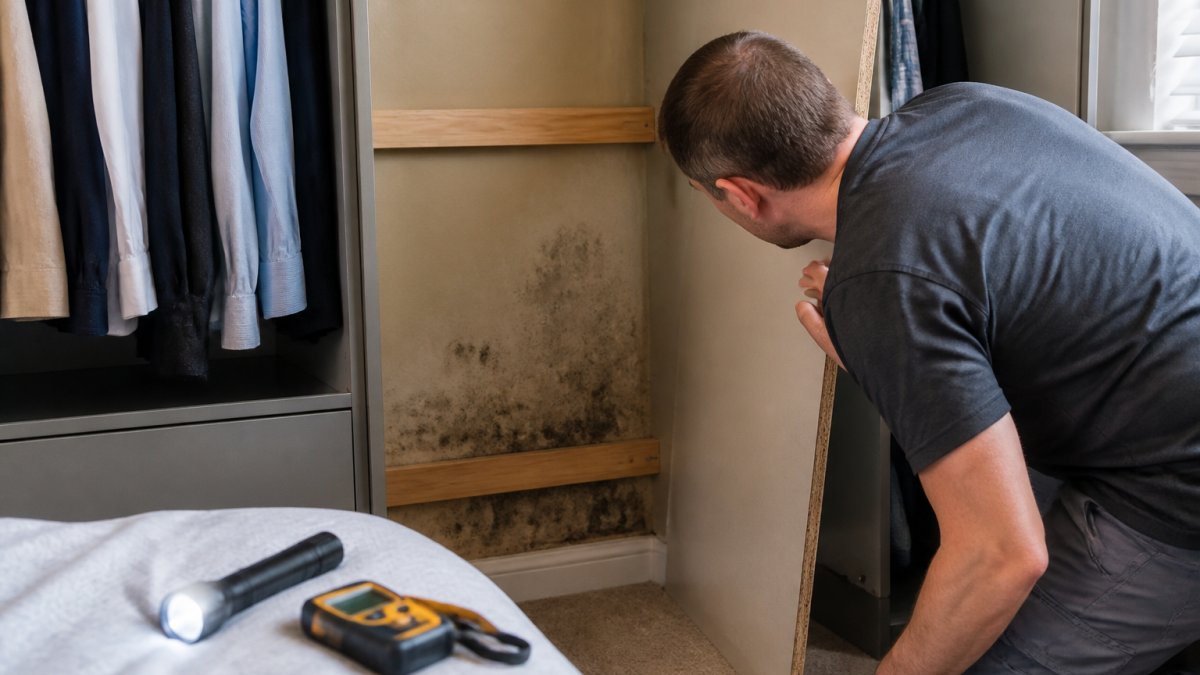
Warning signs to watch for:
- A musty smell in the bedroom
- Mould spots on the wardrobe back panel
- Peeling paint or paper behind the unit
Fitted furniture that sits tight against an external wall traps moisture, leading to condensation, then mould.
Wardrobe Damp or Building Moisture? How to Tell the Difference
The distinction matters because the fix is different. Wardrobe-related damp is usually local and tied to airflow.
Ask these questions:
- Is the damp only behind the wardrobe, or in other rooms too?
- Does it appear in winter and clear in summer?
- Are there other signs, like a leaking roof or rising damp?
If the damp is confined to the wardrobe zone and worsens in cold weather, it’s likely condensation from poor air circulation.
For guidance on controlling condensation and mould in homes, see the government’s guidance on damp and mould in rented homes.
Ventilation, Air Circulation and Bedroom Humidity
Air circulation is the fix for most wardrobe damp.
Ways to improve ventilation:
- Leave a gap between the wardrobe back and the wall
- Fit ventilated back panels
- Keep bedroom doors open during the day
Bedroom humidity rises with breathing, drying laundry indoors, and poor airflow. Keeping humidity down protects both the wardrobe and the wall behind it.
If you’re planning a fitted wardrobe against an external wall, ventilation should be part of the design, not an afterthought.
Repairs, Maintenance and When to Call a Professional
Most minor faults are fixable yourself. Structural or damp problems need a professional. The hard part is knowing which is which.
Repair or Replace? A Decision Guide
Before you reach for a screwdriver, work out whether the fault is adjustment, wear, or failure.
| Fault | Repair | Replace |
|---|---|---|
| Door slightly out of line | Adjust hinge screws | , |
| Hinge loose in the carcass | Fill and re-drill the screw hole, or fit a larger screw | If the hinge plate is cracked or the carcass is split |
| Drawer runner stiff | Clean and lightly lubricate | If the runner is bent or the rollers are flat |
| Sliding roller worn | , | Replace the roller; they are consumable parts |
| Panel warped or swollen | , | Replacement, moisture has penetrated the board |
| Frame pulled from the wall | Re-fix into sound masonry or studwork | If the carcass is distorted |
| Mould on back panel | Clean, then fix the ventilation | If the panel is soft or delaminating |
A useful rule: if the fault is in the hardware, it is usually repairable. If it is in the board itself, warping, swelling, delamination, replacement is the only reliable fix.
DIY Fixes You Can Do Safely
- Tighten loose hinges with a screwdriver, but stop if the screw spins freely, as the hole has stripped
- Adjust door alignment using the hinge’s height, depth, and lateral screws
- Clean sliding tracks with a vacuum brush head, then wipe with a dry cloth
Do not re-hang a heavy door alone or on a tall carcass, two people, or a fitter, is safer.
When to Call a Professional
Call a professional when:
- Doors won’t stay aligned after adjustment
- The frame has pulled away from the wall
- Damp or mould keeps returning after cleaning
Warping and swelling point to moisture, so the cause is bigger than the wardrobe. A fitter can confirm whether the unit needs re-fixing, partial replacement, or whether the room itself needs attention first.
Your Rights If Installation Goes Wrong
If a fitted wardrobe is installed poorly, your first step is the installer’s own complaints procedure. Under consumer protection laws, goods and services must be of satisfactory quality, fit for purpose, and carried out with reasonable care and skill, if not, you can ask for the work to be redone.
Practical steps:
- Put your complaint in writing, with photos and dates.
- Give the installer a reasonable chance to fix it.
- Keep records of all communication.
- If unresolved, you can escalate to a recognised alternative dispute resolution (ADR) provider for guidance on next steps.
Check what warranty the installer offers before you sign, one covering hardware and fitting gives you a clear route if something fails.
A Simple Maintenance Schedule
A little upkeep prevents most long-term problems.
- Monthly: Wipe sliding tracks and check doors run smoothly
- Quarterly: Tighten hinges and check drawer runners
- Seasonally: Check behind the wardrobe for damp or mould
Five minutes a month keeps doors aligned and catches damp early, before it becomes a repair bill.
Prevention Starts at Design Stage
The cheapest repair is the one you never need. Ventilation gaps behind the unit, quality hinges and runners, and a proper site survey all reduce the chance of the faults above. If you are commissioning bespoke fitted wardrobes, ask what hardware is used and how the unit will be ventilated, those two answers tell you more about long-term reliability than any showroom finish.
Frequently Asked Questions
Can fitted wardrobes cause damp?
Fitted wardrobes do not create damp themselves, but they can trap moisture against a cold external wall. Without ventilation, condensation builds up behind the unit and can lead to mould. Bedrooms generate significant humidity through breathing and drying clothes. Leaving a small gap between the wardrobe back and the wall, or fitting vents, helps air circulate. If damp appears, check whether it is condensation or a wider building issue such as a leaking roof or rising damp before assuming the furniture is at fault.
How do you fix a fitted wardrobe door that will not close properly?
Start by checking the hinges. Loose screws are the most common cause of fitted wardrobe door alignment problems. Tighten them, and if the screw holes are worn, fill them with a wooden matchstick and re-drill. For sliding doors, inspect the bottom guides and runners for debris or damage. If the door still sticks, the carcass may have shifted, which usually needs professional adjustment. Persistent misalignment after tightening often points to installation problems that should be raised with your fitter.
What are common mistakes when designing fitted wardrobes?
The most frequent fitted wardrobe design mistakes include failing to account for uneven walls and ceilings, not measuring floor levels, and ignoring door clearance. Homeowners often prioritise internal storage space without checking whether hinged doors will open fully in a tight room. Limited depth caused by chimney breasts or alcoves is another common oversight. Good design starts with accurate measuring, a clear internal layout plan, and honest discussion about how you actually use the space day to day.
Are fitted wardrobes difficult to remove?
Fitted wardrobes are typically built in place and secured to walls, ceilings, or floors, so removal is more involved than taking out a freestanding unit. You may need to disconnect lighting, remove skirting boards, and repair plasterwork afterwards. Units fitted with a back panel are usually easier to take out cleanly. If you are planning to remove fitted bedroom furniture during a renovation, factor in the cost of making good the walls and any electrical work. A professional fitter can advise on the safest approach.
Fitted bedroom furniture problems rarely appear overnight. They build slowly, from a measuring error, a cheap hinge, or a wall that never gets air. Catching them early saves money and stress. At Finest Furniture Studio, we design around awkward spaces, fit in seven days, and back every wardrobe with a 10-year warranty and clear upfront pricing. Book a free design visit and get storage that fits properly the first time.

