
Table of Contents
- Why Custom Shelving Is Better for Awkward Kitchen Corners
- Bespoke Kitchen Shelving Ideas for Difficult Corners
- How to Maximise Kitchen Corner Storage With Custom Fitted Solutions
- Bespoke Shelving vs Flat-Pack: Durability and Weight Capacity
- Accessibility and Smart Integration for Modern Kitchens
- Maintenance and Long-Term Value of Custom Corner Shelving
- Frequently Asked Questions
Last Updated: September 16, 2026
Why Custom Shelving Is Better for Awkward Kitchen Corners
Custom shelving is better for awkward kitchen corners because it is designed around the actual geometry of your room rather than forced into a standard carcass size. At Finest Furniture Studio, we measure the true angle, depth and obstruction of every corner before a single panel is cut.
A standard 600mm base unit pushed into a 90-degree corner leaves a triangular void behind it. That void is dead space, and it is where the awkwardness begins. Below, we explain exactly how bespoke design removes it, which mechanisms work in which corner, and what to check before you commit.
Most guides on awkward kitchen corners stop at pretty photographs. This one covers the parts that decide whether the unit still works in year five: weight capacity, hardware, access, and how to keep a complex mechanism clean.
The Problem With Standard Corner Cabinets
The core failure of a standard corner cabinet is that it is built for a wall, then asked to work in a corner. A 1,000mm corner base unit typically leaves a blind corner of roughly 600mm by 600mm that you cannot see into and cannot reach without kneeling.
Manufacturers solve this with a carousel, but the carousel is sized to the carcass, not the room. If your corner sits beside a boiler boxing or a chimney breast, the carcass either will not fit or leaves a filler panel that wastes 100-150mm of usable width.
The British Standards Institution guidance on furniture safety and stability sets out the stability and strength expectations that fitted units should meet, and standard carcasses meet them only when installed on a flat, uninterrupted run. Corners rarely are.
- Doors collide when both are opened at once
- The back third of the cabinet is effectively sealed off
- Shelf heights are fixed, so tall items have nowhere to go
- Filler panels absorb space that could hold a spice rack or a pull-out
The most common mistake is ordering a corner carousel before checking the door swing. If a full-height unit sits beside the corner, the carousel may become unreachable once the adjacent door is open. Measure the swing arc first, then choose the mechanism.
How Bespoke Design Eliminates Dead Space
Bespoke design eliminates dead space by treating the corner as a unique shape to be filled, not a standard box to be inserted. A made-to-measure corner unit is drawn to the millimetre, so the carcass reaches the wall on both sides with no filler.
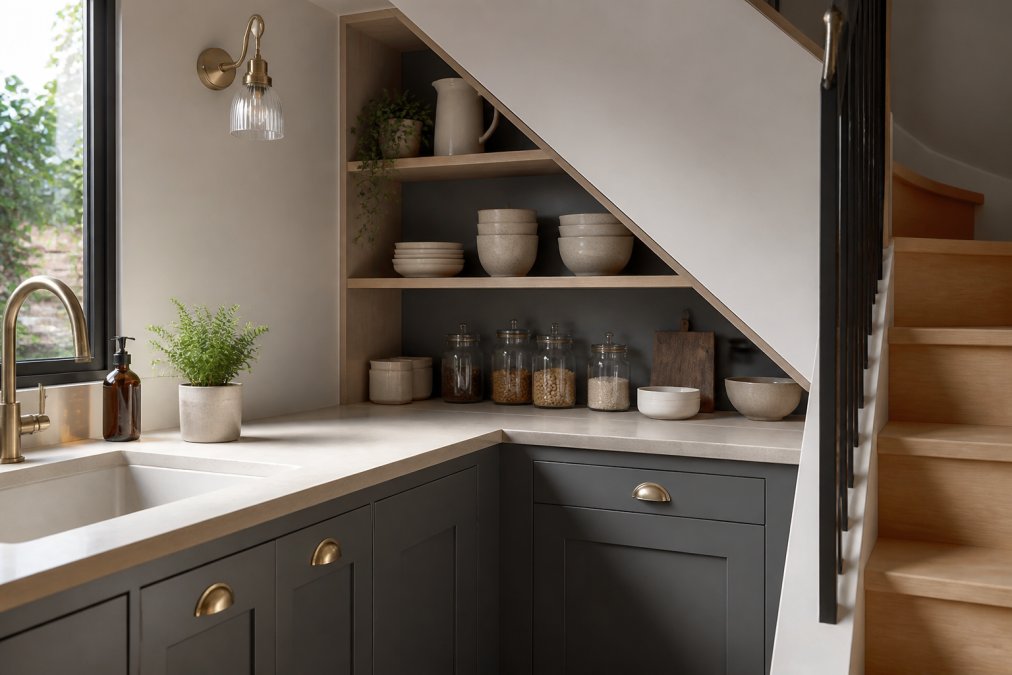
That changes what is possible. A bespoke corner can be shallower at the back and deeper at the front, following the room rather than fighting it. It can step around a boxing, wrap a chimney breast, or taper to meet a sloping ceiling.
The practical result is that a corner which held one awkward cupboard can hold a full-height larder, a pull-out spice rack and a bank of drawers. Space that was previously structural becomes storage.
| Approach | Dead Space Left | Access | Adjustability |
|---|---|---|---|
| Standard corner carcass | High, often 15-25% of the corner | Limited, blind at rear | Fixed shelf heights |
| Flat-pack corner unit | Moderate, filler panels used | Better with carousel | Limited |
| Bespoke fitted corner | Minimal, drawn to the wall | Full, mechanism matched to use | Shelf and drawer positions set at design stage |
Bespoke Kitchen Shelving Ideas for Difficult Corners
The right bespoke kitchen shelving idea depends on what you need to store, not on what looks best in a photograph. A corner beside the hob wants spices and oils within arm’s reach; a corner beside the sink wants cleaning supplies and bins.
Start by listing what will live in the corner, then choose the mechanism. That order matters more than any aesthetic decision.
Pull-Out Shelf Systems and Rotating Carousels
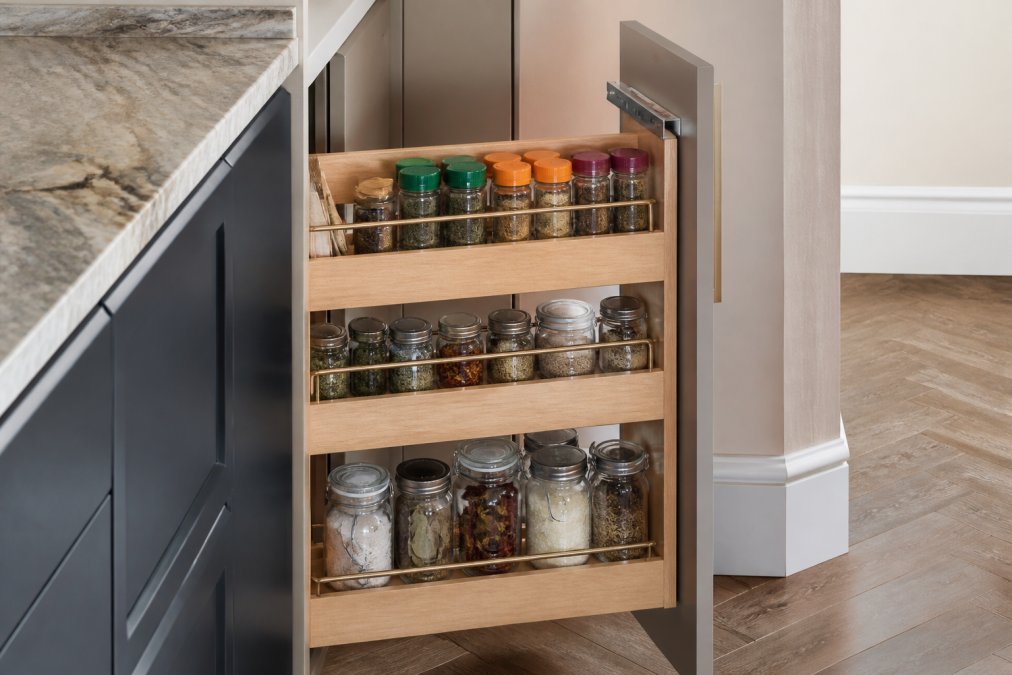
Pull-out shelf systems and rotating carousels solve the same problem in opposite ways. A pull-out brings the contents out to you; a carousel rotates the contents past a fixed opening.
Pull-out shelves suit heavy items. A full-extension runner carries the load, so a shelf holding tinned goods or a stand mixer moves smoothly rather than being lifted. This is the better choice for a corner beside a range cooker.
Rotating carousels, often called a lazy susan, suit lighter, numerous items: jars, bottles, condiments. They use the full depth of the corner because the tray is circular and reaches into the back. The trade-off is that a carousel eats vertical space, so you lose shelf height.
- Pull-out: best for heavy, tall or frequently used items
- Carousel: best for many small, light items
- Combined: carousel on the upper shelf, pull-out below
Floating Corner Shelves and Open Shelving
Floating corner shelves and open shelving work best where the corner is not a cupboard at all. If you have an alcove, a chimney breast return, or a wall that simply cannot take a base unit, open shelving turns that surface into display and daily-use storage.
The minimalist case for open shelving is genuine: it removes the visual weight of a full carcass and makes a small kitchen feel larger. The practical case is that it is only worth doing if you will keep it tidy.
Floating corner shelves need proper fixing into a solid substrate. A corner shelf carrying a stack of cookbooks or a cast-iron pan needs anchors rated for the load, not plasterboard plugs.
For a corner that gets steam from a kettle or hob, specify a wipe-clean finish and avoid open shelving directly above. Grease film on open shelves is the single most common regret we see on open-shelving projects.
How to Maximise Kitchen Corner Storage With Custom Fitted Solutions
To maximise kitchen corner storage, you have to use the two dimensions that standard units ignore: height and depth.
Using Vertical Wall Space and Deep Cabinet Storage
Vertical wall space is the cheapest storage you will ever gain, because it is already there.
Custom Corner Drawers and Niche Alcove Storage
Custom corner drawers suit a specific problem: a corner that is wide but shallow, where a carousel would be wasteful.
Bespoke Shelving vs Flat-Pack: Durability and Weight Capacity
Bespoke shelving and flat-pack units differ less in appearance than in what they can carry.
Materials That Handle Heavy Kitchen Items
Three practical points matter:
- Panel thickness determines sag over a span. A longer unsupported shelf needs a thicker board or a mid support.
- Moisture resistance matters near a sink, dishwasher or hob. Standard chipboard swells when it takes on water; moisture-resistant board does not.
- Edge banding protects the core. An unbanded edge near a steam source is where a shelf fails first.
Hardware Choices: Soft-Close Mechanisms and Full Extension Runners
Hardware is where a good corner unit is won or lost.
Accessibility and Smart Integration for Modern Kitchens
Accessibility is the corner design issue most buyers only think about after installation.
Designing for Aging-in-Place and Ergonomic Access
Aging-in-place design means the corner still works if your reach, grip or balance changes.
Smart Home Kitchen Tech and Modular Storage
The corner is the hardest-working part of a kitchen and the easiest to get wrong. Get the mechanism, the load rating and the access height right at design stage, and the corner stops being a compromise.
Maintenance and Long-Term Value of Custom Corner Shelving
Complex mechanisms need periodic attention, and that is the honest trade-off of a pull-out or carousel.
Frequently Asked Questions
What are the best ways to utilise awkward kitchen corners?
The most effective solutions include pull-out shelf systems, rotating carousels (often called lazy susans), and custom corner drawers. Floating corner shelves work well for lighter items, while bespoke joinery can transform a blind corner into full-extension storage. The key is matching the mechanism to what you store: heavy pans suit pull-out runners, while spices and jars work well on carousels. Custom shelving designed for your exact corner dimensions eliminates the dead space that standard cabinets leave behind.
Why is bespoke shelving more efficient than standard kitchen cabinets?
Standard cabinets come in fixed sizes, so they rarely fit awkward corners without leaving gaps or inaccessible areas. Bespoke shelving is made to measure, meaning every millimetre of your corner is used. You can specify cabinet depth, shelf heights, and hardware such as soft-close mechanisms and full extension runners. This results in greater storage capacity, easier ergonomic access, and a cleaner minimalist design that flat-pack units cannot match.
Can custom shelving increase the value of my home?
Yes. Well-designed bespoke storage is a strong selling point because it demonstrates that every part of the kitchen has been considered. Buyers value functional design that solves common problems like blind corners and limited counter space. Custom joinery also signals quality and longevity, which can justify a higher asking price. For homeowners planning a renovation, investing in made-to-measure shelving is often more worthwhile than replacing standard units that will not fit properly.
Are custom-fitted shelves durable enough for heavy kitchen items?
They are, provided the right materials and fixings are used. Bespoke shelving can be built from solid timber or high-density board with proper wall anchors and reinforced brackets. For heavy items like cast-iron pans or stand mixers, specify thicker shelves (at least 25mm) and full extension runners rated for the weight. A reputable maker will discuss weight capacity during the design visit and recommend hardware that suits your storage needs, ensuring the shelves last for years.
Awkward kitchen corners are a design problem, not a storage problem, and they need a design answer. Finest Furniture Studio draws each corner to your actual walls, specifies the mechanism around what you store, and fits it within a 7-day window. Every wardrobe comes with a 10-year warranty, transparent pricing and a free design visit. Book a free design visit with Finest Furniture Studio and turn the corner you avoid into the one that does the most work.

