

Fitted furniture is custom-built and permanently integrated into a room’s architecture, while free-standing furniture is movable and not fixed to walls or floors. This fundamental distinction shapes how each type functions, how much space it uses, and how well it suits your home over time. Understanding what is fitted vs free-standing furniture helps you make smarter decisions about storage, style, and long-term value. At Finest Furniture Studio, we work with homeowners across London, from Richmond and Wimbledon to Putney and Chelsea, designing bespoke wardrobes, TV media walls, and fitted storage that make every inch count.
What is fitted vs free-standing furniture?
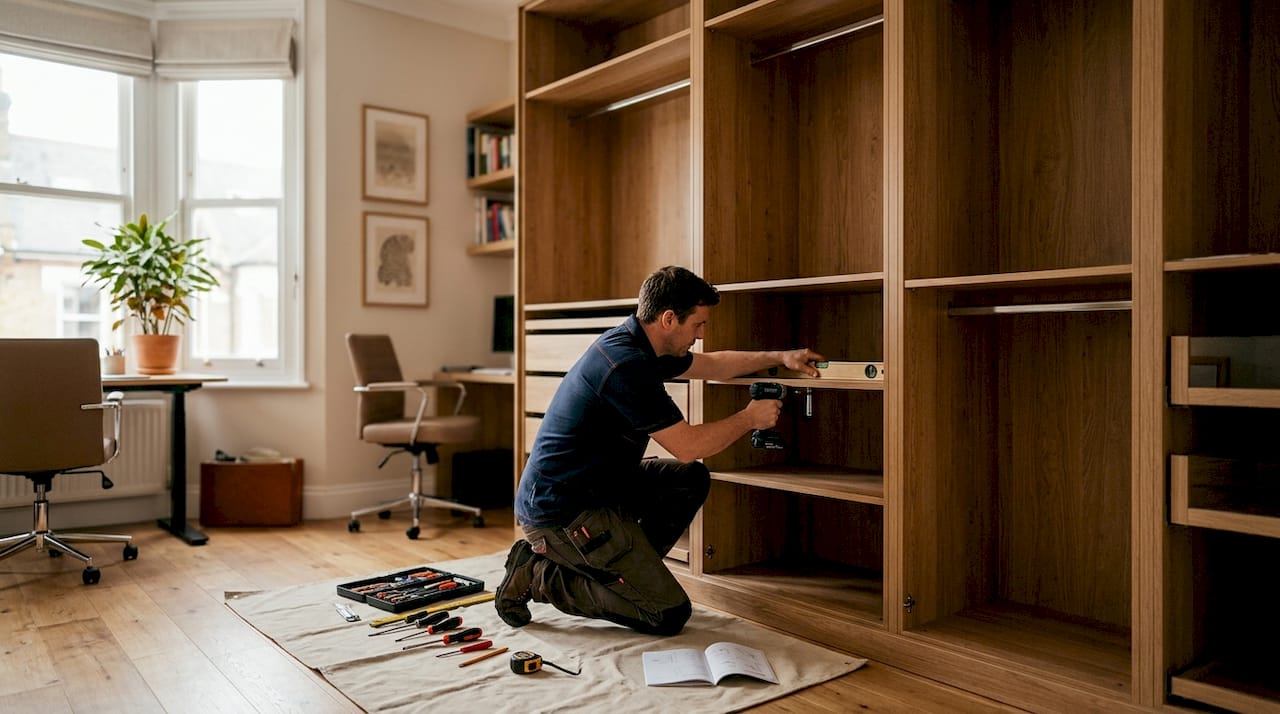
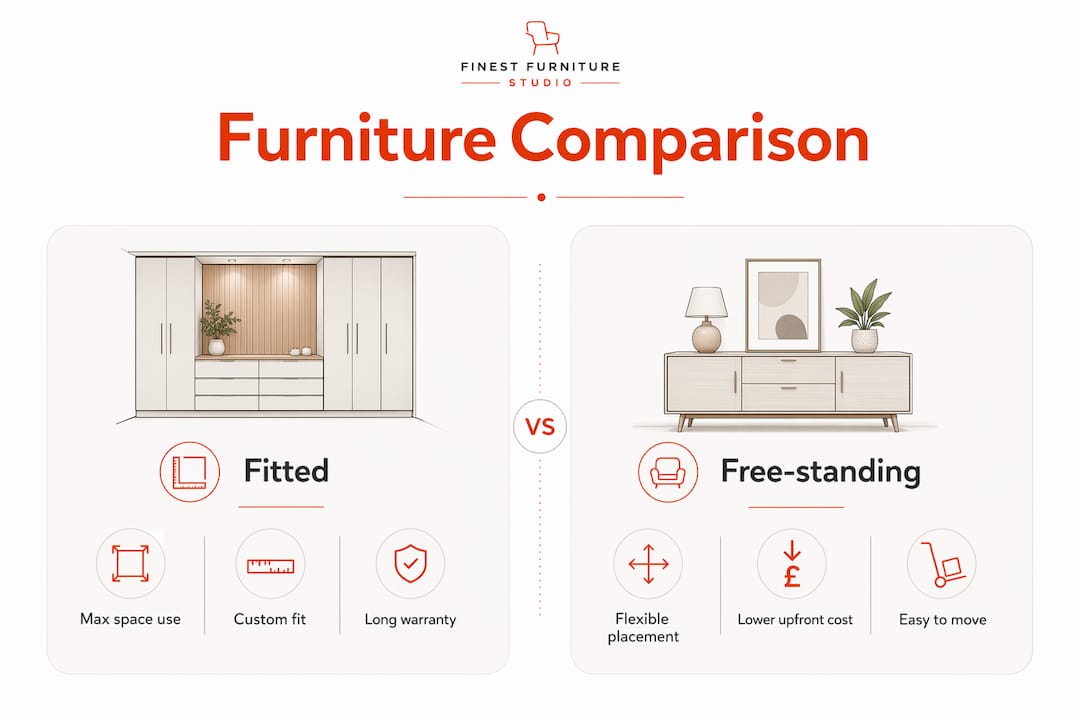
Fitted furniture, also known as built-in furniture or bespoke joinery, is permanently integrated into a home’s architecture. It is custom-designed to fit a specific space, including irregular walls, sloped ceilings, alcoves, and loft rooms. Common examples include fitted wardrobes, bespoke media walls, built-in shelving, Murphy beds, and window seats. Because it is made to measure, fitted furniture leaves no awkward gaps and uses every available centimetre.
Free-standing furniture, by contrast, is manufactured in standard sizes and placed anywhere in a room without fixing to the structure. A chest of drawers, a wardrobe from a high-street retailer, or a freestanding bookcase all fall into this category. Free-standing furniture is movable, which means you can rearrange your room, take pieces with you when you move, or swap them out as your taste changes. The two types serve different needs, and the best homes often use both.
What are the main features and benefits of fitted furniture?
Fitted furniture solves the problems that standard-sized pieces cannot. A room with a chimney breast, a loft conversion with a sloped ceiling, or a narrow alcove beside a fireplace all present challenges that off-the-shelf furniture simply cannot address. Bespoke joinery fills those spaces precisely, creating a clean, built-in look that makes rooms appear larger and more organised.
Space utilisation and custom fit
The defining advantage of fitted furniture is its ability to use irregular spaces that would otherwise be wasted. A fitted wardrobe in a loft bedroom can follow the pitch of the roof, giving you full-height storage where a standard wardrobe would leave a triangular gap. Alcove wardrobes in Victorian terraces, common across Fulham, Hammersmith, and Chiswick, turn dead space into organised storage. At Finest Furniture Studio, we specialise in loft wardrobe solutions and alcove builds that maximise every room.
Long-term value and craftsmanship
Fitted furniture is a long-term investment. High-quality joinery can be comparable to kitchen cabinet costs per linear metre, which reflects the level of craftsmanship involved. That investment pays back through increased home value, particularly in London property markets where storage and finish quality are closely scrutinised by buyers. Bespoke fitted wardrobes, media walls, and built-in storage all contribute to a property’s perceived quality and saleability.
The key benefits of fitted furniture at a glance:
- Precision fit: Built to your exact dimensions, including awkward angles and recesses
- Maximum storage: No wasted floor or wall space, no gaps beside or above units
- Luxury aesthetic: Clean lines, floor-to-ceiling height, and premium materials create a high-end finish
- Added home value: Quality joinery is recognised by estate agents and buyers as a desirable feature
- Bespoke design: Every detail, from internal layout to door style, is chosen to suit your home and lifestyle
Pro Tip: When commissioning fitted furniture, ask your designer to show you the internal layout options, not just the exterior. The configuration of shelves, hanging rails, and drawers determines how useful the piece actually is day to day.
What benefits and flexibility does free-standing furniture offer?
Free-standing furniture offers something fitted pieces cannot: the freedom to change your mind. If you redecorate, move home, or simply want a different layout, free-standing pieces move with you. This flexibility makes them a practical choice for renters, for rooms that serve multiple purposes, and for homeowners who prefer to evolve their interiors gradually.
Style variety and lower upfront cost
Free-standing furniture comes in diverse styles and price points, from budget flat-pack options to handcrafted antique pieces. This range means you can furnish a room quickly and affordably, then upgrade individual pieces over time. A free-standing wardrobe, a vintage chest of drawers, or a mid-century sideboard can all anchor a room’s character without requiring any building work.
Portability and personal style
Free-standing furniture retains personal style and can be moved between homes. This is a genuine advantage for renters or for anyone who moves frequently. A well-chosen piece of free-standing furniture carries sentimental and financial value that a built-in unit, which stays with the property, does not. It also encourages creative layering with rugs, lighting, and accessories, giving rooms a lived-in, personal quality.
The practical advantages of free-standing furniture include:
- Portability: Take it with you when you move, or sell it on
- No installation disruption: Ready to use on delivery without carpentry work or building mess
- Lower upfront cost: Entry-level options are widely available at accessible price points
- Design flexibility: Swap, rearrange, or replace individual pieces as your taste evolves
- Wide availability: Sold across high-street retailers, antique markets, and online platforms
Pro Tip: Mixing free-standing furniture with fitted storage gives you the best of both worlds. Use fitted units for permanent storage needs, then layer in free-standing pieces, such as a bedside table or a reading chair, to add warmth and personality.
How to decide between fitted and free-standing furniture for your home?
The right choice depends on your room, your lifestyle, and your plans for the property. Neither type is universally better. The decision comes down to four key factors: space, storage need, budget, and permanence.
Assessing your room and storage requirements
Built-in furniture is recommended for awkward walls, spaces where storage is paramount, or where joinery defines the architecture. If your bedroom has a sloped ceiling, an alcove, or an irregular wall, fitted furniture is the practical answer. Free-standing pieces work well in standard rooms with flat walls and flexible usage needs. Ask yourself whether the room has a structural challenge that only a custom build can solve.
Storage requirements matter equally. A family home in Kingston or Twickenham with four bedrooms and limited hallway space benefits enormously from fitted wardrobes that go floor to ceiling. A studio flat in Brixton or Central London may be better served by a combination of a fitted wardrobe in the sleeping area and free-standing shelving in the living space.
Budget and long-term value
Fitted furniture carries a higher upfront cost than most free-standing alternatives. However, fitted furniture adds long-term value to homes, which changes the calculation for homeowners planning to sell or remortgage. For renters, free-standing furniture is almost always the wiser financial choice, since built-ins stay with the property when you leave.
Lifestyle and hybrid approaches
Your lifestyle shapes the decision as much as your room does. If you move every few years, free-standing furniture protects your investment. If you own your home and plan to stay, fitted joinery pays dividends in both daily function and property value. Many well-resolved interiors blend fitted and free-standing approaches to adapt as needs evolve. A fitted wardrobe in the bedroom, combined with a free-standing dressing table and bedside tables, is a classic example of this balance.
| Criteria | Fitted furniture | Free-standing furniture |
|---|---|---|
| Space efficiency | Maximises every centimetre, including awkward areas | Limited by standard sizes; gaps often remain |
| Upfront cost | Higher, reflects bespoke craftsmanship | Lower, wide range of price points |
| Flexibility | Permanent; stays with the property | Fully movable; ideal for renters |
| Home value impact | Adds measurable value to the property | Minimal impact on property value |
| Installation | Requires professional fitting, 7–12 days typically | Ready to use on delivery |
| Best suited for | Owners with specific space challenges | Renters or rooms with standard layouts |
What are common misconceptions about fitted vs free-standing furniture?
Several widely held beliefs about fitted and free-standing furniture lead homeowners to make choices they later regret. Addressing these directly helps you avoid the most common pitfalls.
Myth: free-standing is always cheaper
The assumption that free-standing furniture is always the budget option is not accurate. A high-quality free-standing wardrobe from a premium retailer can cost as much as an entry-level fitted wardrobe. Over time, replacing free-standing pieces as they wear or as tastes change adds up. Fitted furniture, built once to a high standard with a 10-year guarantee as offered by Finest Furniture Studio, often works out more cost-effective across a decade of use.
Myth: fitted furniture limits your decorating options
This belief stops many homeowners from commissioning bespoke joinery they would genuinely benefit from. Fitted furniture does not freeze a room’s design. Door styles, finishes, and internal configurations can all be chosen to complement any aesthetic, from Shaker-style painted wardrobes in Barnes and Richmond to modern gloss media walls in Chelsea and Fulham. The bespoke joinery process is a design collaboration, not a constraint.
Expert recommendation: let the architecture breathe
Architectural experts advise asking whether joinery is needed to function or whether free-standing pieces would preserve the room’s natural breathing space. A common homeowner mistake is choosing furniture by default rather than by design, missing the opportunity to let the architecture work for them. The right question is not “fitted or free-standing?” but “what does this specific space actually need?”
“The best interiors are not defined by one furniture type. They are defined by the right furniture in the right place, chosen with purpose rather than habit.”
The practical checklist for avoiding common mistakes:
- Do not fit a room wall to wall simply because you can. Assess whether the space genuinely needs it.
- Do not assume free-standing is cheaper without comparing like for like on quality and longevity.
- Do not overlook awkward spaces. Loft rooms, under-stair areas, and alcoves are where fitted furniture delivers its greatest return.
- Do engage a specialist for bespoke builds. A professional design consultation, such as those offered by Finest Furniture Studio, identifies solutions that a standard retailer cannot.
Key takeaways
Fitted furniture is the superior choice for maximising awkward or limited spaces, while free-standing furniture offers flexibility and portability that suits renters and evolving interiors.
| Point | Details |
|---|---|
| Fitted furniture definition | Custom-built and permanently integrated into a room’s architecture for a precise fit. |
| Free-standing furniture definition | Movable, standard-sized pieces that offer flexibility and portability across homes. |
| Space efficiency | Fitted furniture eliminates wasted gaps and suits irregular rooms, lofts, and alcoves. |
| Cost and value | Fitted furniture costs more upfront but adds measurable long-term value to a property. |
| Best hybrid approach | Combine fitted storage for permanent needs with free-standing pieces for warmth and flexibility. |
Why I think most people approach this decision the wrong way
Most homeowners frame this as a budget question. They assume fitted furniture is the luxury option and free-standing is the practical one. After years of working on bespoke wardrobe and media wall projects across London, I have found the opposite is often true.
The real question is not about cost. It is about what the space demands. A loft bedroom in Ealing with a 45-degree ceiling pitch does not have a free-standing solution. A Victorian terrace in Putney with deep alcoves either side of a chimney breast is begging for fitted shelving or wardrobes. Choosing a standard wardrobe in those situations is not saving money. It is accepting a worse outcome and often spending more over time replacing pieces that never quite fit.
Where I see free-standing furniture genuinely win is in rooms with good bones and no structural challenges. A well-proportioned bedroom with flat walls and generous floor space does not need to be filled with joinery. A beautiful free-standing chest of drawers, a vintage wardrobe, or a bespoke dressing table can define the room far more elegantly than built-ins would.
The approach I recommend is to start with the architecture. Identify the awkward spaces first and commission fitted solutions for those. Then furnish the remaining areas with free-standing pieces that reflect your personal style. This is how the best London interiors are put together, and it is the approach we take at Finest Furniture Studio on every project. You can explore how this works in practice through our fitted living room furniture guide for West London homes.
— Aureliu
Bespoke fitted wardrobes and storage solutions across London
Finest Furniture Studio designs and installs bespoke fitted wardrobes, TV media walls, and custom storage for homeowners across Richmond, Wimbledon, Putney, Kingston, Chiswick, Fulham, Chelsea, Ealing, Twickenham, Barnes, and Hammersmith, as well as Central London, Walton-on-Thames, Guildford, and Reading.
Every project begins with a free design visit, where we assess your space and create a solution tailored to your home. Fitting is completed within 7–12 days, and every installation is backed by a 10-year quality guarantee. We also remove and dispose of your old wardrobe as part of the service. Whether you need a bespoke fitted wardrobe in Richmond or a custom media wall in West London, we are ready to bring your ideas to life. Call us on 07468 150807, message us on WhatsApp, or visit us at 124 City Road, Kemp House, London, EC1V 2NX.
FAQ
What is the main difference between fitted and free-standing furniture?
Fitted furniture is custom-built and permanently fixed to a room’s structure, while free-standing furniture is movable and manufactured in standard sizes. The core distinction is integration versus portability.
Is fitted furniture worth the higher cost?
Fitted furniture adds long-term value to a property and maximises storage in ways standard pieces cannot. For homeowners with awkward spaces or long-term plans, the investment typically pays back through improved function and increased home value.
Can free-standing furniture work in small spaces?
Free-standing furniture can work in small spaces, but it rarely uses the available room as efficiently as fitted furniture does. Standard sizes leave gaps at the top, sides, and floor that fitted pieces eliminate entirely.
What is the best furniture type for a loft bedroom?
Fitted furniture is the clear choice for loft bedrooms with sloped ceilings or irregular walls. Bespoke loft wardrobe solutions follow the pitch of the roof and use space that a standard wardrobe simply cannot reach.
Can you mix fitted and free-standing furniture in the same room?
Yes, and this is often the most effective approach. Use fitted units for permanent storage needs and structural challenges, then layer in free-standing pieces for personality, warmth, and flexibility.

