
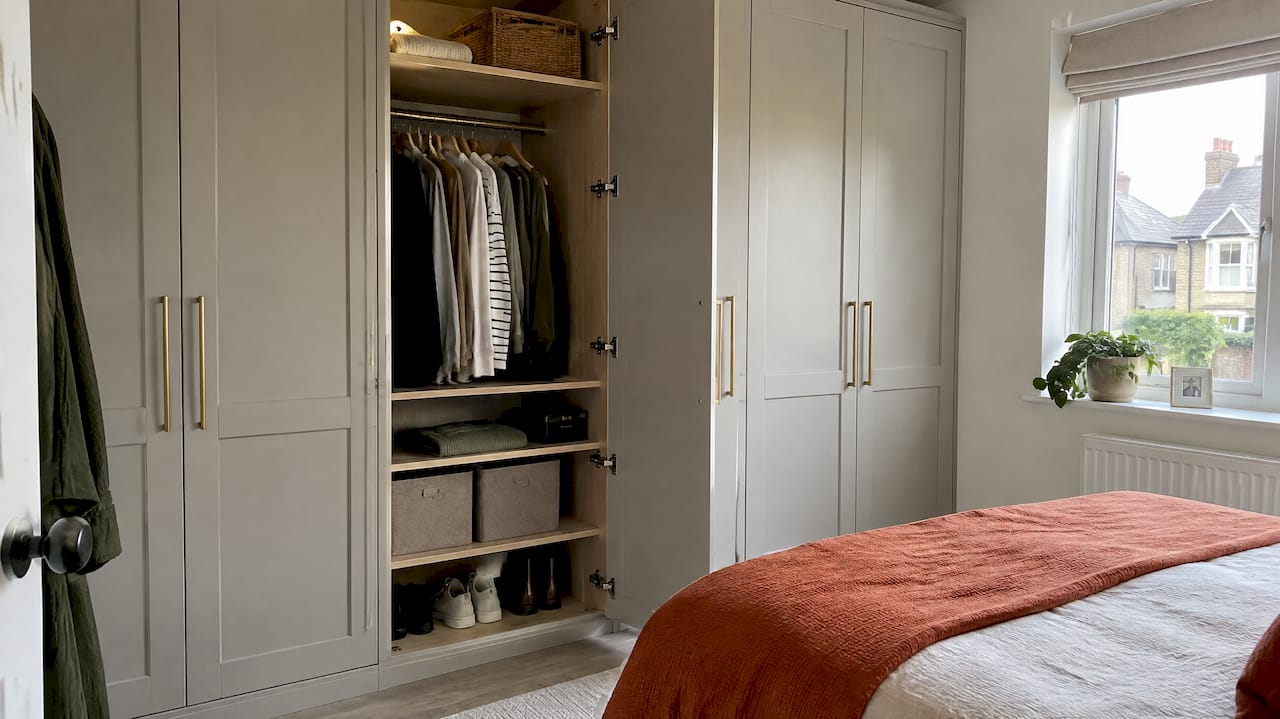
Start with painted or veneered MDF if you want smooth, affordable doors and a clean factory finish, and move to plywood or solid timber when you need long shelf spans, exposed grain, or furniture built to last generations. The one caveat that flips this advice is moisture: unsealed MDF edges in damp rooms will swell and fail faster than either alternative.
TL;DR:
- Plywood is better for long spans and resistance to racking, making it ideal for structural components, while MDF excels in smooth painted finishes.
- Moisture-resistant MDF is suitable for damp areas if edges are fully sealed, but unsealed MDF edges in wet conditions will swell and fail faster.
- Increasing carcass thickness to at least 18mm and properly sealing all cut edges significantly improves wardrobe durability over time.
- Hardware strength must match door weight, with heavier solid timber doors requiring stronger hinges and soft-close mechanisms for longevity.
- Confirm panel specifications, including edge sealing, thickness, and formaldehyde emissions, at the quoting stage to ensure proper performance and safety.
Table of Contents
- Pros and cons: MDF versus solid wood and plywood for wardrobes
- Material types and variants to consider
- Building to last: the specification checklist to demand
- Moisture, emissions and safety: what the E1 standard actually covers
- Cost, appearance and longevity: setting realistic expectations
- Which to choose: a quick decision guide
- Publisher perspective: specifying by component, not by label
- How we can help you get the specification right
- FAQ
- Sources
Pros and cons: MDF versus solid wood and plywood for wardrobes
Each material earns its place for different reasons, and the label alone tells you less than the specification behind it.
- MDF machines cleanly and holds a crisp paint finish because it has a relatively uniform density, though exposed edges and standing water remain its weak points.
- Plywood resists racking and spans wider shelf gaps without sagging, thanks to its cross-laminated layers, making it a strong choice for structural carcasses.
- Solid wood takes knocks and repairs beautifully with sanding and refinishing, but it costs more and moves with the seasons, so doors need room to expand.
- The common myth that “MDF is cheap and wood is quality” misses the point: a thin, badly edged MDF panel will fail faster than a well specified one, and a poorly dried solid timber door will warp regardless of price.
Specification, not the name on the cutting list, decides how a wardrobe performs over ten years.
Material types and variants to consider
Behind “MDF” and “wood” sit several distinct products, each suited to a different job in a wardrobe build.
- MR (moisture-resistant) MDF has improved resin content for damp-prone rooms but still needs sealed edges; it is not a waterproof board.
- Veneered MDF pairs an MDF core with a real wood face, giving the look of grain with the machining stability of a panel product.
- MFC (melamine-faced chipboard) is the standard carcass material in flatpack and many fitted ranges, valued for cost and consistency rather than looks.
- Plywood grades vary by number of plies and face quality; birch plywood is common where a visible, structural panel is wanted.
- Solid timber suits frames, rails, and feature panels where grain and repairability matter more than uniformity.
Doors are usually MDF (painted) or veneered panels; carcasses lean on MFC or plywood; shelves favour plywood or thicker MDF for span. When sourcing, ask for FSC chain-of-custody evidence and confirmation that panels meet the E1 emissions standard, which protects both the environment and your indoor air.
Building to last: the specification checklist to demand
Most wardrobe failures trace back to a handful of overlooked details rather than the base material itself.
- Carcass thickness: specify at least 18mm for sides and verticals; thinner panels flex and loosen fixings over time.
- Shelf thickness and span: unsupported MDF or MFC shelves wider than roughly 600mm need a thicker panel or a mid-span support; plywood copes better at longer spans because of its cross-grain construction.
- Edge sealing: every cut or machined edge, especially on MR MDF, should be lipped, laminated, or painted before installation, not left raw.
- Fixings and back panels: a full ply or MDF back panel screwed into studs or battens resists racking far better than a frame with no rear support.
- Hardware match: heavier solid wood doors need stronger hinges and soft-close mechanisms rated for the extra weight; lighter MDF doors can use standard fittings.
- Supplier questions: ask for the panel’s formaldehyde classification, the adhesive type used, and whether edge sealing is included or an extra.
Pro Tip: Write the panel thickness and edge treatment into your order or cutting list, not just “MDF” or “wood”, so there is no ambiguity when the pieces arrive.
Moisture, emissions and safety: what the E1 standard actually covers
Formaldehyde emissions from wood-based panels are governed by the E1 standard, and most boards supplied to the market are expected to meet it, though a finished wardrobe’s real emissions shift with humidity, age, and ventilation rather than staying fixed at the factory figure.
Most MDF reaching the market is likely to meet E1, since 83% of MDF supplied to Great Britain originates in Great Britain or the EU and is produced to that standard, though this is a supply pattern rather than a guarantee for any single board.
Treat MR MDF as damp-tolerant, not waterproof: it suits bathroom-adjacent cupboards with good ventilation but not shower enclosures or constantly wet areas. Before committing, ask your supplier for an MSDS or adhesive documentation alongside panel test evidence, since real-world performance depends on more than a marketing label.

Cost, appearance and longevity: setting realistic expectations
Budget tends to follow a predictable order: MFC and basic MDF sit at the lower end, veneered MDF and plywood in the middle, and solid timber at the top, with thickness, finish quality, and hardware pushing any of them higher.
- Painted MDF gives you flat, consistent colour with hairline seams, and small scuffs are touched up easily with matching paint.
- Veneers bring real wood grain at a lower cost than solid timber, though deep scratches expose the core beneath and are harder to disguise.
- Stained solid wood shows genuine grain and ages with character, and because it is solid through, sanding and refinishing can restore it repeatedly over decades.
Thinking in lifetime value rather than purchase price changes the calculation: a solid wood door you can refinish twice may outlast two cheaper replacements, while a well sealed MDF door offers excellent value if you are happy repainting every few years.
Which to choose: a quick decision guide
Match the material to the job the panel is doing, not to a general preference for “wood” or “MDF”.
- Painted doors on a budget: choose MDF with a quality primer and topcoat; specify edge sealing on every cut.
- Veneered, wood-look doors: choose veneered MDF or plywood faced panels for grain without solid timber pricing.
- Structural shelving or long spans: choose plywood, or thicker MDF with mid-span support, to avoid sagging.
- Heirloom or statement furniture: choose solid timber where repairability and grain matter more than cost.
- Any damp-adjacent location: confirm MR grade and insist on full edge sealing before installation.
Bring this checklist to any quote: panel thickness, edge treatment, shelf span support, and hardware rating. A materials review of finishes and panels is worth a look if you want to compare options side by side before deciding.
Publisher perspective: specifying by component, not by label
In our design work, we choose materials component by component rather than picking one board for an entire wardrobe. Doors, carcasses, and shelves each get the panel suited to their job. A specification-led approach like this resolves most of the trade-offs this article describes, though a straightforward flatpack or DIY build can still suit a tighter budget or a simpler room.
— Aureliu
How we can help you get the specification right
We design and fit fitted wardrobes, sliding wardrobes, walk-in wardrobes, and solutions for alcoves and awkward spaces, choosing panel thickness, edge treatment, and hardware for your room rather than defaulting to one material for everything.

Every quote sets out the exact board, finish, and shelf support we are specifying, so you are never guessing what is behind the door. If you would like a free design visit to talk through MDF, plywood, or solid wood for your space, get in touch on 07468 150807 or WhatsApp, or head to our fitted wardrobes page to see the range and request a quote.
FAQ
What are the downsides of MDF furniture?
MDF can swell or crumble at cut edges if they are left unsealed and exposed to moisture, and it has less tensile strength than plywood across wide, unsupported spans. Standard MDF is also not designed for constantly damp rooms unless you specify a moisture-resistant grade with properly sealed edges.
Which is better for building a wardrobe, plywood or MDF?
Plywood generally performs better for structural panels and long shelf spans because its cross-laminated layers resist sagging and racking. MDF tends to win for painted doors and flat panels, where its uniform surface gives a smoother, more consistent paint finish.
What is the best material for a built-in wardrobe?
There is no single best material: painted doors usually suit MDF, structural shelving and carcasses often suit plywood or MFC, and solid timber suits frames or statement pieces where repairability matters. The right answer depends on matching board thickness, edge sealing, and hardware to each component’s job rather than picking one material for the whole piece.
Are MDF wardrobes any good?
Yes, when specified well. Most MDF supplied to the market is produced to meet the E1 emissions standard, and with adequate panel thickness, sealed edges, and suitable hardware, MDF wardrobes offer a durable, smooth-finished option at a lower cost than solid timber.
Sources
- Guidance for the Particleboard, Oriented Strand Board and Dry Process Fibreboard Sector
- Formaldehyde in indoor air environments in Great Britain (HSE technical report)

