
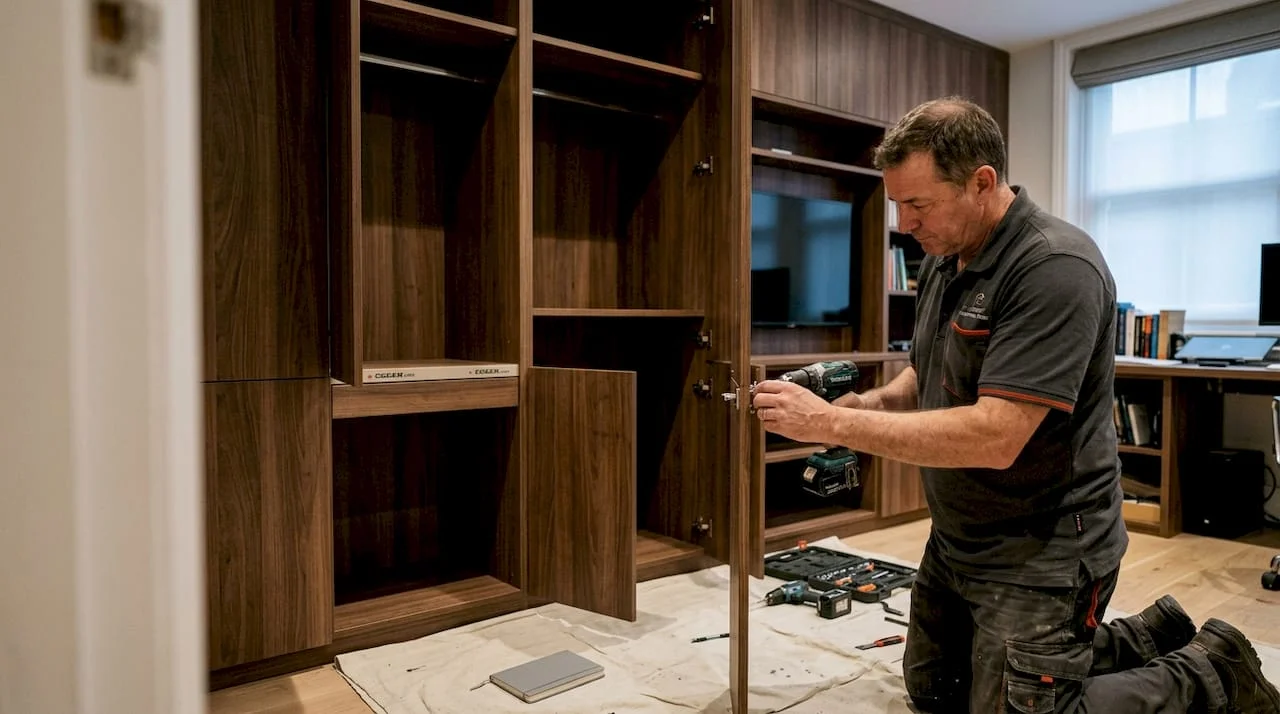
Quick wardrobe installation is the process of assembling and fitting modular or semi-bespoke wardrobes using prefabricated components to create organised, space-maximising storage with minimal disruption to your home. In the industry, this approach is formally known as modular or fitted wardrobe assembly, and it stands apart from traditional bespoke joinery by relying on off-site manufacture and standardised parts. For homeowners and renters across London and the surrounding areas, it offers a practical path to better storage without weeks of building work. Finest Furniture Studio completes fitting within 7–12 days, backed by a 10-year quality guarantee. Understanding what quick wardrobe installation involves, and where it works best, is the first step to getting it right.
What is quick wardrobe installation?
Quick wardrobe installation refers to the rapid assembly and fitting of wardrobes using prefabricated or modular components, typically completed within a few days rather than weeks. The industry term for this process is modular wardrobe assembly, though many homeowners simply call it fast or quick-fit installation. The key distinction from traditional bespoke joinery is that the components are manufactured off-site to standard or semi-custom dimensions, then brought to your home and assembled on location.
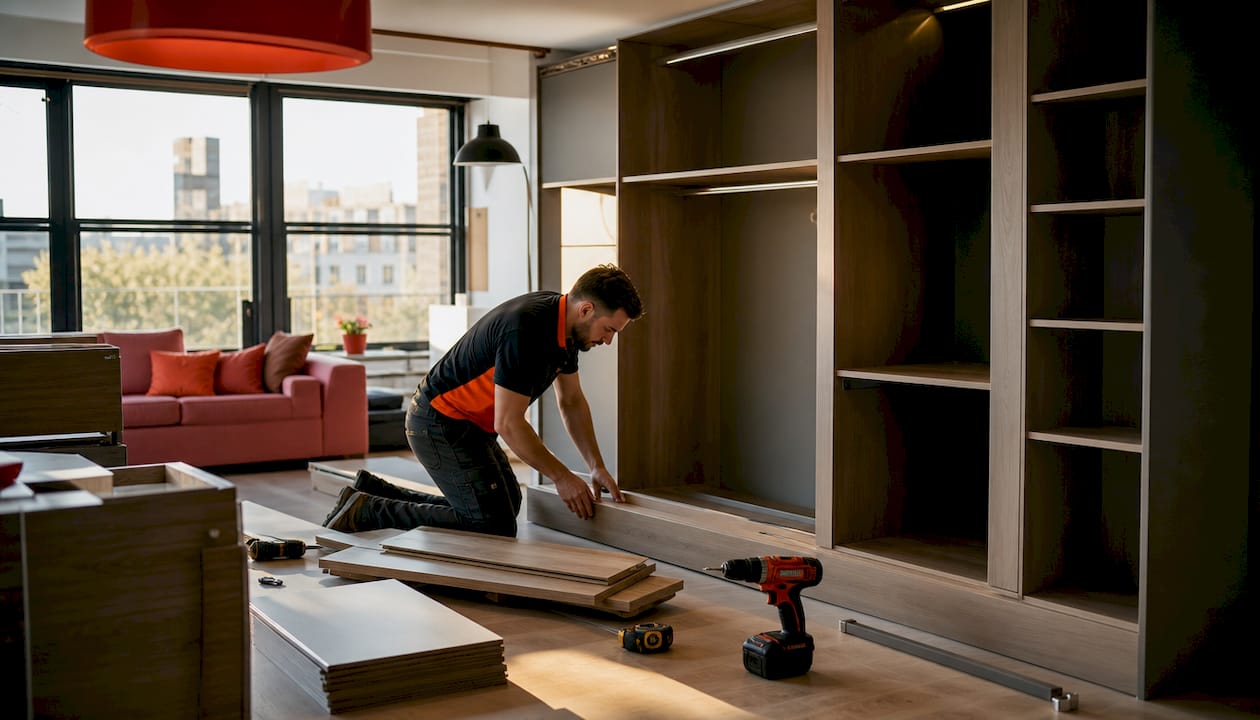
Modular wardrobes use standardised components that allow assembly within a few days, compared to fully bespoke wardrobes that can take 6–12 weeks from design to installation. That time difference is significant for anyone living in a busy household or renting a property where disruption must be kept to a minimum.
The process typically covers three phases: design and measurement, manufacture or component selection, and on-site fitting. Each phase feeds directly into the next. A well-measured design means components arrive ready to fit, and fitting proceeds without delays or adjustments. When any one phase is rushed or skipped, the problems show up immediately in gaps, misaligned doors, or units that simply do not sit flush against the wall.
What types of wardrobes qualify as quick installation?
Not every wardrobe type suits a fast turnaround. The category of quick-install wardrobes covers three main systems, each with different strengths and limitations.
-
Modular wardrobes. These use pre-fabricated standardised components that slot together on-site. Shelves, hanging rails, drawer units, and door frames are manufactured to fixed dimensions and can be configured in multiple layouts. Most modular units can be fully assembled within a single day, minimising household disruption. They suit standard-sized rooms well and offer genuine flexibility because components can be reconfigured or expanded later without a full rebuild.
-
Flat-pack wardrobes. These arrive as self-assembly kits and represent the most accessible entry point for quick wardrobe setup. A professional fitter can assemble a flat-pack unit in a few hours. The trade-off is that flat-pack systems offer the least adaptability to awkward spaces. Sloping ceilings, alcoves, and uneven walls all present problems that standard flat-pack units cannot resolve without modification.
-
Semi-bespoke wardrobes. This is the category that bridges speed and custom fitting most effectively. Semi-bespoke systems use modular components that are cut and finished to your specific room dimensions during manufacture. They arrive largely ready to fit, so on-site time remains short, yet the result looks and functions like a fully fitted wardrobe. For homeowners in London properties with period features, alcoves, or loft conversions, semi-bespoke is often the most practical choice.
-
Fully bespoke wardrobes. These are built entirely to your specification from raw materials. They deliver the highest quality finish and the most precise fit, but they do not qualify as quick installation. Bespoke wardrobes typically take several weeks from design to fitting, making them unsuitable when speed is the priority.
Understanding which system suits your space is the foundation of a successful quick wardrobe setup. A modular system works brilliantly in a standard rectangular bedroom. A semi-bespoke approach is the better call for a loft room with a sloping ceiling or a bedroom with a chimney breast alcove. You can read more about the differences in our guide to modular wardrobe design for homeowners.
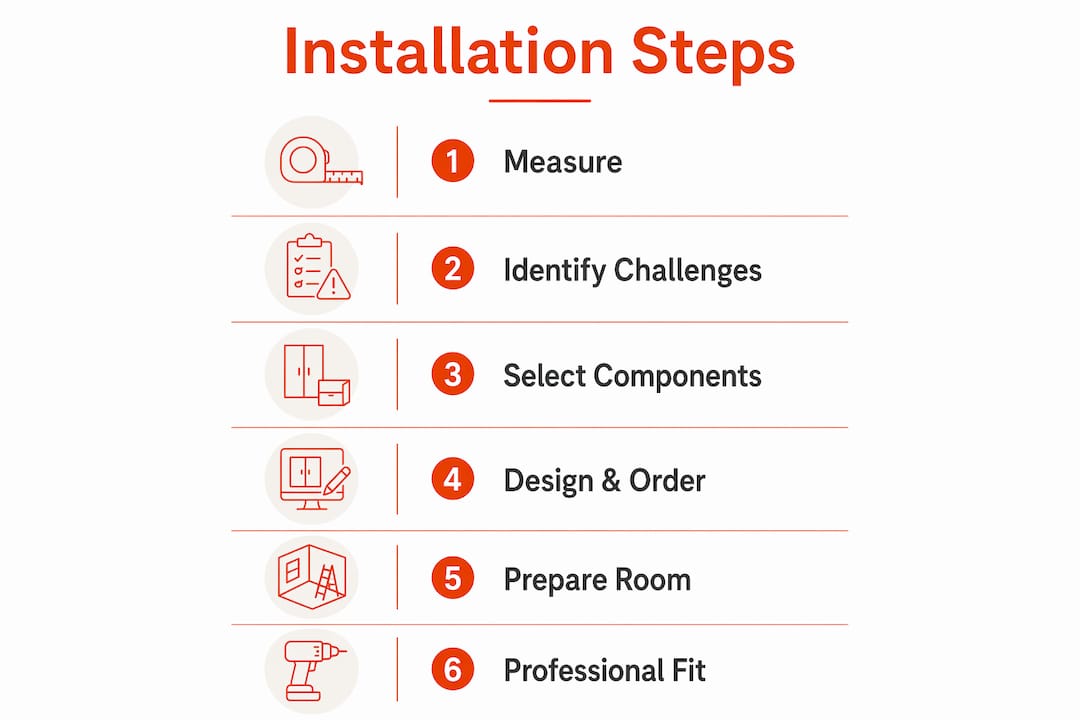
Why quick wardrobe installation matters for modern homeowners and renters
Speed is the obvious benefit, but it is not the only one. Fast wardrobe installation matters because it reduces the period during which your bedroom is unusable, your clothes are piled on the floor, and your daily routine is disrupted. For renters in particular, a quick-fit wardrobe can be installed, enjoyed, and removed or left behind without the commitment of a multi-week building project.
Most modular units complete assembly within a single day, which means your bedroom is functional again the same evening. That matters enormously in a busy household with children, a working-from-home schedule, or a rental property where you cannot take extended time off to manage tradespeople.
Space optimisation is the second major benefit. Modular systems tailored to specific needs reduce visual clutter and improve long-term organisation by making use of vertical height and awkward corners that freestanding furniture simply ignores. In a typical London bedroom where floor space is limited, a fitted or modular wardrobe running floor to ceiling can double usable storage compared to a freestanding unit. For ideas on making every centimetre count, creative space-saving strategies for small homes are worth reviewing alongside your wardrobe plan.
Cost is the third consideration. Quick-install modular systems generally cost less than fully bespoke wardrobes because manufacturing is standardised and on-site labour time is shorter. The saving is real, though it comes with a caveat: cutting costs by skipping the measurement phase or choosing components that do not suit your room will cost more to fix later.
“Proper measurement prevents issues like sliding door misalignment or gaps caused by uneven walls. Quality and precise measurement are non-negotiable, even for quick installations, ensuring lasting performance.”
Pro Tip: Book a professional site survey before ordering any components. A surveyor will identify uneven floors, out-of-square walls, and ceiling height variations that will affect the fit of every component you order.
The quality trade-off is real but manageable. Correct structural fixing and fit is particularly important in older properties with uneven floors and walls, which describes a large proportion of homes across Richmond, Wimbledon, Putney, and Chelsea. A quick installation that skips this step produces a wardrobe that looks wrong from day one and gets worse over time.
How to prepare and successfully install a quick wardrobe
Preparation is where quick wardrobe installation either succeeds or fails. The fitting itself is fast precisely because the preparation is thorough. Rushing the planning phase to save time is the single most common mistake homeowners make.
Step 1: Measure accurately
Accurate measurement is the foundation of the entire process. Measure the width, height, and depth of the space at multiple points, not just once at the centre. Walls in UK homes, particularly period properties in areas like Chiswick, Hammersmith, and Twickenham, are rarely perfectly straight or square. A difference of even 10mm between the top and bottom of a wall will cause a floor-to-ceiling wardrobe to sit visibly out of true. Our guide to measuring for fitted furniture covers every step in detail.
Step 2: Identify architectural challenges
Before selecting components, note any features that will affect the design. These include:
- Sloping ceilings in loft rooms or under-stair spaces
- Chimney breasts or alcoves that create irregular wall depths
- Radiators, sockets, or light switches within the wardrobe footprint
- Uneven or sloping floors common in Victorian and Edwardian properties
Each of these requires a specific design response. A sloping ceiling, for example, demands a wardrobe with a stepped or angled top panel rather than a standard flat-top unit. Ignoring this detail means the unit will not fit, regardless of how quickly it was assembled.
Step 3: Select the right components
Choose modular components that match your storage needs, not just your room dimensions. Think about how you actually use your wardrobe: how many hanging garments, how many folded items, whether you need shoe storage, and whether drawers or shelves suit your habits better. A wardrobe that is fast to install but poorly configured for your needs will frustrate you every day.
Step 4: Finalise the design and order
Once measurements and component choices are confirmed, finalise the design before placing any order. Changes made after manufacture add cost and delay. A professional design consultation, such as the free design visit offered by Finest Furniture Studio, catches conflicts between your design and your room before they become problems on fitting day.
Step 5: Prepare the room
Clear the installation area completely before the fitters arrive. Remove existing furniture, take down any wall-mounted items within the wardrobe footprint, and check that the floor is clean and level. Fitters working in a clear space complete the job faster and with fewer errors.
Step 6: Professional fitting versus DIY
The fitting phase of a modular wardrobe is within the capability of a confident DIY homeowner for simple, standard configurations. However, professional fitting is the better choice for most homeowners because fitters bring the tools, experience, and problem-solving ability to handle the unexpected. Skipping detailed surveys increases the risk of poor fit and future maintenance problems. A professional fitter will also anchor the wardrobe correctly to the wall, which is a safety requirement, not an optional extra.
Pro Tip: Ask your fitter to check door alignment and drawer operation before they leave. Adjustments take minutes on the day but are far more disruptive to fix a week later.
Common challenges in quick wardrobe installation and how to avoid them
Speed creates specific risks. Knowing them in advance means you can plan around them rather than deal with them after the fact.
-
Inaccurate measurements leading to gaps. The most common problem in fast wardrobe installation is a unit that does not fill the space cleanly. Gaps at the sides, top, or floor look poor and collect dust. Proper measurement prevents sliding door misalignment and gaps caused by uneven walls. Measure three times, order once.
-
Generic flat-pack units in awkward spaces. Standard flat-pack wardrobes are designed for standard rooms. They perform poorly in loft conversions, alcoves, or rooms with sloping ceilings. Forcing a standard unit into an irregular space produces a result that looks makeshift and wastes the potential of the room. For loft spaces specifically, loft wardrobe ideas that account for the slope are a far better starting point.
-
Inadequate wall anchoring. A wardrobe that is not properly fixed to the wall is a safety hazard. This applies to modular and flat-pack units equally. Wall anchoring must account for the wall construction: plasterboard, solid brick, and timber stud walls each require different fixings. Never skip this step, regardless of how stable the unit feels when freestanding.
-
Rushed installation that sacrifices durability. Rapid installation works best when modular systems are customised for the specific architectural challenges of the room. A wardrobe fitted in three hours with no site survey will not perform as well over time as one fitted in the same three hours following a thorough preparation phase.
-
Skipping post-installation checks. After fitting, check every door, drawer, and shelf before the fitter leaves. Doors should open and close without catching. Drawers should run smoothly on their runners. Shelves should sit level. Correct structural fixing and fit in older UK properties requires particular attention because the building itself may have settled unevenly over decades.
The underlying principle is consistent: speed in the fitting phase is only possible when the preparation phase is unhurried and thorough. The two are not in conflict. They are sequential.
Key takeaways
Quick wardrobe installation succeeds when modular or semi-bespoke components are matched to accurate measurements and the specific architectural conditions of the room, with professional fitting completing the process within days rather than weeks.
| Point | Details |
|---|---|
| Modular assembly is fastest | Most modular wardrobes complete fitting within a single day, minimising household disruption. |
| Measurement determines the outcome | Accurate site measurement at multiple points prevents gaps, misaligned doors, and poor fit. |
| Semi-bespoke suits awkward spaces | Semi-bespoke systems combine speed with custom dimensions, ideal for lofts, alcoves, and period properties. |
| Professional fitting adds real value | Fitters handle wall anchoring, alignment, and unexpected site conditions that DIY often misses. |
| Preparation phase must not be rushed | Skipping surveys or design finalisation before ordering creates problems that are costly to fix after fitting. |
Why speed without preparation is a false economy
I have seen this pattern repeat itself more times than I can count. A homeowner decides they want a wardrobe fitted quickly, focuses entirely on the fitting timeline, and gives almost no thought to the preparation that makes a fast installation possible. The result is a wardrobe that looks wrong, fits poorly, and needs remedial work within months.
The misconception is that “quick install” means “easy install” or even “DIY install.” It does not. Quick installation is fast because the components are manufactured to precise dimensions off-site, and because the fitter arrives to a room that has been properly measured and prepared. Remove either of those conditions and the speed disappears along with the quality.
What I consistently recommend is this: invest your time in the design and measurement phase, then let the fitting be fast. A free design visit costs you nothing and catches the problems that would otherwise surface on fitting day. For homes in Richmond, Wimbledon, Putney, and across West London, where period architecture creates genuine challenges, this preparation is not optional. It is the difference between a wardrobe that looks built-in and one that looks like it was forced into a space it was never designed for.
Bespoke elements do not have to mean long lead times. Semi-bespoke systems, where components are cut to your room’s exact dimensions before delivery, give you a fitted finish with a modular timeline. That is the approach we take at Finest Furniture Studio, and it is why our installations complete within 7–12 days while still carrying a 10-year guarantee. Speed and quality are not opposites. They are the result of doing the preparation properly.
— Aureliu
Finest Furniture Studio: bespoke wardrobe fitting across London
Finest Furniture Studio designs and installs bespoke fitted wardrobes across Richmond, Wimbledon, Putney, Kingston, Chiswick, Fulham, Chelsea, Ealing, Twickenham, Barnes, Hammersmith, and Central London. Every project begins with a free design visit, where we measure your space accurately and design a wardrobe that fits your room and your storage needs precisely.
We specialise in tricky spaces: loft conversions with sloping ceilings, alcoves, under-stair storage, and rooms where standard units simply will not work. Fitting completes within 7–12 days, and we carry away and dispose of your old wardrobe at no extra charge. Our installations carry a 10-year quality guarantee. Call us on 07468 150807, message us on WhatsApp, or visit us at 124 City Road, Kemp House, London, EC1V 2NX to arrange your free design visit.
FAQ
What is quick wardrobe installation?
Quick wardrobe installation is the assembly and fitting of modular or semi-bespoke wardrobes using prefabricated components, typically completed within a few hours to a few days. It differs from traditional bespoke joinery by relying on off-site manufacture to reduce on-site build time.
How long does quick wardrobe installation take?
Most modular wardrobe installations complete within a single day, while semi-bespoke fitted wardrobes typically take 7–12 days from design confirmation to fitting completion. The timeline depends on the complexity of the space and the number of units being installed.
Can I install a modular wardrobe myself?
A confident DIY homeowner can assemble a standard flat-pack or modular wardrobe in a straightforward room. Professional fitting is recommended for any space with sloping ceilings, uneven walls, or alcoves, and for correct wall anchoring, which is a safety requirement.
What is the biggest risk in fast wardrobe installation?
The biggest risk is inaccurate measurement. Gaps, misaligned sliding doors, and units that sit out of true all trace back to measurements taken at too few points or without accounting for wall irregularities common in older UK properties.
Do quick-install wardrobes work in loft conversions?
Standard modular or flat-pack units do not suit loft conversions well because sloping ceilings require angled or stepped top panels. Semi-bespoke systems, designed to your loft’s exact dimensions, deliver a fitted result within a fast installation timeline and make full use of the available space.

