

Table of Contents
- Why Awkward Corners Matter in Home Office Design
- Small Home Office Storage Ideas That Actually Work
- Corner Desk Storage Ideas for Compact Workstations
- Home Office Shelving Ideas for Vertical Space
- Awkward Corner Storage Ideas for Irregular Spaces
- Practical Considerations for Corner Office Setup
- Bespoke and Renter-Friendly Storage Solutions
- Frequently Asked Questions
Last Updated: October 10, 2026
Why Awkward Corners Matter in Home Office Design
Awkward corners are often treated as dead space in home offices. But these overlooked areas hold enormous potential for space-saving storage awkward corners that transforms how you work. Sloped ceilings, recessed alcoves, and undersized corners create real challenges because most off-the-shelf furniture won’t fit. Thoughtful design makes the difference between a cramped workspace and one that feels organised and calm.
At Finest Furniture Studio, we’ve spent years solving this exact problem for homeowners across London and the South East. Corners that seemed impossible to use often become the most functional part of the entire room once designed properly.
Awkward corners aren’t wasted space, they’re untapped storage potential waiting for the right solution.
Small Home Office Storage Ideas That Actually Work
The best storage solutions match the space, not the other way around. Generic shelving and filing cabinets force compromises; custom-fitted storage eliminates them.
Floating shelves and wall-mounted solutions
Floating shelves draw the eye upward, making rooms feel larger while delivering storage capacity. Position them to work with the room’s natural lines and anchor them to solid structure, check for studs or use appropriate fixings to prevent sagging. Use open shelving for daily-use items (reference books, desk supplies) and closed storage for paperwork, cables, and items you don’t want visible.
Corner cabinets and modular units
Corner cabinets maximise depth that standard units waste. Modular units offer flexibility to add or remove sections as needs change, valuable if you’re renting or your setup evolves. Pull-out shelves or rotating mechanisms make it easy to reach items at the back without stretching.
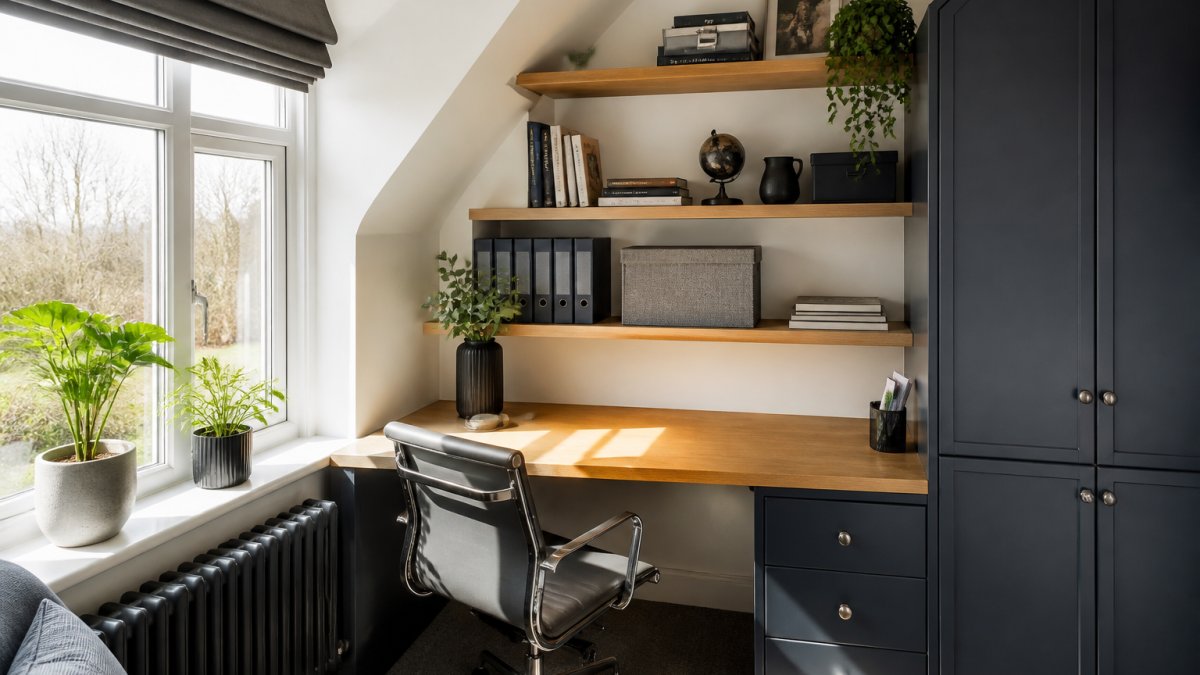
Maximizing these vertical surfaces transforms a cramped nook into a functional hub, ensuring that every element of your home office setup contributes to a seamless and productive workflow.
Corner Desk Storage Ideas for Compact Workstations
Corner desks with integrated drawers and shelving eliminate the need for separate filing cabinets and storage units.
L-shaped and corner desk configurations
An L-shaped desk uses corner space efficiently, with one arm for your monitor and work surface and the other for storage or additional workspace. Standard L-shaped desks often leave gaps or misalign with room angles. Custom fitting ensures proper depth, shallow desks feel cramped, deep ones waste floor space.
Built-in drawers and integrated storage
Desks with built-in storage reduce clutter and reclaim floor space that separate filing cabinets would occupy. Drawer dividers turn a single drawer into a multi-purpose system for pens, sticky notes, USB cables, and charging leads.
Home Office Shelving Ideas for Vertical Space
Vertical storage is essential in small offices. Floor space is precious. Wall space is abundant.
Floor-to-ceiling shelving in corner alcoves
Corner alcoves are perfect for floor-to-ceiling shelving that maximises the entire wall without protruding into the room. Adjustable shelving lets you adapt to different book heights and storage needs over time.
Adjustable shelving for books and files
Adjustable shelves accommodate books and files of varying heights and depths without wasting space. Quality systems have sturdy brackets that don’t sag under weight. Labelling shelves makes retrieval faster.
| Storage Type | Best For | Space Impact | Flexibility |
|---|---|---|---|
| Floating shelves | Daily-use items, display | Minimal floor impact | Easy to adjust |
| Corner cabinets | Hidden storage, files | Compact footprint | Moderate |
| Built-in desk storage | Work essentials | Integrated, efficient | Limited |
| Floor-to-ceiling shelving | Maximum capacity | Uses full wall | High |
Awkward Corner Storage Ideas for Irregular Spaces
Sloped ceilings, angled walls, recessed alcoves, bay windows, and corners obstructed by radiators or electrical outlets each demand different approaches. Precise measurement and understanding your specific corner type determines whether a solution fits perfectly.
Measuring irregular corners: a step-by-step approach
Measure your corner accurately before choosing any storage solution; a half-inch difference can prevent a unit from fitting.
For angled or sloped corners: Measure wall height at three points (tallest, shortest, midpoint) and width at floor, mid-height, and ceiling.
For recessed alcoves: Measure depth at back, middle, and front (alcoves are rarely uniform). Check width at floor, mid-height, and ceiling. Measure from back wall to protruding features and confirm distance to adjacent doors or windows.
For bay windows and curved corners: Measure the curve at multiple points (every 30 cm) rather than assuming uniformity.
For corners with obstacles: Measure radiator depth and protrusion. Locate electrical sockets and switches, noting height and type. Check for pipes and vents using a stud finder with metal-detection capability.
Shape-specific storage solutions
Sloped ceilings and understairs storage:
Sloped ceilings require stepped or custom shelving that follows the slope’s angle. Measure ceiling height at the wall and at 30 cm intervals to determine the exact angle.
Angled alcoves and recessed corners:
Angled alcoves create unusual dimensions that vary room to room. Choose between a custom unit built to exact angles or a modular system with adjustable shelves that can be trimmed to fit.
Bay windows and curved walls:
Curved corners require curved shelving units, stepped or angled units that approximate the curve, or freestanding modular units. Measure carefully; even 2 cm variation in radius changes fit.
Corners with radiators, sockets, or pipes:
Confirm whether radiators need 10 cm clearance for air circulation, whether sockets can be relocated, and whether pipes are live (never box in live pipes without access).
Always measure multiple times and account for uneven walls. Use a laser measure or a long spirit level to check for deviation. If walls lean inward or outward by more than 1 cm over a 1-metre height, note this, it affects how shelving or cabinets will sit. For any permanent installation, have a surveyor or experienced fitter assess the space before commissioning custom work.
Fit-check checklist before you buy or commission
Before purchasing, verify: height clearance under sloped ceilings, door and drawer swing (simulate with cardboard), chair clearance and movement, access to radiators and sockets, and delivery fit through doorways and stairs. These 15-minute checks prevent costly mistakes.
Practical Considerations for Corner Office Setup
How your office functions day-to-day, power access, heat management, screen visibility, and tool reach, determines whether a corner workspace is genuinely usable or just cramped.
Cable management and power access
Cables accumulate quickly in home offices. In a corner workspace, tangled cables look messy, create tripping hazards, and make it difficult to unplug or replace equipment.
Plan power access before installing storage: Identify every device needing power and trace cable routes to the nearest socket. If no socket is nearby, use an extension lead or hire a qualified electrician, never run cables across floors or behind closed storage.
Integrate cable management into your storage design: Choose shelving with pre-drilled holes or cable clips. Use cable trays or conduit to bundle wires neatly. Label cables at both ends. Leave slack in cables rather than pulling tight.
For rented spaces: Use adhesive cable clips or sleeves to route wires without drilling. Position a power strip where it’s accessible and won’t be a trip hazard. Avoid running cables behind closed storage.
Ventilation and heat management
Corner spaces often feel warmer because air circulation is poor. Equipment generates heat, and poor airflow makes the room uncomfortable, shortens electronics lifespan, and can trigger thermal throttling.
Check airflow before positioning storage: Identify air vents, radiators, and windows. Leave at least 10 cm of clear space in front of radiators. If far from a window, use a small desk fan. Avoid enclosing your desk completely with storage.
Design storage to allow airflow: Use open shelving for items you don’t need to hide. For closed cabinets, use slatted shelves to allow air circulation. Position units 5-10 cm from the wall. Keep the area under your desk clear.
Lighting and visibility
Corner spaces often feel darker because they’re away from windows. Poor lighting causes eye strain, headaches, and reduced productivity.
Assess natural light: Position your desk to face a window if possible. If far from a window, use a mirror or light-coloured shelving to reflect available light.
Add task lighting: Install a desk lamp above your work surface to eliminate shadows. Choose adjustable brightness and colour temperature (cooler light for daytime, warmer for evening). Position to the side of your monitor to avoid glare.
Reduce glare: Position your monitor perpendicular to windows. Use a monitor hood or anti-glare screen if your corner gets direct sunlight. Avoid glossy shelving finishes.
Ergonomics and accessibility in compact spaces
A corner workspace must be comfortable for hours at a time. Poor ergonomics lead to back pain, neck strain, and repetitive strain injuries.
Desk height and positioning: Your desk should position elbows at 90 degrees when arms are relaxed (standard height 72-76 cm).
Monitor and keyboard placement: Position your monitor at arm’s length (50-70 cm) with the top at or slightly below eye level. Use a riser or arm if needed.
Storage accessibility: Keep frequently used items within arm’s reach at eye level. Limit shelving depth to 25-30 cm to keep everything visible and reachable. Ensure pull-out shelves and rotating mechanisms move smoothly.
Chair clearance and movement: Your office chair should roll freely in all directions. A typical chair needs a 1.5-metre diameter circle of clear floor space.
Test your corner setup for a full working day before committing to permanent storage. Spend 8 hours at your desk and note any discomfort, visibility issues, or cable tangles. Use this feedback to refine your layout before installing shelving or cabinets.
Bespoke and Renter-Friendly Storage Solutions
Not every home office solution requires permanent installation. Your situation determines the best approach.
Custom-fitted furniture for permanent results
Custom-fitted storage is a long-term investment designed specifically for your space, needs, and style. Finest Furniture Studio creates custom home office storage that transforms awkward corners into functional, beautiful spaces, accounting for irregular dimensions, sloped ceilings, and unusual angles that standard furniture can’t handle.
Flexible options for temporary installations
Renting doesn’t mean settling for poor storage. Freestanding units, modular shelving, and wall-mounted solutions work without permanent installation. Tension rods and adhesive hooks are removable and won’t damage walls. Temporary solutions adapt easily but typically offer less capacity than custom-fitted alternatives.
Awkward corners stop being a problem when you stop treating them as afterthoughts. The right storage solution transforms wasted space into your office’s most functional area.
UK government guidance on home office workspace design recommends adequate storage to reduce clutter and improve focus. Proper organisation directly impacts productivity and wellbeing in remote work environments.
Discover how Finest Furniture Studio can turn your awkward corners into organised, beautiful storage. Book a free design visit and see what’s possible in your space.
Frequently Asked Questions
What are the best space-saving storage ideas for a small home office?
Vertical storage is key: wall-mounted shelves, corner cabinets, and floor-to-ceiling units make the most of unused wall space without consuming floor area. Floating desks with integrated storage, corner cabinets, and modular shelving systems work well for small offices. Combine these with drawer organisers and storage boxes to keep files, stationery, and supplies neatly contained. The goal is to move storage upward and into corners, leaving your floor clear and your workspace functional.
How do you handle storage in an awkward corner with a sloped ceiling?
Sloped ceilings require custom solutions. Bespoke fitted furniture can be designed to follow the roof line precisely, maximising storage even where a standard unit would waste space. Consider tapered shelving, angled cabinets, or stepped storage that adapts to the slope. Understairs storage works similarly, custom-built drawers or cabinets fit the exact dimensions, turning dead space into functional storage for files, books, and office equipment.
What corner desk storage ideas work best for remote workers?
L-shaped corner desks with built-in drawers and shelves keep everything within arm’s reach without clutter. Integrated storage compartments for cables, chargers, and stationery reduce desk surface mess. Floating corner desks with open shelving below offer a clean look while providing space for storage boxes or a printer. Pairing a corner desk with wall-mounted shelving above creates a complete workstation that maximises both storage and usable work surface.
Are bespoke fitted solutions worth the investment for a small home office?
Yes, especially if you’re working with irregular spaces. Bespoke furniture fits precisely into awkward corners, sloped ceilings, and alcoves that standard units cannot accommodate. Custom solutions eliminate wasted space, provide better organisation, and typically last longer than mass-produced alternatives. Many bespoke providers offer transparent pricing, design visits, and warranties. For remote workers and homeowners staying long-term, the durability and tailored fit justify the investment.

