
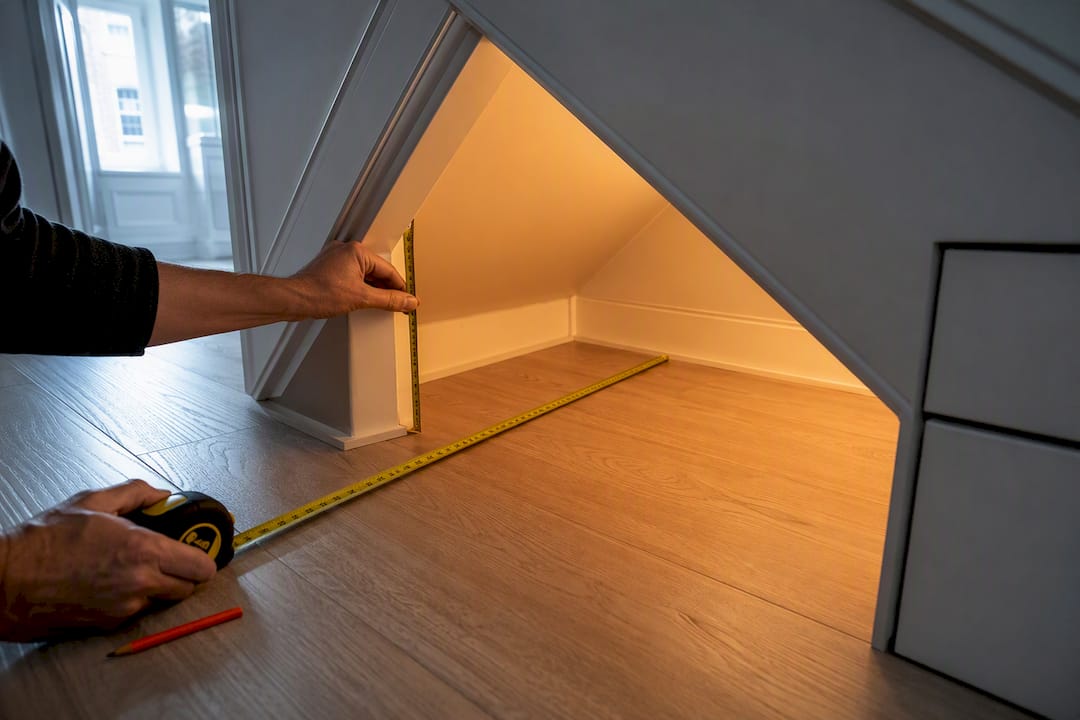
For most homes, pull-out drawers built into a bespoke fitted cupboard give the best balance of access and space use, especially where the void narrows sharply at one end. If your budget is tight or you’re renting, modular units or a freestanding rack do the job without touching the structure. Awkward, irregular voids justify bespoke fitted cabinetry, which turns wasted triangular space into properly usable storage.
TL;DR:
- Modular storage solutions suit regular, shallow voids and are ideal for renters or quick setups, but they often do not utilize the deepest or most awkward space efficiently.
- Bespoke fitted cabinetry is more suitable for irregular, angled, or winder stair cases, offering a precise fit that minimizes wasted space and lasts longer.
- Accurate measurement of width, depth, height, and structural features is crucial before choosing a solution; irregular shapes require professional assessment to avoid project stalls.
- Costs range from £250 to £750 for ready-made units and £500 to £2,500 for custom cabinetry, with installation duration from one day to several weeks depending on complexity.
- Using the existing stair structure, like riser drawers or deep curved cupboards, can maximize space and reduce costs, provided structural fixings are confirmed.
Table of Contents
- What are the main under stairs shoe storage options?
- Should you go DIY or bespoke fitted?
- How do you measure and plan an under stairs void?
- What does under stairs shoe storage cost and how long does it take?
- What materials and hardware keep shoe storage tidy long-term?
- When is bespoke under stairs storage worth the investment?
- How can you repurpose the existing stair structure itself?
- How do ready-made shoe storage products compare?
- How do you store boots, heels, and trainers differently?
- What the research actually tells us about getting this right
- How Finest Furniture Studio can help with your under stairs storage
- Sources
- FAQ
What are the main under stairs shoe storage options?
Four approaches cover almost every household, and the right one depends on your space, budget, and how long you plan to stay put.
- Modular or ready-made units: flat-pack shelving or stackable boxes that slot into the void with minimal fuss, ideal for renters or anyone testing an idea before committing.
- DIY pull-out drawers: built from plywood or MDF on runners, these suit competent DIYers with a weekend to spare and a fairly regular-shaped void.
- Bespoke fitted cabinetry: custom-built cupboards, drawers and shelving designed around your exact stair angle, best justified when the space is irregular or you want a seamless hallway finish.
- Freestanding racks or benches: simple shoe benches or racks placed in front of the stairs, offering flexibility with zero installation and easy relocation if you move.
Modular kits and freestanding racks rarely make full use of the deepest, most awkward part of the void, according to IKEA’s own under-stairs storage guidance, which is precisely where bespoke joinery earns its keep.
Should you go DIY or bespoke fitted?
The honest answer depends less on preference and more on the shape of your stairs. A regular, boxy void with a decent front height suits DIY drawers well. An irregular, sharply raked void with a low front and deep back almost always performs better with bespoke fitted work, simply because standard drawer runners and flat-pack frames struggle with acute angles.
Fit and space use: bespoke cabinetry is built to the millimetre, so nothing is wasted at the back of the void. DIY and modular kits leave gaps because they’re built to standard box shapes, not your actual stair line.
Cost versus long-term value: modular and DIY routes cost less upfront but can look mismatched and may need replacing within a few years. Bespoke costs more initially but is built to last and typically comes backed by a workmanship guarantee.
Installation time and disruption: modular installs finish in a day, DIY drawer builds usually take a weekend, and bespoke cabinetry takes longer to design and fit but disrupts your hallway for a fixed, known window.
Durability and finish: fitted joinery matches your skirting, paint and flooring, while flat-pack units rarely blend into a period hallway.
Pro Tip: If your stairs have any curve or winder step near the bottom, measure that section separately. A single straight-line measurement will underestimate how much the void tapers, and it’s the most common reason DIY drawer projects stall halfway through.
Hire a professional when the void has structural features (a boiler flue, meter box, or sloping floor) that a standard kit can’t account for.
How do you measure and plan an under stairs void?
Get this stage right and everything downstream, from drawer depth to door swing, falls into place.
- Measure width at floor level and at the highest point of the stair line, since many voids narrow noticeably as you move away from the front.
- Measure depth at both the front and back of the void, taken at several points along its length, because stair pitch changes depth more than people expect.
- Measure height at the front (usually the lowest point) and at 300mm intervals moving back, to establish where a drawer or shelf can actually sit upright.
- Take a diagonal measurement across the opening to catch any twist in the stair structure that straight measurements miss.
- Check for pipes, cables, vents, or a boiler flue running through the space, as these dictate where drawers or doors can be positioned.
- Sketch the void from the front and side, noting every measurement, then photograph it from three angles for anyone quoting on the job.
- Confirm access clearance: pull-out drawers need floor space in front to fully extend, while hinged doors need a clear swing arc that doesn’t block the hallway.
What does under stairs shoe storage cost and how long does it take?
Ready-made units typically cost between £250 and £750 in the UK, while custom-built cabinetry usually runs from around £500 to £2,500 or more depending on complexity, according to MyBuilder’s cost guide.
In numbers: ready-made under-stairs storage costs £250 to £750, while bespoke fitted units range from £500 to £2,500+, and installation runs from a single day for modular kits to 3 to 14 days for bespoke joinery.
Soft-close drawer runners, integrated lighting, and veneered or painted finishes matching your existing skirting all push bespoke pricing towards the upper end of that range. When comparing quotes, ask each supplier for the same three things: the exact drawer or door count, the runner type specified, and whether removal of your old unit is included, so you’re comparing like for like rather than a bare box against a fully fitted design.
What materials and hardware keep shoe storage tidy long-term?
Material choice affects how well storage survives daily boots, wet trainers, and heeled shoes over years, not months.
- MDF takes paint beautifully and suits a smooth, hallway-matching finish, but it’s less forgiving of repeated moisture from wet shoes.
- Plywood handles damp better than MDF and is a sensible core material for drawer boxes that will see mud and rain.
- Solid timber looks the part in a period property but costs more and needs sealing to resist scuffing.
- Full-extension soft-close runners are worth specifying on any drawer, since standard runners rarely give full access to the back of a tapering void.
- Removable trays or dividers stop trainers, heels, and boots sliding together and make cleaning the unit far simpler.
- A small ventilation gap or vent at the back of enclosed cupboards helps stop damp shoes turning musty, particularly in cupboards built against an exterior wall.
Combining drawers with a cupboard and an open niche, rather than one uniform block, tends to make the most of an irregular void, a layout specialist joiners commonly recommend for exactly this reason.
When is bespoke under stairs storage worth the investment?
Bespoke fitted work earns its higher price when the void itself is the obstacle, not the budget. An irregular shape, a winder staircase, or a desire to combine shoe storage with seating and coat hooks in one continuous run is where flat-pack solutions genuinely fall short.
“Well-designed fitted storage under the stairs can combine drawers, hanging space, and seating to solve several hallway problems at once,” notes joinery specialist Hale & Murray, reflecting the multi-purpose approach that makes bespoke cabinetry worth considering for busy hallways.
Some bespoke furniture providers design each under-stairs project around your exact void, with installation often completed within a week and backed by a workmanship guarantee. For irregular voids, integrated bench seating, or storage that needs to hold shoes, coats, and household items in one design, bespoke fitted joinery consistently outperforms a standard kit, because it’s built once around your measurements rather than adapted after the fact.
How can you repurpose the existing stair structure itself?
Before ordering any unit, look at what the staircase already gives you to work with. The riser boards under each step, the skirting line, and the newel post base often hold clues to how the space can be adapted rather than boxed over from scratch.
If your stairs have a closed-string design (solid boards along the side, no open treads), the triangular void behind them is usually sound enough to cut into directly, turning individual step risers into small pull-out drawers rather than building a separate cupboard in front. This works particularly well for shoes, since each riser drawer sits at a slightly different depth and height, naturally separating trainers from boots by size.

Where the staircase has a winder or curved section near the bottom, that curved void is often the deepest part of the whole space, better suited to a single deep cupboard with an angled door than to multiple small drawers. Existing understairs cupboard doors, if your home already has one, can usually be retained and refitted with a new interior carcass rather than replaced outright, which cuts both cost and disruption.
Check whether the stair stringer (the structural side board) can bear light fixings before attaching anything directly to it. Older Victorian and Edwardian stairs often have solid stringers that take fixings well, while newer staircases may rely on a lighter frame that needs additional bracing before you hang a door or drawer unit from it.
How do ready-made shoe storage products compare?
If a bespoke build isn’t the right fit for your timeline or budget, ready-made options fall into a few clear categories worth understanding before you buy.
Flat-pack modular shelving units, the kind sold by general furniture and DIY retailers, are the cheapest and fastest route. They typically arrive as adjustable shelves or cubes that you configure to roughly match your void, though they rarely reach into the deepest, lowest section of the space. IKEA’s own guidance on awkward under-stairs spaces is explicit about this limitation, recommending modular pieces mainly as a starting point rather than a complete solution.
Stackable shoe boxes and incline racks, often sold as freestanding accessories, work well as a low-cost layer inside a larger unit or cupboard rather than as the whole storage solution on their own. They’re light, easy to move, and forgiving of an imperfect fit, which makes them a sensible stopgap while you plan something more permanent.
Purpose-built understairs storage kits marketed as a complete solution are less common than general shelving, and reviews consistently flag the same issue: no two staircases are identical, so a kit designed for an average void often leaves gaps or doesn’t reach the back corner. For anyone comparing options, the practical test is simple. Measure your void first, then check whether a ready-made product’s dimensions genuinely match it, rather than assuming any “under stairs” label means a guaranteed fit.
How do you store boots, heels, and trainers differently?
Different shoe types need different storage depths and heights, and treating them all the same is the most common reason under-stairs storage feels cramped within a year.
Trainers and flat shoes are the easiest to store efficiently. A shelf height of around 150 to 180mm per pair, arranged toe-in, fits comfortably in the shallower front section of most voids and works well in a pull-out drawer with a simple divider.
Boots need vertical space, not just depth. Tall boots stored upright can need 350 to 450mm of height, which usually means allocating the tallest part of the void, typically near the back where the stairs rise highest, specifically to boot storage rather than splitting that space evenly across shelves. A dedicated boot rack or wide-set vertical dividers stop knee-high boots from slumping sideways and losing their shape.
Heels and narrow-heeled shoes benefit most from angled or slatted shelving rather than flat shelves, since a slight incline stops them tipping over and wastes less width than storing them flat side by side. Grouping heels together on one shelf, separate from flats and trainers, also makes it far easier to find a matching pair quickly on a busy morning.
The general rule: allocate your tallest, deepest void space to boots, your shallowest front section to flat shoes and trainers, and reserve one narrow shelf specifically for heels rather than mixing shoe types across the same level.

What the research actually tells us about getting this right
Most advice on under-stairs shoe storage jumps straight to product recommendations without addressing the one variable that determines whether any solution works: the actual shape of your void. That’s backwards. No universal kit exists because no two staircases share the same angle, depth and height profile, which is exactly why DIY drawer guides consistently warn against generic kits and instead recommend measuring first.
The conventional wisdom oversells modular storage as a universal fix. It’s genuinely good for renters and shallow, regular voids. It performs poorly the moment your stairs have any winder, curve or steep rake, which describes a large share of period homes across London’s older suburbs.
What the reader should prioritise first is measurement, not styling. Get accurate width, depth and height readings before browsing a single product or quote. Once you know your void’s real shape, the choice between modular, DIY and bespoke becomes obvious rather than a guessing game. Budget and tenancy status should decide the route; the void’s geometry should decide whether that route will actually work.
— Aureliu
How Finest Furniture Studio can help with your under stairs storage
There are genuine DIY and modular routes to sorting your hallway, and for a straightforward, regular-shaped void, they’re worth trying first. Where your space is irregular, oddly angled, or you simply want it done properly in one visit rather than a weekend of trial and error, Finest Furniture Studio offers a different route: a free design visit, a bespoke build measured to your exact void, and installation typically completed within seven days, backed by a 10-year guarantee on workmanship.

At your first visit, our designer measures the space, discusses drawer versus cupboard layouts, and talks through finishes that match your existing hallway. The old wardrobe or unit is typically removed and disposed of as part of the job, so there’s nothing left for you to deal with afterwards. This same measured, bespoke approach applies across our understairs storage solutions, as well as awkward spaces elsewhere in the home, and our fitted wardrobes for bedrooms and hallways alike.
If your under-stairs void is irregular, or you’d rather have a professional confirm the measurements before you commit to a design, contact us for a free design visit. Call or WhatsApp 07468 150807, or visit us at 124 City Road, Kemp House, London, EC1V 2NX, to get your project scheduled.
Sources
- How much does under stairs storage cost in 2026? – MyBuilder
- Under Stairs fitted storage that works hard – Hale & Murray
- Awkward no more: that space under the stairs – IKEA
FAQ
What is the best shoe organizer for under stairs?
Pull-out drawers with full-extension runners are generally the most practical option, since they bring shoes forward for easy access rather than forcing you to reach into a dark void. For irregular voids, a bespoke fitted design built around the exact space usually outperforms a standard shelving unit.
Can I DIY under stairs shoe storage?
Yes, if your void is a fairly regular shape and you have a weekend to spare, DIY pull-out drawers are a realistic project using plywood or MDF and correctly specified runners. Sharply angled or winder staircases are harder to DIY successfully and usually suit a bespoke or professionally measured approach instead.
What is the best storage option for under the stairs?
There’s no single best option. It depends on your void’s shape, your budget, and whether you’re renting: modular units suit tight budgets and rented homes, while bespoke fitted cabinetry suits irregular voids and gives a longer-lasting, tailored finish, typically installed within seven days with a 10-year guarantee.
Can a shoe rack be kept under stairs?
Yes, a freestanding shoe rack works well as a low-cost, no-installation option, particularly for shallow or awkward front sections of the void that aren’t worth building into. It won’t make full use of the deepest part of the space, which is where a fitted cupboard or drawer system adds more value over time.
How much does under stairs shoe storage cost in the UK?
Ready-made units typically cost between £250 and £750, while bespoke fitted cabinetry usually ranges from £500 to £2,500 or more depending on complexity and finish. Installation runs from a single day for modular kits to several days for bespoke joinery.

