
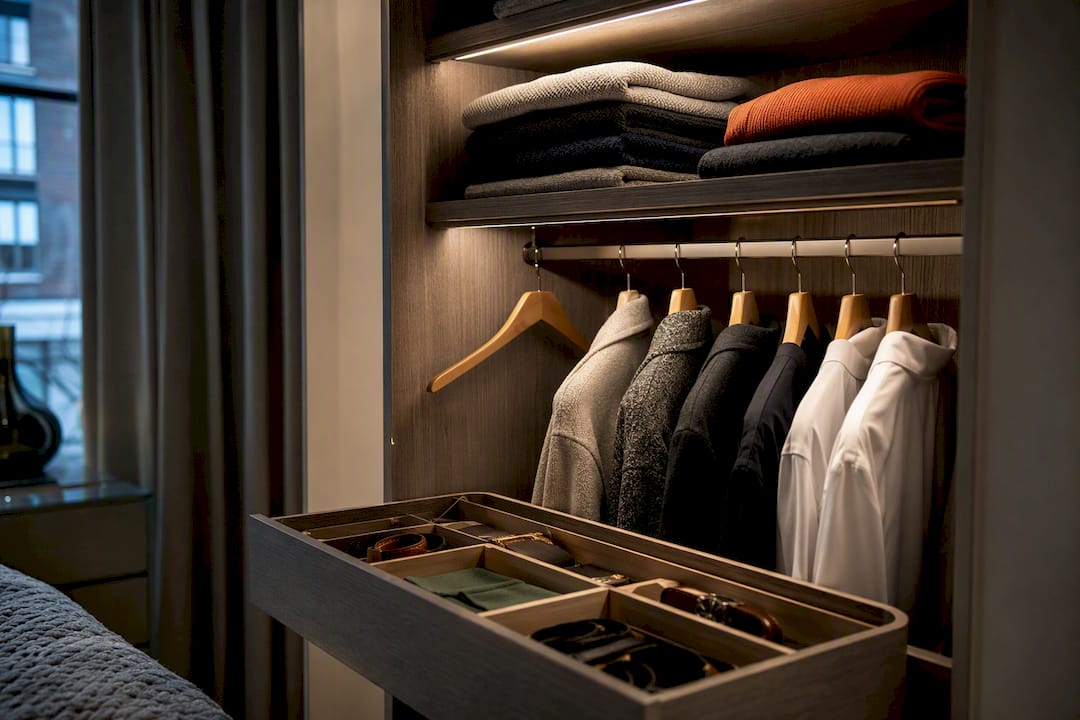
The most space-efficient wardrobe interior layouts for most households use double-hang as the primary section making up nearly half of the interior width, with one long-hang bay for coats and dresses, adjustable shelving, and a small drawer stack for folded items. That balance suits the way most people actually dress, but the exact split still depends on how many long garments you own and how wide the wardrobe carcass is. Every measurement and safety point below helps you adjust it.
TL;DR:
- Double-hang should occupy 45-55% of the wardrobe’s interior width to maximize daily clothing capacity in limited spaces.
- Standard rail heights are 90-100 cm for double-hang and 150-170 cm for long-hang garments, with shelves matching garment widths at 350-400 mm deep.
- For wardrobes over 1.2 meters tall, fixing into wall studs with at least two anchor points is essential for stability and safety.
- A typical 2.4-meter wardrobe uses about 1.2 meters for double-hang, 0.4 meters for long-hang, and similar ratios for shelving, with the rest for shoes and drawers.
- Fitting accessories like trouser racks and LED lighting on opposite sides reduces reach and enhances usability.
Table of Contents
- Which wardrobe interior layout suits your bedroom?
- How much space should each wardrobe zone get?
- What measurements and clearances should you plan around?
- Which fittings make the biggest difference to daily use?
- How do you keep a fitted wardrobe interior layout safe?
- What clients get wrong before calling a joiner
- Ready to plan your own fitted wardrobe interior?
- Sources
- FAQ
Which wardrobe interior layout suits your bedroom?
Before picking a pattern, count your clothes. Designers who plan fitted interiors for a living almost always start with a clothing audit rather than a generic template, because a household with three suits and two evening dresses needs a very different rail split from one with mostly tshirts and jeans. Once you know your inventory, one of these seven patterns will fit.
- Balanced everyday layout. Double-hang across 50% of the width, one long-hang bay, a shelf tower, and a shoe rack at the base. Works for most primary bedrooms.
- Long-hang emphasised. Two long-hang bays side by side for coats, dresses and suits, with double-hang reduced to one section. Suits households with formal wardrobes.
- Drawer-heavy layout. Internal drawers replace one double-hang bay, useful where fold-friendly fabrics (knitwear, activewear) dominate.
- Shoe-centred layout. A dedicated shoe tower with adjustable shelves at varied heights, paired with a single hanging bay. Good for shared or family wardrobes.
- Compact double-hang. Two double-hang bays only, no long-hang, for narrow wardrobes under 1.2 metres wide, common in guest rooms.
- Rental-friendly layout. A simple hanging rail plus two open shelves, designed to be low-cost and reversible for tenants.
- Shared wardrobe split. The carcass is divided vertically, each half getting its own double-hang, shelf and drawer allocation, useful for couples or siblings.
A fitted wardrobe interior layout gallery can show you how these patterns look once built, but the pattern only earns its place once it matches what actually hangs in your current wardrobe.
How much space should each wardrobe zone get?
Every well-planned wardrobe interior layout works around three horizontal bands rather than one continuous space. The active zone, roughly 70 to 160 cm from the floor, holds everyday hanging and folded items you reach without stretching or bending, and it’s the band that gets used dozens of times a week. Below it sits the passive zone, given over to low drawers or floor level shoe storage. Above the active zone, a mezzanine shelf handles seasonal or rarely worn items.
Interior ratios recommended for built-in wardrobes generally run as follows:
- Double-hang: 45–55% of interior width, the single most space-efficient way to increase daily clothing capacity in a limited footprint.
- Long-hang: 15–20%, enough for coats, dresses and suits without wasting height on shirts.
- Shelving: 15–20%, ideally adjustable so it can flex as your wardrobe changes.
- Shoe storage: 10–15%, more if the household owns several pairs of boots.
- Drawers: an optional 10–15%, useful in primary bedrooms, less essential in guest rooms.
Take a typical 2.4 metre (8 ft) wardrobe run. That gives you roughly 1.2 metres of double-hang, 0.4 metres of long-hang, 0.4 metres of shelving, and the remainder split between shoes and drawers. The most common mistake is allocating too much width to long-hang out of habit, leaving double-hang cramped. The second is fitting shelves so deep they become “black holes” where jumpers vanish at the back, a problem solved simply by keeping shelf depth close to garment width rather than to the full 600 mm carcass depth.
What measurements and clearances should you plan around?

Standard wardrobe depth sits at 600 mm, which suits full-size hangers without garments brushing the back panel or door. Shallower runs of 450–500 mm work in tight bedrooms, but hangers sit at an angle and coats can crease against the door, so treat shallow depth as a compromise rather than a default.
Rail and shelf heights follow a fairly consistent set of rules across carpentry planning guides:
- Short hang rail: 100–110 cm of clearance, enough for folded trousers on hangers or shirts.
- Double-hang rails: two rails at roughly 90–100 cm clearance each, stacked to double your hanging capacity in the same width.
- Long-hang rail: 150–170 cm of clearance for coats, dresses and full-length garments.
- Knitwear shelves: 350–400 mm depth, matching the ergonomic guidance for avoiding black hole shelving.
- Folded stack shelves: 250–300 mm height between shelves, tight enough to stop stacks toppling.
- Shallow drawers: 12–15 cm high, ideal for underwear, socks and accessories.
- Deeper drawers: 25–30 cm high, for jumpers or bulkier folded items.
A planning checklist for fitted wardrobes is worth working through before you order hardware, since getting rail height wrong by even five centimetres changes how many garments actually fit without dragging on the floor.
Which fittings make the biggest difference to daily use?
A pull-out trouser rack earns its keep in households with more than five or six pairs of tailored trousers, since it keeps creases sharp and lets you see every pair at a glance; a fixed trouser hanger bar works fine for smaller collections and costs less to fit. Beyond the rail choice, a handful of accessories do most of the heavy lifting for usability:
- Shoe shelving by type: allow up to 50 cm height for boots, 25–30 cm for ankle boots, and 15–20 cm for trainers and flats.
- Shallow drawers with dividers for jewellery, belts and watches, kept at the 12–15 cm height band rather than mixed into deep drawers.
- A dedicated valet tray near the active zone for tomorrow’s outfit, reducing morning searching.
- LED strip lighting, ideally on a door-mounted sensor, since dark upper shelves are where forgotten garments accumulate.
Pro Tip: Fit the trouser rack and shoe tower on opposite sides of the wardrobe rather than stacking them. It halves the reach distance for the two things people search for most in the morning.
How do you keep a fitted wardrobe interior layout safe?

Stability matters as much as storage. BS EN 14749:2016+A1:2022 sets the safety requirements and test methods for domestic storage units, and taller or top-heavy wardrobes must either pass dynamic stability testing or come with documented anchoring hardware. Industry testing bodies note that strength and stability checks go hand in hand with clear fixing guidance from the manufacturer, not an afterthought bolted on at installation.
Practical anchoring rules to follow:
- Locate wall studs before fixing; metal L-brackets on studs consistently outperform plastic wall plugs on plasterboard alone.
- Fit at least two anchor points spaced across the width of any unit taller than 1.2 metres, not one central point.
- Keep heavy items low, in the passive zone, to lower the centre of gravity, and never place a television on top of a wardrobe carcass.
- Choose soft-close drawer runners to stop repeated slamming loosening fixings over time.
For floor-to-ceiling runs or anything structurally tied into stud walls, bring in a professional installer rather than anchoring it yourself.
What clients get wrong before calling a joiner
Most briefs we hear start the same way: “we need more space but the room hasn’t changed.” What’s changed is the household, not the walls, and off-the-shelf wardrobes were never built to flex around real clothing collections. Bespoke interiors solve that by matching rail and shelf placement to the garments a household actually owns, not to a generic template.
Finest Furniture Studio typically installs within seven days once a design is signed off, backed by a 10 year guarantee on the finished unit. Clients notice the difference within a week, once mornings stop starting with a search through three shelves for one jumper.
— Aureliu
Ready to plan your own fitted wardrobe interior?
If you’ve been sketching layouts on the back of an envelope, the next sensible step is a free design visit rather than another hour of guesswork. Finest Furniture Studio measures your actual wardrobe space, talks through your clothing inventory, and returns a quotation fast, with installation typically completed in seven to twelve working days and every project backed by a 10 year guarantee. We will also take away and dispose of the old wardrobe, so there’s no separate clearance job to arrange.

Whether you need an alcove wardrobe built around a chimney breast, a sloped ceiling solution for a loft conversion, a full walk-in wardrobe, or under-stairs storage that finally uses dead space, the process starts the same way: a proper measure-up, not a template. Homes across Richmond, Wimbledon, Putney, Kingston, Chiswick, Fulham, Chelsea, Ealing, Twickenham, Barnes and Hammersmith have had interiors planned this way, from double-hang ratios to trouser rack placement, before a single panel is cut. For a detailed look at what’s possible on a typical West London bedroom, the custom made wardrobes guide covers process, pricing shape and finish options.
Contact us for a free design visit, message or call 📞07468 150807 or WhatsApp, or visit us at 124 City Road, Kemp House, London, EC1V 2NX to book your consultation.
Sources
The dimensions and safety guidance above draw on BS EN 14749:2016+A1:2022 for storage unit safety, a SATRA industry overview on strength and stability testing, and the interior ratio guidance used in the built-in wardrobe layout guide referenced throughout the zoning section. Together they underpin the measurements, percentages and anchoring advice given here.
- BS EN 14749:2016+A1:2022 — furniture domestic and kitchen storage units: safety requirements and test methods
- How storage furniture is tested for strength, durability and stability — SATRA industry insight
- Built-in wardrobe interiors: designing for maximum capacity — Cabinet World guide
- Wardrobe interior layout guide — Miolook
FAQ
What is the best wardrobe interior layout for a small bedroom?
A compact double-hang layout, two hanging bays with no long-hang section, usually fits best under 1.2 metres of width and avoids wasted height.
What rail height should I use for a double-hang wardrobe?
Fit two rails at roughly 90–100 cm of clearance each, stacked to double hanging capacity within the same width.
How deep should wardrobe shelves be for jumpers?
Keep knitwear shelves at 350–400 mm depth; anything deeper creates “black hole” shelving where folded items get lost at the back.
Is a pull-out trouser rack worth fitting?
Yes, if you own more than five or six pairs of tailored trousers; smaller collections are fine on a fixed trouser hanger bar.
Do fitted wardrobes need to be anchored to the wall?
Taller or unstable units should be fixed with anchoring hardware into wall studs under BS EN 14749:2016+A1:2022, using at least two anchor points across the width.
How long does a bespoke wardrobe installation take?
Finest Furniture Studio typically completes installation within seven to twelve working days from design sign off, backed by a 10 year guarantee.

