
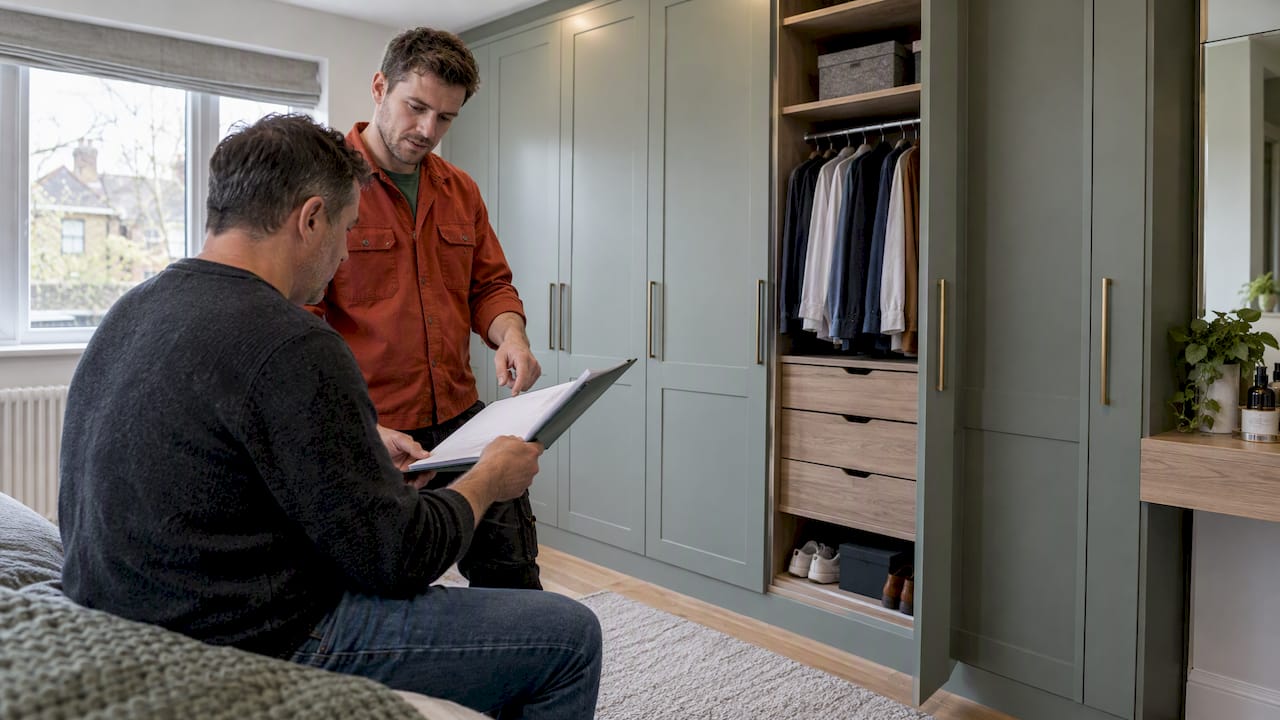
A commercial wardrobe warranty gives extra cover but does not replace your statutory rights. Under the Consumer Rights Act 2015, you keep legal remedies regardless of what a guarantee promises. In practice, rely on your statutory rights within the first six months, then insist on a written, UK-based guarantor for anything longer, such as the 10-year guarantee Finest Furniture Studio offers on its fitted wardrobes.
TL;DR:
- A written guarantee for fitted wardrobes should explicitly name the UK-based guarantor, detail coverage of workmanship separately from materials, and specify the guarantee’s duration and scope.
- Statutory rights under the Consumer Rights Act 2015 remain valid for up to six years in England and Wales, and claim burden favors consumers within the first six months.
- Guarantees shorter than five years often offer minimal additional protection, while long guarantees are only valuable if backed by a solvent, insurance-backed business and clear written terms.
- Installation is the primary risk for fitted wardrobes, making installer-backed workmanship guarantees essential, with documentation of the fitter’s identity and signed checklists strongly recommended.
- Consumers should verify guarantee details before purchase, ensuring it is in writing, covers workmanship, and is backed by a reliable trader, to avoid invalid or meaningless promises.
Table of Contents
- What a wardrobe warranty or guarantee usually covers
- How statutory consumer rights interact with warranties in the UK
- Typical warranty lengths and what they actually mean
- Workmanship and installation: why fitted wardrobes need installer-backed guarantees
- How to check a warranty before you buy: a 10-point checklist
- Making a claim: step-by-step for UK homeowners
- Common exclusions, red flags and questions to ask the seller
- Publisher perspective: how Finest Furniture Studio structures guarantees
- Returns, cancellations and your warranty under the Consumer Contracts Regulations
- Manufacturer warranties versus retailer warranties for wardrobes
- Warranties, second-hand wardrobes and online marketplace purchases
- What the market gets wrong about long guarantees
- How Finest Furniture Studio can help with your fitted wardrobe
- Where to check official guidance before you act
- Sources
- FAQ
What a wardrobe warranty or guarantee usually covers
A warranty and a guarantee are often used interchangeably, but worth separating in practice. A manufacturer guarantee comes from whoever made the carcass and doors. A trader warranty comes from the business that sold or fitted the wardrobe. A workmanship guarantee, which matters most for fitted furniture, covers the quality of the installation itself rather than the materials.
Most written guarantees for wardrobes bundle together several elements, and knowing what should be listed helps you spot a thin one straight away.
- Carcass and board: coverage against warping, delamination or structural failure in the main frame.
- Door fittings and runners: hinges, sliding tracks and soft-close mechanisms, which take the most daily wear.
- Workmanship: how the wardrobe was fitted, including alignment, fixing to walls and finishing.
- Electricals: where LED lighting or power points are supplied as part of the unit.
- Exclusions: usually fair wear and tear, accidental damage and anything caused by the homeowner’s own alterations.
Flat-pack wardrobes bought off the shelf tend to carry a straightforward parts warranty from the manufacturer, since there is no installer involved beyond the buyer. Bespoke and fitted wardrobes shift the balance. The materials are often similar quality to what you would find in a good flat-pack range, but the risk moves to how the piece is built into your home: whether the carcass is square, whether doors hang level, whether the unit is properly fixed. That is why a credible guarantee for fitted furniture should name workmanship explicitly, not just materials. Which? notes that professional installation is the most common point of failure for fitted wardrobes, which is worth bearing in mind when you compare two quotes with similar board quality but different guarantee wording.
How statutory consumer rights interact with warranties in the UK
Your statutory rights exist whether or not you accept, register or even read a commercial warranty. Under the Consumer Rights Act 2015, goods must be of satisfactory quality, fit for purpose and as described, and any written guarantee must set out the guarantor’s name and address, the duration and the territorial scope in plain English.
You generally have six years to bring a claim in England and Wales, and five years in Scotland, under the Consumer Rights Act, though in practice remedies narrow the longer you wait.
Within the first six months, the burden of proof sits with the trader, not you. If a wardrobe door starts sagging in month three, the seller has to show the fault was not there at delivery rather than you having to prove it was. Which?’s explainer on the Consumer Rights Act confirms this reversal, which is exactly why relying on statutory rights early on is often simpler and faster than chasing a warranty claim through a manufacturer.
After six months, the burden shifts back to you, and this is where a well-written warranty becomes genuinely useful rather than a nice extra. Gov is explicit that a warranty sits on top of your legal rights: it cannot remove them, and you keep the right to a repair or replacement regardless of what the guarantee document says. Crucially, your contract is with the trader who sold and fitted the wardrobe, so you can usually claim against them directly even when a separate manufacturer’s guarantee exists on the materials. You are not obliged to chase an overseas board manufacturer when the fault is really about how the local fitter installed the product; the trader who took your money and signed the contract remains the first port of call.
Typical warranty lengths and what they actually mean
Warranty lengths in the UK fitted furniture market cluster around a few common points, and the number alone tells you less than the wording behind it.
- Two years: often the statutory minimum dressed up as a guarantee, with little beyond what the law already gives you.
- Five years: a reasonable mid-tier offer, usually covering carcass and major fittings but sometimes excluding soft-close mechanisms or electricals.
- Ten years or more: increasingly common marketing language in the bespoke sector, and genuinely valuable when it names workmanship, states a UK guarantor and has clear written terms.
Which? notes that some fitted wardrobe guarantees run 10 to 12 years, but the value of any long guarantee depends entirely on whether the guarantor is still trading and whether the promise is backed by insurance or a solvent business, not just the number printed on the quote. A ten-year guarantee on carcass and board means little if it quietly excludes workmanship, which is where fitted wardrobes most often go wrong.
Before accepting a long warranty at face value, test it on three points: who the named guarantor actually is, whether the terms are written down rather than verbal, and whether the promise is insurance-backed so a claim can still be honoured if the original business stops trading. A verbal “ten-year guarantee, don’t worry” from a fitter with no paperwork is not a guarantee at all; it is a sales line.
Workmanship and installation: why fitted wardrobes need installer-backed guarantees
For bespoke and fitted wardrobes, the biggest practical risk sits with installation rather than materials. Which?’s buying guide points to professional installation as the most common point of failure, ahead of board quality or hardware defects. Doors that bind, carcasses fixed slightly out of square, and gaps where the unit meets an uneven wall are all installation issues, not material ones, and a parts-only warranty will not touch any of them.
A strong workmanship guarantee states four things clearly: how long it runs, exactly what it covers (alignment, fixing, finishing), who carries out any remedial work, and whether the promise is insurance-backed. Vague language such as “fully guaranteed” with nothing else written down gives you almost nothing to act on if a door starts dropping eighteen months later.

Before signing anything, insist that the fitter’s name and contact details appear on the written guarantee itself, not just on an invoice. This matters because a guarantee issued by a sales office with no link to whoever actually installed the wardrobe can leave you stuck if the fitting team was subcontracted and has since moved on. Asking the fitter to record the room’s condition and sign off a final checklist, as recommended in Which?’s advice on planning fitted wardrobes, also gives you a clean reference point if a dispute arises later over what was pre-existing and what developed afterwards.
Pro Tip: Ask for the fitter’s name and mobile number in writing before the job starts, not after; a guarantee with no accountable person behind it is hard to enforce.
How to check a warranty before you buy: a 10-point checklist
Run through this list at quote stage, before you put down a deposit, rather than after the wardrobe is installed.
- Is it written down? A verbal promise of “ten years” carries no weight; ask for the full terms on paper.
- Does it name the guarantor? The Consumer Rights Act 2015 requires the guarantor’s name and address to appear.
- What is the duration? Check whether it is one figure for the whole wardrobe or different periods for parts versus workmanship.
- What is the territorial scope? Confirm the guarantee applies in the UK and covers your address.
- Does it cover workmanship separately from materials? Fitted wardrobes need both named explicitly.
- What are the exclusions? Ask to see them in writing rather than taking “the usual stuff” as an answer.
- Is there a registration step? Some guarantees require you to register online or by post within a set window.
- What is the claim process? You should be told exactly who to contact and what evidence to provide.
- What proof of purchase do you need? Keep the invoice, quote and any survey report together from day one.
- Is it insurance-backed? This protects you if the original trader stops trading before the guarantee period ends.
Verifying these takes little time. A quick search of Companies House confirms whether the guarantor is a registered, active business, and a reputable fitter will happily provide a sample guarantee document before you commit. Strong wording names a person and a process: “Finest Furniture Studio guarantees workmanship for 10 years from installation; contact [number] to report a fault.” Weak wording hides behind generalities: “fully guaranteed for your peace of mind,” with no named guarantor, no duration and no claims route at all.
Making a claim: step-by-step for UK homeowners
If something goes wrong with a fitted wardrobe, a methodical approach protects your position whether you end up relying on the warranty or your statutory rights.
- Document the fault first: photograph the problem clearly, note the date it appeared, and keep any packaging or offcuts if relevant.
- Gather your paperwork: proof of purchase, the written guarantee, and any installation checklist or survey report.
- Contact the trader first: your contract is with whoever sold and fitted the wardrobe, so start there rather than a manufacturer named on the board.
- Escalate to the manufacturer only if named: some guarantees point you toward the original board or hardware maker for specific parts.
- Use Citizens Advice if you stall: Citizens Advice’s guidance on claiming under a warranty or guarantee sets out how to check whether cover is manufacturer or trader backed, and notes that warranties are particularly useful once you are past the first six months.
- Report to Trading Standards if the trader is unresponsive: they handle patterns of poor practice rather than individual refunds, but a report can help.
- Small claims court is the last resort: for disputes under the relevant limit, this remains available if every other route fails.
Expect a trader to ask for evidence before agreeing a repair, and be aware that a claim can be challenged if the fault looks like misuse or unauthorised DIY alteration rather than a manufacturing or installation defect. Keeping dated photographs and a simple written record of every call or email makes any later dispute far easier to resolve.
Common exclusions, red flags and questions to ask the seller
Most wardrobe guarantees exclude the same handful of things: fair wear and tear, accidental damage, water damage, consumables such as light bulbs, and anything caused by the homeowner altering the unit after fitting. None of that is unreasonable, but it should be written down rather than left to interpretation after something breaks.
Watch for these signs before you sign anything:
- No named guarantor: if the paperwork does not state who stands behind the promise, the guarantee is effectively unenforceable.
- Overseas manufacturer with no UK contact: makes any parts claim slow and difficult to pursue practically.
- Vague claims process: “just give us a call” is not a process; ask what happens next, in writing.
- Reluctance to sign a guarantee document: a trader who hesitates to put terms on paper is telling you something.
- Deposit protection gaps: ask how your deposit is protected if the company stops trading before installation.
Useful questions to put directly to any seller include: who is the named guarantor, is the guarantee insurance-backed, does it cover workmanship separately from materials, and what evidence will you need if you make a claim in year seven rather than year one. Put the answers in the contract itself, not just in a conversation.
Publisher perspective: how Finest Furniture Studio structures guarantees
Some bespoke and fitted wardrobe providers back their products with a 10-year guarantee and aim for installation within seven days. This can be faster than much of the bespoke sector. Workmanship sits at the centre of how the guarantee is written, in direct response to the installation risk that Which? identifies as the most common failure point for fitted wardrobes. Some providers include removal and disposal of old wardrobes as part of the service, so customers are not left managing that separately.
A guarantee is only as strong as the paperwork behind it: a named guarantor, a clear duration, and a workmanship clause that survives beyond the sales conversation.
Our advice to anyone comparing quotes mirrors what we build into our own process: request the written guarantee before you commit, get a signed survey or installation checklist, and register the warranty promptly if the terms ask you to. A ten-year promise means little without those three steps behind it. You can see how our own fitted wardrobe guarantee is structured on our fitted wardrobes page, or read our fuller breakdown in the bespoke wardrobe warranty guide.
— Aureliu
Returns, cancellations and your warranty under the Consumer Contracts Regulations
A warranty only becomes relevant once a wardrobe is delivered and accepted; cancellation rights under the Consumer Contracts Regulations sit earlier in the process and work differently. If you buy at a distance, such as ordering online or agreeing a bespoke design during a home visit without signing on the spot, you typically have a 14-day cooling-off period to cancel, separate from anything the warranty promises.
Bespoke and made-to-measure wardrobes complicate this picture. Once production starts on a piece built to your exact measurements, the standard cancellation right can be affected, because the goods are personalised and cannot be resold as standard stock. A reputable trader will explain this clearly before you sign, including when the cooling-off period ends and when production commitments begin. This is separate from your warranty, which only starts protecting you once the wardrobe is fitted and accepted. If you cancel within the regulations’ window, you are entitled to a refund rather than a warranty claim, since there is no faulty product yet to claim against. Always check the contract’s wording on bespoke orders before the fitter begins cutting board to your measurements, since that moment often marks where cancellation rights narrow.
Manufacturer warranties versus retailer warranties for wardrobes
A manufacturer warranty comes from whoever produced the board, hinges or soft-close mechanisms, and it usually covers defects in those specific components regardless of who installed them. A retailer or trader warranty comes from the business you actually contracted with, the one that measured your room, designed the layout and sent a fitter.
For flat-pack wardrobes bought largely as a product, the manufacturer warranty tends to matter most, since there is little installation risk to cover separately. For bespoke and fitted wardrobes, the trader warranty usually matters more, because your contract and your statutory rights under the Consumer Rights Act 2015 sit with the trader, not the board supplier. If a hinge fails, you can often claim through either route, but if a door is fitted unevenly, only the trader’s workmanship cover is relevant.
A practical point worth checking at quote stage: does the trader’s warranty simply repeat the manufacturer’s parts cover, or does it add genuine workmanship protection on top, as explained in this guide on how to replace sliding wardrobe doors? Some traders present a manufacturer’s standard terms as their own guarantee without adding anything. The strongest position for a fitted wardrobe buyer is a trader warranty that names both the materials and the installation separately, so you are not left relying on an overseas manufacturer for a fault that was really about how the unit was fitted into your room.

Warranties, second-hand wardrobes and online marketplace purchases
Buying a wardrobe second-hand or through an online marketplace changes your position considerably. Any original manufacturer or trader guarantee is usually non-transferable unless the paperwork explicitly says otherwise, so a ten-year guarantee given to the first owner may offer you nothing at all as a second buyer.
Your statutory rights under the Consumer Rights Act 2015 only apply in full when you buy from a business acting in the course of trade. A private seller on a listings site is not bound by the same satisfactory quality requirements, which means your main protection is simply checking the item carefully before you buy and agreeing terms in writing with the seller. If you are buying a used fitted wardrobe that a previous homeowner is leaving behind during a house move, there is typically no warranty to inherit at all, since fitted units are built into the specific property rather than sold on. Citizens Advice’s guidance on returning faulty goods confirms that only the original buyer can usually make a claim unless the guarantee expressly allows third-party rights, which is worth checking before assuming any cover carries over to you.
What the market gets wrong about long guarantees
The conventional advice treats warranty length as the headline number worth comparing, and that is the wrong starting point. A ten-year guarantee with no named guarantor and no workmanship clause is weaker than a five-year guarantee from a trader who puts their installer’s name on the document and backs the promise with insurance.
The research behind this guide points to a simpler priority order: check who stands behind the promise before you check how long it runs. Workmanship, not materials, is where fitted wardrobes most often fail, yet it is the part buyers ask about least at quote stage, often because the conversation gets dominated by finishes and door styles instead.
If you take one thing from this guide, make it this: ask for the written guarantee before you ask about soft-close hinges or mirror finishes. The paperwork tells you far more about what you are actually buying than the marketing language around it ever will.
— Aureliu
How Finest Furniture Studio can help with your fitted wardrobe
A clear written guarantee from a UK-based trader, paired with installer-backed workmanship cover, gives you the strongest practical protection available for a fitted wardrobe. That is exactly how we structure our own service.

- A 10-year guarantee on workmanship and materials, named in writing with Finest Furniture Studio as the guarantor.
- Installation typically within seven days, so you are not left waiting months between survey and finished wardrobe.
- We take away and dispose of your old wardrobe, so you are not managing removal separately.
- Bespoke designs for awkward layouts, including alcoves, lofts and under-stair spaces, across Wimbledon, Richmond, Kingston, Chiswick, Ealing, Twickenham and the wider West London area.
If you would like a written guarantee you can actually check against this list, contact us for a free design visit, by message or call on 07468 150807 or WhatsApp, or start by browsing our fitted wardrobes page.
Where to check official guidance before you act
Keep these close by if you ever need to check wording or push a claim forward.
- Gov: the government’s own summary of how warranties sit alongside statutory rights.
- Citizens Advice: claim using a warranty or guarantee: step-by-step guidance for making a claim, including what to check first.
- Which? Consumer Rights Act explained: a plain-English breakdown of your legal remedies and time limits.
- Trading Standards: the route for reporting a trader who is unresponsive or acting unfairly, rather than for resolving a single refund.
Go to Citizens Advice for a practical walkthrough of your own situation, and Trading Standards when you are reporting a wider pattern of poor practice rather than chasing an individual repair.
Sources
- Consumer Rights Act 2015 — Section 30
- Gov
- Claim using a warranty or guarantee — Citizens Advice
- How to plan and buy fitted wardrobes — Which?
FAQ
Does a wardrobe warranty replace my consumer rights?
No. A warranty adds extra protection on top of your legal rights; it never replaces them. GOV.UK confirms that you keep the right to a repair or replacement under the Consumer Rights Act 2015 regardless of what any warranty document states.
How long do I have to claim for a faulty wardrobe in the UK?
You generally have up to six years in England and Wales, and five years in Scotland, under the Consumer Rights Act 2015. Claims are far easier to make successfully within the first six months, since the burden of proof sits with the trader during that period.
What should a written wardrobe guarantee include?
It should name the guarantor, state the duration and the territorial scope, and set out what is covered in plain English, as required under the Consumer Rights Act 2015. For fitted wardrobes, it should also cover workmanship separately from materials.
Does Finest Furniture Studio offer a warranty on fitted wardrobes?
Yes. Finest Furniture Studio provides a 10-year guarantee on its bespoke and fitted wardrobes, with installation typically completed within seven days. Details are available through a free design visit or on the fitted wardrobes page.
Can I claim against the trader if a manufacturer’s warranty also exists?
Yes. Your contract is usually with the trader who sold and fitted the wardrobe, so you can claim against them directly even when a separate manufacturer’s guarantee covers the materials. Citizens Advice recommends checking whether cover is trader or manufacturer backed before deciding where to start a claim.

