

Handcrafted furniture is defined as furniture made primarily by skilled human hands using traditional woodworking methods, where the artisan controls every critical aesthetic and structural decision rather than an automated production line. The industry term for this practice is bespoke joinery, and it covers everything from solid oak dining tables to fitted wardrobes built to exact room dimensions. Unlike factory-assembled pieces, handcrafted furniture relies on human judgement at every stage, from selecting the timber board to fitting the final joint by feel. At Finest Furniture Studio, we see this standard of craftsmanship every day in the bespoke fitted wardrobes, TV media walls, and loft storage solutions we design and build for homes across London.
What is handcrafted furniture and how is it defined?
Authentic handcrafted furniture is made by skilled artisans who control all critical aesthetic and structural decisions using traditional woodworking methods, not automated production lines. That definition matters because the word “handcrafted” appears on a great deal of furniture that is, in reality, machine-assembled with minimal human input. The distinction lies in where human judgement enters the process and how much of the work it governs.
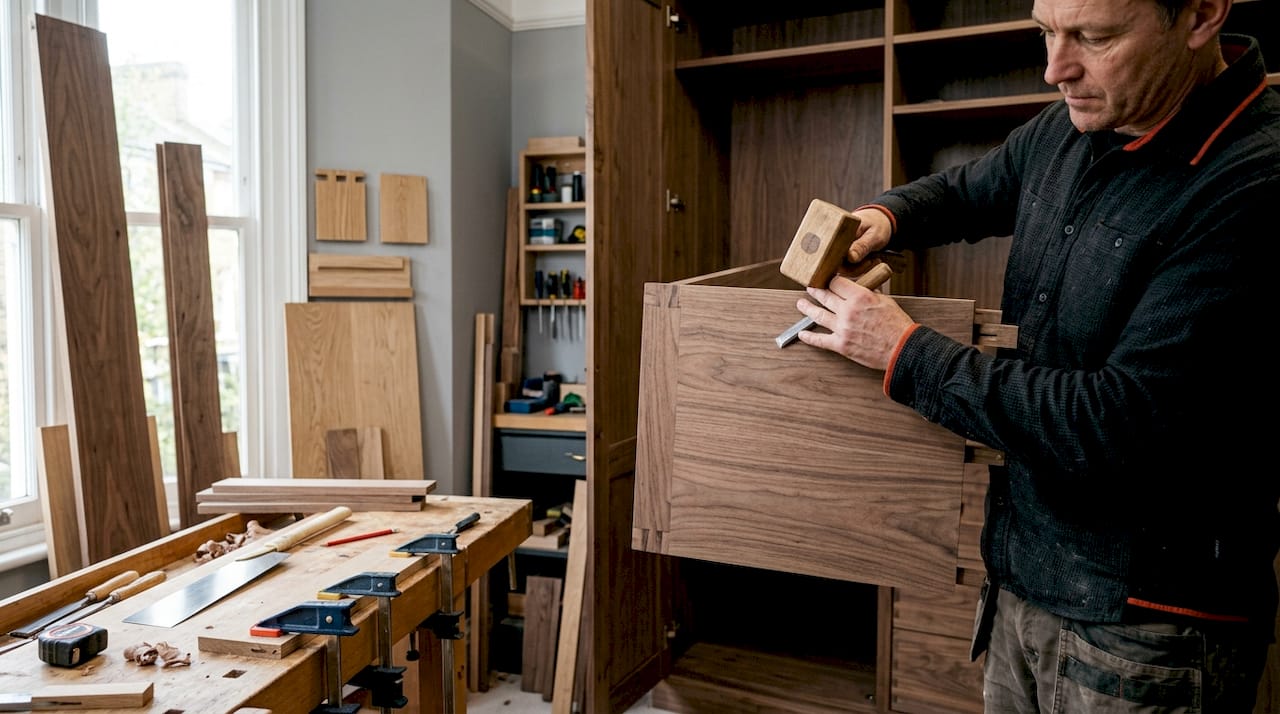
True handcrafted furniture involves reading each timber board for grain direction and natural defects, shaping components by hand or with guided tools, and fitting joints by feel rather than relying on CNC routers or automated assembly rigs. Modern power tools may assist the artisan, but human judgement governs every critical stage including hand-sanding and finish application. The result is a piece of furniture that carries the maker’s decisions in every surface, joint, and proportion.
This is fundamentally different from what is custom furniture in the mass-market sense, where “custom” often means selecting a colour from a swatch chart while the factory builds the same cabinet it always builds. Genuine handcrafted or bespoke furniture means the artisan adapts the design, dimensions, and materials to the specific space and the specific person.
What materials and construction methods distinguish handcrafted furniture?
The materials used in handcrafted furniture are the first visible difference from factory production. Artisans work with solid hardwoods throughout: oak, walnut, and maple are the most common choices in British workshops. These timbers are structurally sound across their full thickness, not just at the surface. Factory furniture typically uses MDF or particle board with a thin veneer on top, which looks similar in a showroom but behaves very differently over years of use.
The construction methods are equally telling. The three joinery techniques that define quality handcrafted work are:
- Mortise-and-tenon joints. A projecting tenon fits into a precisely cut mortise cavity. This wood-to-wood connection resists racking forces and seasonal timber movement.
- Dovetail joints. The interlocking fan-shaped tails and pins used in drawer construction are stronger than the wood itself and resist pulling apart under load.
- Dowelling. Wooden pegs align and reinforce glued joints, adding mechanical strength without metal fasteners that can corrode or loosen.
These joints share one critical property: they can be repaired. A mortise-and-tenon joint that loosens after decades of use can be re-glued and re-clamped. A cam-lock or staple joint in a factory cabinet simply fails, and the piece goes to landfill.
Artisans also hand-select and match wood grain across panels. A dining table top made from three boards will have its grain patterns aligned so the eye reads the surface as continuous. This process, called grain matching, is time-consuming and entirely absent from factory production. The role of materials in bespoke furniture extends beyond aesthetics: the right timber species, properly dried and matched, determines how a piece behaves over decades of central heating cycles and seasonal humidity changes.
Pro Tip: Ask any seller to show you the underside or back of a drawer. A dovetail joint cut by hand has slight variations between each tail. Machine-cut dovetails are perfectly uniform. Both are functional, but only one is genuinely handcrafted.
How does handcrafted furniture compare to mass-produced pieces in terms of cost and longevity?
The upfront cost difference is real and significant. Handcrafted furniture costs 200% to 500% more than equivalent mass-produced items. That gap stops many buyers from looking further. The more useful calculation is cost per year of use, not purchase price.
“A handcrafted table priced at £2,000 that lasts 30 years costs approximately £67 per year of use. A factory-made table at £200, replaced every three years, costs the same amount annually. The handcrafted piece delivers identical annual cost with far superior quality, repairability, and no landfill contribution.”
— Smithers of Stamford, furniture investment analysis
The table below sets out the key differences across the full ownership period.
| Factor | Handcrafted furniture | Mass-produced furniture |
|---|---|---|
| Typical lifespan | 30 years or more | 3–5 years before replacement |
| Annual cost of use | Comparable or lower over time | Higher due to repeat purchases |
| Repairability | Fully repairable: re-glue, sand, re-oil | Largely irreparable when damaged |
| Material quality | Solid hardwood throughout | MDF or particle board with veneer |
| Environmental impact | Low: one purchase, long life | High: repeated disposal and replacement |
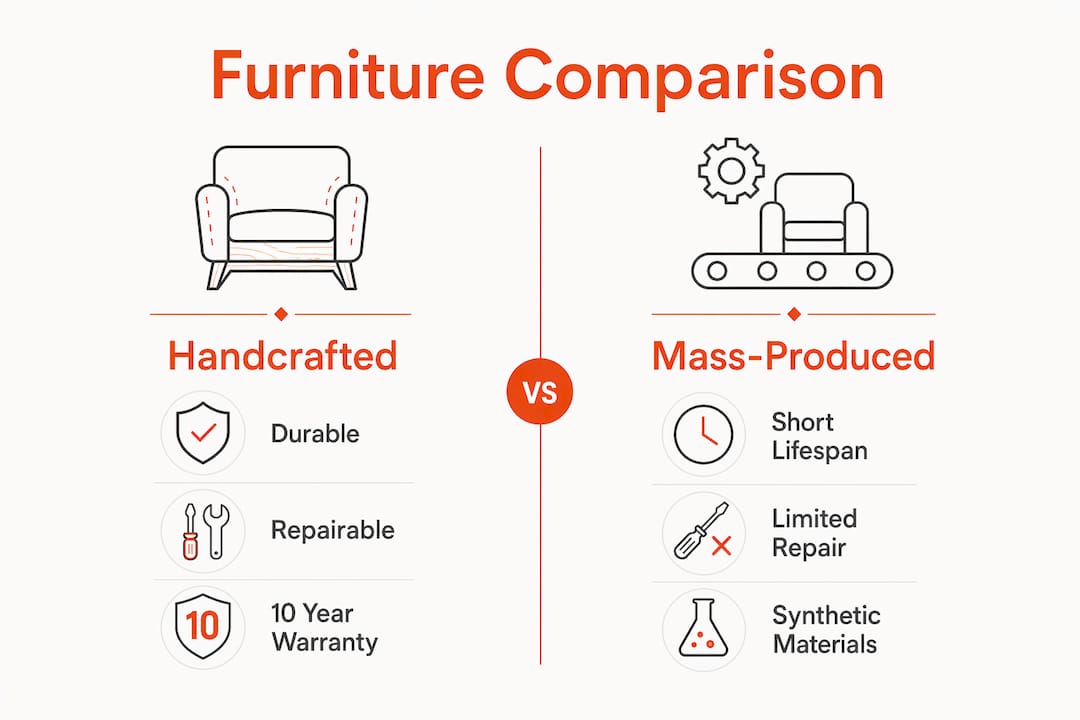
Calculating cost per year reveals that handcrafted pieces are economical over their full lifespan despite higher initial prices. This is the framework we recommend to any homeowner weighing up a bespoke fitted wardrobe against a flat-pack alternative. The investment in luxury furniture pays back through longevity, repairability, and the absence of repeat replacement costs.
Mass-produced furniture often conceals inferior assembly with synthetic coatings and metal fasteners, making repairs impossible when the piece is damaged. That is not a design flaw. It is a deliberate production choice that prioritises low unit cost over long-term value.
What aesthetic qualities make handcrafted furniture unique?
The aesthetic character of handcrafted furniture comes directly from the materials and the maker. Subtle variations in grain patterns, tonal shifts across a panel, and minor asymmetry in hand-cut joints are intentional outcomes of working with natural materials. They define authenticity rather than signal poor quality.
These characteristics matter in a home environment because they give each piece a presence that identical factory items cannot replicate. A walnut sideboard with visible grain movement and a hand-rubbed oil finish reads differently in a room than a printed-veneer cabinet. The surface has depth. The colour shifts with the light. That quality is what designers mean when they describe a piece as having character.
The aesthetic benefits of handcrafted work include:
- Natural grain variation. No two boards are identical. Artisans select and position timber to make variation work with the design rather than against it.
- Tonal depth in finishes. Hand-applied oils and waxes penetrate the wood rather than sitting on top. The result is a finish that improves with age and polishing rather than peeling or chipping.
- Proportional intelligence. Artisans adjust proportions for real-world use: the height of a chair back, the depth of a shelf, the angle of a writing surface. These decisions are made for the human body and the specific room, not for a production template.
- Slight asymmetry as a signature. A hand-carved detail or a hand-planed edge carries the maker’s touch. This is the furniture equivalent of a brushstroke in a painting.
Handcrafted furniture’s unique variations contribute to a personalised home environment that identical mass-produced pieces cannot create. For homeowners in areas like Chelsea, Chiswick, or Richmond who invest carefully in their interiors, this distinction is the difference between a room that looks assembled and one that feels considered.
Pro Tip: When viewing a handcrafted piece, run your hand along the underside of a shelf or the inside of a cabinet. Hand-sanded surfaces feel slightly warmer and less uniform than machine-finished ones. That tactile difference is a reliable authenticity signal.
How to identify genuine handcrafted furniture when shopping
Distinguishing authentic handcrafted furniture from mass-produced imitations requires looking past the marketing language and examining the physical evidence. Here is a practical process for doing that.
-
Examine the joinery. Open every drawer and look at the corners. Dovetail joints with slight hand-cut variation indicate genuine craftsmanship. Staples, cam locks, or dowels with plastic caps indicate factory assembly.
-
Check the material throughout. Lift the piece if possible. Solid hardwood is noticeably heavier than MDF. Look at an unfinished edge or the back panel: solid wood shows end grain; MDF shows a uniform grey-brown composite.
-
Look for hand-finished surfaces. Run your fingertips across the surface. Machine-sanded finishes are perfectly flat and slightly cold. Hand-sanded and hand-oiled surfaces have micro-variation in texture and feel warmer to the touch.
-
Ask the seller to explain their process. Genuine craftsmen discuss details like grain matching, joinery techniques, and drying times for their timber. A seller who cannot explain these details is likely reselling factory goods with handcrafted marketing. An artisan’s ability to explain their practices is a critical measure of authenticity.
-
Look for transparency about the workshop. Authentic makers name their timber suppliers, describe their drying and preparation process, and can tell you where the piece was built. Vague answers about “our craftsmen” without specifics are a red flag.
-
Assess the finish quality. Synthetic coatings applied by spray gun produce a perfectly uniform sheen. Hand-applied oils and waxes show slight variation in depth and sheen across the surface. Both protect the wood, but only one is consistent with genuine handcrafted production.
-
Check for a luxury furniture checklist approach. Reputable makers provide documentation of materials, joinery methods, and finish specifications. If none of this exists, the “handcrafted” claim is marketing, not fact.
The most common red flag is perfect uniformity. Handcrafted furniture is not perfectly uniform. If every surface is identical, every edge is machine-sharp, and every finish is flawless, the piece was made by a machine, regardless of what the label says.
Key takeaways
Handcrafted furniture is defined by skilled artisan control over every structural and aesthetic decision, using solid hardwoods and traditional joinery that produces pieces lasting 30 years or more at a comparable annual cost to disposable factory alternatives.
| Point | Details |
|---|---|
| Definition of handcrafted | Artisans control all structural and aesthetic decisions using traditional methods, not automated lines. |
| Materials matter | Solid hardwoods like oak and walnut outperform MDF and particle board across decades of use. |
| Cost per year of use | A handcrafted piece lasting 30 years costs the same annually as a factory piece replaced every 3 years. |
| Authenticity signals | Hand-cut dovetails, grain matching, and an artisan who explains their process confirm genuine craftsmanship. |
| Aesthetic value | Natural grain variation and hand-applied finishes create character that factory furniture cannot replicate. |
Why I think most buyers underestimate what handcrafted furniture actually does for a home
Working with homeowners across London, from Wimbledon to Putney to Hammersmith, I have seen the same pattern repeat itself. A buyer chooses a flat-pack wardrobe or a factory-made sideboard because the upfront number is lower. Three years later, the drawer fronts are peeling, the carcass has swollen near a radiator, and the piece looks tired. The replacement cycle begins again.
What surprises me is how rarely buyers calculate the full cost of that cycle. The annual cost of a well-made handcrafted piece is not higher than its factory equivalent. It is often lower, and the piece improves with age rather than degrading. A solid oak wardrobe that is re-oiled every few years looks better at year fifteen than it did at year one. A veneered MDF cabinet looks worse at year three than it did on delivery day.
The emotional dimension is equally real, and I do not think it gets enough credit. A piece of furniture made by a specific person, from a specific tree, with decisions made for your specific room, carries a different weight in a home. It is not sentimentality. It is the difference between a space that feels assembled from a catalogue and one that feels genuinely considered. Homeowners in areas like Chelsea or Richmond who invest in their interiors understand this instinctively.
My honest recommendation: before dismissing the price of a handcrafted or bespoke piece, calculate the cost per year of use and compare it honestly to what you have spent replacing cheaper alternatives. The number is almost always closer than you expect. And the quality gap is not close at all.
— Aureliu
Bespoke fitted furniture for London homes: what Finest Furniture Studio offers
If the craftsmanship principles behind handcrafted furniture appeal to you, the same standards apply directly to bespoke fitted wardrobes, TV media walls, and loft storage solutions.
Finest Furniture Studio designs and builds bespoke fitted wardrobes for homes across Richmond, Wimbledon, Putney, Fulham, Ealing, and surrounding areas. Every project begins with a free design visit, where we measure your space and discuss your storage needs in detail. Fitting is completed within 7–12 days, and every installation carries a 10-year quality guarantee. We also remove and dispose of your old wardrobe at no extra charge. For fitted wardrobes in Putney or anywhere across West London, call us on 07468 150807 or WhatsApp, or visit us at 124 City Road, Kemp House, London, EC1V 2NX.
FAQ
What is the handcrafted furniture definition in simple terms?
Handcrafted furniture is furniture made primarily by skilled human hands using traditional woodworking methods, where the artisan controls all key structural and aesthetic decisions rather than an automated machine.
What are the main benefits of handcrafted furniture over factory-made pieces?
The main benefits are superior durability, full repairability, and a comparable annual cost over a 30-year lifespan. Handcrafted pieces use solid hardwoods and traditional joinery that outlast factory alternatives by decades.
How do I identify genuine handcrafted furniture when buying?
Look for hand-cut dovetail joints with slight variation, solid hardwood throughout, hand-applied finishes with tactile depth, and a maker who can explain their grain-matching and joinery process in specific detail.
What is the difference between handcrafted and mass-produced furniture?
Handcrafted furniture uses solid wood, traditional joinery, and human judgement at every stage. Mass-produced furniture uses MDF or particle board, cam locks or staples, and synthetic coatings that conceal structural weaknesses and cannot be repaired.
Does handcrafted furniture apply to fitted wardrobes and storage solutions?
Yes. The same principles of solid materials, traditional joinery, and artisan control apply to bespoke fitted wardrobes and built-in storage. Finest Furniture Studio applies these standards to every fitted wardrobe, loft conversion, and TV media wall it builds across London.

