
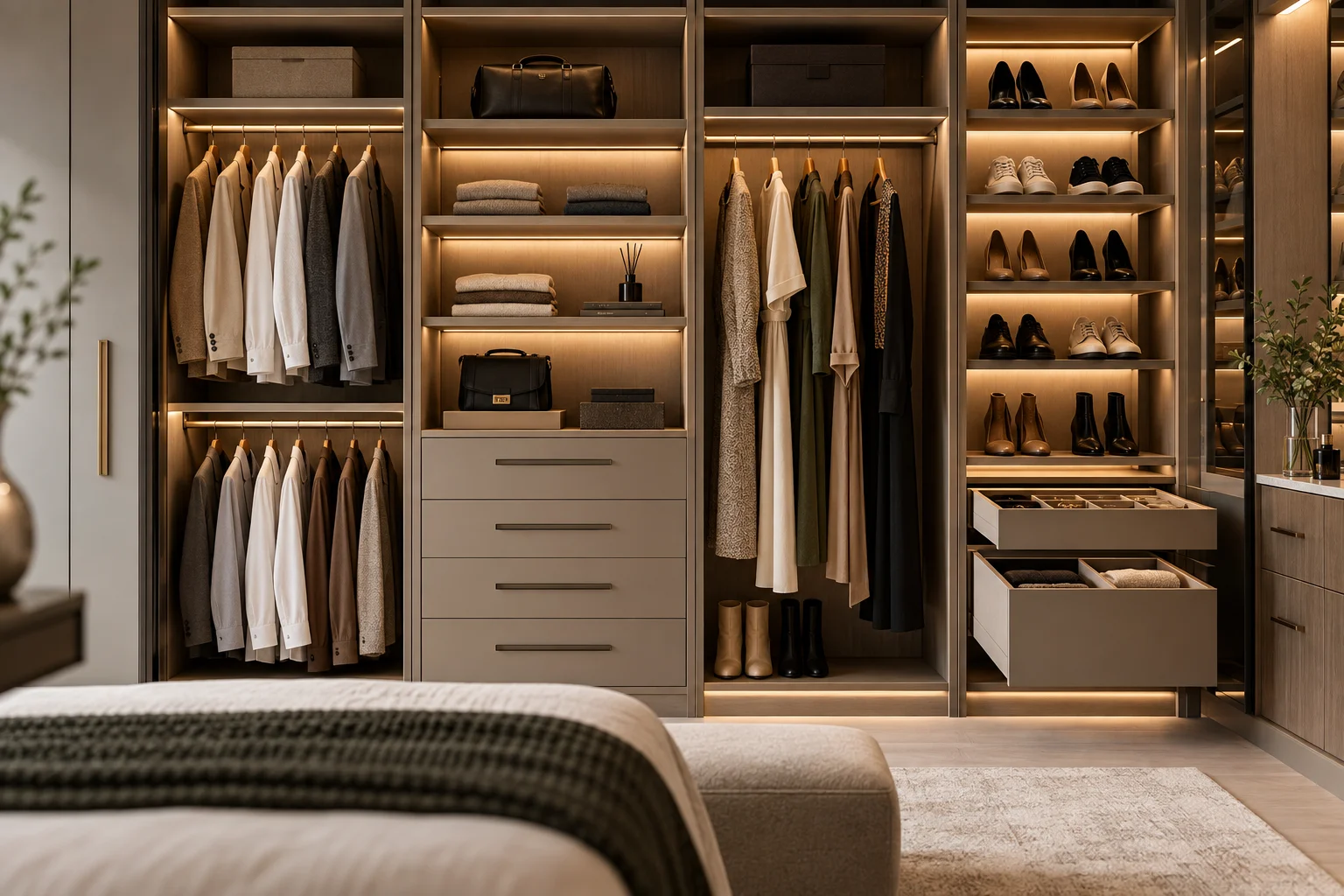
A bespoke wardrobe should do more than look beautiful from the outside. The real difference is what happens when you open the doors.
A well-designed wardrobe gives every part of your clothing collection a logical place: everyday clothes are easy to reach, dresses and coats have enough hanging space, folded clothing has dedicated drawers, shoes are organised rather than piled on the floor, and integrated lighting helps you see everything clearly.
But what should actually be inside a bespoke wardrobe?
The answer depends on what you own, how you use your bedroom and the space available. There is no single internal layout that works for everyone. The best bespoke wardrobe interiors are designed around your lifestyle rather than forcing your belongings into a standard configuration.
In this guide, we look at the key components worth considering — drawers, hanging rails, shelving, lighting and shoe storage — and explain how to decide what your wardrobe really needs.
What Should a Bespoke Wardrobe Include?
A well-planned bespoke wardrobe will usually combine several different storage zones rather than relying entirely on shelves or hanging rails.
The most useful components to consider are:
- Hanging rails for shirts, jackets, dresses and coats
- Double hanging rails for shorter garments
- Internal drawers for folded clothing and accessories
- Adjustable shelving
- Dedicated shoe storage
- Integrated LED lighting
- Pull-out trouser, tie and belt racks
- Upper storage for seasonal or less frequently used items
- Specialised storage for jewellery, watches and other accessories
The important point is balance.
A wardrobe filled with hanging rails may waste valuable vertical space. One with too many shelves may leave you struggling to store longer garments. The internal layout should reflect your actual wardrobe rather than a generic formula.
Finest Furniture Studio’s existing guide to fitted wardrobe interiors similarly recommends starting with an inventory of what the wardrobe needs to hold before designing the internal framework.
1. Hanging Rails: Start With the Clothes You Hang
Hanging rails are usually one of the largest components inside a fitted wardrobe, but simply adding one long rail across the entire unit isn’t necessarily the best use of space.
Think about what you actually hang.
Shirts, blouses, jackets and trousers require considerably less vertical space than long dresses, coats and formalwear.
Consider dividing your hanging space into zones
Short hanging
Ideal for:
- Shirts
- Blouses
- Jackets
- Trousers
- Skirts
This can often be combined with another rail below it, creating a double-hanging section and making much better use of the wardrobe’s height.
Long hanging
Best for:
- Dresses
- Coats
- Long skirts
- Evening wear
- Longer garments
Keeping these garments in their own zone prevents them from becoming compressed or folded awkwardly at the bottom.
How many hanging rails do you need?
There is no universal number.
Instead, count the garments you actually own and separate them into:
- Short-hanging clothes
- Long-hanging clothes
- Items that should be folded
This gives your wardrobe designer a much better starting point than simply deciding that every section should contain one rail.
For more detailed planning around wardrobe interiors, see our guide to fitted wardrobe interiors and bespoke organisation
2. Internal Drawers: The Storage You Use Every Day
Drawers are one of the most useful additions to a bespoke wardrobe because they provide accessible storage for items that don’t need to be hung.
They are particularly useful for:
- T-shirts
- Underwear
- Socks
- Knitwear
- Gym clothing
- Belts
- Ties
- Accessories
But drawer design matters.
A wardrobe shouldn’t simply have six identical drawers because there is space for six drawers.
Different items need different drawer depths
For example:
| Drawer type | Suitable for |
|---|---|
| Shallow | Jewellery, watches, ties, belts, socks |
| Medium | T-shirts, shirts, folded clothing |
| Deep | Knitwear, denim, gym clothing |
The most frequently used drawers should generally sit in an easy-to-reach area rather than at floor level.
For a deeper look at drawer planning, read Drawers Inside Fitted Wardrobes: Your Practical Guide.
Don’t forget drawer dividers
Small items quickly become disorganised when they are placed together in a large open drawer.
Dividers or dedicated inserts can create separate zones for:
- Socks
- Underwear
- Watches
- Jewellery
- Belts
- Ties
This is a small detail, but it can make a significant difference to everyday usability.
3. Shelving: Use Vertical Space Properly
Shelving is essential, particularly for folded clothes, bags and items that don’t need to be hung.
Good wardrobe shelving can be used for:
- Jumpers
- T-shirts
- Handbags
- Boxes
- Hats
- Linen
- Seasonal clothing
- Accessories
The important thing is not to make every shelf the same height.
Different items require different amounts of vertical space.
Think about your wardrobe in zones
Eye-level shelves
Use these for items you access regularly.
Lower shelves
Useful for heavier clothing, bags and less frequently accessed items.
Upper shelves
Ideal for seasonal clothing, luggage and items you don’t need every day.
This vertical approach makes better use of the full height of a fitted wardrobe.
For additional layout ideas, our guide to wardrobe design ideas for maximising space and style covers dimensions, layouts, lighting and different wardrobe configurations.
4. Shoe Storage: Give Every Pair a Proper Place
Shoes are often one of the first things to become difficult to organise.
If there isn’t a dedicated shoe zone, footwear can end up:
- On the bedroom floor
- Under hanging clothes
- In boxes
- Stacked on top of each other
- Hidden at the back of the wardrobe
A bespoke wardrobe gives you the opportunity to design shoe storage around the size and type of your collection.
Options include:
Fixed shelves
A simple solution for everyday footwear.
Angled shelves
Useful when you want shoes to be visible and easy to select.
Pull-out shoe racks
Particularly useful when depth is limited or you want better access to footwear stored towards the back.
Dedicated shoe drawers
A more concealed option for keeping footwear protected and visually hidden.
If footwear is an important part of your storage requirements, read our dedicated guide to bespoke shoe storage and luxury wardrobe interiors.
5. Integrated Lighting: One of the Most Useful Upgrades
A wardrobe can have an excellent internal layout and still be frustrating to use if you can’t see what’s inside it.
This is particularly noticeable in deep wardrobes, darker bedrooms and wardrobes with several internal sections.
Integrated LED lighting can illuminate:
- Hanging rails
- Shelves
- Drawers
- Shoe storage
- Display areas
Where should wardrobe lighting go?
Rather than relying on one light source, consider lighting the areas where you actually need visibility.
For example:
Rail lighting
Helps you distinguish between garments and colours.
Shelf lighting
Makes folded clothes and accessories easier to identify.
Drawer lighting
Makes smaller items much easier to find.
Motion-activated lighting
Can automatically illuminate the wardrobe when the door is opened.
Lighting should ideally be considered during the design stage, rather than treated as something to add afterwards.
Finest’s existing wardrobe design guidance also highlights integrated lighting as an important part of modern wardrobe planning.
6. Don’t Forget Specialist Storage
Once the main components are planned, consider the smaller details that can make a bespoke wardrobe genuinely personal.
Depending on your lifestyle, you may benefit from:
Pull-out trouser racks
Useful for keeping trousers organised and reducing creasing.
Tie and belt racks
A dedicated location prevents accessories from disappearing into drawers.
Pull-down rails
Particularly useful when you have high storage areas that would otherwise be difficult to reach.
Jewellery inserts
Small compartments can protect watches, jewellery and other delicate accessories.
Laundry or hamper sections
A concealed laundry compartment can keep worn clothing separate from clean clothes.
Charging zones
For a dressing room or larger wardrobe, integrated charging can provide a convenient place for devices while keeping cables hidden.
The goal isn’t to include every accessory available.
The goal is to include the accessories that solve a real problem in your daily routine.
7. How to Decide What Your Wardrobe Actually Needs
Before your bespoke wardrobe is designed, take a few minutes to audit what you already own.
Ask yourself:
What do I hang?
Count dresses, coats, shirts, jackets and trousers.
What do I fold?
Identify how much drawer and shelving space you need.
How many shoes do I own?
Don’t underestimate this one. Plan for the collection you actually have rather than the collection you wish you had.
Which items do I use every day?
These should occupy the easiest-to-reach areas.
Which items are seasonal?
Winter coats, holiday clothing and occasional accessories can use higher or less accessible storage.
Do two people share the wardrobe?
If so, consider dividing the internal layout into clearly defined zones.
This simple inventory can make the design process considerably more accurate.
8. The Best Bespoke Wardrobe Layout Is Personal
There is no perfect wardrobe interior that works for every homeowner.
A professional wardrobe collection may require more hanging space.
A large shoe collection may need an entire dedicated section.
Someone who wears mostly casual clothing may benefit from more drawers and shelving.
A shared bedroom may need two clearly separated storage zones.
A walk-in wardrobe may allow dedicated areas for dressing, accessories and display.
This is exactly where bespoke furniture has an advantage over standard modular storage: the interior can be designed around you.
Instead of asking:
“What components come with this wardrobe?”
you should be asking:
“What storage will make my everyday routine easier?”
That is the real purpose of a bespoke wardrobe.
9. A Simple Bespoke Wardrobe Planning Checklist
Before finalising your design, make sure you have considered:
Hanging
- ☐ Short-hanging section
- ☐ Long-hanging section
- ☐ Double hanging where appropriate
- ☐ Pull-down rail if required
Drawers
- ☐ Everyday clothing drawers
- ☐ Shallow accessory drawers
- ☐ Drawer dividers
- ☐ Soft-close mechanisms
Shelving
- ☐ Folded clothing
- ☐ Bags
- ☐ Seasonal items
- ☐ Upper storage
Shoes
- ☐ Everyday footwear
- ☐ Dedicated shoe shelving
- ☐ Pull-out storage if useful
- ☐ Space for future additions
Lighting
- ☐ Hanging rail lighting
- ☐ Shelf lighting
- ☐ Drawer lighting
- ☐ Motion activation
Specialist storage
- ☐ Trouser rack
- ☐ Tie/belt storage
- ☐ Jewellery
- ☐ Laundry
- ☐ Charging zone
This checklist can also make your design consultation much more productive.
Bespoke Wardrobe Interior FAQs
What should be inside a bespoke wardrobe?
A well-planned bespoke wardrobe may include hanging rails, double-hanging sections, drawers, adjustable shelving, shoe storage, integrated lighting and specialist accessories such as trouser racks, tie storage and jewellery inserts. The exact combination should be based on your clothing collection and daily routine.
How many drawers should a fitted wardrobe have?
There is no fixed number. The right number depends on how much folded clothing and accessory storage you need. A good design should prioritise frequently used items and provide different drawer configurations for different types of belongings.
Are wardrobe lights worth it?
Yes, particularly in deep or enclosed wardrobes. Integrated LED lighting makes clothes, accessories and shoes easier to see and can significantly improve the everyday experience of using the wardrobe.
What is the best way to store shoes in a fitted wardrobe?
The best solution depends on the size of your collection and the available space. Fixed or angled shelves work well for accessible footwear, while pull-out racks and dedicated drawers can provide better organisation for larger collections.
Should clothes be hung or folded in a bespoke wardrobe?
Generally, garments that crease easily or need to retain their shape should be hung, while knitwear, T-shirts and heavier folded clothing are better suited to shelves or drawers. Your internal layout should reflect the types of clothing you actually own.
Can a bespoke wardrobe be designed for two people?
Yes. A shared wardrobe can be divided into dedicated zones for each person, with different combinations of hanging rails, drawers and shelving based on each person’s storage requirements.
Plan Your Bespoke Wardrobe With Finest Furniture Studio
The best wardrobe isn’t necessarily the one with the most storage.
It is the one where everything has a place and the things you use most are easiest to reach.
At Finest Furniture Studio, bespoke fitted wardrobes are designed around the space, the architecture and the way you actually use your home. From internal drawers and hanging rails to integrated lighting and dedicated shoe storage, every component can be considered as part of the overall design.
If you’re planning a fitted wardrobe in West London and aren’t sure what your interior should include, a professional design consultation can help you turn your storage requirements into a practical layout.
Book a free design visit with Finest Furniture Studio and start planning a wardrobe designed around you.

