
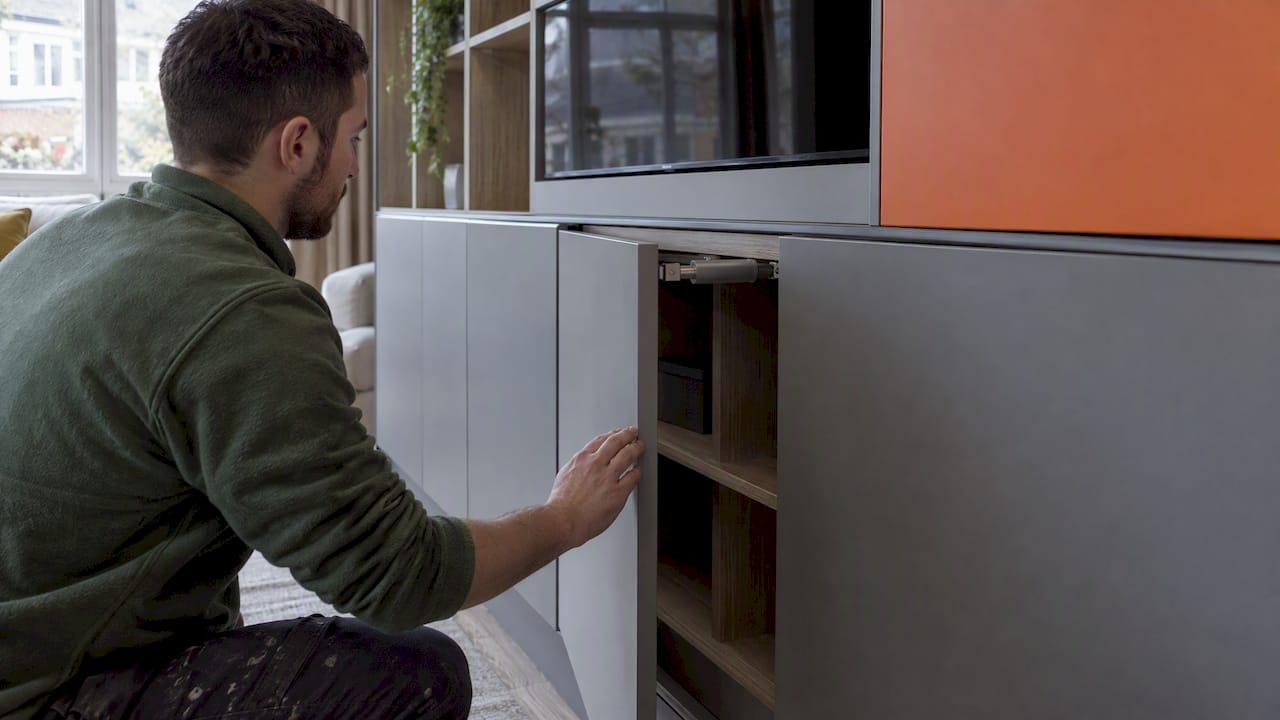
For most heavy-use drawers and fitted wardrobes, soft-close wins on durability and everyday comfort. For handleless upper cabinets where you want a clean, knob-free front, push-to-open makes more sense. If you want both qualities in one fitting, TIP-ON BLUMOTION gives you mechanical one-touch opening with a controlled soft close, no wiring required.
TL;DR:
- Soft-close mechanisms, especially BLUMOTION, are integrated into hinges or runners and prevent slamming while protecting cabinet edges over time.
- Push-to-open hardware suits handleless fronts for modern and minimalist designs, but it risks accidental activation and often lacks soft-close unless paired with damping.
- Hybrid solutions like TIP-ON BLUMOTION combine mechanical push-to-open with soft-close in a single system, ideal for retrofit or bespoke furniture without wiring.
- Retrofits require checking hinge types, cup sizes, and trigger ranges to avoid mismatched or dysfunctional hardware, with professional help recommended for complex adjustments.
- Soft-close hardware is generally worth the extra cost in high-use or household settings, especially where durability, safety, and quiet operation matter most.
Table of Contents
- How soft-close and push-to-open mechanisms actually work
- Soft-close: the real benefits and drawbacks
- Push-to-open: the real benefits and drawbacks
- Can you have both? Hybrid and combined solutions
- Compatibility and retrofit: hinges, runners and trigger range
- Which to choose: a quick decision checklist by location
- DIY installation checklist and common mistakes to avoid
- When bespoke fitting matters more than the hardware choice
- How we handle soft-close and handleless hardware at Finest Furniture Studio
- FAQ
- Sources
- Manufacturer and technical pages to read next
How soft-close and push-to-open mechanisms actually work
Soft-close hardware uses a damper fitted inside a hinge, drawer runner or lift system. As the door or drawer nears its closed position, the damper absorbs momentum and slows the final few centimetres, so nothing bangs shut. BLUMOTION is the system most fitted furniture makers specify because it’s built into the hinge or runner itself rather than bolted on afterwards.
Push-to-open hardware works differently. A light press on the front releases a sprung or mechanical catch, which ejects the door or drawer slightly so you can pull it open by hand, with no handle needed. TIP-ON is a purely mechanical version of this. SERVO-DRIVE is the electrical alternative, opening fronts with a motor rather than a spring.
- Integrated soft-close sits inside the hinge or runner from the factory.
- Add-on dampers are cheaper but can work loose and look untidy over time.
- Mechanical push systems need no power; electrical ones need wiring and a power supply.
Soft-close: the real benefits and drawbacks
Soft-close hardware earns its keep in daily life. It stops slamming, protects cabinet carcasses and door edges from repeated impact, and removes the risk of fingertips getting caught as a drawer closes. It also gives fitted furniture that quieter, more considered feel that most homeowners notice within the first week.
- Prevents slamming and the wear that comes with it.
- Reduces the chance of trapped fingers, particularly useful with young children around.
- Gives doors and drawers a noticeably premium, controlled close.
- Adds to the unit cost compared with standard hinges or runners.
- Can fail or stiffen over time, occasionally needing the damper replaced.
- Retrofitting onto existing cabinets sometimes means swapping hinges entirely, not just adding a part.
Pro Tip: Check whether a cabinet uses a 35mm hinge cup before buying replacement soft-close hinges; mismatched cup sizes are the most common retrofit mistake.
Push-to-open: the real benefits and drawbacks
Push-to-open hardware is the obvious choice when you want a flush, handleless look, particularly on wall cabinets or sleek fitted wardrobe fronts. It also works well when your hands are full, since a light nudge with an elbow or hip is enough to release the door.
- Delivers a clean, handle-free front that suits modern and minimalist kitchens or bedrooms.
- Opens with a simple push, useful when carrying items.
- Usually needs unsprung hinges rather than standard sprung ones.
- Prone to accidental activation, especially on base units where pets or children brush past.
- Rarely includes soft close on its own unless paired with a damping system.
Can you have both? Hybrid and combined solutions
Yes, and this is where handleless fitted furniture gets genuinely practical. TIP-ON BLUMOTION combines mechanical push-to-open with BLUMOTION soft close in a single unit, so a light push releases the front and the same mechanism controls the close. Nothing needs plugging in, which makes it a sensible default for bespoke wardrobes and fitted living rooms where you don’t want visible wiring.

Hybrid mechanical systems deliver both opening convenience and soft closing without electricity, a detail that matters for any retrofit project where running power to a cabinet isn’t practical, according to Blum’s handleless product documentation.
SERVO-DRIVE is the electrical equivalent, opening fronts with a motor rather than a spring. It can feel more effortless on very large or heavy fronts, but it adds cost and requires wiring, which usually only makes sense in a new build where cabling can be planned in from the start.
- TIP-ON BLUMOTION: mechanical, no power needed, soft close included.
- SERVO-DRIVE: electrical, smoother on heavy fronts, needs wiring and higher budget.
- Best used in new builds or bespoke fitted furniture where the system is specified from the design stage.
Compatibility and retrofit: hinges, runners and trigger range
Before buying any hardware, check what you’re working with.
- Confirm hinge type: sprung hinges generally suit soft-close retrofits, while push-to-open needs unsprung hinges, so check which you have before ordering parts.
- Check the hinge cup size, typically 35mm, since push-to-open and soft-close hinges are designed around this standard and a mismatch means the new hinge won’t seat properly.
- Inspect drawer runners for soft-close compatibility; many modern runners already include a damper, others need a full runner swap.
- For wide fronts, check whether synchronisation is fitted. Product listings for synchronisation accessories show that wide drawer fronts generally need a synchronisation rod to stop twisting or uneven release when pushed from one side.
- Test the trigger range on push-to-open fronts; too wide a range increases accidental activation from a stray knock or a pet brushing past.
Pro Tip: Measure your existing hinge cup diameter and door overlay before ordering replacement hardware; the wrong overlay is the second most common reason retrofits fail.
Which to choose: a quick decision checklist by location
The right mechanism depends on where the cabinet sits and who uses it.
- Base drawers and heavy-use kitchen units: soft-close, since frequent use and weight favour durability over novelty.
- Wall cabinets and upper units: push-to-open suits a handleless look where reach and weight are both lower.
- Wardrobes and fitted bedroom furniture: soft-close as standard, with push-to-open or TIP-ON BLUMOTION on handleless fronts.
- Pantries and tall units: soft-close runners, since these get opened and closed often and carry weight.
- Households with young children or pets: soft-close reduces slamming injuries; avoid push-to-open on low, reachable base units.
| Location | Typical priority | Recommended system |
|---|---|---|
| Base drawers | Durability, frequent use | Soft-close |
| Wall cabinets | Handleless look | Push-to-open |
| Wardrobe doors | Daily comfort, longevity | Soft-close or TIP-ON BLUMOTION |
| Pantry units | Heavy, frequent use | Soft-close runners |
For more detail on choosing between the two in fitted cabinetry, our soft-close wardrobes buyer’s guide walks through the same decision in more depth.
DIY installation checklist and common mistakes to avoid
Getting this right on a retrofit project means working through the basics in order, not skipping straight to fitting the new hardware.
- Measure hinge cup size, overlay and door weight before ordering anything.
- Dry-fit one hinge or runner first and test the action before committing to the full set.
- Check synchronisation on any front wider than a single drawer box.
- Live-test the trigger range with normal household movement before calling the job finished.
- Call a professional if the cabinet carcass needs modifying or if hinge positions don’t align with standard spacing.
Common mistakes include mixing hinge types across one unit, skipping synchronisation on wide fronts, buying generic push latches without checking trigger range, and underestimating how much door weight affects which runner or hinge grade you need. Our guide to drawers inside fitted wardrobes covers runner selection in more detail if you’re planning a full retrofit.
When bespoke fitting matters more than the hardware choice
Hardware specification is only half the job. Bespoke fitters tend to specify soft-close as standard across a whole project and synchronise wide fronts so every door and drawer behaves consistently, something that’s harder to achieve piecemeal with retrofit parts bought separately. If you’re planning a fully handleless fit-out, that consistency is usually worth paying a professional for rather than mixing hardware yourself.
— Aureliu
How we handle soft-close and handleless hardware at Finest Furniture Studio
Soft-close mechanisms are typically installed as standard across bespoke wardrobes, fitted living furniture and under-stair storage. Handleless finishes with push-to-open and synchronised wide fronts can be offered as part of bespoke designs, fitted to match the room rather than adapted from a generic kit.

- Soft-close fitted as standard on every bespoke project.
- Handleless and synchronised wide-front options available on request.
- Installations are typically completed quickly, and long-term guarantees are provided.
- Free design visit to discuss hinge, runner and handleless choices for your space.
If you’d like to talk through the right hardware for your own fitted wardrobes, book a free design visit and we’ll walk you through the options in person. Call or WhatsApp us on 07468 150807, or visit us at 124 City Road, Kemp House, London, EC1V 2NX.
FAQ
What are the disadvantages of soft-close drawers?
Soft-close drawers cost more than standard runners and occasionally need the damper replaced if it stiffens or fails. Retrofitting them onto existing cabinets can also mean swapping the whole runner rather than adding a simple part.
Is soft-close worth the extra cost?
For drawers and doors used daily, most homeowners find soft-close worth it, since it reduces wear, noise and the risk of trapped fingers. It matters most on base units, wardrobes and anywhere children or pets are around.
Are push-to-open drawers good?
Push-to-open drawers work well on handleless wall cabinets and upper units where weight is lower and reach is limited. They’re less suited to heavy base drawers, where accidental activation and the lack of built-in soft close become more noticeable.
What are the pros and cons of soft-close hinges?
Soft-close hinges prevent slamming and give doors a controlled, quiet close, but they add cost and may need the hinge cup size checked before retrofitting. A mismatched 35mm cup is the most common reason a retrofit hinge fails to seat properly.
Sources
Manufacturer and technical pages to read next
For full specifications, TIP-ON BLUMOTION and TIP-ON product pages cover mechanical opening and soft-close integration in detail. Blum’s handleless furniture documentation explains BLUMOTION across hinges, runners and lift systems, and our handleless fitted wardrobes guide covers the same choices for bespoke bedroom furniture.

