
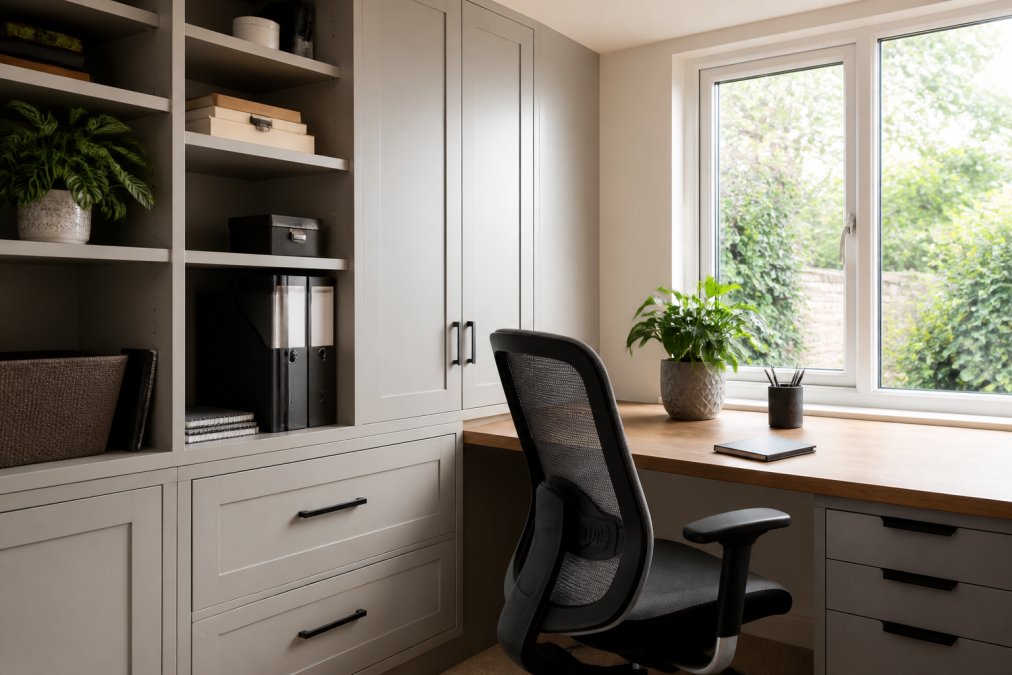
Table of Contents
- 1. Go Vertical: Floor-to-Ceiling Shelving and Wall-Mounted Units
- 2. Make Awkward Spaces Work: Alcove and Under-Stair Storage
- 3. Choose Multifunctional Furniture for a Compact Layout
- 4. Hide the Clutter: Concealed Storage and Desk Organisation
- 5. Fitted Home Office Design Ideas for a Seamless Look
- 6. Consider Bespoke Home Office Furniture for a Perfect Fit
- 7. Embrace Digital Decluttering to Free Up Physical Space
- Conclusion: Build a Home Office That Works for You
- Frequently Asked Questions
Last Updated: September 9, 2026
Small home offices share one challenge: there is never enough room for everything. A desk, a printer, reference files, stationery, and cables all compete for the same few square metres. The solution is to plan your home office storage around the space you actually have, including the awkward corners most people ignore.
This guide from Finest Furniture Studio covers seven practical ways to maximise small home office storage. We specialise in bespoke, custom-fitted solutions that turn understairs voids and sloping alcoves into organised, productive space.
TL;DR:
- Go vertical with floor-to-ceiling and wall-mounted storage to double your usable space
- Turn alcoves, nooks, and under-stair voids into dedicated storage zones
- Choose multifunctional furniture that works harder in a compact layout
- Conceal everyday clutter with drawers, bins, and cable management
- Consider fitted and bespoke home office furniture when you want a seamless, permanent result
- Go paperless where you can to free up physical space for what matters
1. Go Vertical: Floor-to-Ceiling Shelving and Wall-Mounted Units
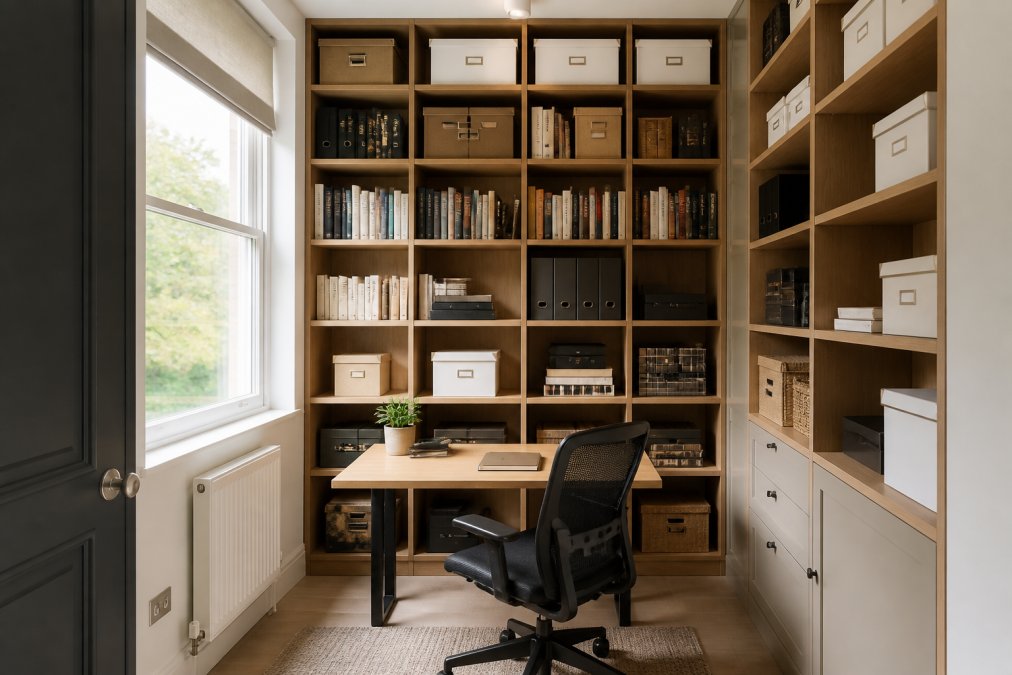
The single most effective way to maximise small home office storage is to use the full height of the room. Floor-to-ceiling shelving takes advantage of vertical wall space that freestanding units leave empty, doubling your capacity without taking up extra floor area.
Keep frequently used items at eye level and archive anything you rarely touch on the top tiers. Adjustable shelving lets you reconfigure the layout as your needs change.
When loading high shelves, store the heaviest items at waist height or below. Reaching above shoulder level for a heavy box file is an ergonomic risk, not a storage solution. Always check the manufacturer’s guidelines for weight limits on shelving.
For a truly seamless result, cabinetry that runs from floor to ceiling with integrated lighting can make a small room feel taller and more ordered. A common mistake is stopping shelving at head height, which wastes the most valuable storage zone in the room.
2. Make Awkward Spaces Work: Alcove and Under-Stair Storage
Most homes contain dead space that simply collects dust: the alcove beside a chimney breast, the void under the stairs, the sloping ceiling at the edge of a room. These awkward areas are prime candidates for home office storage once you view them as an asset rather than an obstacle.
Under-stair voids can house deep pull-out drawers, filing cabinets, or a compact desk that folds away when not in use. The key is measuring precisely, because off-the-shelf units rarely fit these irregular shapes.
For sloping ceilings, custom joinery is often the only way to use the space properly. A fitted unit that follows the roofline turns a useless corner into archive storage or a printer station. This is where a made-to-measure approach genuinely outperforms anything you can buy flat-packed.
3. Choose Multifunctional Furniture for a Compact Layout
In a small home office, every piece of furniture should earn its floor space twice over. Multifunctional designs combine storage with workspace, so a single footprint serves multiple purposes. The real skill is mapping each item to the way you actually move through a working day.
Start with a simple zone plan. Divide your room into three functional bands: the primary work zone (desk, monitor, keyboard), the reference zone (files, books, printer), and the peripheral zone (coats, bags, supplies you use less than once a week). Multifunctional furniture should bridge two of these zones, never all three.
Desk-and-storage combinations that actually work
Look for a pedestal with at least two deep drawers for suspension filing and one shallow drawer with dividers for stationery.
A fold-down wall desk is an excellent option for a room that doubles as a guest bedroom or nursery. When closed, the unit should protrude no more than 30 cm from the wall. Choose a model with gas-assisted or spring-loaded hinges rated for at least 30 kg, because cheaper friction hinges tend to sag within a year of daily use.
The ergonomic angle competitors miss
Most multifunctional furniture advice stops at “buy a storage ottoman,” but how you store items affects your posture and reach. The ergonomic principle of zone-of-convenience storage states that items used more than three times per day should sit within a 40 cm radius of your seated position. Items used weekly can sit at arm’s length, and monthly items can live further away.
The trade-off: storage volume versus accessibility
Every multifunctional piece involves a compromise between how much it stores and how easily you can reach that storage. A storage ottoman holds a surprising volume of paperwork, but accessing it requires standing and lifting the lid. That makes it suitable for archive files you touch monthly, not daily reference materials.
Measure the depth of your desk before adding a hutch: if the desk is shallower than 60 cm, a hutch will likely encroach on your monitor viewing distance.
Before buying any multifunctional piece, ask yourself one question: “What single task will this furniture make faster or more comfortable?” If you cannot answer with a specific activity, printing, filing, charging devices, the piece is probably adding storage you do not need rather than solving a problem you have.
Where fitted multifunctional furniture wins
A fitted desk-and-storage run built into an alcove can combine a fold-down work surface, pull-out keyboard tray, concealed cable channel, and closed cabinetry above and below, all within a single 60 cm deep footprint. Unlike freestanding pieces, a fitted unit can include a recessed monitor niche that brings the screen to the correct ergonomic height without a separate riser. This is where bespoke home office furniture specialists earn their keep: the unit is designed around your reach, your equipment, and your workflow.
For rooms under 8 square metres, a fitted solution that integrates the desk, storage, and shelving into one wall typically reclaims 15-20% more usable floor space than an equivalent arrangement of freestanding pieces. That difference often means the difference between a home office and a home office that also fits a guest bed.
4. Hide the Clutter: Concealed Storage and Desk Organisation
Visual clutter is a quiet productivity killer. A desk covered in loose papers, cables, and stationery makes it harder to focus. The fix is a layered approach: concealed storage for the items you use daily, plus disciplined desk organisation for everything else.
The three clutter zones on every desk
Walk into any small home office and you will find clutter concentrated in three zones: the landing zone at the front edge of the desk where keys, phones, and post collect; the cable zone behind and beneath the monitor where chargers and adapters tangle; and the paper zone where unread post and notes stack. Each zone needs a different solution.
Fixing the landing zone
Install a small wall-mounted shelf or caddy beside the office door. This gives incoming items, keys, phone, post, a home before they reach the desk. A shallow tray on the shelf catches daily essentials; a small waste bin beneath it catches junk mail before it lands on your work surface.
Fixing the cable zone properly
Cable management is the most underrated home office storage task. A tangle of cables makes swapping equipment or cleaning the desk a frustrating chore. The systematic approach has four steps:
- Audit every cable. Label each one with a small tag or piece of masking tape at both ends. You cannot organise what you cannot identify.
- Eliminate duplicates. Most home offices have at least three spare USB cables and two spare power adapters that serve no current device. Store spares in a labelled box in a drawer, not on the desk.
- Route vertically, not horizontally. Fix a vertical cable channel to the back leg of the desk or the wall behind it. Cables run down the channel to a power strip mounted at desk height, not on the floor. This keeps cables off the work surface and makes them individually traceable.
- Use a cable tray beneath the desk for the power strip and any excess cable length. A tray with a hinged or removable cover makes future changes far easier than a fixed enclosure.
A power strip mounted on the underside of the desk, rather than on the floor, is the single most effective cable-management upgrade you can make. It shortens every cable run, keeps plugs accessible without bending down, and frees floor space for a pedestal unit or bin.
Fixing the paper zone with a decision point
The paper zone persists because paper arrives faster than it is filed. The fix is a three-tier paper system within arm’s reach: an inbox tray for paper needing action within 48 hours (holding no more than five items); a shallow drawer or magazine file for current-month paper such as receipts and warranties; and a filing cabinet or archive box for long-term retention. This system forces a decision at the point of entry, paper either gets actioned, filed monthly, or archived. space saving solutions.
The digital decluttering connection
The most effective concealed storage is the storage you do not need. Every document you scan and file digitally removes physical paper from your desk, your drawers, and your archive boxes. A small home office with a paperless workflow can often eliminate an entire filing cabinet.
Switch to digital statements wherever your provider offers them, and set up a folder structure that mirrors the filing system you would otherwise build in a cabinet. Store any original paper documents you must keep in a single fireproof document box.
Digital decluttering only works if you have a retrieval system. Scanning documents into an unstructured folder simply replaces a physical pile with a digital one. Set up a consistent naming convention, for example, `YYYY-MM-DD_Document-Type_Description`, and a folder hierarchy before you start scanning.
Where concealed storage belongs
Concealed storage works best when it is placed near the point of use. Keep printer paper in a drawer beneath the printer, not across the room. Store chargers and cables in the drawer where you charge your devices.
For a truly seamless result, concealed storage can be built into the architecture of the room. A fitted desk run with integrated drawers, a hidden cable channel, and a pull-out keyboard tray hides the entire working mechanism behind a clean fascia. Bespoke fitted furniture studios can build a retractable monitor niche, a flip-down printer shelf, or a concealed document safe into the joinery.
5. Fitted Home Office Design Ideas for a Seamless Look
Fitted home office design ideas centre on one principle: storage that looks like it belongs in the room, not furniture that happens to be there. Built-in units that span the full width and height of a wall create a clean, architectural appearance that freestanding pieces cannot match.
Integrated lighting, whether under-shelf LEDs or spotlights in alcoves, adds both practicality and atmosphere.
Beyond aesthetics, fitted units maximise space efficiency because they are built to your exact room dimensions. There are no gaps behind or above the unit. For a room with unusual proportions, this custom fit is the difference between a functional office and one that feels cramped.
6. Consider Bespoke Home Office Furniture for a Perfect Fit
When standard sizes will not work, bespoke home office furniture is the answer. A custom-built unit is designed around your room, your storage needs, and your working habits.
The process starts with a design visit, where a specialist measures your space and discusses how you work. From there, the unit is crafted to fit exactly, whether that means a desk built into an alcove, shelving that follows a sloping ceiling, or a full wall of cabinetry with integrated filing.
Bespoke furniture costs more upfront than flat-packed alternatives, but it uses your available space far more efficiently and lasts considerably longer. For a permanent home office, the long-term value is hard to beat.
Quality matters here. A well-built bespoke unit should come with a meaningful warranty and a realistic installation timeline. Transparent pricing, with no hidden charges for fitting or finishing, is essential when comparing quotes.
7. Embrace Digital Decluttering to Free Up Physical Space
The most overlooked home office storage solution is the one that removes the need for storage altogether. Digital decluttering frees up entire shelves and drawers that were previously dedicated to paperwork.
Adopt a paperless workflow for bills, statements, and invoices where providers offer digital statements. For documents you must keep in original form, consolidate them into a single fireproof storage box.
This approach has a compounding benefit. Every paper file you eliminate reduces the storage capacity you need, which means you can choose a smaller desk, fewer cabinets, or a more open, minimalist layout. A clear desk surface and reduced visual clutter support focus.
Conclusion: Build a Home Office That Works for You
Maximising small home office storage comes down to planning, not purchasing. Start by using vertical space and awkward alcoves, choose multifunctional furniture, and conceal the clutter that undermines your focus. Where standard furniture cannot deliver the fit you need, bespoke home office furniture from a specialist studio transforms challenging spaces into organised, productive areas.
At Finest Furniture Studio, we design and build custom-fitted storage that maximises organisation and style, even in understairs voids and rooms with sloping ceilings. Our service includes a free design visit, transparent pricing with no hidden fees, and a 10-year warranty on wardrobes, with installation completed in as little as 7 days. Book a free design visit and see how your awkward space can become your favourite room.
Frequently Asked Questions
What are the best ways to maximise storage in a small home office?
The best approach combines several strategies: using vertical wall space with floor-to-ceiling shelving, fitting units into awkward alcoves, choosing multifunctional furniture like desks with built-in drawers, and concealing equipment to reduce visual clutter. For a truly seamless result, bespoke home office furniture can be designed to fit your exact room dimensions and workflow, ensuring every centimetre is used effectively.
Are bespoke fitted units better than freestanding furniture for small offices?
Yes, for awkward or limited spaces, bespoke fitted units are often superior. They are built to fit your exact wall dimensions, including sloping ceilings and alcoves, eliminating wasted gaps. Freestanding pieces can leave unusable space and add visual clutter. A fitted design can incorporate hidden storage, integrated cable management and a consistent finish, creating a more simplified and organised environment.
How do I utilise vertical space in a small home office?
Start by installing wall-mounted shelves or floor-to-ceiling cabinetry above your desk for items you don’t need daily. Use tall, narrow storage units to draw the eye upward. Consider adjustable shelving to accommodate different item heights. This approach frees up valuable desk space and keeps essential items within reach without overcrowding the room.
How can I organise a small home office without it looking cluttered?
Focus on hidden storage. Use drawer dividers, storage bins and boxes to group similar items out of sight. Choose a desk with drawers or a hutch. Implement a paperless workflow for documents you can digitise. Finally, limit what sits on your desk to your monitor, keyboard and one or two personal items to maintain a clean, minimalist look.

