
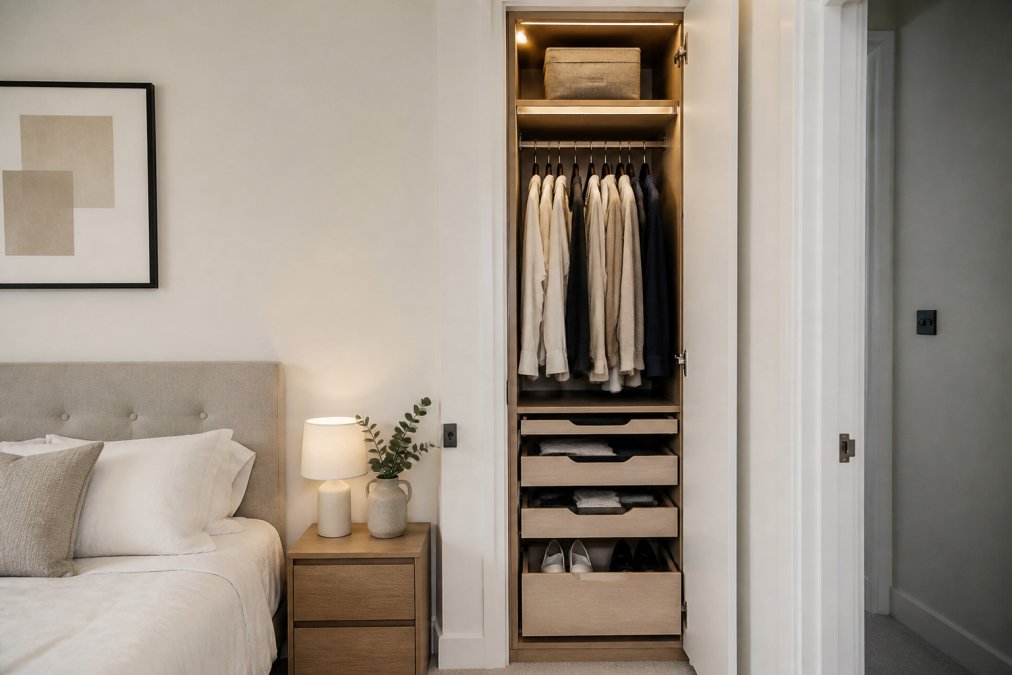
Table of Contents
- Why Narrow Bedroom Wardrobes Need Specialist Organisation
- Maximising Vertical Space in Narrow Wardrobes
- Bespoke Fitted Wardrobes vs. Modular Storage Systems
- Small Bedroom Storage Ideas That Actually Work
- Accessibility and Load-Bearing Considerations
- DIY Installation vs. Professional Fitting
- Decluttering and Wardrobe Editing for Narrow Spaces
- Frequently Asked Questions
Last Updated: September 24, 2026
Why Narrow Bedroom Wardrobes Need Specialist Organisation
Narrow bedroom wardrobes present a genuine design challenge. Standard storage solutions fail because they’re built for average-sized spaces, not the cramped footprints many homes have. A 60-80cm-wide wardrobe creates a depth-to-width ratio that makes conventional hanging rails and shelving impractical, leaving wasted corners and inaccessible items.
The real problem isn’t that you own too much. It’s that generic storage doesn’t account for the geometry of narrow spaces. According to Closets Creation’s expert ranking of closet organization systems, custom built-in systems are ranked as the top choice for small spaces precisely because they’re fully tailored to specific room dimensions. This matters more than you’d think. A 30cm shelf depth is recommended for small spaces to maximise organisation without encroaching on room floor space, yet most off-the-shelf units come in 35-40cm, eating into precious room volume.
Homeowners in narrow spaces typically fall into two camps: those who accept clutter as inevitable, and those who invest in solutions designed specifically for their constraints. The difference is whether their storage actually fits the space.
Maximising Vertical Space in Narrow Wardrobes
When floor space is limited, vertical storage transforms a narrow wardrobe into a functional asset. The trick is using every inch of height without creating instability or inaccessibility.
Floor-to-ceiling solutions force you to think in layers rather than rows. A 200cm-tall narrow wardrobe gives far more usable capacity than a wider one at standard height. Tension rods and hanging compartments can be stacked vertically, creating separate zones for different clothing categories, trousers, shirts, lightweight items, each with dedicated space.
Accessibility is key. Adjustable shelving lets you control height based on what you’re storing and how often you access it. Everyday items go at arm level, seasonal pieces higher, heavy items lower to avoid strain on narrow supports.
Stackable bins consolidate vertical space by grouping lightweight items in single bins, preventing shifting in narrow spaces where movement is limited.
Bespoke Fitted Wardrobes vs. Modular Storage Systems
Bespoke fitted wardrobes and modular systems solve the same problem differently. Which suits you depends on your space, budget, and permanence requirements.
Custom Built-In Solutions for Awkward Dimensions
Bespoke fitted wardrobes are engineered specifically for your room. A surveyor measures wall angles, ceiling height, and architectural quirks, then designs a system that uses 100% of available space. In narrow wardrobes with sloping ceilings or alcoves, this precision eliminates gaps that off-the-shelf units leave.
Load-bearing capacity matters in narrow spaces because weight distributes differently on slender supports. A properly engineered bespoke system ensures shelves don’t sag and rails don’t flex. A narrow wardrobe with inadequate support fails faster than a wider one, and failure is expensive.
Bespoke solutions handle accessibility better. You can specify shelf heights, drawer depths, and compartment widths based on actual needs. A bespoke solution with custom-sized drawers can be far more functional than one with standard-sized drawers.
The trade-off is permanence. A bespoke fitted wardrobe is built into your home and stays if you move. Modification is costly. This works for homeowners planning to stay put; for renters or those uncertain about their future, it’s less practical.
Modular and Adjustable Systems for Flexibility
Modular storage systems offer a different value proposition: flexibility. Rubbermaid custom closet kits are identified as a leading affordable solution for compact storage needs, according to Good Housekeeping’s 2026 storage guide. IKEA Boaxel is identified as the top modular design for flexibility in rearranging closet layouts, per Better Homes & Gardens’ organization systems review.
These systems combine individual components into configurations you can rearrange later. This flexibility is valuable for renters, those testing new approaches, or anticipating future changes.
The limitation is precision. Modular systems come in standard dimensions. A 60cm-wide wardrobe might accept a 55cm shelf, leaving gaps. You work around constraints rather than designing around your actual space, reducing full capacity.
Small Bedroom Storage Ideas That Actually Work
Storage that works depends on compartmentalisation, accessibility, and preventing compression chaos. A narrow wardrobe crammed with inaccessible items is barely better than no storage.
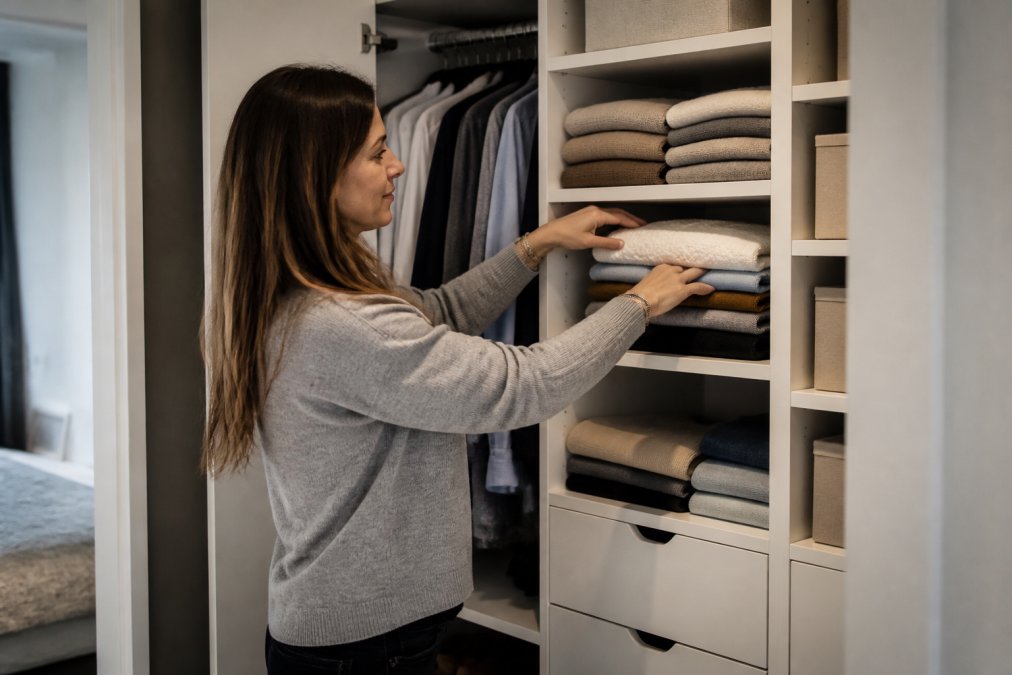
Maximising these vertical dimensions often requires a broader reassessment of how other bedroom furniture for small spaces integrates with your existing storage layout to maintain a sense of openness.
Hanging Storage and Compartmentalisation
Hanging storage should be your primary tool in narrow spaces. A single rail holds 25-30 items versus 8-10 folded stacks on a shelf.
The challenge is preventing items from shifting and becoming inaccessible. Items tangle and slip behind one another on a single rail, making retrieval difficult.
Hanging compartments (fabric dividers that hang from the rail) create separate zones for different clothing types, keeping each item in its designated area and preventing compression chaos. In a 60cm-wide wardrobe, 3-4 compartments at 15cm wide force intentional organisation.
Compartments improve visibility, letting you see each section at a glance, particularly valuable in narrow spaces where you can’t step back far enough to see the full width.
Tiered hanging systems double capacity by using vertical space efficiently. Two rails at different heights (100cm and 160cm) hold 50-60 items without expanding footprint. Reserve the lower rail for items you wear less frequently.
For narrow wardrobes, slim velvet or non-slip hangers (38-40mm wide) are essential. Standard plastic hangers (45-50mm) waste width. Avoid wire hangers, they rust, damage fabrics, and waste space.
Drawer Dividers, Shelf Inserts, and Stackable Solutions
Drawer dividers prevent stacks from collapsing when you remove items from the middle. In narrow wardrobes with limited shelf space, this chaos is costly because reorganising requires removing everything.
Shelf dividers and inserts create individual slots for folded items, preventing shifting and improving visibility. Shelf dividers and inserts create individual slots for folded items, preventing shifting and improving visibility. This can be beneficial in constrained spaces.
Choose dividers that are adjustable, sturdy (bamboo or rigid plastic), non-slip (with rubber feet), and at least 15cm tall to prevent toppling.
Stackable bins and boxes work well for seasonal clothing, workout gear, and accessories. Choose bin heights that match shelf heights precisely, wasted vertical space is costly in narrow wardrobes.
For narrow spaces, use shallow, wide bins (40cm wide × 25cm deep × 20cm tall) rather than tall, narrow ones. Choose clear or semi-transparent bins with handles for easy removal.
Practical Example: Organizing a 60cm-Wide Wardrobe
A thoughtfully designed layout for a narrow wardrobe can include pull-out drawers for knitwear and accessories, a hanging rail with fabric compartments, and shelves with stackable bins for seasonal items. This approach uses all available height, keeps everyday items accessible, and prevents dead zones.
A common mistake in narrow wardrobes is overloading the hanging rail. Limiting hanging to 25-30 items and using drawers or shelves for folded pieces creates a more functional system.
Accessibility and Load-Bearing Considerations
Narrow wardrobes create unique structural demands. Weight distributes differently on slender supports, and poor design leads to sagging shelves or warped rails within months, a problem that accelerates in confined spaces.
Load-Bearing Capacity in Narrow Spaces
A narrow wardrobe shelf experiences different stress patterns than a wider one. Without adequate internal bracing or wall anchors, shelves can sag over time.
Bespoke solutions outperform modular ones in narrow spaces because they’re engineered for specific geometry. A professionally designed narrow wardrobe includes appropriate bracing, wall anchors, and load-rated shelving materials to ensure durability and stability.
Modular systems rely on standard brackets rated for average spans. Manufacturers rarely specify load capacity for narrow spans, leaving users guessing.
The Dead-Zone Problem: Accessibility in Deep, Narrow Closets
The most overlooked accessibility challenge is the dead zone, items at the very back that are effectively inaccessible. In a 60cm-wide, 50cm-deep wardrobe, the back 15-20cm is nearly impossible to access. This dead zone becomes a dumping ground where clothes deteriorate from poor air circulation.
Pull-out drawers and baskets are the most practical. A 40cm-deep pull-out drawer in a 50cm-deep wardrobe brings back items within arm’s reach. Use smooth-running mechanisms (ball-bearing slides) rated for the weight you’re storing.
Rotating carousels or turntables work for smaller spaces. Rotating carousels or turntables can work for smaller spaces, rotating to bring items to the front and maximising deep corners.
Tiered hanging systems with forward-facing hooks allow items to hang at different depths.
Accessibility for Everyday Use
Everyday accessibility matters. Design your layout so items worn 3+ times per week are at arm level (90-150cm), seasonal pieces go higher or lower, heavy items stay on lower shelves, and lightweight items occupy higher shelves safely.
DIY Installation vs. Professional Fitting
The choice between DIY and professional installation hinges on three factors: complexity, precision, and permanence.
Decluttering and Wardrobe Editing for Narrow Spaces
The most overlooked aspect of narrow wardrobe organisation is ruthless editing. A narrow space forces this conversation. You cannot store everything, so you must choose what matters.
Frequently Asked Questions
What is the ideal shelf depth for narrow bedroom wardrobes?
A 30cm shelf depth is recommended for narrow bedroom wardrobes to maximise organisation without encroaching on floor space. This depth allows for efficient storage of folded items whilst maintaining accessibility in tight spaces. Deeper shelves can make retrieving items difficult in narrow wardrobes, so shallower configurations often work better for both functionality and ergonomics.
Are bespoke fitted wardrobes better than off-the-shelf organisers for narrow spaces?
Custom built-in systems are ranked as the top choice for narrow bedroom wardrobes because they can be fully tailored to specific room dimensions and awkward layouts. Bespoke fitted wardrobes accommodate sloping ceilings, understairs spaces, and depth-to-width constraints that off-the-shelf solutions cannot address. While modular systems offer flexibility, bespoke solutions maximise every centimetre of usable space and provide superior load-bearing capacity.
How can I organise a deep but narrow bedroom wardrobe?
Use tension rods and hanging compartments to create multiple layers within the depth, install drawer inserts and shelf dividers to compartmentalise folded items, and consider stackable bins for seasonal storage. Vertical storage is key, floor-to-ceiling solutions and wall-mounted accessories help you use the full height of the space. Lighting solutions also improve accessibility when reaching into deeper sections of narrow wardrobes.
What are the most space-efficient closet organisers for small bedrooms?
Modular shelving systems, adjustable hanging rails, and pull-out drawers are among the most space-efficient options for small bedrooms. Stackable bins and foldable designs reduce footprint whilst maintaining storage capacity. For maximum efficiency, combine vertical storage with door-back organisers and drawer inserts. Custom solutions tailored to your room’s exact dimensions deliver the best results for genuinely small spaces.

