

Last Updated: October 22, 2026
Quick Summary
Choosing internal fittings for sloped wardrobes starts by measuring usable height at the back, middle and front, then splitting the run into low, mid and full-height bands. Match fittings to each band: pull-out shoe racks and low drawers under 1 m, short rails and adjustable shelves from 1 m to 1.6 m, and long or double rails above 1.6 m.
- Record lowest height, highest height, depth and angle before specifying any fittings.
- Allow roughly 150-170 cm of drop below a rail for long coats and dresses.
- Internal drawers work best in the mid band where height stays steady.
- Fix rails and shelves into solid structure, not just plasterboard.
- A metre of densely hung coats can weigh 30-50 kg.
Table of Contents
- Start With the Slope, Not the Fittings
- How to Measure a Sloped Wardrobe Before You Specify Anything
- Matching Fitting Types to Usable Height
- Getting the Sloped Wardrobe Hanging Rail Right
- Wardrobe Drawers Under a Sloping Ceiling: Clearance and Access
- Sloped Ceiling Wardrobe Storage Ideas That Use the Low Side
- Fitting It Yourself: Load Limits and Safety
- Frequently Asked Questions
Start With the Slope, Not the Fittings
Choosing internal fittings for sloped wardrobes starts with the ceiling, not the catalogue. The angle decides what fits, what opens, and what you can actually reach. Get that wrong and even good fittings waste space.
At Finest Furniture Studio, we design fitted wardrobes for loft rooms, eaves and alcoves where the ceiling line changes everything. The slope is the brief. Fittings serve it.
Here is the core idea most guides skip: a sloped wardrobe is not one wardrobe. It is a series of height bands, each suited to different storage.
Below, we show you how to measure the slope, match fittings to usable height, and avoid the mistakes that make angled storage awkward.
Measure usable height at the back, middle and front of the run. That three-band map tells you exactly which fittings belong where.
How to Measure a Sloped Wardrobe Before You Specify Anything
To measure a sloped wardrobe, record the ceiling height at several points along the run, plus the available depth and the angle. One height reading is not enough, because the ceiling falls as you move back.
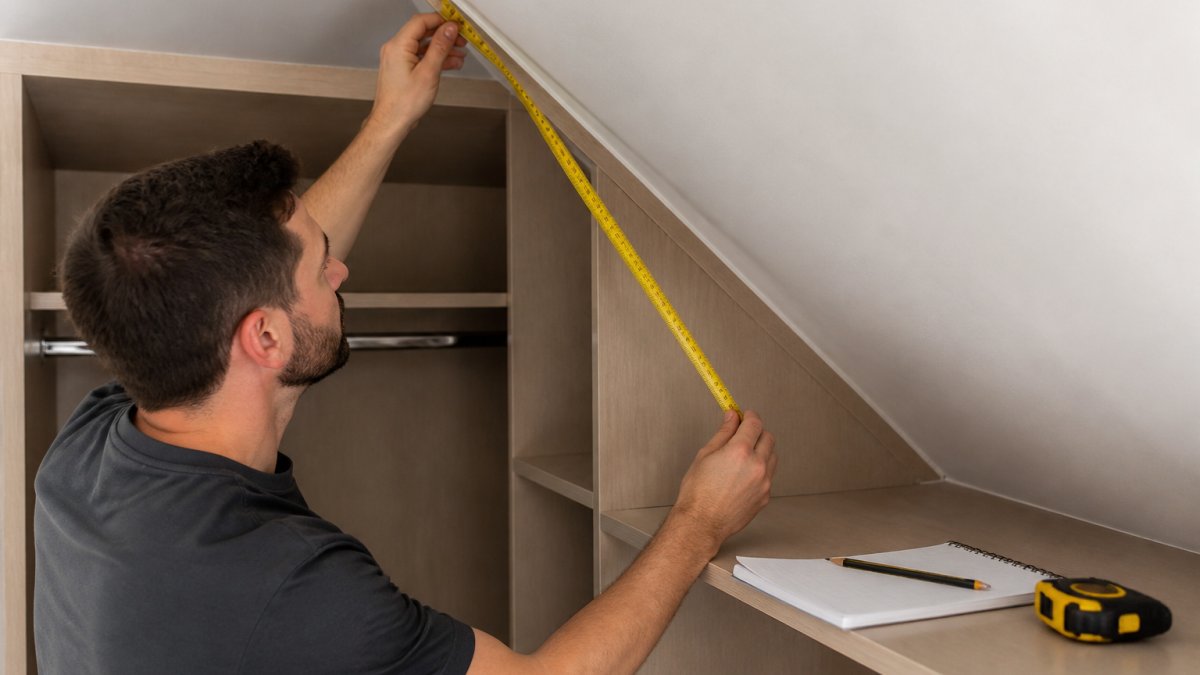
You need four numbers:
- Lowest height: where the ceiling meets the back wall or eaves
- Highest height: at the tallest point of the opening
- Depth: from the front frame to the back wall
- Angle: the rise and run of the slope, which sets how fast height changes
Measure to the nearest centimetre and write everything down. Guessing here costs you later.
The government guidance on safe loft conversions is worth a look if the room is a conversion, since headroom and structure affect what you can fix to.
Mapping the Slope in Three Height Bands
Split the run into three bands: low, mid and full height.
- Low band (under the eaves): under roughly a metre of usable height
- Mid band: the transition zone where height climbs
- Full-height band: the tallest section, usually at the front
Mark each band on a simple sketch. This map is what you hand to a designer or fitter. It shows where a hanging rail works and where it cannot.
Photograph the empty space with a tape measure held against the ceiling at each band. A fitter can read those photos faster than any description.
Matching Fitting Types to Usable Height
The right fitting depends on usable height, not on what looks good in a brochure. Match the fitting to the band and the wardrobe works. Force it and you lose access.
Use this as your decision guide:
| Usable height | Best fittings | Avoid |
|---|---|---|
| Under 1 m (low band) | Pull-out shoe racks, low drawers, open shelving | Full hanging rails, deep drawers |
| 1 m to 1.6 m (mid band) | Short hanging rails, adjustable shelves, internal drawers | Long rails, tall pull-outs |
| Over 1.6 m (full band) | Long hanging rails, double rails, fixed top shelves | Bulky drawer stacks |
A made-to-measure angled fitted wardrobe lets each band carry the fitting it suits. Off-the-shelf units rarely allow that.
For the low band, think horizontally. Shoe storage, folded items and occasional-use boxes all work well down there. For the tall band, hanging space earns its place.
Putting a full-length hanging rail in a low section means clothes drag on the base and the rail sits unusable. Measure the drop before you commit.
Getting the Sloped Wardrobe Hanging Rail Right
A sloped wardrobe hanging rail must sit where clothes hang clear of the base and stay reachable. In most cases that means the rail belongs in the full-height band, with a shorter rail in the mid band. But the rail itself, its type, height and hardware, needs as much thought as its position.
Calculating the Drop Before You Fix Anything
Rail height is set by what you hang. Work backwards from the longest garment:
- Long coats and dresses: allow roughly 150-170 cm of drop below the rail
- Shirts, blouses and jackets: allow roughly 90-110 cm
- Trousers on hangers: allow roughly 70-90 cm
- Skirts and shorts: allow roughly 50-70 cm
Add the rail’s own diameter and a few centimetres of clearance above the floor, then check that total against the usable height in each band. A long rail only belongs where the ceiling gives you the full drop. In the mid band, a short rail for shirts or trousers is usually the better fit.
Comparing Rail Options
Not all rails suit a sloped run. Here is how the main options compare:
| Rail type | Best for | Trade-offs |
|---|---|---|
| Standard round rail | Full-height band, everyday hanging | Simple and cheap, but fixed height |
| Oval rail | Heavier loads, long runs | Stronger than round, slightly pricier |
| Double rail | Full-height band with two tiers | Doubles capacity, needs more height |
| Pull-down rail | High sections above eye level | Brings clothes within reach, adds hardware cost and a moving part |
| Short mid-band rail | Transition zone | Limited drop, suits shirts and trousers only |
A pull-down rail is worth considering where the ceiling is tall but the floor space is tight, it lets you use the upper band without a step stool. The trade-off is extra hardware and a mechanism that needs to run smoothly.
Hardware That Keeps a Loaded Rail Steady
Hardware matters as much as position:
- Risers lift the rail so garments clear the base
- Anti-jump fittings stop hangers sliding off the end
- Heavy-duty end supports keep a loaded rail from sagging
- Soft-close fittings on drawers prevent slamming
Fix the rail into solid structure, not just plasterboard. A loaded rail is heavy, and a sloped ceiling gives fewer solid fixing points, so plan the fixing positions before the wardrobe interior goes in.
Our fitted wardrobes come with a 10-year warranty, so the hardware is built to last rather than replaced in a few years.
Wardrobe Drawers Under a Sloping Ceiling: Clearance and Access
Wardrobe drawers under a sloping ceiling need enough clear space in front to pull out fully, plus enough height above to open without catching the slope. Skip either and the drawer jams or stays half-used.
Check three clearances:
- Pull-out depth: the drawer needs its full depth clear in front
- Head clearance: the top of the drawer must clear the slope as it opens
- Handle space: leave room for your hand and the handle
Internal drawers work best in the mid band, where height is steady. In the low band, shallow drawers beat deep ones. A deep drawer under a low ceiling is hard to see into and harder to use.
For pull-outs near a slope, choose shallow drawers with soft-close runners. They open clear of the angle and close quietly.
Sloped Ceiling Wardrobe Storage Ideas That Use the Low Side
The low side is where most sloped wardrobes waste space. Used well, it holds the things you reach for least and frees the tall side for hanging.
Five storage ideas that work:
- Pull-out shoe racks in the low band, where height is tight
- Low drawers for folded knitwear and accessories
- Open shelving for boxes, bags and seasonal items
- Adjustable shelves that shift as your storage needs change
- Fixed shelves at the very bottom for heavy, rarely used items
Adjustable shelves give you flexible storage that adapts over time. Fixed shelves suit the deepest, least reachable corners.
A bespoke wardrobe interior planned around these bands turns dead space into usable space. That is the whole point of custom design in an awkward room.
Fitting It Yourself: Load Limits and Safety
Fitting internal cabinetry yourself is possible for simple shelves and rails, but load limits and fixing points decide whether it stays safe. A loaded hanging rail is heavy, and a sloped ceiling gives fewer solid fixing points. This is the part most guides skip, so here is what actually matters.
What Loads You Are Asking Fixings to Carry
A hanging rail loaded with winter coats can weigh far more than people expect. As a working guide:
- A metre of densely hung coats can weigh 30-50 kg
- A shelf of folded knitwear can weigh 15-25 kg per metre
- A pull-out shoe rack fully loaded can weigh 10-20 kg
These are rough figures, but they show why fixings matter. A rail held by two screws into plasterboard will not carry a full winter wardrobe. Fix into timber studs, masonry, or a properly anchored batten, and use fixings rated for the load, not the lightest ones in the box.
Checking the Structure Before You Drill
Before you fit anything:
- Identify what the wall and ceiling are made of, plasterboard, lathe and plaster, masonry or timber
- Find the studs or joists with a detector, and mark them
- Fix rails and shelves into solid structure, not just the plasterboard skin
- Keep heavy items low and light items high
- Leave access for doors and drawers to open fully
In a loft conversion, the ceiling may be a lined-out slope with shallow rafters. That limits both fixing depth and load. If you cannot find solid structure, do not guess.
When to Call a Professional
A professional fit is the safer choice when:
- The slope is steep or the ceiling structure is unclear
- You need a pull-down rail or other moving hardware
- The run is long enough that sagging becomes a risk
- The wardrobe interior needs to be scribed to an uneven ceiling line
A poorly fixed rail can pull free under the weight of winter coats, and repairing the damage costs more than fitting it properly the first time.
At Finest Furniture Studio, our 7-day fitting service and free design visit take the guesswork out of angled rooms. We map the slope, specify the fittings and install to suit, so the load is carried by structure rather than hope.
Frequently Asked Questions
What fittings work best in a wardrobe under a sloping ceiling?
It depends on the height at each point. In the tall section, a full-length hanging rail plus a high fixed shelf works well. In the mid band, a shorter hanging rail for shirts and jackets sits comfortably. In the low band, use adjustable shelves, internal drawers and pull-out shoe racks rather than hanging space. Splitting the wardrobe into these height bands before you choose any hardware stops you buying fittings that will not physically fit once the carcass is in place.
How do you fit a hanging rail in a sloped wardrobe?
Set the sloped wardrobe hanging rail at the lowest point where garments still clear the ceiling above, usually measured from the floor up rather than from the slope down. Fit the rail to the carcass sides with heavy-duty brackets, not just the back panel, and check the rail is level even though the ceiling above it is not. For long garments, drop the rail to the tallest part of the run; for shirts, a second rail in the mid band adds capacity without fouling the slope.
Where should drawers go in a wardrobe with a sloping ceiling?
Put wardrobe drawers under the sloping ceiling at the low end, where hanging space is unusable but floor-level access is still comfortable. Allow enough clear floor in front of each drawer for it to pull out fully, and avoid placing drawers so high that you cannot see inside them. Internal drawers on soft-close runners work best here, and shallow drawers suit folded items while deeper ones take bedding. Check the drawer front clears the door swing before finalising the layout.
Can you use standard wardrobe fittings in a sloped wardrobe?
Many standard rails, shelves and drawer boxes can be used, but the carcass and infills usually need to be made to measure so the fittings sit at the right height along the slope. Off-the-shelf units assume a level ceiling, so the top panel will not follow the angle. Adjustable shelves and modular internal cabinetry give you the flexibility to fit standard components into a custom-shaped shell, which is usually the most practical route in a loft room or understairs space.

