

Table of Contents
- Why Loft Conversion Eaves Storage Matters
- Under-Eaves Storage Ideas That Work
- Loft Storage Drawers: Integrated Solutions
- Sliding Doors for Loft Eaves
- Storage Under Sloping Ceilings
- Shelving and Floating Storage for Eaves
- Making the Most of Awkward Angles
- Frequently Asked Questions
Last Updated: October 18, 2026
Why Loft Conversion Eaves Storage Matters
Loft conversions transform unused attic space into functional rooms. But they come with a challenge: sloping ceilings and awkward angles. These spaces waste valuable real estate. Most homeowners leave them empty or dump clutter there.
The truth is simple. Creative storage solutions for loft conversion eaves turn dead space into organized storage. A well-designed eaves storage system can add 15-20% more usable storage to your loft bedroom or office.
Custom-fitted storage works where standard furniture fails. It fits perfectly into sloping ceilings, alcoves, and under-roof spaces. The result is a room that feels bigger, more organized, and genuinely liveable.
This guide covers the best creative storage solutions for loft conversion eaves. We’ll show you practical ideas you can implement today, whether you’re planning a DIY approach or investing in bespoke furniture.
Under-Eaves Storage Ideas That Work
The space between the floor and the sloping ceiling is prime real estate. Most people ignore it. Smart homeowners maximize it.
Built-in cupboards and fitted wardrobes
Built-in cupboards are the gold standard for eaves storage. They fit flush against sloping ceilings without wasting a millimetre of space. Unlike freestanding furniture, they work with the room’s geometry instead of fighting it.
Fitted wardrobes are ideal for bedrooms. They provide hanging space for clothes, shelves for accessories, and drawers for smaller items. The key is designing them to follow the roof line.
Bespoke wardrobes offer the best solution because they’re custom-built for your exact measurements. A standard wardrobe leaves gaps or doesn’t fit at all. Bespoke furniture solves this completely.
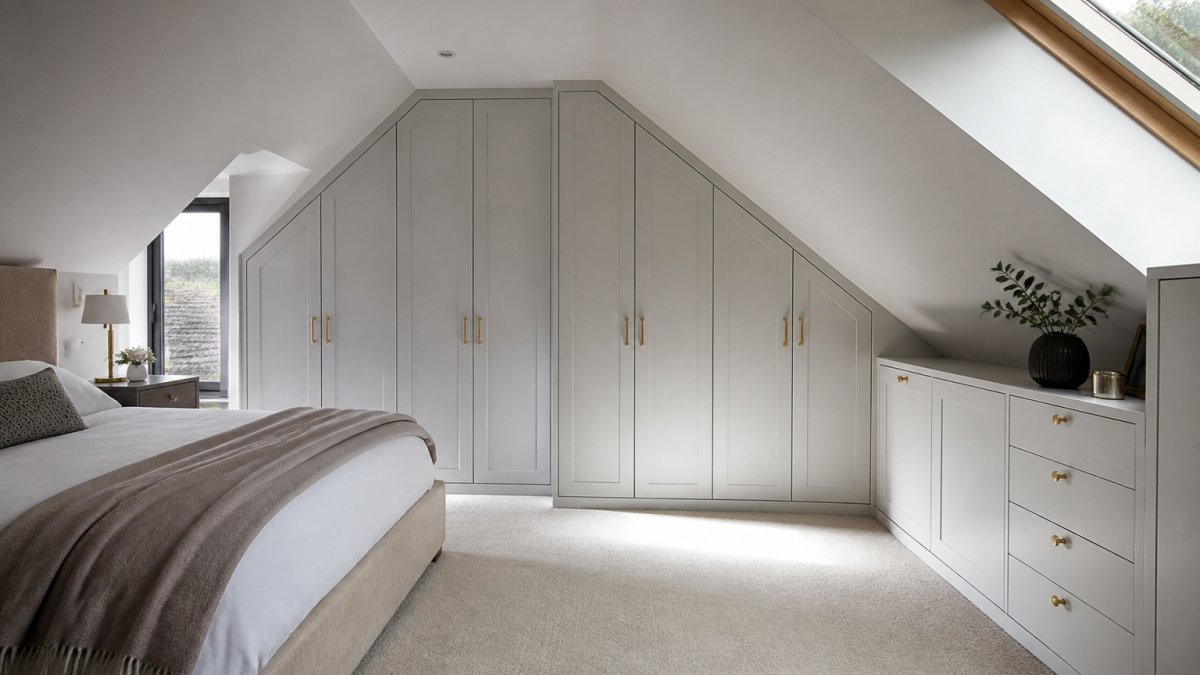
Consider these features when planning fitted wardrobes:
- Hanging rails at varying heights to use the full space
- Shelves that step back to follow the slope
- Drawers at the base for heavier items
- Interior lighting for easy access
- Soft-close doors to prevent slamming in tight spaces
Window seat storage
Windows in loft rooms are often positioned low due to the sloping ceiling. This creates an opportunity. A window seat with built-in storage underneath serves double duty: seating and storage.
Window seat storage works brilliantly for storing blankets, cushions, seasonal items, or books. It keeps clutter off the floor and out of sight. The seat itself becomes a cosy spot to read or work.
The design is straightforward. A hinged or lift-up lid reveals storage underneath. Cushions on top make it comfortable. This approach maximizes the awkward space around windows.
Loft Storage Drawers: Integrated Solutions
Drawers built into the eaves are underrated. They slide smoothly, hide clutter completely, and use space efficiently. Most people think of drawers as small accessories. In reality, integrated drawer systems can store enormous amounts.
The best loft storage drawers are custom-built to fit specific spaces. They follow the slope of the ceiling and maximize depth.
Key advantages of integrated drawers:
- Silent, smooth operation with quality slides
- Easy access without bending excessively
- Dust-proof design keeps items clean
- Customizable dividers for organization
- Can be designed to match your décor
Finest Furniture Studio designs drawer systems that work in tight spaces. This requires precise measurement and expert installation.
Sliding Doors for Loft Eaves
Swing doors don’t work in tight loft spaces. They hit the sloping ceiling or take up floor space when open. Sliding doors solve this problem elegantly.
Sliding doors for loft eaves come in several styles. Bypass doors slide past each other. Pocket doors slide into the wall. Both save valuable floor space and look modern.
The advantages are clear:
- No door swing means more usable floor space
- Smooth, quiet operation
- Modern aesthetic that suits contemporary lofts
- Easy to customize with mirrors or glass
- Works even in the tightest corners
Consider the track system carefully. Quality tracks ensure smooth, reliable operation for years. Poor-quality tracks jam and frustrate. Invest in solid hardware from the start.
Storage Under Sloping Ceilings
The challenge with sloping ceilings is that standard storage doesn’t fit. The ceiling gets lower as you move away from the centre. This creates an awkward zone where most furniture won’t work. But the bigger risk is not the furniture, it’s what happens behind it. Fitting storage into eaves without planning for insulation, ventilation, and access is the most common way loft storage goes wrong.
Planning for insulation and ventilation
Before installing storage under sloping ceilings, check your insulation and ventilation. Many loft conversions have insulation between rafters. Storage must not block airflow or compress insulation. Compressing mineral wool insulation reduces its thermal performance, and blocking the ventilation path at the eaves can trap moist air.
Work with your builder or surveyor to understand your loft’s setup. A common pattern is a 50 mm ventilation gap between the back of the storage unit and the insulation face, maintained top and bottom so air can move through the eaves.
Ensure storage doesn’t seal off the eaves completely. Air needs to flow through. This keeps the room dry and prevents damage to the structure.
Never compress insulation to make a wardrobe fit. If the depth is tight, reduce the wardrobe depth or use a shallower carcass, do not squash the insulation.
Access and usability in tight spaces
Storage in tight spaces must be accessible. A cupboard you can’t reach is useless. Design storage so you can actually use it comfortably.
Consider these practical points:
- Shelves should be reachable without climbing.
- Drawers need space to open fully.
- Hanging rails should be at comfortable heights.
- Lighting inside storage areas makes finding things easier. Battery-powered LED strip lights avoid the need to run mains cable into a confined void.
- Handles and pulls should be easy to grip. Recessed finger pulls are a good choice where space is tight.
Access panels matter more than most homeowners expect. If a boiler, stopcock, or ventilation unit sits behind the eaves storage, fit a hinged or removable access panel rather than sealing it in.
Load limits are another practical consideration. Shelves fixed to plasterboard alone will sag or pull out. Fix shelving and wardrobe carcasses into the rafters or studwork using appropriate structural screws, and keep heavy items such as luggage and toolboxes low and over a load-bearing wall where possible.
The best creative storage solutions for loft conversion eaves balance maximum capacity with genuine usability. A storage system that’s awkward to use gets abandoned. Make it easy, and you’ll actually use it.
Measured layouts for different eaves heights
Eaves height varies enormously between lofts, and the right solution changes with it. As a guide:
- Low eaves (under 900 mm at the wall): shallow cupboards or open shelving no deeper than 350 mm, or lift-up floor hatches. Avoid wardrobes, there is not enough headroom to hang clothes.
- Medium eaves (900-1,400 mm): the sweet spot for fitted wardrobes with a sloping back. A carcass that steps back to follow the roof line gives full-height hanging at the front and shelving at the rear.
- Taller eaves (over 1,400 mm): full-height fitted wardrobes, integrated drawers, and even a small desk or dressing area can work, provided the ventilation path is maintained.
Sketch the roof line on paper before you buy anything, and you will quickly see which storage types will fit and which will not.
Shelving and Floating Storage for Eaves
Shelving works beautifully in loft eaves when designed correctly. Floating shelves create a clean, modern look. They also maximize space because there are no legs or supports taking up floor area.
Custom shelving follows the slope of the ceiling. Each shelf can be a different depth. This creates a stepped, organized appearance that looks intentional rather than improvised.
Floating shelves work well for:
- Books and decorative items
- Storage boxes and baskets
- Plants and artwork
- Collections and memorabilia
- Everyday items you want visible but organized
Install shelving on solid backing. Loft walls often have rafters behind them. Shelves must attach to these structural elements, not just drywall. This ensures they’re safe and won’t sag over time.
Making the Most of Awkward Angles
Loft conversions have angles that standard furniture simply cannot accommodate. Corners where two sloping ceilings meet. Spaces between the roof and walls. These awkward zones either become dead space or opportunities. The difference usually comes down to how carefully the space is measured and how honestly you compare the options.
Bespoke furniture for non-standard spaces
This is where bespoke furniture shines. Standard pieces are designed for rectangular rooms. Your loft isn’t rectangular. It has angles, slopes, and quirks.
Bespoke furniture is built for your specific space. A bespoke cabinet fits exactly into that angled corner. A custom shelving unit follows the exact slope of your roof. Nothing is wasted. Nothing is left empty.
But bespoke is not the only route, and it is worth understanding the trade-offs before you commit:
- Ready-made furniture: cheapest and quickest, but rarely fits a sloping ceiling without gaps. Best for low eaves where a shallow bookcase or a set of stacking boxes will do.
- DIY fitted storage: a mid-range option for confident DIYers. A timber frame clad in MDF, finished with paint, can work well in a simple eaves run, but getting the slope right and fixing safely into rafters takes care. Budget for mistakes.
- Bespoke joinery: the highest-quality fit and the best use of awkward angles, with interior layouts tailored to what you actually store. It costs more and takes longer, but it is the only option that reliably solves corners where two slopes meet.
A useful rule of thumb: if the angle is more than about 15 degrees off square, ready-made furniture will leave a visible gap or a useless void.
Finest Furniture Studio specialises in solving these awkward-space problems. We measure precisely, design carefully, and build furniture that transforms unusable areas into functional storage. The result feels like the room was always meant to have that storage there.
Storage by frequency of use
Smart storage organisation puts frequently used items in easy-to-reach places. Items you rarely need go in less convenient spots. This sounds obvious, but most people get it backwards.
Organise your loft eaves storage this way:
- Daily use items: eye level, easy to access, everyday clothing, phone chargers, current reading.
- Weekly use items: slightly higher or lower, still accessible, shoes, bags, workwear.
- Seasonal items: upper shelves, corners, less convenient spots, winter coats, fans, holiday decorations.
- Archive storage: deepest, least accessible areas, old paperwork, sentimental items, spare bedding.
Match the storage type to the item as well as the frequency. Hanging rails suit clothing; deep drawers suit bedding and towels; open shelving suits books and boxes; lift-up seats suit occasional items you want out of sight. Luggage is best stored low and towards the centre of the room where headroom is greatest, not crammed into the lowest eaves corner where it is hard to retrieve.
This approach means you’re not constantly reaching into awkward spaces for things you use regularly. Your daily life becomes easier. Your loft stays organised.
Label archive boxes on the end facing the room, not the lid. In a low eaves cupboard you will see the end of the box far more often than the top.
Frequently Asked Questions
What can you store in loft conversion eaves?
Loft conversion eaves work well for seasonal items, bedding, off-season clothing, books, and rarely-used household goods. Built-in drawers suit smaller items like accessories and documents. Shelving holds decorative pieces or storage boxes. The key is storing items you access infrequently, keeping everyday essentials in more accessible areas of your bedroom or home office.
Can you put drawers in loft eaves?
Yes. Integrated drawers are one of the most practical solutions for loft eaves because they maximise vertical space and keep contents hidden and dust-free. Drawers work especially well where headroom is limited, they slide smoothly without needing doors that swing open. Bespoke fitted drawers can be designed to fit precisely around sloping ceilings and awkward angles.
How do you make full use of eaves space in a loft conversion?
Combine multiple storage types: fitted wardrobes along longer walls, integrated drawers for under-slope areas, shelving for lighter items, and window seat storage to capture unused corners. Plan storage by frequency of use, everyday items in accessible spots, seasonal or archived items deeper in eaves. Proper lighting and ventilation ensure the space stays functional and healthy long-term.
Are sliding doors a good option for eaves storage?
Sliding doors are excellent for loft eaves because they require minimal swing space in tight rooms. Unlike hinged doors, they won’t obstruct pathways or bump into sloping ceilings. They’re especially useful for fitted wardrobes and cupboards where headroom is limited. Sliding mechanisms can be customised to fit non-standard widths and angles common in loft conversions.

