
Table of Contents
- Why Custom Wardrobe Design Beats Off-the-Shelf for Children’s Rooms
- Children’s Bedroom Storage Ideas That Actually Work
- Fitted Wardrobes for Small Rooms: Making Every Centimetre Count
- Bespoke Bedroom Furniture That Grows With Your Child
- Safety, Materials and Ergonomics: What Parents Need to Know
- How the Custom Wardrobe Design Process Works
- Frequently Asked Questions
Last Updated: September 16, 2026
Why Custom Wardrobe Design Beats Off-the-Shelf for Children’s Rooms
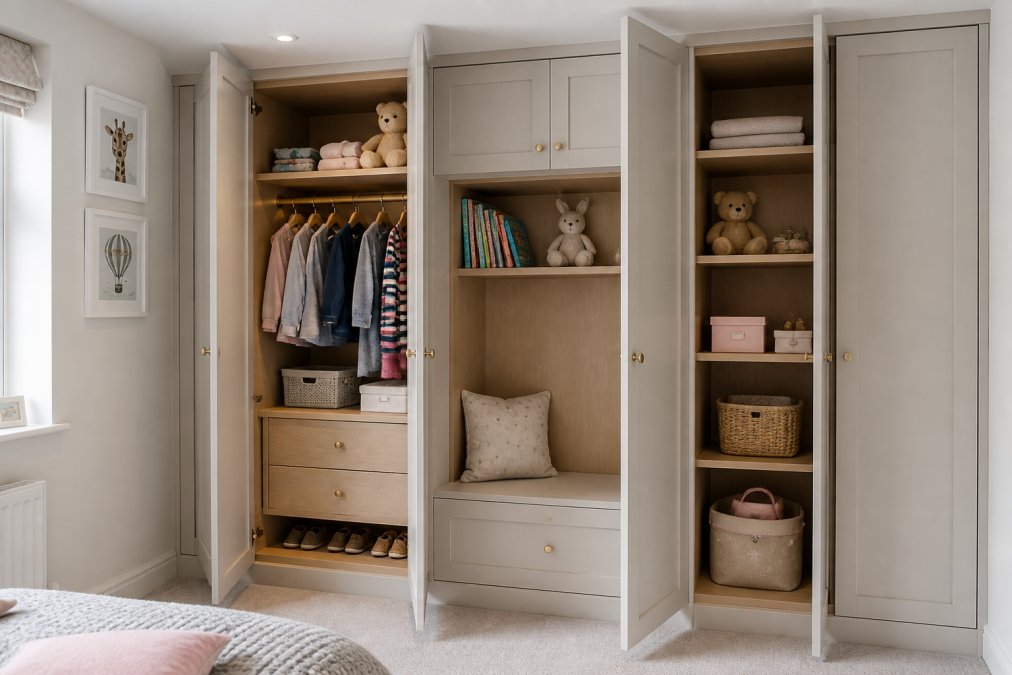
Custom wardrobe design for children’s rooms solves a problem that flat-pack furniture simply cannot: a child’s room changes constantly, and standard units are built for a hypothetical average child who does not exist. This guide from Finest Furniture Studio explains how bespoke storage adapts to real rooms, real growth spurts and real clutter.
The difference shows up in three places:
- Usable volume: bespoke cabinetry fills awkward corners that freestanding units leave empty.
- Safety: fitted wardrobes are anchored to the wall as standard, removing tip-over risk.
- Longevity: a well-built carcass with durable finishes can be re-fitted as needs change, rather than replaced.
Children’s Bedroom Storage Ideas That Actually Work
Storage that works is storage a child can actually reach and use. That means low hanging rails, open baskets at floor level and shelving scaled to small hands, not adult-height rails that turn every morning into a climbing exercise.
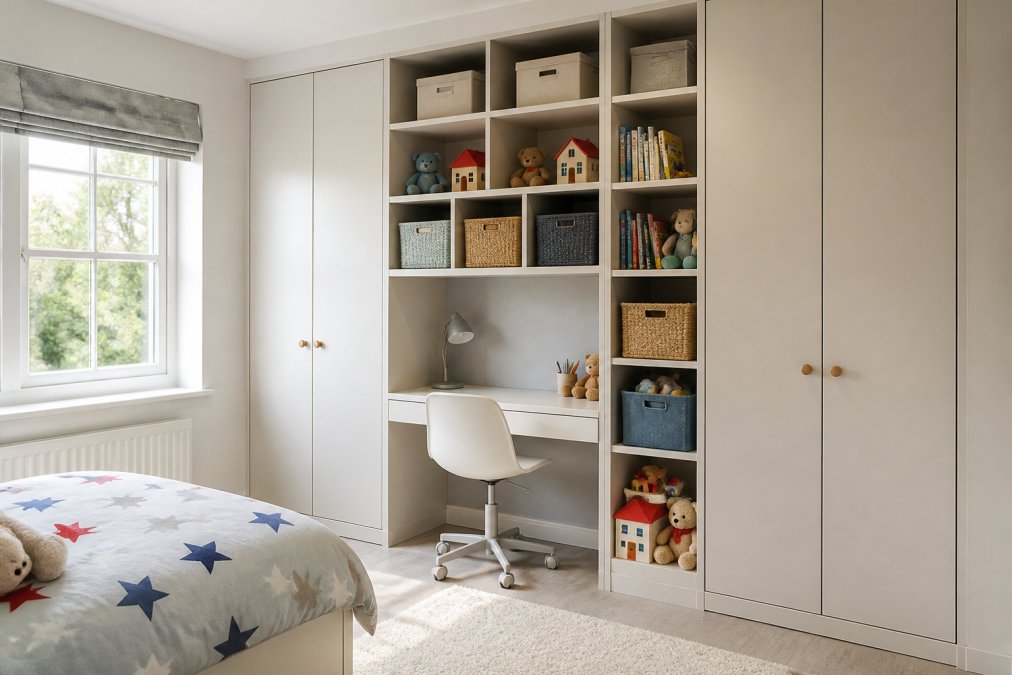
Three configurations cover most rooms:
- Floor-to-ceiling run: maximum volume along one wall, with the top third reserved for off-season items.
- Alcove build: turns a dead recess beside a chimney breast into full-height storage.
- Cabin bed with integrated drawers: pairs sleeping space with under-bed storage in one footprint.
Internal Storage Configurations: Drawers, Hanging Rails and Shelves
A practical split for a primary-school-age child is roughly half hanging space, a quarter drawers and a quarter open shelving. Hanging rails should sit at a height the child can reach without a stool, with a second, higher rail added later.
Sliding Doors vs Hinged Doors for Small Bedrooms
Sliding doors win in small bedrooms because they need no swing clearance. A hinged door can demand 60cm of clear floor space in front of the wardrobe, which is often the difference between a usable room and a cramped one.
If you choose sliding doors, specify a track system with a soft-close mechanism. Cheaper tracks are the single most common failure point on sliding wardrobes, and replacing them later means dismantling the doors.
Fitted Wardrobes for Small Rooms: Making Every Centimetre Count
Fitted wardrobes for small rooms earn their keep by using the full height and depth available. Standard units stop short of the ceiling and leave a gap above that collects dust and nothing else.
Maximising Space in Compact and Awkward Layouts
Awkward layouts are where custom joinery pays for itself. Sloping ceilings, boxed-in pipework, chimney breasts and understairs recesses all defeat standard furniture, but each can be boxed, stepped or angled around.
A few approaches that work well:
- Angled tops follow a sloped ceiling rather than leaving a triangular void.
- Stepped carcasses wrap around a chimney breast and use the return walls.
- Shallow-depth units at 35cm to 40cm suit narrow rooms where a full-depth wardrobe would block the door.
Bespoke Bedroom Furniture That Grows With Your Child
Bespoke bedroom furniture that grows with a child is designed around adjustable components rather than a fixed layout. The carcass stays; the interior changes. This is the single biggest advantage bespoke joinery has over flat-pack, and it is the part most buying guides skip entirely.
Adapting Designs for Different Age Groups
The needs shift predictably, and the design should be planned around that shift from day one. The table below sets out the priorities by stage.
| Age group | Priority storage | Key design feature |
|---|---|---|
| Toddler (2-4) | Open baskets, low shelves | Rounded edges, no climbable rails |
| Primary (5-10) | Reachable hanging, drawers | Adjustable rail heights |
| Teen (11+) | Full-height hanging, shelving | Integrated desk and mirror |
Ergonomics for Different Developmental Stages
Most guides stop at aesthetics. The practical detail that matters is reach. A useful rule of thumb is that a child can comfortably use anything between roughly shoulder height and knee height, so the everyday zone should sit in that band and everything above it should be reserved for adults or seasonal items.
- Toddlers (2-4): hanging rails set low, around 90cm to 100cm from the floor, so a child can pull a coat off without a stool. Drawers should be shallow and light enough to open with one hand, and handles should be large, rounded pull styles rather than small knobs that are hard for small fingers to grip.
- Primary age (5-10): a second rail can be added above the first as the child grows, and a low drawer bank becomes the natural home for school uniform and PE kit. This is the stage where a pull-out shelf or a shallow homework surface earns its place.
- Teens (11+): the low rail is removed and a full-height rail fitted in its place, with shelving above for bags and boxes. A full-length mirror and a charging point inside or beside the wardrobe are the two additions teenagers actually ask for.
Planning Adjustability Into the Carcass
Adjustability is cheap when it is designed in and expensive when it is retrofitted. Three details make the difference:
- Rail positions: specify at least two sets of drillings for hanging rails so the rail can be dropped or raised as the child grows.
- Shelf peg holes: a full run of peg holes up both side panels lets shelves be repositioned without new drilling.
- Modular internals: drawer banks and shelving units that sit on the base of the wardrobe, rather than being fixed to it, can be swapped out as needs change.
Safety, Materials and Ergonomics: What Parents Need to Know
Safety and material choice are the two areas where parents should ask the most questions. Fitted furniture should be fixed to the wall as standard, and finishes should be low-emission and easy to wipe clean. The third area, durability, is the one that determines whether the wardrobe still looks right in ten years.
Child-Safe Features and Non-Toxic Material Sourcing
Look for soft-close hinges and drawer runners, rounded or chamfered edges on exposed surfaces, and ventilation gaps where a wardrobe sits against an external wall. Wall-fixing is non-negotiable on any unit over waist height.
A few specifics worth raising with a designer:
- Board: low-emission MDF or plywood, with the formaldehyde class confirmed in writing rather than assumed.
- Finish: water-based lacquer or a low-VOC paint, which cures faster and smells far less than solvent-based alternatives.
- Adhesives and edge banding: these are often overlooked, but they contribute to emissions just as the board does.
- Ventilation: a small gap behind the carcass where it meets an external wall helps prevent condensation and mould.
Skipping wall-fixing on a tall wardrobe is the most serious mistake in a child’s room. A freestanding or unfixed unit can tip forward if a child climbs or pulls on an open drawer.
Maintenance and Durability: Keeping the Wardrobe Looking New
A child’s wardrobe takes more punishment than almost any other piece of furniture in the home, so the finish and hardware matter as much as the layout.
- Cleaning: a damp cloth and a mild soap solution is enough for most lacquered and laminate finishes. Avoid abrasive creams and scouring pads, which dull the surface and leave scratches that collect dirt.
- Drawer runners and hinges: these are the parts that fail first. Soft-close mechanisms can be adjusted with a screwdriver as they loosen, and most quality hinges allow the door to be re-aligned without removal.
- Sliding door tracks: vacuum the track regularly to stop grit building up, and check the rollers for wear once a year. A track that starts to judder is usually telling you the rollers need replacing, not the doors.
- Touch-ups: water-based lacquers can often be spot-repaired, whereas laminate and melamine edges tend to chip and are harder to disguise. If the room is likely to see heavy use, a painted finish is usually the more forgiving choice.
- Updating rather than replacing: handles, knobs and internal fittings can be swapped as tastes change, which is far cheaper than replacing the carcass.
How the Custom Wardrobe Design Process Works
The process runs from a free design visit through to installation, and it is shorter than most parents expect. At Finest Furniture Studio, the sequence is designed to keep disruption to a minimum, with a 7-day fitting service once the design is agreed.
- Free design visit. A designer measures the room, photographs awkward features and discusses how the child uses the space.
- Design and quote. You receive a layout drawing and a clear, itemised price with no hidden fees.
- Material and finish selection. Board, finish and hardware are chosen together so the quote stays accurate.
- Manufacture. Units are built to the measured dimensions of your room.
- Installation. Fitting is completed within the 7-day window, with the room left clean.
- Aftercare. Wardrobes are covered by a 10-year warranty.
Measure first, design second. The awkward features in a room are usually the reason custom wardrobe design is worth the investment in the first place.
Frequently Asked Questions
How much does it cost to build a custom wardrobe for a child’s room?
Pricing for custom wardrobe design depends on the size of the space, the materials you choose, and the internal fittings such as drawers, hanging rails, and shelving. A free design visit gives you a clear, itemised quote with no hidden fees. For current pricing, visit the Finest Furniture Studio website or book a consultation to discuss your specific requirements and budget.
What safety features should be included in custom children’s furniture?
Child-safe features include soft-close hinges to prevent trapped fingers, rounded edges on drawers and doors, and secure wall-fixing for all tall units. Avoid heavy freestanding pieces that a child could pull over. Bespoke fitted furniture is anchored to the wall, which removes tipping risk entirely. Also specify non-toxic finishes and low-VOC paints, especially for younger children who may chew or touch surfaces frequently.
How can custom wardrobe designs adapt as a child grows?
Modular internal fittings let you reconfigure the wardrobe as needs change. A toddler’s room might need low hanging rails and open baskets; a teenager needs more shelf space, a full-height rail, and possibly a study nook. Adjustable shelving, removable dividers, and multi-functional units mean the carcass stays the same while the interior evolves. This approach avoids replacing the entire wardrobe every few years.
How do you maximise storage in a small children’s bedroom?
Use floor-to-ceiling fitted wardrobes to capture vertical space that freestanding units waste. Sliding doors save the clearance a hinged door needs. Build storage into awkward spots such as alcoves, under sloping ceilings, or beneath a cabin bed. Internal configurations like double hanging rails, deep drawers, and shelving units keep everything organised without taking more floor area than necessary.
What materials are best for durable children’s bedroom furniture?
Moisture-resistant MDF with durable finishes works well for painted wardrobes because it holds up to knocks and is easy to wipe clean. Solid wood or high-quality plywood offers long-term strength for drawer boxes and frames. Look for low-VOC and formaldehyde-free boards, especially in a child’s room. Soft-close hinges and quality drawer runners also extend the life of the furniture significantly.
How does the bespoke wardrobe design process work?
It starts with a free design visit where measurements are taken and your storage needs discussed. You then receive a detailed design and transparent quote. Once approved, the furniture is built to your room dimensions and installed, often within a seven-day fitting window. A ten-year warranty on wardrobes covers manufacturing defects, so you have long-term reassurance. Book a free design visit to begin.
What is the best wardrobe layout for a child’s room?
A good layout balances hanging space, drawers, and open shelving. Younger children benefit from low rails they can reach and open baskets for toys. Older children need a full-height hanging section, shelves for books and equipment, and possibly a desk integrated into the unit. Sliding doors work well in narrow rooms. The right mix depends on your child’s age and the room’s dimensions, which a designer can assess during a home visit.
Children’s rooms are the hardest spaces to furnish well because the requirements change every couple of years. Finest Furniture Studio builds bespoke storage around your room’s real dimensions, backed by a 10-year warranty on wardrobes, a 7-day fitting service and transparent pricing with no hidden fees. Book a free design visit with Finest Furniture Studio and get storage that fits the room, the child and the years ahead.

