
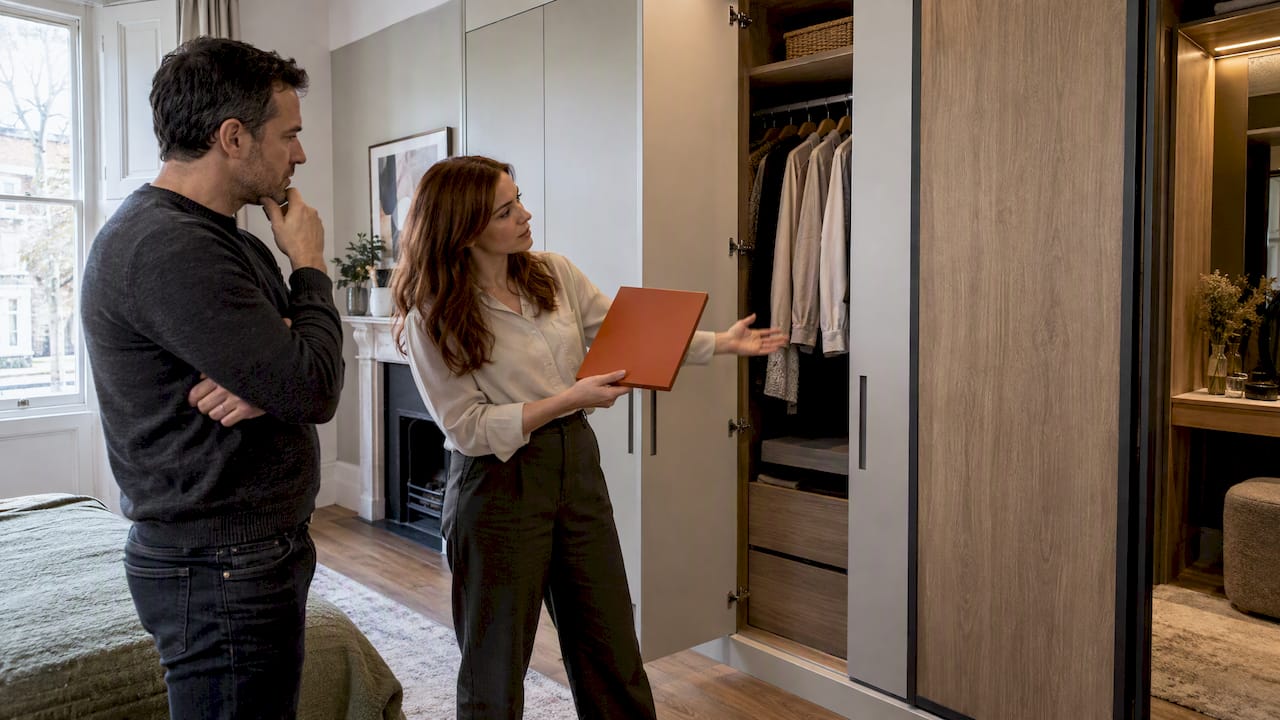
For most homes, sliding doors suit patios and showers best, while hinged doors usually work better for wardrobes unless the layout is designed around them. Patios and showers benefit from the space-saving glide of a sliding panel, while wardrobes need full access to hanging rails, something a well-planned hinged door delivers more reliably than a standard slider.
TL;DR:
- Sliding wardrobe doors limit access to about half of the interior unless internal layout is customized with more panels or internal storage.
- External sliding doors need carefully detailed thresholds to ensure weatherproofing, especially for patio or garden openings.
- Hinged doors generally provide full access and are more suitable for frequently used wardrobes or traditional aesthetic preferences.
- Both sliding and hinged doors can meet security standards if installed correctly and with certified products, but material and sealing impact thermal performance more than mechanism type.
- Proper installation, routine maintenance, and clear specifications, including warranties and compliance with standards, are essential for long-term door performance.
Table of Contents
- Types of hinged and sliding doors explained
- Pros and cons by use: space, security, cost and more
- How to choose the right door for your project
- Getting the installation and upkeep right
- How bespoke fitting changes the trade-offs
- What experience teaches about choosing doors
- Bespoke fitted wardrobes built around how you actually live
- FAQ
- Sources
Types of hinged and sliding doors explained
Before comparing performance, it helps to know what you are actually choosing between. Sliding doors run along a track, either in-line (where panels sit side by side) or lift-and-slide (where the panel lifts slightly off its seal before gliding, giving a tighter closure). Hinged doors swing on a pivot and include single doors, French doors (a symmetrical pair) and bi-fold doors, which concertina open in sections.
For wardrobes, the mechanics shift slightly. A sliding wardrobe door runs on an internal track and typically covers two or three panels across one opening, while a hinged wardrobe door swings outward like a cupboard, usually in pairs.
- In-line sliders: slim sightlines, smooth daily use, common on patios and modern wardrobes.
- Lift-and-slide: heavier doors with better sealing, often chosen for larger patio openings.
- Single and French hinged doors: classic swing action, full aperture access, common on wardrobes and shower enclosures.
- Bi-fold doors: fold back in sections, opening most of the aperture but needing clear floor space to stack.
Materials vary by use. Aluminium and uPVC dominate patio doors, timber and painted MDF are standard for wardrobes, and toughened glass with metal framing is typical for showers. Bespoke sliding systems that stack flush against a wall, or slide-and-turn hybrids, are increasingly used where a standard track would not suit an awkward recess or an alcove.
Pros and cons by use: space, security, cost and more
The right door depends on which trade-off matters most in that specific room. Here is how hinged and sliding doors compare across the dimensions that actually affect daily life.

Space and access. A hinged door needs clearance to swing, typically the full width of the door plus a turning margin, which can eat into a small bathroom or a tight bedroom layout. A sliding door needs none of that swing space, but a standard two-panel wardrobe slider only ever exposes half the wardrobe at once. Which? warns that sliding wardrobe doors can limit access unless the interior is designed to compensate, which is a common surprise for first-time buyers.
Aesthetics and sightlines. Sliding systems tend to carry slimmer frames and larger glazed areas, which is why Homebuilding’s coverage shows sliding doors have become more popular than bi-folds for many larger apertures, offering a cleaner look for patios and open-plan rooms. Hinged doors, particularly French styles, suit period properties where a traditional frame reads more naturally.
Security. Modern hinged and sliding doorsets are assessed under the same benchmark. PAS 24:2022+A1:2024 applies to both single and double hinged doors and sliding or folding sliding doorsets, so for external doors, the type matters less than whether the specific product and installation meet that standard.
Thermal performance. Frame material and glazing specification drive heat loss more than the opening mechanism does. Homebuilding notes that well-specified aluminium sliding systems narrow the performance gap with other door types, so a poorly sealed hinged door can lose more heat than a quality slider, and vice versa.
Maintenance. Sliding doors depend on clean tracks and well-lubricated rollers, and grit build-up is the most common cause of a sticking panel. Hinged doors rely on sound hinges and an intact door sill, with sagging hinges the usual failure point after years of use.
Cost. Pricing scales with size, material and glazing rather than mechanism alone, so get quotes against your exact specification rather than assuming one type is always cheaper.
Pro Tip: Ask any installer to confirm the PAS 24 test certificate for the exact door model you are buying, not just the product range, since specifications can change between batches.
How to choose the right door for your project
Working through a short checklist before you commission any door, wardrobe or shower enclosure saves most of the common regrets. Knowing what kind of doors are best for interiors helps you make an informed choice.
- Measure the full aperture and the swing or slide clearance needed, including any radiators, light switches or furniture in the path.
- Think about how you actually use the space. A wardrobe you open daily for work clothes needs full access; a guest room wardrobe opened occasionally can tolerate a slider.
- Check thresholds and ventilation. External sliding doors need a properly detailed threshold to stay weathertight, and shower doors need enough gap for steam to escape.
- Ask your supplier for the warranty terms in writing, including what counts as a workmanship issue versus a product fault.
- Confirm the lead time and site survey process before you commit, since a rushed survey is one of the most common causes of a poor fit.
- For external doors, ask explicitly whether the doorset meets PAS 24, and request the certificate reference.
- For wardrobes, ask what happens to the old unit. A good fitter will remove and dispose of it as part of the job, not leave it for you to deal with.
Red flags include a supplier who skips a site survey, gives vague answers about track or threshold specification, or cannot produce a written guarantee. Which? guidance stresses that installer credibility and written warranties materially affect long-term outcomes, which is worth checking before any deposit changes hands.
Pro Tip: If a sliding wardrobe is your preferred look, brief your fitter on internal layout first. Splitting hanging rails and shelving across more than two panels, or adding a bespoke interior, reduces the half-access problem considerably.
Bespoke fitted solutions tend to make the most sense in awkward rooms: sloped ceilings, alcoves either side of a chimney breast, or narrow spaces where a standard flat-pack door simply will not fit. In your brief, specify the exact aperture dimensions, your preferred door type, and how you plan to use the storage day to day.

Getting the installation and upkeep right
A good installation is level, properly sealed and leaves the track or hinge mechanism accessible for future maintenance. For patio and internal sliding doors, check that the frame sits dead level, that weatherseals are continuous with no gaps, and that the track is fitted on a stable, properly supported threshold.
- Check the door is plumb and level before the installer leaves, using a spirit level across the frame.
- Confirm seals are continuous around the full perimeter of external doors.
- Ask that tracks remain accessible for cleaning, rather than boxed in permanently.
- Test the action of every panel or hinge before signing off the job.
Routine maintenance is simple. Vacuum tracks monthly to clear grit, lubricate rollers twice a year with a light silicone spray, and check hinge screws on swinging doors annually, tightening as needed. Inspect weatherseals on external doors each autumn, since perished seals are the most common cause of draughts.
Most fitted wardrobe installations complete within a single working day once the survey and manufacturing are done, with the overall process from order to fitting typically running around one to two weeks. A reputable installer should offer aftercare contact for any snagging issues in the weeks following fitting.
How bespoke fitting changes the trade-offs
Bespoke design solves most of the drawbacks that come with off-the-shelf doors. A wardrobe built around your actual layout, rather than a standard flat-pack carcass, can use three or four sliding panels instead of two, cutting the half-access problem down considerably. Internals can also be designed so the most-used items sit behind the panel you open most often.
We build every fitted wardrobe around the room it goes into, whether that is a sloped loft ceiling, an alcove beside a chimney breast, or an awkward understairs recess. Installation usually completes within about a week after the final design is confirmed, and projects carry a multi-year workmanship guarantee. Premium materials and soft-close mechanisms come as standard, which matters most on sliding systems where cheaper rollers are the first thing to fail.
A reputable fitter matters more than the door type itself. The same mechanism performs very differently depending on whether the frame is square, the track is supported properly and the hardware is specified for the actual weight of the doors.
What experience teaches about choosing doors
The most common mistake we see is choosing a sliding wardrobe purely to save floor space, then discovering it only ever shows half the hanging rail at once. The second is treating thermal performance on an external door as an afterthought, assuming any modern frame will perform the same regardless of specification.
A simple rule helps here: prioritise function for anything you use daily, and leave aesthetics to carry more weight on doors you open occasionally. A wardrobe you dress from every morning deserves full, easy access over a slimmer sightline. A rarely used guest room slider can trade some convenience for a cleaner look.
Whichever direction you lean, hire a reputable installer and put your requirements in writing before work starts. A clear brief, covering access needs, thresholds and warranty expectations, prevents most of the disputes that follow a rushed job.
— Aureliu
Bespoke fitted wardrobes built around how you actually live
If you are weighing up hinged against sliding doors for a bedroom, loft conversion or awkward alcove, the better starting point is often a layout designed around your space rather than a standard flat-pack choice. We design and fit bespoke wardrobes with your choice of sliding or hinged doors, built to the exact dimensions of your room rather than the nearest off-the-shelf size.

Our services cover sliding wardrobes, walk-in wardrobes, fitted living spaces, and under-stairs storage for awkward spaces that standard furniture cannot fill. Every project carries a workmanship guarantee, installations are completed quickly after design sign-off, and we take away and dispose of your old wardrobe as part of the job. We cover various locations including Richmond, Wimbledon, Putney, Kingston, Chiswick, Ealing, Twickenham, Barnes, Hammersmith, Fulham, Chelsea and Central London, as well as New Malden, Walton-on-Thames, Woking, Bracknell, Reading and Guildford.
Contact us for a free design visit, by phone or WhatsApp on 07468 150807, or visit us at 124 City Road, Kemp House, London, EC1V 2NX.
FAQ
What are the disadvantages of a sliding door?
The main drawback is restricted access: a standard two-panel slider only exposes about half the opening at once, which matters most for wardrobes used daily. Sliding mechanisms also depend on clean tracks and well-lubricated rollers, so neglected maintenance can cause sticking over time.
Are hinged doors cheaper than sliding doors?
Cost depends more on size, material and glazing specification than on the mechanism itself, so there is no fixed rule that one type is always cheaper. Get quotes against your exact aperture and finish before assuming either option costs less.
Are sliding or hinged doors better for a wardrobe?
Hinged doors generally give better daily access since both sides open fully, while sliding doors save floor space but can limit access to roughly half the wardrobe at a time. Bespoke internal layouts with extra panels can reduce this trade-off considerably.
Why do Japanese houses use sliding doors?
Traditional Japanese interior doors, known as fusuma and shoji, slide rather than swing mainly to save floor space and allow rooms to be reconfigured easily. That same space-saving logic is why sliding doors remain popular in small modern bedrooms and compact bathrooms today.
Sources
- Doors | Standards explained | Secured by Design
- How to plan and buy fitted wardrobes – Which?
- Bifold vs sliding doors – which should you choose? | Homebuilding

