
Table of Contents
- Why Minimalist Storage Matters in Small Bedrooms
- Maximizing Vertical Space and Wall-Mounted Solutions
- Under-Bed and Multi-Functional Storage Options
- Bespoke Fitted Wardrobes for Awkward Spaces
- Small Bedroom Organisation Tips for Clutter-Free Living
- Custom Built-In Furniture vs. Store-Bought Solutions
- Creating a Simplified Aesthetic Without Compromising Function
- Frequently Asked Questions
Last Updated: September 21, 2026
Why Minimalist Storage Matters in Small Bedrooms
A cluttered bedroom drains mental energy. When storage is scattered, visible, and chaotic, your mind never truly relaxes. Minimalist bedroom storage solves this by hiding what you don’t need and displaying only what matters. For small spaces, this approach isn’t optional, it’s essential.
Small bedrooms force a choice: keep fewer items or accept clutter. Minimalist storage flips this by designing storage that fits your space perfectly, reducing visual noise while increasing capacity.
According to Extra Space Storage’s 2026 storage trends analysis, multi-functional furniture and vertical storage utilisation are increasingly adopted by homeowners managing compact rooms. The principle is straightforward: when every piece of furniture serves a purpose and storage is built in rather than bolted on, small bedrooms feel larger and function better.
At Finest Furniture Studio, we’ve spent years solving this exact problem for homeowners across London and the South East. Awkward spaces, understairs alcoves, sloping ceilings, narrow corners, become assets rather than liabilities when storage is custom-fitted. This guide covers the strategies that actually work.
Maximizing Vertical Space and Wall-Mounted Solutions
Floating shelves and wall-mounted storage eliminate the footprint problem entirely. A shelf that holds ten items costs nothing in floor space, making vertical storage the foundation of minimalist small-space design.
Wall-mounted solutions are invisible when empty and sculptural when styled. A single floating shelf with three carefully chosen objects creates visual interest without clutter.
Research from Better Homes & Gardens’ 2026 design trends report confirms that vertical storage utilisation keeps floor space clear in compact rooms, directly supporting the minimalist aesthetic. The practical benefit is significant: you gain storage capacity without making the room feel smaller.
Place shelves on empty wall space to feel integrated rather than above the bed. The goal is storage that feels like part of the room’s architecture.
Under-Bed and Multi-Functional Storage Options
Under-bed storage is the most underutilised space in small bedrooms. A bed is already taking up significant floor area, use it.
Drawers built into bed frames provide storage without adding furniture. Rolling bins and stackable containers maximise space beneath the mattress, keeping items accessible but hidden.
Multi-functional furniture multiplies options: a storage ottoman serves as seating and storage; a bed with integrated headboard drawers provides shelving; a bedside table with shelves stores items in the same footprint.
According to Houzz’s minimalist bedroom storage case study, installation of storage along a single wall using cabinets with plain doors maintained a minimalist aesthetic while creating a simplified, clutter-free appearance in a small cottage bedroom. This principle applies equally to under-bed solutions: simple, plain designs feel less intrusive than decorative pieces.
Choose pieces that blend seamlessly: neutral colours, clean lines, and minimal hardware keep multi-functional furniture from looking cluttered.
Bespoke Fitted Wardrobes for Awkward Spaces
Standard wardrobes don’t fit alcoves, accommodate sloping ceilings, or use corner space efficiently. Bespoke fitted wardrobes solve every constraint, using every centimetre of available space.
Bespoke fitted wardrobes exploit awkward spaces: understairs alcoves become full wardrobes, sloping ceilings become integrated shelving, narrow corners become hanging space.
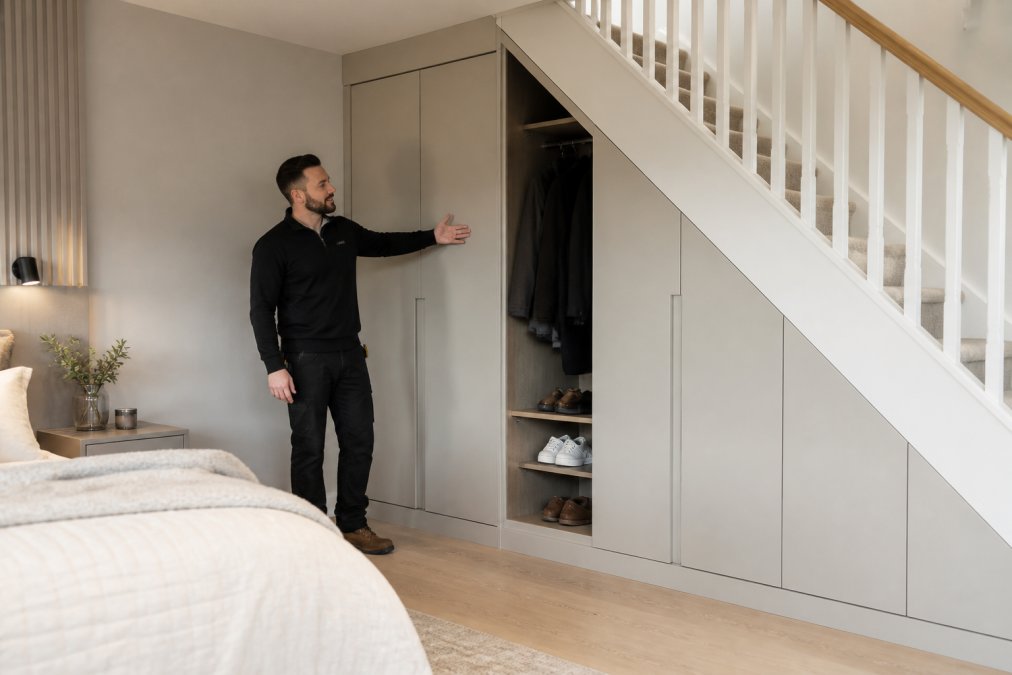
When storage is built in rather than freestanding, the room feels unified with no gaps or wasted corners. This visual coherence makes small spaces feel intentional rather than cramped.
Finest Furniture Studio specializes in custom solutions for awkward spaces. A complimentary design visit identifies every opportunity, with 7-day fitting and a 10-year warranty on wardrobes.
Small Bedroom Organisation Tips for Clutter-Free Living
Storage holds items; organisation makes them accessible and sustainable. The difference between a clutter-free bedroom and one that fills with chaos is the system, not the furniture.
The Psychology of Minimalist Maintenance
Visual clutter increases cortisol levels and reduces focus. A decluttered bedroom supports better sleep and mental clarity, but maintaining it requires understanding why clutter returns.
Clutter accumulates through acquisition without removal, lack of designated homes, and decision fatigue. Without assigned spaces and clear rules, items scatter and decisions default to leaving things out.
Minimalist organisation solves this by establishing clear rules upfront. A bedroom with assigned spaces for every category requires no daily decision-making: items either have a home or don’t belong.
The One-In-One-Out Rule
The one-in-one-out rule prevents gradual accumulation: for every new item, one leaves. This is particularly effective in small spaces where every item impacts how the room functions.
This rule shifts mindset from “Do I have space?” to “What am I willing to remove?” This creates intentionality and stops habitual acquisition.
Seasonal Rotation and Off-Season Storage
Seasonal rotation keeps active wardrobes manageable while storing off-season items elsewhere, maintaining a clutter-free aesthetic year-round.
Off-season storage works best when systematic: labelled boxes, vacuum-sealed bags, or loft shelving keep items accessible but invisible. Consistency creates a predictable rhythm.
Decluttering Before Designing Storage
Decluttering must come first. A custom wardrobe won’t solve an overstuffed closet, and shelves won’t fix a room full of unused items.
Remove items you haven’t worn in a year, books you won’t reread, and objects that don’t serve a purpose. Match your storage to your actual life.
Design storage around what remains after decluttering. A bedroom with half-full storage feels spacious; overflowing storage feels cramped regardless of furniture added.
The Role of Visibility in Maintenance
Open shelving creates accountability; you notice immediately if something’s out of place. Closed storage hides items but requires discipline to keep organised inside.
Combine closed storage for everyday items and selective open shelving for regularly used or displayed items. This balance maintains minimalist aesthetics while keeping frequently used items accessible.
Custom Built-In Furniture vs. Store-Bought Solutions
The choice between custom and store-bought storage defines how well your bedroom functions and whether the solution fits your living situation.
Understanding Your Living Situation
Homeowners with long-term plans benefit most from custom built-in furniture. Every measurement is precise. Every shelf aligns. Every door closes perfectly. The result feels integrated rather than added. This integration is what makes small spaces feel intentional rather than cramped. The trade-off is permanence, built-in furniture stays, and reconfiguring it is costly or impossible. But in a small bedroom, this stability is actually an advantage. Once you’ve optimised the space, you’re not moving or replacing storage repeatedly.
Renters face a different constraint: most leases prohibit permanent fixtures. Drilling into walls, installing shelving, or fitting built-in wardrobes can result in deposit deductions or lease violations. This is where the rental-specific storage gap emerges, most guides ignore renters entirely, yet they represent a significant portion of small-space dwellers.
Renter-Friendly, Non-Permanent Solutions
Renters need storage that delivers minimalist benefits without permanent installation. Several approaches work:
Freestanding modular units designed for small spaces offer flexibility renters need. These are not the flimsy flat-pack alternatives; quality modular systems use solid construction, clean lines, and neutral finishes that align with minimalist aesthetics. They can be reconfigured, moved between rooms, or taken to a new property. The downside is they consume floor space and rarely fit awkward corners perfectly. Maximizing the utility of these units often requires a streamlined approach to your bedside essentials, which is why it helps to declutter a small nightstand to maintain the visual calm that modular storage is intended to support.
Tension rods and over-door organisers require no drilling.
Store-Bought vs. DIY vs. Custom: A Practical Comparison
| Approach | Installation | Fit to Space | Awkward Spaces | Portability | Aesthetic Integration | Best For |
|---|---|---|---|---|---|---|
| Store-bought modular | Hours to days | Approximate | Limited options | High | Visible as separate | Renters, temporary situations |
| DIY built-in (shelves, brackets) | Days to weeks | Good with planning | Moderate | None | Depends on execution | Homeowners with basic skills |
| Custom built-in | 7 days | Exact | Full utilisation | None | Seamless | Long-term homeowners, awkward spaces |
The DIY Middle Ground
A third option exists between store-bought and fully custom: DIY built-in solutions. A homeowner with basic carpentry skills can install floating shelves, build simple box storage, or fit a basic wardrobe frame. This approach offers better fit than store-bought whilst avoiding the cost of fully custom solutions.
The Real Trade-Off: Precision vs. Flexibility
Store-bought solutions prioritise flexibility. You can rearrange them, move them between rooms, or replace them. They work for temporary situations or when you’re uncertain about your long-term plans. But they rarely fit perfectly. A standard wardrobe leaves gaps. A mass-produced shelving unit doesn’t match your room’s proportions. Compromises accumulate, and the room never feels fully optimised.
Creating a Simplified Aesthetic Without Compromising Function
Minimalism isn’t about having less storage, it’s about hiding storage effectively.
Frequently Asked Questions
What are the best minimalist storage ideas for small bedrooms?
The most effective approach combines vertical storage, multi-functional furniture, and hidden storage solutions. Wall-mounted floating shelves, under-bed drawers, and storage ottomans serve dual purposes while keeping the visual landscape uncluttered. Bespoke fitted wardrobes tailored to your room’s dimensions ensure every inch works harder. Focus on closed storage where possible, visible clutter undermines minimalist aesthetics, and choose pieces with clean lines and neutral finishes to maintain a streamlined appearance.
Are bespoke fitted wardrobes worth it for small bedrooms?
Yes, particularly when dealing with awkward spaces like understairs areas or sloping ceilings. Bespoke fitted wardrobes maximize storage capacity in ways off-the-shelf units cannot, eliminating wasted space and reducing visual clutter. They’re designed specifically for your room’s dimensions and layout, improving both functionality and aesthetic appeal. While the initial investment is higher than mass-produced alternatives, the durability, custom fit, and long-term warranty make them a sound choice for homeowners seeking lasting solutions that add property value.
How can I organise a very small bedroom without it looking cluttered?
Start by decluttering ruthlessly, keep only what you use regularly. Invest in stackable, foldable storage bins and use vertical wall space aggressively. Install floating shelves above the desk or bedside area, add hooks behind the door, and use under-bed storage for seasonal items. The key is choosing storage solutions with clean, simple designs that blend into the room rather than dominate it. Aim for a consistent colour palette and avoid open shelving where possible, as exposed items create visual weight even if the space is physically tidy.
What storage solutions work best for renters in small spaces?
Renters benefit most from non-permanent solutions: rolling carts, freestanding shelving units, over-door organisers, and adhesive hooks. Stackable storage bins and ottomans with hidden compartments offer flexibility without requiring installation. Wall-mounted floating shelves using damage-free adhesive strips work well in rented properties. If your lease allows minor modifications, consider removable shelving systems. The advantage of these solutions is that you can take them with you when you move, making them cost-effective across multiple homes.

