
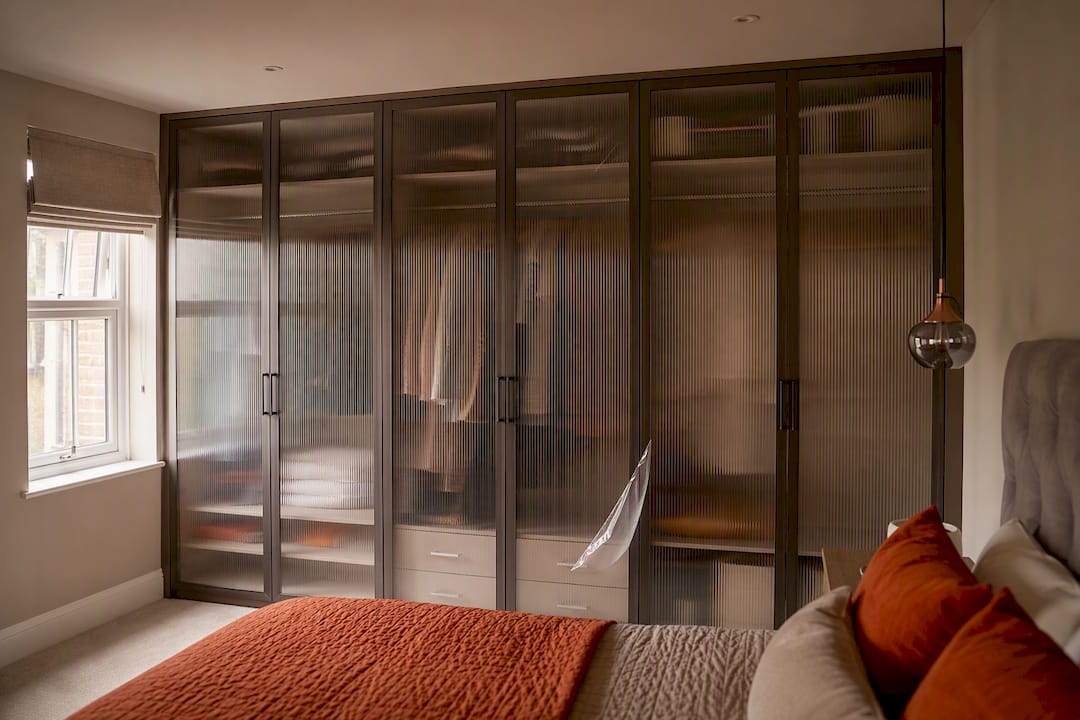
Reeded glass wardrobe doors are an excellent choice when you want natural light, texture and partial privacy for bedroom storage. They suit most bedrooms because the vertical fluting scatters light without exposing what is behind it, and made-to-measure suppliers can specify, produce and fit them to your exact opening within days rather than weeks.
TL;DR:
- Reeded glass panels require a minimum of 6mm thickness for standard sizes and 8mm for panels wider than 900mm to prevent flexing and wear.
- Laminated safety glass is recommended for households with children, as it holds together on impact better than tempered glass.
- Fixed panel layouts with mixed solid and glass sections are more practical for privacy and durability than full-height glass doors.
- Lead times for bespoke doors are typically seven to twelve days, but unusual finishes or oversized panels can extend production and cost.
- Proper cleaning involves using a soft cloth along the ribs with mild cleaner, avoiding abrasive materials to maintain surface quality.
Table of Contents
- What do reeded glass wardrobe doors actually do?
- Materials and technical specifications you need to specify
- Sliding, hinged or mixed panels: which layout suits you?
- How do you order made-to-measure reeded glass wardrobe doors?
- Caring for reeded glass wardrobe doors
- Our take on specifying reeded glass wardrobes
- Ready for your own reeded glass wardrobe?
- Sources
- FAQ
What do reeded glass wardrobe doors actually do?
Reeded glass, sometimes called fluted glass, is pressed with continuous vertical ribs that bend light as it passes through; the luxury of glass interior doors offers a unique blend of texture and light to enhance any bedroom design (the luxury of glass interior doors). Stand close and you will see soft, elongated colour and shape rather than sharp outlines, which is exactly why it works so well on a wardrobe front. At normal bedroom viewing distances, reeded glass scatters light while obscuring detail, hiding whatever clutter sits behind it while still letting daylight bounce into the room.
Compared with clear glass, reeded glass gives you noticeably more privacy while still transmitting significant light, which is why designers reach for it on wardrobe fronts more often than plain glazing. Frosted glass achieves privacy differently, through an even, flat opacity, whereas reeded glass adds a rhythm of vertical lines that breaks up a long run of doors and makes a wardrobe wall feel less like a slab of furniture.
Reeded glass tends to work best when:
- You want a wardrobe wall to feel lighter and less dominant in a small or narrow bedroom.
- The wardrobe faces a window and you want to keep the room bright without displaying folded jumpers to visitors.
- You are matching a period property’s crittall-style windows or an Art Deco scheme, where fluted textures already sit naturally.
- You prefer texture over the flat sheen of high-gloss or plain mirrored fronts.
Materials and technical specifications you need to specify
Getting this right on paper avoids problems on installation day. Glass thickness matters more than most homeowners expect: as a rule, specify 6mm glass as a minimum for standard sliding panels and move up to 8mm for anything wider than roughly 900mm. Thinner glass on a wide panel will flex under the weight of sliding hardware, and that flex accelerates wear on rollers and tracks.
Statistic callout: Panels over 900mm wide need 8mm glass or a reinforced support rail. Below that width, standard 6mm glass is usually enough, but it is the threshold worth checking with your supplier before you sign off a quote.
Safety glass is not optional in most family homes. Tempered glass is the standard baseline, but laminated safety glass is the better choice in households with young children, because a laminated pane holds together on impact rather than shattering into loose fragments.
A few other specification points worth locking in early:
- Frame material: slim aluminium frames are common with reeded glass and keep sightlines minimal, while matt black finishes are a popular way to sharpen the contrast between the ribs and the frame.
- Ripple depth and tint: these are usually fixed per production run at the glass factory, so decide on them before ordering rather than after.
- Panel proportion: a two-thirds solid, one-third glass split is a practical default, hiding mid-level clutter while still letting light spill through the upper section.
Sliding, hinged or mixed panels: which layout suits you?
The door system you choose changes how the reeded glass reads in the room as much as the glass itself does.
- Sliding doors suit most bedrooms, particularly where floor space is tight or a wardrobe spans a full wall. They keep a flush, continuous surface and let you run reeded glass across several panels for an unbroken rippled effect.
- Hinged doors feel more like traditional furniture and work well on smaller runs, alcove fittings, or where you want a more tailored, cabinetry look rather than a wall of glass.
- Mixed panel layouts, combining solid painted or wood-effect doors with reeded glass inserts, let you control privacy precisely. Put glass at eye level and above, keep the lower half solid, and you get borrowed light without ever exposing shelving or drawers.
Heavier glass panels change the hardware conversation. Wider or thicker reeded glass doors need a robust track and roller set rated for the extra load, and it is worth asking your supplier to confirm the hardware specification for bespoke sliding doors rather than assuming a standard track will cope.
Pro Tip: If you are torn between sliding and hinged, think about how often you open both doors at once. Hinged doors give full access to the whole wardrobe interior instantly; sliding doors only ever expose half at a time.

How do you order made-to-measure reeded glass wardrobe doors?
Ordering bespoke glass doors is straightforward once you know the sequence, but a few measuring mistakes cause most of the delays.
Measuring checklist:
- Measure the opening width and height in at least three places (top, middle, bottom) since older walls are rarely perfectly square.
- Note ceiling coving, skirting boards and any radiator pipework that might interfere with a sliding track.
- Check floor level across the full width of the run. A slope of even a few millimetres affects door alignment.
- Photograph the space and bring rough dimensions to your first consultation rather than relying on memory.
Order workflow:
- Site survey to confirm exact measurements and discuss glass finish, frame colour and panel layout.
- Fixed quote covering glass, frame, hardware, installation and removal of your existing wardrobe.
- Production, where custom glass and specialised finishes typically add the most time to the schedule.
- Delivery and installation, usually completed within seven to twelve days once measurements are confirmed.
Oversized panels, unusual tints, or ripple depths outside a supplier’s standard range will extend both cost and lead time, so flag these early. Before you commit, ask any supplier directly about their workmanship guarantee, the exact glass specification they intend to fit, whether they remove and dispose of your old wardrobe, and what site access they need on installation day.
Caring for reeded glass wardrobe doors
Reeded glass is more forgiving day to day than plain glass because the fluting hides fingerprints and light surface marks, but it still needs the right cleaning approach.
- Use a soft microfibre cloth with a mild glass cleaner, working along the direction of the ribs rather than across them to avoid streaking in the grooves.
- Avoid abrasive pads or strong solvents near aluminium or wood-effect frames, which can dull the finish over time.
- Check door edges periodically for chips. Edge damage is the most common issue with fluted glass, and it is one reason laminated safety glass is worth the upgrade in busy households.
- Small edge chips can sometimes be smoothed by a glazier, but a cracked or badly chipped panel usually means full pane replacement rather than a patch repair.
Because glass wardrobe doors ask a little more of your internal organisation than solid ones, even reeded and frosted options benefit from tidy hanging rails and drawer dividers behind the glass.
Our take on specifying reeded glass wardrobes
We have fitted enough reeded glass wardrobe fronts across bedrooms in Richmond, Wimbledon and Chiswick to know where homeowners usually go wrong: they choose the glass finish before they think about where the light in the room actually falls. Reeded glass performs completely differently on a north facing wall than it does bouncing afternoon sun across a west facing bedroom, and a good design visit should talk about orientation before it talks about ripple depth.

The other pattern we see constantly is homeowners assuming full-height glass is the only option. In practice, mixed panel layouts, glass above, solid timber or painted MDF below, solve the privacy question far more elegantly than an all-glass run, and they tend to age better because the lower panels take the daily knocks rather than the glass.
Our installations typically run seven to twelve days once measurements are signed off, backed by a 10-year guarantee on workmanship, which matters more with glass than with any other wardrobe material because glass exposes poor fitting immediately. A wonky sliding track on a solid door is invisible. On reeded glass, every millimetre out of alignment catches the light and shows.
— Aureliu
Ready for your own reeded glass wardrobe?
Finest Furniture Studio designs and fits made-to-measure reeded glass wardrobe doors across Richmond, Wimbledon, Putney, Kingston, Chiswick, Fulham, Chelsea, Ealing, Twickenham, Barnes, Hammersmith and central London, so you get a wardrobe built for your exact opening rather than a standard size squeezed to fit.

A free design visit covers everything you need before committing: we measure the space, talk through glass ripple depth, frame finish and panel layout, and give you a fixed quote on the spot. Bring a few photos of the room, rough dimensions if you have them, and any finishes you like the look of, and we will work out whether sliding or hinged doors suit your layout better. Every installation runs on a 7 to 12 day timeline, comes with a 10-year guarantee on workmanship, and we will also take away and dispose of your old wardrobe, so there is nothing left for you to sort out afterwards. Explore our bespoke fitted wardrobes for Richmond homes or start with the complete guide to made-to-measure wardrobes across West London. To book your free design visit, call or WhatsApp 07468 150807, or contact us directly, we are based at 124 City Road, Kemp House, London, EC1V 2NX.
Sources
- Reeded glass vs clear glass internal doors — Doorphoria
- Fluted & Reeded Glass applications and specifications – The Design Factory (2025)
- Reeded glass wardrobe doors: Hide clutter & upgrade home aesthetics – Kailansen
FAQ
Is reeded glass back in fashion for wardrobes?
Yes. Fluted and reeded glass has returned strongly as a wardrobe and door finish because it combines texture with light in a way flat glass or solid panels cannot, and it suits both period and contemporary bedroom schemes.
Can I just buy wardrobe doors on their own?
You can buy standalone doors for a like-for-like swap, but reeded glass doors perform best when the frame, thickness and hardware are specified together as part of a made-to-measure order, since panel width and glass thickness are directly linked.
What is the current trend for closet doors?
Sliding doors with mixed panels, solid below and reeded or fluted glass above, are the dominant trend, giving bedrooms borrowed light and a lighter visual top third without exposing the whole wardrobe interior.
Can you see through a reeded glass door?
Not in the way you can with clear glass. Reeded glass scatters light and obscures fine detail at normal viewing distances, so shapes and colour blur together rather than showing sharp outlines, which is what makes it useful for hiding clutter while still letting daylight through.

