

Table of Contents
- Smart Technology Features for Modern Wardrobes: What Actually Earns Its Place
- Wardrobe Lighting Ideas That Make a Fitted Wardrobe Easier to Use
- Motion Sensor Wardrobe Lights: Where They Work and Where They Annoy
- Adding a Wardrobe Charging Station Without Cluttering the Interior
- Smart Mirrors, Voice Control and Home Integration in a Fitted Wardrobe
- Wardrobe Organisation Ideas That Work With the Technology
- Privacy, Installation and Reliability: What to Check Before You Commit
- Frequently Asked Questions
Last Updated: October 13, 2026
Smart Technology Features for Modern Wardrobes: What Actually Earns Its Place
Smart technology features for modern wardrobes change how you use the space daily: automated LED lighting, motion sensors, integrated charging, and sometimes smart mirrors and voice control.
Most smart wardrobe technology is convenience, not necessity. The features that earn their place solve a real problem, finding clothes in a dark corner, charging a phone without a cable trail.
That distinction matters because smart features add cost and complexity. If you are planning a bespoke build, know which ones you will still value in five years.
guidance on electrical safety in the home
Wardrobe Lighting Ideas That Make a Fitted Wardrobe Easier to Use
The best wardrobe lighting is the kind you never think about: it comes on when you open the door and fades when you close it, so you see every shelf without squinting into a shadow.
- Illuminated hanging rails light the full length of a rail, so dark suits and navy knitwear stop blending together.
- Backlit shelves wash light across folded items and make the interior feel larger.
- Vertical strip lighting in tall sections helps with floor-to-ceiling fitted wardrobes.
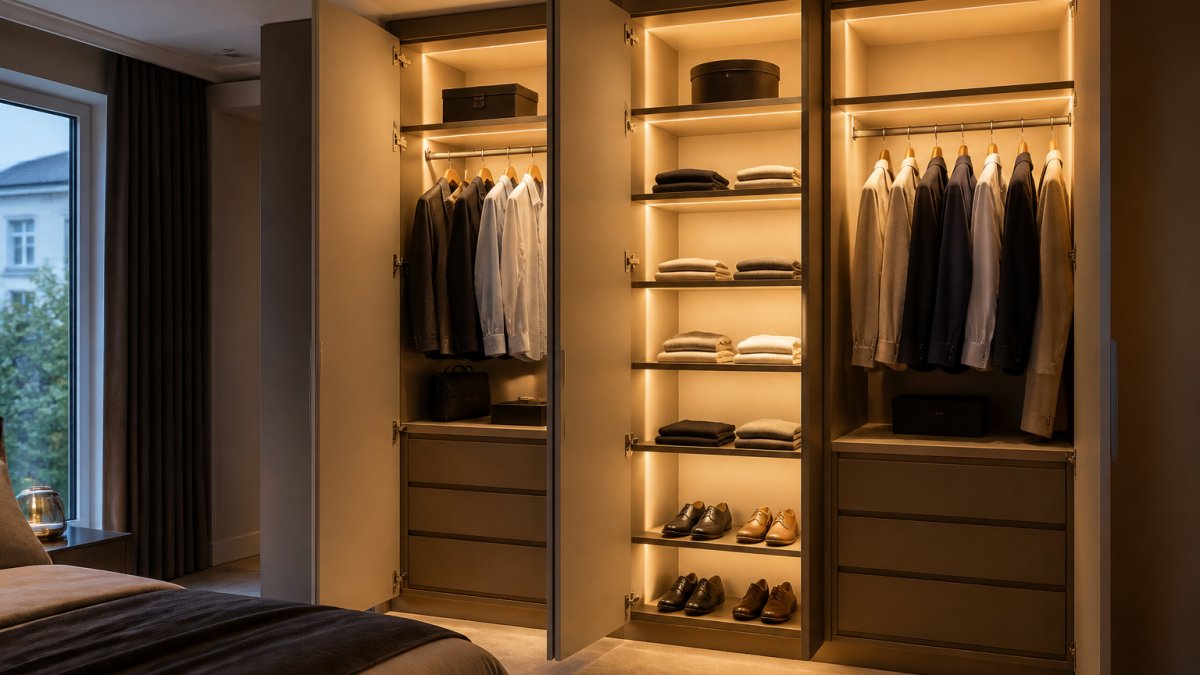
Illuminated Rails and Backlit Shelves
Illuminated rails and backlit shelves make the biggest practical difference, putting light exactly where your clothes are rather than lighting the room around them.
A common mistake is over-lighting: too many strips create glare and heat and cost more to run. Two or three well-placed runs beat a full interior wash.
Plan lighting before the carcass is built, not after. Retro-fitting LED strips into a finished wardrobe means chasing cables through panels, which is fiddly and rarely looks clean. Our designers map the lighting runs at the drawing stage.
Motion Sensor Wardrobe Lights: Where They Work and Where They Annoy
Motion sensor wardrobe lights work well on doors and drawers, badly in walk-in wardrobes. The sensor triggers on movement, ideal on a hinged door, wrong when you are standing still reading a label.
Where sensors earn their place:
- Inside hinged doors, so light comes on as the door opens
- On pull-out drawers and racks
- In dark alcoves and under-stair sections with no natural light
Where they frustrate:
- Walk-in wardrobes, where you move constantly and the light keeps re-triggering
- Low-traffic cupboards, where the sensor battery drains for nothing
- Anywhere the sensor is aimed at a corridor, so it fires every time someone walks past
Door and occupancy sensors are more reliable than pure motion sensors in a walk-in layout: a door contact switch simply knows the door is open.
Cheap PIR sensors are the most common complaint we hear about smart wardrobes. They trigger late, miss small movements, and the batteries go flat within months. If the sensor is the weak link, the whole lighting system feels broken.
Adding a Wardrobe Charging Station Without Cluttering the Interior
A wardrobe charging station is a dedicated drawer or shelf with built-in power points, so phones, watches and tablets charge out of sight. Done well it removes bedside cable tangle; done badly it puts mains power somewhere it should not be.
The practical rules:
- Keep sockets in a fixed, ventilated section, never loose inside a clothes compartment
- Use a drawer with a cable cut-out so devices sit flat
- Add a USB-C and USB-A outlet for mixed devices
If you are planning bespoke bedroom furniture, raise this at design stage: power must reach the wardrobe before the panels go on, and moving a socket later means making good the wall.
Smart Mirrors, Voice Control and Home Integration in a Fitted Wardrobe
Smart mirrors and voice control are the features buyers ask about most and use least.
The bigger question is integration. If your home already runs on a smart-home system, adding wardrobe lighting and sensors is straightforward, one app, one routine.
What most guides miss: integration is a commitment. Once lighting depends on an app or hub, a failed update or dropped Wi-Fi becomes a wardrobe problem, not a phone problem.
Match the technology to your household, not to the showroom. A family that wants light on demand needs a door switch. A tech-forward household with an existing smart-home setup can justify voice control and app routines.
Wardrobe Organisation Ideas That Work With the Technology
Good wardrobe organisation ideas make the technology more useful. Sensors and lighting only help if the layout underneath is sensible, planned around how the smart layer will be wired, sensed and maintained.
Start with what you actually wear: most people use a small share of their wardrobe most of the time. A layout built around that reality beats a symmetrical grid of shelves.
Adjustable Shelving, Pull-Out Racks and Drawers
Adjustable shelving lets you change the layout as needs shift, a height that suits winter boots suits summer shirts.
Pull-out racks and drawers bring the back of a deep wardrobe into reach, most useful in alcove fitted wardrobes and under-stair spaces.
| Feature | Best For | Watch Out For |
|---|---|---|
| Adjustable shelving | Changing storage needs | Cheap brackets that sag under weight; lighting fixed to a shelf you later move |
| Pull-out racks | Deep or low wardrobes | Rails that need a clear floor run; cables that snag as the rack extends |
| Pull-out drawers | Accessories and shoes | Overloading, which strains runners; sensors that misread a half-open drawer |
| Foldable hanging rods | Guest rooms and seasonal use | Fiddly catches on low-cost units |
| Illuminated rails | Dark interiors | Cabling planned too late; heat build-up if strips are over-specified |
| Motorised lift rails | High or deep runs | Needs mains power and a manual override in case of failure |
For tighter spaces, sliding fitted wardrobes free up floor room, and internal organisation matters more because you cannot open everything at once.
Accessibility and Inclusive Design
A smart wardrobe should work for everyone in the household. Practical adjustments include:
- Reachable controls. Put physical switches and app-free overrides at a height that suits every regular user, not just the tallest.
- Lighting for low vision. Higher colour rendering (CRI 90+) and warm white around 3000K make garment colours easier to distinguish than cool white at the same brightness.
- Voice and touch alternatives. Where a household includes someone with limited mobility, voice control or a large-button wall plate can replace reaching for a switch.
Decide the layout before the lighting plan, not after. Shelf positions, drawer runs and rail heights determine where the cable routes and sensors can go, and moving either later means opening up finished panels.
Privacy, Installation and Reliability: What to Check Before You Commit
Three things decide whether smart wardrobe features are a pleasure or a nuisance: data, wiring, and what happens when something fails.
Privacy and Data Handling
Smart mirrors, app-controlled lighting and voice assistants collect more than most buyers realise. A connected mirror with a camera or microphone, an app logging when the wardrobe opens, and a cloud voice assistant are all data-collecting devices, even when they look like furniture.
What to check before you commit:
- What the app records. Usage logs, timestamps and device identifiers are common. Ask whether the app works without an account, and whether it can be used offline.
- Where data is stored. Cloud storage means the manufacturer holds your data; local storage on a hub keeps it in the home. Both are valid, but the trade-off should be a choice, not a default.
- Camera and microphone presence. If a mirror or display has either, check whether they can be physically disabled, not just switched off in software.
Installation, Wiring and Retrofit
Mains-powered lighting and charging points need a qualified electrician and must meet current wiring rules. A fitted wardrobe is the right moment to plan this, because electrics go in before the panels.
What the installation actually involves:
- A dedicated circuit or a fused spur for the wardrobe’s power, depending on load. Lighting alone is usually light enough to share; a charging drawer with several devices is not.
- Low-voltage LED drivers mounted in an accessible place, not sealed behind a fixed panel. Drivers are the component most likely to need replacement first.
- Cable routes planned at drawing stage, so strips, sensors and sockets land where the layout needs them rather than where the joists allow.
Retrofit is possible but messier: adding lighting usually means surface-mounted trunking or chasing into the wall, and a charging point means extending a circuit. If you are planning bespoke bedroom furniture, raise power and data at the design visit and the whole job is cleaner.
Reliability, Maintenance and Manual Overrides
Every smart feature should have a manual fallback. Lights that also work from a standard switch. A door that opens without the app. If the smart layer fails, the wardrobe still has to function as a wardrobe.
Failure modes worth planning for:
- Power cut. Battery-backed sensors and a standard wall switch keep the wardrobe usable. A system that only responds to an app does not.
- Network outage. If lighting depends on Wi-Fi or a hub, a dropped connection becomes a wardrobe problem. Local control (a switch, a door contact) removes that dependency.
- Sensor failure. PIR sensors are the most common weak link. A door contact switch is more reliable in a walk-in layout because it knows the door is open rather than guessing from movement.
Running Costs and Energy Use
Smart wardrobe lighting is low-draw by nature: a typical LED strip run draws a few watts per metre, so running cost is small next to the fittings and installation. The bigger considerations are:
- Standby draw from drivers, hubs and always-on sensors, which adds up across a whole home.
- Battery replacement for wireless sensors, which is a recurring cost and a recurring annoyance if the sensors are hard to reach.
- Repairability. A wardrobe built with standard LED profiles and accessible drivers can be maintained for years. One built with sealed proprietary modules often cannot.
Sustainability and Longevity
Efficient LED lighting, durable hinges and runners, and repairable components matter more than any single smart feature. A wardrobe that lasts twenty years and can have its lighting replaced is more sustainable than one discarded when a proprietary module fails. Ask about the expected life of lighting and sensors, and whether replacement parts are stocked.
Ask for a manual override on every powered feature, and ask where the LED drivers will be mounted. Both cost very little at build stage and save a great deal of frustration later.
This is where a warranty matters. Our wardrobes carry a 10-year warranty, and our fitting service runs to a 7-day schedule, with clear upfront pricing and no hidden fees. We also offer a free design visit so you can see the plan before committing.
electrical installation and building regulations guidance
Frequently Asked Questions
What smart features can you add to a fitted wardrobe?
The most practical additions are LED lighting on shelves and rails, motion sensor wardrobe lights that switch on when the door opens, a wardrobe charging station with USB points for phones and watches, and adjustable shelving that moves as your storage needs change. Smart mirrors, voice control and home integration suit larger rooms. Focus on features you will use daily, and plan the wiring during the design stage so nothing needs retrofitting later.
Are motion-sensor lights useful inside a wardrobe?
Yes, provided the sensor is positioned correctly. A sensor that faces the door triggers the light the moment you open it, which helps most when the wardrobe sits in a dim corner or you are reaching for clothes early in the morning. Choose a warm white output rather than a bright cool white, and set a short delay so the light switches off automatically. Poorly placed sensors that trigger every time you walk past cause more frustration than benefit.
Can you add charging points to a wardrobe?
Yes. A wardrobe charging station is usually a drawer or shelf with USB sockets and cable routing built into the carcass. The important step is planning it during the design stage, because the sockets need a safe power feed and the cables need a route that does not cross moving parts. Ask about the socket type and how cables are managed before you commit, and confirm the work is carried out by a qualified electrician.
What should I consider when planning a smart fitted wardrobe?
Start with how you actually use the space, then choose technology that supports it. Check the power supply, whether existing wiring can be extended, and how much disruption installation will cause. Ask how the system behaves during a power cut or if a component fails, and confirm there is a manual override. Finally, check what the warranty covers, including any electrical parts, and get the scope in writing before work begins.

