

Contemporary wardrobe design is defined as a fitted storage system that combines minimalist aesthetics with highly customised, functional interiors to optimise bedroom space and reflect modern living. Known in the industry as bespoke fitted cabinetry, this approach moves well beyond a simple cupboard. It treats the wardrobe as an architectural element of the room itself, influencing spatial flow, light, and the overall feel of the space. Whether you are planning a full bedroom transformation in Richmond, Wimbledon, or Chelsea, or simply looking to replace an outdated freestanding unit, understanding what contemporary wardrobe style actually means will save you time, money, and regret.
The defining shift in 2026 is that wardrobes function as architectural elements, shaping room perception rather than simply occupying wall space. This matters most in compact London homes where every square metre counts. At Finest Furniture Studio, we see this transformation daily across projects in Putney, Fulham, and Chiswick. The result is always the same: a well-designed fitted wardrobe does not just store clothes. It changes how a room feels to live in.
What are the core design elements of contemporary wardrobes?
Contemporary wardrobe design features handleless doors, matte or high-gloss finishes, and a deliberate focus on spatial efficiency through integrated storage. These are not stylistic choices made in isolation. Each element serves a practical purpose that compounds over years of daily use.
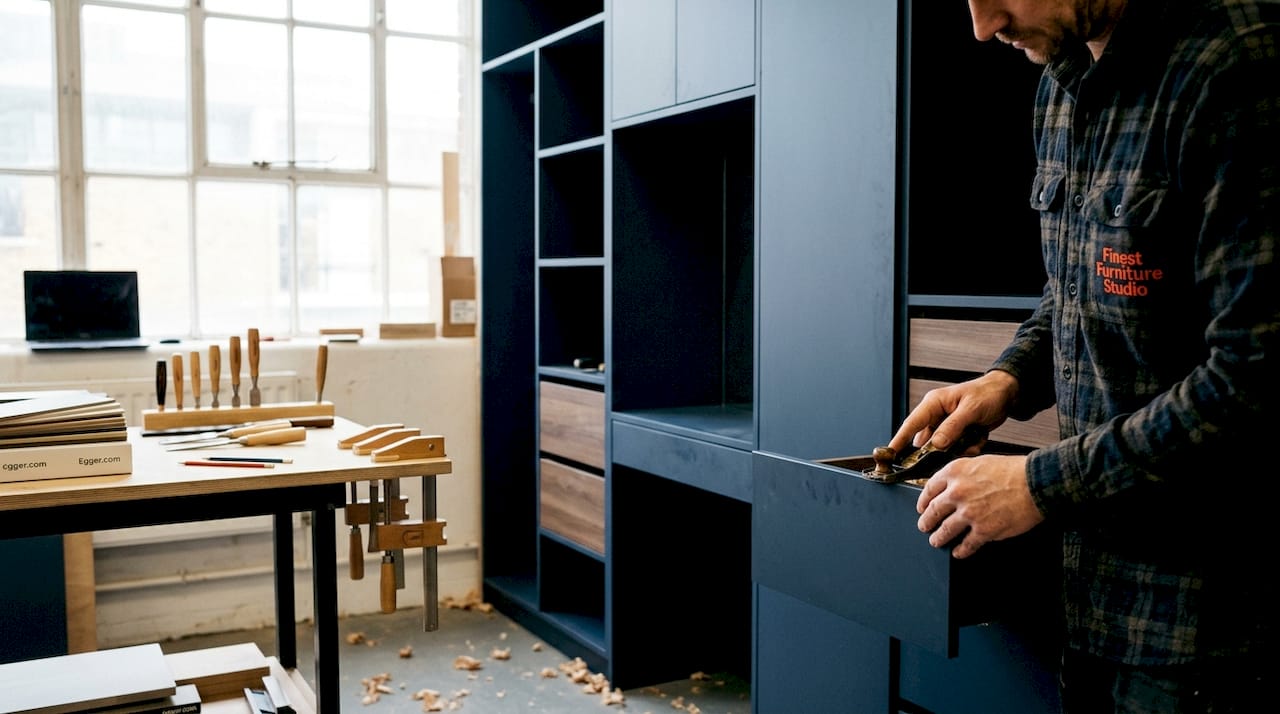
The most recognisable feature is the handleless door. Push-to-open mechanisms and soft-close hinges replace traditional knobs and pulls, producing a flush, uninterrupted surface that makes rooms appear larger and brighter. In a bedroom in Ealing or Twickenham where floor space is limited, this visual expansion is genuinely significant.
The four defining design characteristics are:
- Handleless doors with push-to-open or soft-close mechanisms for a flush, seamless facade
- Neutral colour palettes centred on whites, warm greys, and natural wood tones that complement rather than compete with existing décor
- Clean, unornamented surfaces using MDF substrates, natural wood veneers, glass inserts, or metal accents
- Integrated interior storage including pull-out racks, drawer dividers, and modular shelving configured to the homeowner’s specific needs
Materials deserve particular attention. MDF provides a stable, warp-resistant substrate that accepts paint and veneer finishes with precision. Natural wood veneers add warmth and texture without the cost or weight of solid timber. Glass-fronted panels work well in larger bedrooms in Barnes or Hammersmith where displaying curated clothing adds a boutique-like atmosphere. Metal accents in brushed brass or matte black provide contrast without overwhelming the composition.
Pro Tip: Choose your door finish before selecting bedroom wall colours. Matte finishes absorb light and suit warmer, cosier rooms, while high-gloss finishes reflect light and work best in rooms with strong natural daylight.
The colour palette in contemporary fitted wardrobes is intentionally restrained. Whites, off-whites, warm greys, and wood-effect finishes dominate because they create visual continuity with the room rather than drawing attention to the wardrobe itself. This restraint is a design decision, not a limitation. You can explore current wardrobe design ideas to see how finish combinations work across different room types and sizes.
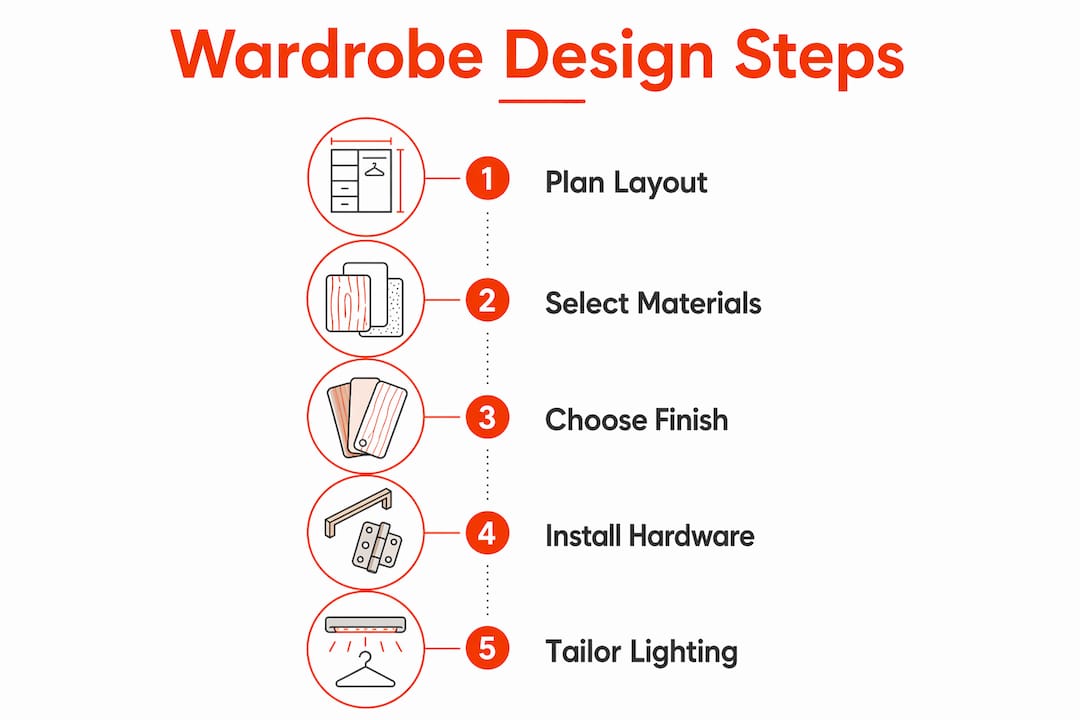
How to design a wardrobe interior using zoning principles
A wardrobe’s interior layout should align with daily habits for intuitive organisation rather than default measurements. This is the single most important principle in functional wardrobe design, and it is the one most homeowners overlook when focusing on external aesthetics.
The starting point is always an inventory audit. Before any cabinetry is specified, you need to know exactly what you are storing. Count your long-hang garments such as dresses and coats, your short-hang items such as shirts, jackets, and skirts, your folded pieces, and your accessories. This data drives every subsequent decision about rail heights, shelf depths, and drawer configurations.
A practical zoning process follows these steps:
- Conduct a full inventory audit. Separate clothing into long-hang, short-hang, folded, and accessory categories. Count each group accurately.
- Allocate vertical zones. Short-hang zones require approximately 42 inches of vertical clearance for shirts and skirts without dragging. Long-hang zones need a minimum of 60 to 70 inches for full-length dresses and coats.
- Plan folded storage separately. Shelving for folded jumpers and trousers should sit between 12 and 16 inches deep. Shallower shelves reduce the tendency to stack items too high, which causes clutter.
- Designate an accessories zone. Drawer dividers, pull-out shoe racks, and tie or belt organisers belong in a dedicated section, typically at mid-height for easy access during the morning routine.
- Specify hardware to match each zone. Pull-out trouser racks, soft-close drawers, and internal LED strip lighting each serve specific zones and should be specified at the design stage, not added as afterthoughts.
The zoning approach transforms a wardrobe from a space where you store things into a system where you find things. In shared wardrobes, particularly in master bedrooms in Kingston or Walton-on-Thames, dividing the interior into clearly defined his-and-hers zones reduces friction and speeds up the morning routine considerably.
Pro Tip: When planning your zoning layout, photograph your existing wardrobe contents before your design consultation. This gives your designer an accurate picture of your actual storage needs rather than an estimate, and it almost always results in a more useful interior configuration.
Balancing hanging space against folded storage is where most off-the-shelf wardrobes fail. Standard freestanding units allocate roughly equal space to each, regardless of the owner’s wardrobe. A bespoke fitted wardrobe designed through Finest Furniture Studio starts with your inventory and builds the interior around it. The result is a wardrobe organisation workflow that genuinely reflects how you dress, not how a manufacturer assumes you dress.
What materials and finishes suit contemporary wardrobes in 2026?
The material and finish choices in a contemporary fitted wardrobe determine its durability, its visual impact, and its long-term value. Getting this decision right matters because a well-specified wardrobe in a London home should last 15 to 20 years with minimal maintenance.
The table below compares the most common finish options across the criteria that matter most to homeowners:
| Finish type | Aesthetic effect | Maintenance | Best suited for |
|---|---|---|---|
| Matte lacquer | Soft, sophisticated, non-reflective | Wipes clean; shows fewer fingerprints | Bedrooms with warm, ambient lighting |
| High-gloss lacquer | Bright, expansive, light-reflective | Shows fingerprints; requires regular wiping | Rooms with strong natural daylight |
| Wood veneer | Warm, natural, textured | Occasional conditioning; durable | Traditional or Shaker-style interiors |
| Foil wrap (PVC) | Consistent colour, cost-effective | Very easy to clean; moisture-resistant | Family homes and high-use bedrooms |
| Glass insert panels | Open, display-oriented, elegant | Requires regular cleaning | Walk-in wardrobes and dressing rooms |
MDF remains the substrate of choice for bespoke fitted wardrobes because it is dimensionally stable, takes precision cuts without splintering, and accepts all finish types uniformly. Solid timber, while beautiful, expands and contracts with humidity changes, which can cause doors to warp or stick over time.
Sustainability shapes wardrobe design choices in 2026, with homeowners increasingly requesting FSC-certified veneers, low-VOC lacquers, and reconfigurable modular interiors that can be adapted rather than replaced. This preference for fewer, better-constructed pieces reflects a broader shift away from disposable furniture towards long-term investment. At Finest Furniture Studio, we source materials that meet these standards without compromising on finish quality or visual appeal.
Hardware quality is equally important and often underestimated. Soft-close hinges and drawer runners from manufacturers such as Blum or Hettich are rated for 50,000 to 100,000 cycles. Cheaper alternatives fail within three to five years. Specifying quality hardware at the outset is one of the most cost-effective decisions you can make in a bespoke wardrobe project.
What advantages do bespoke and modular fitted wardrobes offer?
Modular wardrobe systems provide superior hardware durability, tighter assembly tolerances, and greater volume utilisation compared to traditional site-built carpentry. This is because factory-controlled production environments maintain precision that is difficult to replicate on-site, particularly in older London properties where walls are rarely perfectly square or plumb.
The advantages of bespoke and modular fitted wardrobes over traditional freestanding designs are substantial:
- Precise fit to room dimensions. Measuring width at three heights and using the smallest dimension prevents gaps and ensures the wardrobe sits flush against walls and ceilings. This level of precision is only achievable with a bespoke approach.
- Maximised volume utilisation. A fitted wardrobe extends from floor to ceiling and wall to wall, capturing storage space that freestanding units leave unused above and beside them.
- Solutions for awkward spaces. Alcove wardrobes, loft fitted wardrobes, and under-stair storage units are only possible with bespoke design. These are particularly valuable in London homes in areas such as Brixton, Hammersmith, and New Malden where room shapes are irregular. You can see practical examples of storage for awkward corners on the Finest Furniture Studio website.
- Adaptable interior layouts. Modular components allow shelves, rails, and drawers to be repositioned as storage needs change over time, without replacing the entire unit.
- Improved hardware performance. Factory-fitted soft-close mechanisms and precision-cut carcasses operate more smoothly and last longer than site-assembled alternatives.
The architectural impact of a well-fitted wardrobe extends beyond storage. In a bedroom in Chelsea or Fulham, a floor-to-ceiling fitted wardrobe with a continuous matte finish reads as a designed wall feature rather than a piece of furniture. This distinction matters when you consider resale value. Buyers in competitive London property markets respond positively to bedrooms where storage is integrated and considered rather than added as an afterthought.
How to tailor a contemporary wardrobe to your daily routine
Designing a wardrobe around your actual dressing habits produces a far more useful result than designing around a standard specification. The interior layout should reflect the sequence in which you dress, the types of garments you own, and the frequency with which you access different items.
Practical considerations for tailoring your wardrobe to daily life include:
- Organise by use frequency. Items used daily should be at eye level and within easy reach. Seasonal or occasional pieces can occupy higher shelves or deeper zones.
- Build in adjustable shelving. Fixed shelves limit adaptability. Adjustable shelving systems allow you to reconfigure the interior as your wardrobe evolves, without structural changes to the carcass.
- Incorporate layered lighting. Layered lighting with ambient and accent illumination on hanging zones improves clothing colour accuracy and makes the wardrobe significantly easier to use. Interior lighting should match the colour temperature of the bedroom for visual cohesion.
- Plan for circulation space. Adequate circulation with door swings and drawer extensions is critical to usability, especially in shared wardrobes. A drawer that cannot open fully because it hits the bed frame is a design failure, not a minor inconvenience.
- Future-proof the layout. A wardrobe designed for one person’s wardrobe today may need to accommodate two people’s clothing in five years. Building in flexibility at the design stage costs far less than a full redesign later.
Pro Tip: Specify LED strip lighting inside hanging zones and on shelving rather than relying solely on ceiling light. The difference in usability is immediate and significant, particularly when selecting colours in the early morning.
Sustainability and adaptability are now central to how homeowners think about wardrobe investment. A reconfigurable interior that can be adjusted as life changes is worth considerably more over a ten-year period than a fixed layout that becomes obsolete. This is why Finest Furniture Studio designs every fitted wardrobe with adjustable components as standard, backed by a 10-year quality guarantee.
Key takeaways
Contemporary wardrobe design delivers lasting value when it combines precise bespoke fitting, functional zoning, quality materials, and adaptable interiors tailored to the homeowner’s actual daily routine.
| Point | Details |
|---|---|
| Zoning drives usability | Divide interiors into short-hang, long-hang, folded, and accessory zones before specifying any cabinetry. |
| Bespoke fit maximises space | Measuring at three heights and fitting floor to ceiling captures storage volume that freestanding units cannot. |
| Material choice determines longevity | MDF with quality lacquer or veneer, combined with Blum or Hettich hardware, outlasts cheaper alternatives by a decade. |
| Lighting is non-negotiable | Layered ambient and accent LED lighting inside the wardrobe improves colour accuracy and daily usability significantly. |
| Adaptability protects your investment | Adjustable shelving and modular components allow the interior to evolve with changing storage needs over time. |
Why interior usability matters more than you think
I have worked on fitted wardrobe projects across London for years, from loft conversions in Wimbledon to alcove wardrobes in Victorian terraces in Chiswick and Putney. The pattern I see most consistently is this: homeowners spend the majority of their decision-making energy on the external finish and almost none on the interior layout. They choose a beautiful matte white door, specify the right handles or push-to-open mechanism, and then accept a default interior configuration that does not reflect how they actually live.
The result is a wardrobe that looks exactly right and works only adequately. Within six months, the interior is cluttered again, items are piled on top of each other, and the morning routine is no more efficient than it was before.
The most transformational projects I have seen are the ones where the client arrived with a clear picture of their clothing inventory and their daily habits. A homeowner in Kingston who knew she owned 40 long-hang dresses and almost no short-hang items ended up with a wardrobe that felt like a personal dressing room. A couple in Twickenham who mapped out their individual morning sequences got a shared wardrobe with two completely distinct zones that eliminated the daily friction of sharing a single space.
My honest view is that the interior planning process deserves at least as much attention as the finish selection. The door colour is what guests notice. The interior layout is what you live with every single day. Invest your thinking time accordingly.
— Aureliu
Discover bespoke fitted wardrobes with Finest Furniture Studio
At Finest Furniture Studio, we design and install bespoke fitted wardrobes across Richmond, Wimbledon, Putney, Kingston, Chiswick, Fulham, Chelsea, Ealing, Twickenham, Barnes, Hammersmith, and throughout Central London, Walton-on-Thames, Woking, Guildford, and Reading. Every project begins with a free design visit where we measure your space, discuss your storage needs, and present a fully tailored solution.
We handle everything from design through to installation, and we remove and dispose of your old wardrobe at no extra charge. Fitting is completed within 7 to 12 days, and every wardrobe we install carries a 10-year quality guarantee. If you are ready to see what a properly designed custom wardrobe in West London can do for your home, contact us today. Call or WhatsApp us on 07468 150807, or visit us at 124 City Road, Kemp House, London, EC1V 2NX.
FAQ
What is the difference between contemporary and modern wardrobe design?
Contemporary wardrobe design refers to current trends and styles in 2026, including handleless doors, matte finishes, and integrated storage. Modern wardrobe design is a specific mid-century aesthetic characterised by clean lines and natural materials. The two terms overlap significantly but are not identical.
How long does a bespoke fitted wardrobe installation take?
A professionally installed bespoke fitted wardrobe typically takes 7 to 12 days from measurement to completion. Finest Furniture Studio completes fitting within this window and includes removal and disposal of the existing unit.
What interior zones should a contemporary wardrobe include?
A well-designed wardrobe interior should include dedicated zones for short-hang garments at approximately 42 inches clearance, long-hang items at 60 to 70 inches, folded storage on adjustable shelves, and a separate accessories section with drawer dividers and pull-out racks.
Are bespoke wardrobes suitable for awkward spaces like lofts and alcoves?
Bespoke fitted wardrobes are specifically designed to accommodate irregular room shapes, including loft conversions, alcoves, and under-stair spaces. Factory-precision components and site-specific measurement protocols make a precise fit achievable in spaces where freestanding furniture cannot work.
What finish is most practical for a contemporary fitted wardrobe?
Matte lacquer on an MDF substrate is the most practical choice for most London bedrooms. It shows fewer fingerprints than high-gloss, is easy to wipe clean, and pairs well with a wide range of bedroom colour schemes and lighting conditions.

